Questões de Concurso Comentadas sobre verbos | verbs em inglês

Foram encontradas 2.281 questões

Q3621461 Inglês
Analyze the verbs below and mark the only option with irregular verbs.buy; take; say; got; see; think. 
Alternativas
Q3621458 Inglês
The phrases below are in the Present Perfect tense. Identify the false one. 
Alternativas
Q3621455 Inglês
Mark the phrase that is incorrect about the past tense.
Alternativas
Q3621454 Inglês

Choose the right option to complete sentence below.


When they broke up she suffered so much that she wished she _____ him.

Alternativas
Q3621451 Inglês

Choose the right option about he heighted words in the sentence below:


“They saw themselves on TV last night. She was wonderful only this nothing else.”


The highlighted words are respectively;

Alternativas
Q3621449 Inglês
Mark the option which completes the sentence: In only a short time, the computer ________ the way in which many jobs_________
Alternativas
Q3621448 Inglês

Read the text below and mark the right option for questions.


The Rules of the Game


You will receive a body. You may like it or hate it a bit but it will be yours for duration of your life on Earth. You will lear6yk,jkl´-n lessons. You are enrolled in a full-time informal school called Life. Each day in this school you have the opportunity to learn lessons. You may like the lessons or think they are irrelevant and stupid. There are no mistakes, only lessons. Growth is a process of experimentation. Failures are as much a part of the process as success. Lessons are repeated until learned. A lesson will be presented to you in various forms until you learn it – then you can go on the next lesson. Learning does not end. There is no part of life that does not contain its lessons. If you are alive, there are lessons to be learned. ‘‘There’’ is no better ‘‘here’’. When your ‘‘there’’ has become a ‘‘here’’, you will simply obtain another ‘‘there’’ that will again look better than ‘‘here’’. Others are only mirrors of you. You cannot love or hate something about ranother person unless it reflects something you love or hate about yourself. What you make of your life is up to you. You have all the tools and resources you need. What you do with them is up to you. The choice is yours. All the answers lie inside of you. The answers to life’s questions lie inside of you. All you need to do is look, listen and trust. You will forget all this.


( ) With the failures in our life we may have success or continue the process until get it.


( ) The end of the text is optimist. 


( ) The text is about game called life and we have many to learn lessons with it.


( ) Life is no a school where we have the opportunity to learn lessons that we may like or ignore them.


( ) You don’t have all the tools and resources you need.

The underline sentence in the text about the verb tense it can be insert.
Alternativas
Q3616387 Inglês
Which sentence is INCORRECT: 
Alternativas
Q3616386 Inglês

Complete the sentences with do or make:


Shall I open the window? No, it´s ok. I´ll ____ it.

What did you ____ at the weekend? Did you go away?

What do they ____ in the factory? Shoes.

Do you know how to ____ bread?


The correct sequence is: 

Alternativas
Q3616384 Inglês
Which sentence is INCORRECT: 
Alternativas
Q3616383 Inglês

Choose the best dialogue completion:


I can´t find my keys. I have____________ them everywhere.

Alternativas
Q3607740 Inglês
Brazilian Indigenous groups protest as lawmakers approve bill limiting recognition of ancestral lands


(1º§) Brazil's lower house of Congress on Tuesday night approved a bill that would limit the recognition of ancestral lands in a vote met by protests from Indigenous groups.


(2º§) The bill, known as PL 490/2007, would strip the environment and Indigenous people ministries of some powers, weakening their oversight__ environmental protections and the demarcation of Indigenous lands.


(3º§) The proposed legislation, which passed by 283 votes to 155, still requires approval from the Senate and President Luiz Inacio Lula da Silva.


(4º§) Ahead of the vote, Indigenous groups blocked a highway just outside the country's largest city Sao Paulo. Protesters burned tires, fired arrows and threw objects __ the riot and military police, who used water cannons and tear gas in return.


(5º§) Indigenous groups from across the country also planned protests in the capital Brasilia, where Lula da Silva is meeting with South American leaders.


(6º§) The president could still veto the bill, Reuters reports, but Congress could have enough support to override the move.


(7º§) "PL490 has been approved by the Chamber: a serious attack on indigenous peoples and the environment," Sônia Guajajara, the Indigenous Peoples minister, tweeted late on Tuesday.


(8º§) "We keep fighting for life. Still in the Senate, we will dialogue to avoid negotiating our lives in exchange for profit and destruction. We will not give up!."


(9º§) Lula da Silva has promised to repair the damage to the Amazon caused during the tenure of his predecessor, Jair Bolsonaro. A surge in invasions and illegal extraction of natural resources in protected Indigenous lands were reported under the far-right former leader's time in office.


(10º§) Last month, Lula da Silva recognized six Indigenous territories, Reuters reports, fulfilling part of his campaign promise to protect Indigenous lands from being taken for farming, gold mining and logging in the Amazon.


(11º§) But Lula da Silva has had to face a hostile Congress, which approved expediting the bill's review process last week.


(12º§) While the bill does not impact fully recognized Indigenous territories, it would affect territories that are under claim.


(13º§) Rights groups warn that the bill would "prevent Indigenous communities from obtaining title of their lands if they were not physically present on them on October 5, 1988, the day Brazil's current Constitution was adopted," writes Human Rights Watch.


(14º§) "Indigenous peoples who were expelled from their territory before October 1988 and cannot prove they were involved in an ongoing dispute over their claim on that date would not be able to secure legal recognition of their lands," Human Rights Watch wrote in a statement. 


(15º§) "Choosing an arbitrary cutoff date and refusing to recognize ancestral lands claimed after that date is not __ line with international standards," it added.


(16º§) If the bill passes, it could tarnish Lula da Silva's climate ambitions. "If Lula loses this battle in Congress, it will represent yet another political defeat for his administration and display the conservative force he faces," Bruna Santos, director of the Wilson Center's Brazil Institute, told CNN.


i--nt--aaammmmindex.htm /2023/05/30/americas/brazil-indigenous-protest-bill-intl-latam/index.html 
Consider the following sentence:

"A surge in invasions and illegal extraction of natural resources in protected Indigenous lands were reported under the far-right former leader's time in office." (9º§)

Choose the alternative that presents the tense of the sentence:
Alternativas
Q3607739 Inglês
Brazilian Indigenous groups protest as lawmakers approve bill limiting recognition of ancestral lands


(1º§) Brazil's lower house of Congress on Tuesday night approved a bill that would limit the recognition of ancestral lands in a vote met by protests from Indigenous groups.


(2º§) The bill, known as PL 490/2007, would strip the environment and Indigenous people ministries of some powers, weakening their oversight__ environmental protections and the demarcation of Indigenous lands.


(3º§) The proposed legislation, which passed by 283 votes to 155, still requires approval from the Senate and President Luiz Inacio Lula da Silva.


(4º§) Ahead of the vote, Indigenous groups blocked a highway just outside the country's largest city Sao Paulo. Protesters burned tires, fired arrows and threw objects __ the riot and military police, who used water cannons and tear gas in return.


(5º§) Indigenous groups from across the country also planned protests in the capital Brasilia, where Lula da Silva is meeting with South American leaders.


(6º§) The president could still veto the bill, Reuters reports, but Congress could have enough support to override the move.


(7º§) "PL490 has been approved by the Chamber: a serious attack on indigenous peoples and the environment," Sônia Guajajara, the Indigenous Peoples minister, tweeted late on Tuesday.


(8º§) "We keep fighting for life. Still in the Senate, we will dialogue to avoid negotiating our lives in exchange for profit and destruction. We will not give up!."


(9º§) Lula da Silva has promised to repair the damage to the Amazon caused during the tenure of his predecessor, Jair Bolsonaro. A surge in invasions and illegal extraction of natural resources in protected Indigenous lands were reported under the far-right former leader's time in office.


(10º§) Last month, Lula da Silva recognized six Indigenous territories, Reuters reports, fulfilling part of his campaign promise to protect Indigenous lands from being taken for farming, gold mining and logging in the Amazon.


(11º§) But Lula da Silva has had to face a hostile Congress, which approved expediting the bill's review process last week.


(12º§) While the bill does not impact fully recognized Indigenous territories, it would affect territories that are under claim.


(13º§) Rights groups warn that the bill would "prevent Indigenous communities from obtaining title of their lands if they were not physically present on them on October 5, 1988, the day Brazil's current Constitution was adopted," writes Human Rights Watch.


(14º§) "Indigenous peoples who were expelled from their territory before October 1988 and cannot prove they were involved in an ongoing dispute over their claim on that date would not be able to secure legal recognition of their lands," Human Rights Watch wrote in a statement. 


(15º§) "Choosing an arbitrary cutoff date and refusing to recognize ancestral lands claimed after that date is not __ line with international standards," it added.


(16º§) If the bill passes, it could tarnish Lula da Silva's climate ambitions. "If Lula loses this battle in Congress, it will represent yet another political defeat for his administration and display the conservative force he faces," Bruna Santos, director of the Wilson Center's Brazil Institute, told CNN.


i--nt--aaammmmindex.htm /2023/05/30/americas/brazil-indigenous-protest-bill-intl-latam/index.html 
 In the sentence "Brazilian Indigenous groups protest as lawmakers approve bill limiting recognition of ancestral lands", what phrasal verb is used to indicate approval? 
Alternativas
Q3594196 Inglês
How would you draw an elephant if you’d never seen one?

        For illustrators in medieval Europe, depicting animals like elephants that they’d never set eyes on was a key part of their task to shape the morality of humankind.

        What mattered most was what such creatures represented in Christian spiritual terms—and so a lion might represent the virtues of strength and courage.

        Such depictions appeared alongside biblical stories and in extraordinary illuminated manuscripts—including illustrated bestiaries—created by hand before printing became dominant in the 16th century.

        And among the earliest medieval European representations of fantastic ________ were elephants. Their bond with their solitary children represented devotion, while stories of elephants taking care to be _________ around smaller animals symbolized kindness to others. Elephants were also said to represent the spiritual redemption of Jesus Christ, possibly because they had the strength to easily lift a person out of sin.

        The problem was, however, that few artists in medieval Europe had ever seen a real elephant—instead they created an astonishing variety of fabulous pachyderms that still fascinates today.

        Elephants first appeared in Europe with invading armies as far back as 280 B.C., when the Hellenistic king Pyrrhus __________ 20 along for his failed invasion of Italy.

(Source: National Geographic — adaptation.)
Concerning the present continuous, analyze the sentences below:
They are watching a movie right now (1st part). She walked to the park yesterday (2nd part).
The sentences are: 
Alternativas
Q3592289 Inglês
Will Vladimir Putin ever face a war crimes trial?

Published by Robert Plummer

BBC News


Although the International Criminal Court (ICC) in The Hague has issued a warrant for President Vladimir Putin's arrest, it is no more than the first step in a very long process.

The United Nations clearly believes there is sufficient evidence to accuse the Russian leader of war crimes in Ukraine.

However the practical and logistical problems in pursuing such a case are immense.

This is what the process of bringing Mr Putin to justice could look like.

Can President Putin be arrested?

At present, the Russian leader enjoys unchallenged power in his native land, so there is no prospect of the Kremlin handing him over to the ICC.

As long as he stays put in Russia, he faces no risk of being arrested.

Mr Putin could be detained if he leaves the country. But, given the fact that his freedom of movement is already severely limited by international sanctions against him, he is unlikely to show up in a country that would want to put him on trial.

Since Russian troops invaded Ukraine in February 2022, he has visited just eight countries. Seven of those would be considered by him to be part of Russia's "near abroad" - that is, they were constituent parts of the Soviet Union before it collapsed at the end of 1991.

His only recent destination that does not fall into this category is Iran, which he visited in July last year to meet the theocracy's Supreme Leader, Ali Khamenei.

Since Iran has helped the Russian war effort by supplying drones and other military hardware, any repeat visit to Tehran would be unlikely to place Mr Putin in any jeopardy.

What war crimes is Russia accused of?

Will Putin actually face trial?

There are at least two big obstacles to that. Firstly, Russia does not recognise the jurisdiction of the ICC.

The court was established in 2002 by a treaty known as the Rome Statute.

This statute lays down that it is the duty of every state to exercise its own criminal jurisdiction over those responsible for international crimes. The ICC can only intervene where a state is unable or unwilling to carry out the investigation and prosecute perpetrators.

In all, 123 states have agreed to abide by it, but there are some significant exceptions, including Russia. 

Some countries, including Ukraine, have signed the treaty, but not ratified it. You can see a full list of countries that are party to the Rome Statute here.

So you can see that the legal position is already getting shaky.

And secondly, although it's not unknown for trials to be held without the defendant in the dock, that's not an option here. The ICC does not conduct trials in absentia, so that avenue is closed off too.

Who else has faced this kind of trial?

The idea of trying people for crimes against humanity pre-dates the existence of the ICC.

It began in 1945 after World War Two with the Nuremberg Trials, which were held to punish key members of the hierarchy in Nazi Germany for the Holocaust and other atrocities.

Those included Nazi leader Adolf Hitler's deputy Rudolf Hess, who was sentenced to life imprisonment and died by his own hand in 1987.

Of course, Mr Putin has not actually been charged with crimes against humanity, even though US Vice-President Kamala Harris has argued that he should be.

And if he were, that would pose another legal dilemma as the UN itself says, "crimes against humanity have not yet been codified in a dedicated treaty of international law, unlike genocide and war crimes, although there are efforts to do so."

Other bespoke bodies have sought to convict those accused of war crimes. That includes the International Criminal Tribunal for the former Yugoslavia, a UN organisation that existed from 1993 to 2017.

During that time, it convicted and sentenced 90 people. But arguably the most notorious of those indicted, former Yugoslav President Slobodan Milosevic, died of a heart attack in 2006 while in detention.

As for the ICC itself, it has so far indicted 40 individuals apart from Mr Putin, all from African countries. Of those, 17 people have been detained at The Hague, 10 have been convicted of crimes and four have been acquitted.

What does this mean for the war in Ukraine?

The arrest warrant is being seen as a signal from the international community that what is taking place in Ukraine is against international law.

The court says the reason it is going public with these warrants is that these crimes are continuing. In doing so, it is trying to deter further crimes taking place.

But, the main reaction from Russia so far has been to dismiss the warrants as meaningless.

In fact, the Kremlin denies its forces have committed any atrocities in Ukraine, and Mr Putin's spokesman called the ICC's decision "outrageous and unacceptable".

Faced with such defiance, it seems unlikely that the ICC's actions will have any impact on Russia's war in Ukraine - and Mr Putin's "special military operation" will continue to grind mercilessly on.


https://www.bbc.com/news/world-64994992
A oração "Some countries, including Ukraine, have signed the treaty" encontra-se no:
Alternativas
Q3587395 Inglês
The future expressed in lines 15 and 16, indicates that:
Alternativas
Q3587394 Inglês
About the use of patterns, mark the wrong question:
Alternativas
Q3587393 Inglês
Link the columns according the numbers below:

(1) - ‘teamed up’ (line 9) with no complement…
(2) - A short object (complement), usually…
(3) - On a separable phrasal verb, a long object…
(4) - Separable and Inseparable…
(5) - A phrasal verb…

(I) - … are the classifications of phrasal verb.
(II) - …comes before the adverb in a phrasal verb.
(III) - …it’s an inseparable phrasal verb.
(IV) - … goes after the adverb.
(V) - … is a verb + adverb. 
Alternativas
Q3573270 Inglês

An archaeologist talks trash


Author, UChicago Asst. Prof. Sarah Newman reframes history of waste in her new book


(1º§) Seeing constant images of floating trash islands and overwhelmed landfills can make it seem as though garbage has been a problem piling up for all of human existence.


(2º§) Book cover for Unmaking Waste by Sarah Newman. Cover has a blue background with grey and white images of trash items. However, UChicago Asst. Prof. Sarah Newman wants to dispose of this simplified version of history. In "Unmaking Waste: New Histories of Old Things," she argues that "waste is neither universal nor self-evident." The anthropological archaeologist claims that waste—what we deem "unwanted"—is a relatively recent idea.


(3º§) According to Newman, Western assumptions about waste begin with an imagined long, dirty stretch of "ancient past" broken up by a few expectations like a gleaming Rome (which Newman says is nastier than we think). In traditional histories of trash, this is followed by a filthy, unwashed Middle Ages leading into a dawning awareness of hygiene, public health and sanitation.


(4º§) Newman moves away from this sanitized narrative and heads to ancient Mesoamerica where the story of waste is far from linear. Using examples and archeological evidence from before and during colonization, Newman shows that people have thought about—and used—"trash" in many different ways.


(5º§) Q: What drew you to study the history of waste?


(6º§) I got interested in the history of waste during graduate school, while I was working at an ancient Maya city called El Zotz, in northern Guatemala. Over a couple of field seasons, archaeologists from our team uncovered unusual, very dense deposits of artifacts in the palace at the city's center.


(7º§) Basically, they were things that seemed to be ancient trash because they were burnt, broken and scattered, but they were also things that didn't seem to be ancient trash because some of the materials were rare or valuable.


(8º§) This made me wonder not only how exactly other archaeologists and I were classifying ancient artifacts as trash or not-trash, but also whether people in the past even had something like the category of "waste" that we have today.


(9º§) Q: In what ways has "trash" defined archaeology and in what ways has our understanding of waste been defined by archaeologists?


(10º§) Archaeology has sometimes been called "the science of rubbish." Although meant to be something of a joke, this also reflects an assumption that archaeologists usually deal with things that people have left behind because they are unwanted or useless. That may be true in some cases, but people also leave things behind that are valuable or serve a specific purpose (such as a burial or an offering).


(11º§) Archaeologists are the ones who decide whether or not what we find is or is not trash, but we don't do that in a vacuum—we can't help but be influenced by the ways the societies that we come from decide what is or is not trash.


(12º§) For example, in the mid-20th century, when the U.S. was celebrating postwar production and consumerism, archaeologists tended to view ancient trash the same way most people viewed modern trash: as evidence of technological progress. With the rise of environmentalism, however, people (including archaeologists) were suddenly more conscious of the trash they themselves were making and we started to view ancient trash and ways of discarding it as reflections of broader social structures.


(13º§) I also think archaeology has had a role (even if an unintentional one) in making trash appear to be an inevitable, even natural fact of life—imagining that our ancestors have been making waste for many thousands of years gives us a convenient excuse for all the trash we make today.


(14º§) Q: You talk about how trash has some mirror-like qualities. What can our trash tell us about ourselves?


(15º§) If you were to imagine someone you know going through the contents of your trash can right now, it would probably make you uncomfortable. Think about all the things someone would learn about you—what you've eaten recently, what newspapers or magazines you've read, what kinds of health or beauty products you use, maybe even some financial details, just to name a few.


(16º§) When I'm teaching about trash, I often use an incredible series of photos by Gregg Segal called "7 Days of Garbage" to illustrate this point. Sometimes I remove the individuals in the portraits and ask my students to describe the missing people just from their trash. It's surprising how much the students can tell about the people—the products and packaging reveal details about family composition, socioeconomic status, ethnicity, gender roles, tastes and hobbies, etc.


(17º§) Q: What are some interesting ways that people have thought about or managed waste in the past?


(18º§) One of the things I write about in the book is the way that the Aztec capital of Tenochtitlán (now Mexico City) had a sophisticated system of waste management in place in the early sixteenth century—a time when many European cities were plagued by garbage-lined streets, clogged gutters, and the indiscriminate dumping of bodily wastes and animal remains.


(19º§) Spaniards described the size and structures of Tenochtitlán with wonder, but they also marveled at the order and cleanliness throughout the city. Several accounts note that an army of laborers were constantly at work sweeping and whitewashing the streets, temples, stairways, courtyards, and houses.


(20º§) One conquistador even describes a system of public latrines, hidden from sight with reeds or grass, from which excrement was collected and reused as agricultural fertilizer. The same account also mentions that canoes full of human waste were sold at the local marketplace, where it was then used in tanning animal hides. Bodily waste could also sometimes be used as a religious offering, especially in acts of penitence.


(21º§) Q: What are some of the common myths we have about trash?


(22º§) The biggest myth about trash is simply that we talk about throwing things "away." There is not, nor has there ever been, an "away" for things to go. As inhabitants of industrialized cities, we often think of landfills as places set apart for things to decay, deteriorate and vanish, but in reality, landfills tend to offer ideal conditions for preservation.


(23º§) Not only do materials refuse to disappear, but the things we think we discard make their way back to us, into our very bodies. Of all the plastic waste ever created—billions of metric tons—about 9% has been recycled. The rest has been found, often reduced to microplastics, everywhere from the Mariana Trench to the top of Mount Everest and from human breast milk to human blood.


(24º§) The title of my book is really about this myth—there is no unmaking our actual waste, but I think we can unmake the idea that it is an inevitable part of human life.


https://news.uchicago.edu/story/archaeologist-talks-trash

Identify the grammatical class of the word "Unmaking" in the book's title "Unmaking Waste: New Histories of Old Things" by Sarah Newman.

Alternativas
Q3560250 Inglês

Text 1


Green shoppers around the world


If you want to be a responsible consumer, think about not just how much you buy, but also about what’s good for the planet. Green Shoppers United is an international non-profit organization for the promotion of responsible consumerism.


Labels


Read the labels. Some...................the ingredients that manufacturers use in products, such as cosmetics or toiletries, can damage the environment. Some ingredients are only used...................make things prettier, or more colorful, but they might also be harmful. Don’t buy things that contain substances that harm you or the world you live................... For example, research shows a potential link...................the preservatives called parabens, often found in beauty products, and some types of cancer. 


Transport


In today’s global economy, it is easier for companies to buy products and materials where they’re cheap, and transport them over enormous distances to get them to customers. If you can, buy things locally. The local food movement has grown steadily in recent years, and it’s often possible to track down locally grown, or produced, products, rather than those that have been transported long distances. If we stop buying goods that have had to fly over continents to get to us, companies may stop transporting them around unnecessarily. A bargain may cost you less personally, but the real price we pay for it in the long run may turn out to be too high, as jet fuel continues to pollute our environment. 


Environment 


Responsible consumers recycle to reduce waste, and its negative impact on our environment. A lot of the plastic packaging we use for food and drink is recyclable, but not all of it. The most common packaging materials are still non-recyclable polyethylene and PVC. Seventy million tons are used every year. Look at the recycling labels carefully. Manufacturers should use recyclable plastics, like PET, wherever possible. Some have also begun using lighter materials, for example, 30% lighter PET plastic for drinks bottles, to reduce the amount of plastic waste. Transporting lighter materials is cheaper, and uses less fuel, too – so the solution may actually benefit everyone. 


Packaging


We’ve all purchased products wrapped in foil, then sealed in a bag, and then put in a box. Why? Write to companies that you think produce wasteful packaging. Ask them to think about what’s really necessary. Make them realize they can save money by using less packaging and, at the same time, help save our planet.


Consumers


A lot of us expect products these days to be more environmentally friendly. However, research has shown that we don’t want to pay more, and we don’t want to compromise on the quality of products, either. For example, one manufacturer recently had to switch back to less environmental packaging of potato chips, just because customers didn’t like the noise their “green” bags made when they were opened! Think about the effects of your shopping choices. Buy less to save the world, and join our effort to make shopping greener!


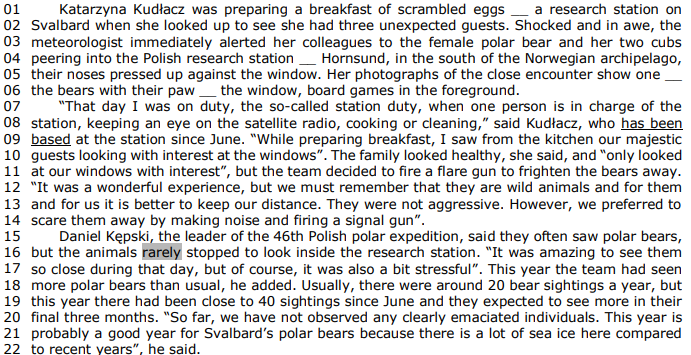
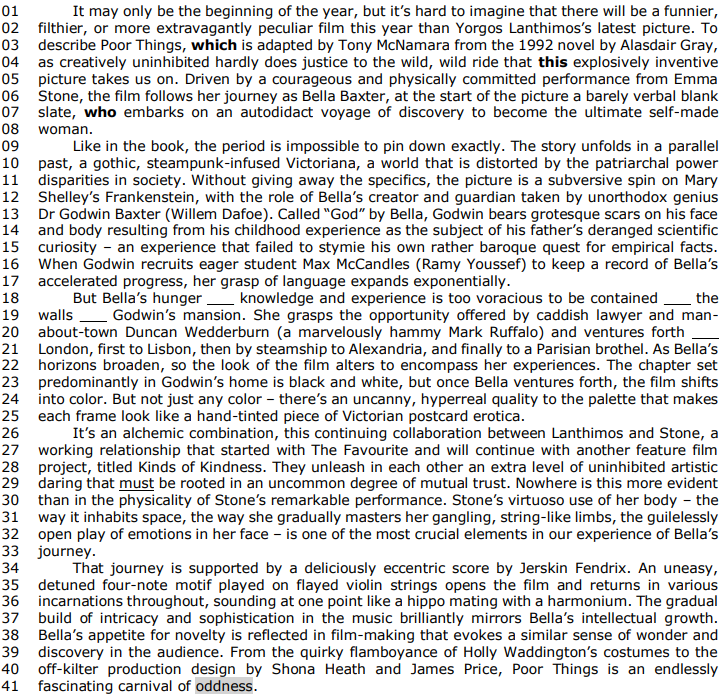
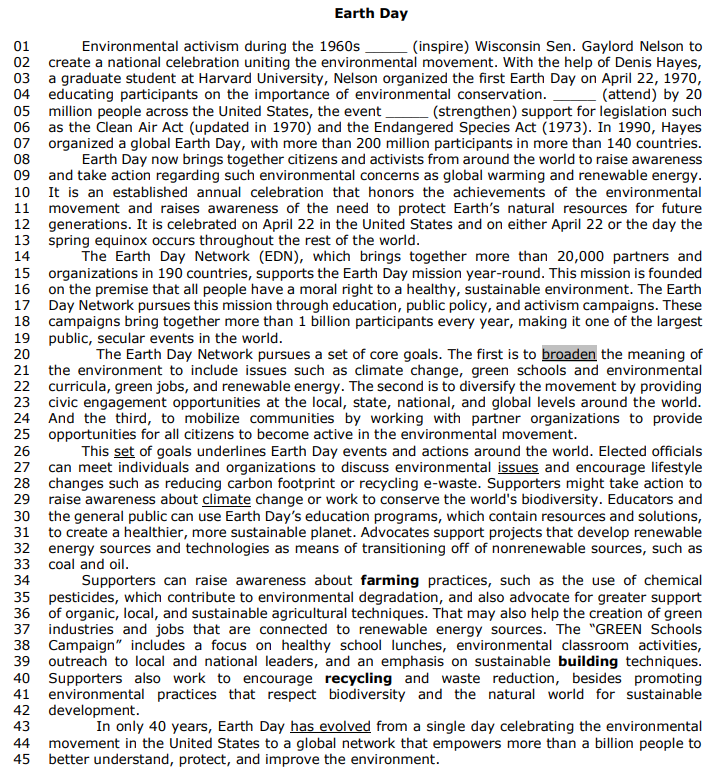
Choose the alternative which presents the correct infinitive forms of the following verbs (in bold in the text): found, grown and begun.
Alternativas
Respostas
961: A
962: C
963: E
964: A
965: A
966: A
967: C
968: B
969: B
970: C
971: B
972: E
973: C
974: B
975: C
976: B
977: D
978: B
979: D
980: A