Questões de Concurso
Comentadas sobre verbos | verbs em inglês
Foram encontradas 2.457 questões


Ano: 2015
Banca:
CEPERJ
Órgão:
SEEDUC-RJ
Prova:
CEPERJ - 2015 - SEDUC-RJ - Professor Docente I - Inglês |
Q503729
Inglês

Modal verbs can be classified into two major categories of me- aning: epistemic and deontic. Epistemic modals refer to the logical status of events or states. The following alternatives are examples of epistemic modals. The only exception is:
Ano: 2015
Banca:
IDECAN
Órgão:
INMETRO
Provas:
IDECAN - 2015 - INMETRO - Pesquisador - Tecnologista em Metrologia e Qualidade - Engenharia Química
|
IDECAN - 2015 - INMETRO - Analista Executivo em Metrologia e Qualidade - Administração Geral e Pública |
IDECAN - 2015 - INMETRO - Analista Executivo em Metrologia e Qualidade - Análise e Desenvolvimento de Sistemas |
IDECAN - 2015 - INMETRO - Analista Executivo em Metrologia e Qualidade - Ciências Contábeis |
Q499577
Inglês
A man stepped onto the overnight train and told the conductor, “I need you to wake me up in Philadelphia. I'm a deep sleeper and can be angry when I get up, but no matter what, I want you to help me make that stop. Here's $100 to make sure".
The conductor agreed. The man fell asleep, and when he awoke he heard the announcement that the train was approaching New York, which meant they had passed Philadelphia a long time ago. Furious, he ran to the conductor. “I gave you $100 to make sure I got off in Philadelphia, you idiot!" “Wow," another passenger said to his traveling companion. “Is that guy mad!" “Yeah," his companion replied. “But not half as mad as that guy they forced off the train in Philadelphia."
(English2Go, No 7,The Reader's Digest Association, 2005. P. 80.)
In “ ...the train was approaching New York" a gerund is used as a/an
The conductor agreed. The man fell asleep, and when he awoke he heard the announcement that the train was approaching New York, which meant they had passed Philadelphia a long time ago. Furious, he ran to the conductor. “I gave you $100 to make sure I got off in Philadelphia, you idiot!" “Wow," another passenger said to his traveling companion. “Is that guy mad!" “Yeah," his companion replied. “But not half as mad as that guy they forced off the train in Philadelphia."
(English2Go, No 7,The Reader's Digest Association, 2005. P. 80.)
In “ ...the train was approaching New York" a gerund is used as a/an
Ano: 2015
Banca:
IDECAN
Órgão:
INMETRO
Provas:
IDECAN - 2015 - INMETRO - Pesquisador - Tecnologista em Metrologia e Qualidade - Engenharia Química
|
IDECAN - 2015 - INMETRO - Analista Executivo em Metrologia e Qualidade - Administração Geral e Pública |
IDECAN - 2015 - INMETRO - Analista Executivo em Metrologia e Qualidade - Análise e Desenvolvimento de Sistemas |
IDECAN - 2015 - INMETRO - Analista Executivo em Metrologia e Qualidade - Ciências Contábeis |
Q499576
Inglês
A man stepped onto the overnight train and told the conductor, “I need you to wake me up in Philadelphia. I'm a deep sleeper and can be angry when I get up, but no matter what, I want you to help me make that stop. Here's $100 to make sure".
The conductor agreed. The man fell asleep, and when he awoke he heard the announcement that the train was approaching New York, which meant they had passed Philadelphia a long time ago. Furious, he ran to the conductor. “I gave you $100 to make sure I got off in Philadelphia, you idiot!" “Wow," another passenger said to his traveling companion. “Is that guy mad!" “Yeah," his companion replied. “But not half as mad as that guy they forced off the train in Philadelphia."
(English2Go, No 7,The Reader's Digest Association, 2005. P. 80.)
In “They had passed Philadelphia a long time ago" the verb tense is a:
The conductor agreed. The man fell asleep, and when he awoke he heard the announcement that the train was approaching New York, which meant they had passed Philadelphia a long time ago. Furious, he ran to the conductor. “I gave you $100 to make sure I got off in Philadelphia, you idiot!" “Wow," another passenger said to his traveling companion. “Is that guy mad!" “Yeah," his companion replied. “But not half as mad as that guy they forced off the train in Philadelphia."
(English2Go, No 7,The Reader's Digest Association, 2005. P. 80.)
In “They had passed Philadelphia a long time ago" the verb tense is a:
Ano: 2015
Banca:
CESGRANRIO
Órgão:
Petrobras
Provas:
CESGRANRIO - 2015 - Petrobras - Profissional Júnior - Serviço Social
|
CESGRANRIO - 2015 - Petrobras - Profissional Júnior - Administração |
CESGRANRIO - 2015 - Petrobras - Profissional Júnior - Direito |
CESGRANRIO - 2015 - Petrobras - Profissional Júnior - Engenharia Mecânica |
CESGRANRIO - 2015 - Petrobras - Profissional Júnior - Ciências Contábeis |
CESGRANRIO - 2015 - Petrobras - Profissional Júnior - Engenharia Elétrica |
CESGRANRIO - 2015 - Petrobras - Profissional Júnior - Comunicação/Relações Públicas |
CESGRANRIO - 2015 - Petrobras - Profissional Júnior - Engenharia de Produção |
CESGRANRIO - 2015 - Petrobras - Profissional Júnior - Engenharia do Meio Ambiente |
CESGRANRIO - 2015 - Petrobras - Profissional Júnior - Engenharia de Segurança do Trabalho |
Q483200
Inglês

The modal verb may in the fragment of the text “It may be years before the economic benefits of natural gas vehicles can be realized” (lines 35-36) is associated with the idea of
Ano: 2015
Banca:
RBO
Órgão:
CIJUN - SP
Prova:
RBO - 2015 - CIJUN - Analista Administrativo Compras e Licitações (Pleno) |
Q481070
Inglês
Read the dialogues below:
I- Do you know I’m working at Macy’s now?
Oh, really? What do you do there?
I work part-time as a cashier.
II- Are you studying French this semester?
Yes, I am enjoying the course so much!
How often do you have classes?
Twice a week.
III- Where are you having lunch today?
At Laguna’s. Are you usually going there?
Yes, almost every day.
IV- What do you do in your free time?
I often go to the seaside.
Are you going there this weekend?
No, because I think it’s raining on Saturday.
Choose the only possible option, according to the correct use of simple present and/or present continuous tense in the dialogues above:
I- Do you know I’m working at Macy’s now?
Oh, really? What do you do there?
I work part-time as a cashier.
II- Are you studying French this semester?
Yes, I am enjoying the course so much!
How often do you have classes?
Twice a week.
III- Where are you having lunch today?
At Laguna’s. Are you usually going there?
Yes, almost every day.
IV- What do you do in your free time?
I often go to the seaside.
Are you going there this weekend?
No, because I think it’s raining on Saturday.
Choose the only possible option, according to the correct use of simple present and/or present continuous tense in the dialogues above:
Q1197720
Inglês
Read the text below to answer questions 15-17.
Solar System’s Water is Older Than the Sun
Next time you’re swimming in the ocean, consider this: part of the water is older than the sun.
So concludes a team of scientists who ran computer models comparing the ratios of hydrogen isotopes over time. Taking into account new insights that the solar nebula had less ionizing radiation than previously thought, the models show that at least some of the water found in the ocean, as well as in comets, meteorites and on the moon, predate the sun’s birth.
The only other option, the scientists conclude, is that it formed in the cold, intersteller cloud from which the sun itself originated.
The discovery, reported in this week’s Science, stems from the insight of lead author Lauren Ilsedore Cleeves, a doctoral student at the University of Michigan, who realized that planetforming disks around young stars should be shielded from galactic rays by the strong solar winds, dramatically altering the chemistry occurring inside the disks, said Conel Alexander, with the Carnegie Institution of Washington.
“The finding... makes it quite hard for these regions in the disk to synthesize any new molecules. This was an ‘aha’ moment for us – without any new water creation the only place these ices could have come from was the chemically rich interstellar gas out of which the solar system formed originally,” Cleeves wrote in an email to Discovery News.
“It’s remarkable that these ices survived the entire process of stellar birth,” she added.
The finding has implications for the search for life beyond Earth, as water is believed to be necessary for life.
“If the sun’s formation was typical, interstellar ices – including water – are likely common ingredients present during the formation of all planetary systems, which puts a wonderful outlook on the possibility of other life in the universe,” Cleeves said.
In addition, it’s not just water that likely survived the solar system’s birth.
“The same must be true for the organic matter that we know is present in molecular cloud ices. So I think this strengthens the case that we have interstellar organic matter in meteorites and comets too,” Alexander wrote in an email to Discovery News.
Available in: http://news.discovery.com
Read the sentence taken from the text.
“The finding has implications for the search for life beyond Earth, as water is believed to be necessary for life.”
Choose the alternative in which the underlined word is conjugated in the same verb tense as the one above.
Solar System’s Water is Older Than the Sun
Next time you’re swimming in the ocean, consider this: part of the water is older than the sun.
So concludes a team of scientists who ran computer models comparing the ratios of hydrogen isotopes over time. Taking into account new insights that the solar nebula had less ionizing radiation than previously thought, the models show that at least some of the water found in the ocean, as well as in comets, meteorites and on the moon, predate the sun’s birth.
The only other option, the scientists conclude, is that it formed in the cold, intersteller cloud from which the sun itself originated.
The discovery, reported in this week’s Science, stems from the insight of lead author Lauren Ilsedore Cleeves, a doctoral student at the University of Michigan, who realized that planetforming disks around young stars should be shielded from galactic rays by the strong solar winds, dramatically altering the chemistry occurring inside the disks, said Conel Alexander, with the Carnegie Institution of Washington.
“The finding... makes it quite hard for these regions in the disk to synthesize any new molecules. This was an ‘aha’ moment for us – without any new water creation the only place these ices could have come from was the chemically rich interstellar gas out of which the solar system formed originally,” Cleeves wrote in an email to Discovery News.
“It’s remarkable that these ices survived the entire process of stellar birth,” she added.
The finding has implications for the search for life beyond Earth, as water is believed to be necessary for life.
“If the sun’s formation was typical, interstellar ices – including water – are likely common ingredients present during the formation of all planetary systems, which puts a wonderful outlook on the possibility of other life in the universe,” Cleeves said.
In addition, it’s not just water that likely survived the solar system’s birth.
“The same must be true for the organic matter that we know is present in molecular cloud ices. So I think this strengthens the case that we have interstellar organic matter in meteorites and comets too,” Alexander wrote in an email to Discovery News.
Available in: http://news.discovery.com
Read the sentence taken from the text.
“The finding has implications for the search for life beyond Earth, as water is believed to be necessary for life.”
Choose the alternative in which the underlined word is conjugated in the same verb tense as the one above.
Ano: 2014
Banca:
FAURGS
Órgão:
TJ-RS
Provas:
FAURGS - 2014 - TJ-RS - Programador
|
FAURGS - 2014 - TJ-RS - Técnico em Informática - Classe M |
FAURGS - 2014 - TJ-RS - Técnico em Eletrônica |
Q883483
Inglês

O uso de ’s na expressão another’s computer
system (l. 16-17) é o mesmo em:
Ano: 2014
Banca:
IESES
Órgão:
GasBrasiliano
Prova:
IESES - 2014 - GasBrasiliano - Administrador Júnior |
Q819483
Inglês
Complete the sentence (prepositions): When did they
__________ the hotel?
Ano: 2014
Banca:
IESES
Órgão:
GasBrasiliano
Prova:
IESES - 2014 - GasBrasiliano - Administrador Júnior |
Q819480
Inglês
Complete the sentence (use the present perfect):
Where’s the book I gave you? What _____________ with it?
Ano: 2014
Banca:
UFSBA
Órgão:
UFSBA
Prova:
UFSBA - 2014 - UFSBA - Técnico em Assuntos Educacionais |
Q758719
Inglês
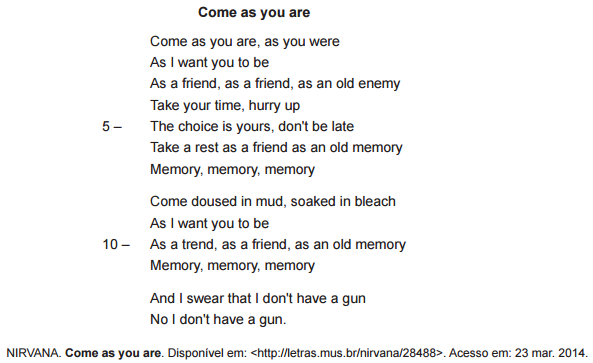
Marque C,se a proposição é verdadeira; E,se a proposição é falsa.
As formas verbais “are” (v.1) e “were” (v.1) descrevem, respectivamente, a oposição de tempo presente e de tempo passado.
Q626166
Inglês
The Phrasal Verb “bring up a topic” is the same of:
Ano: 2014
Banca:
Gestão Concurso
Órgão:
CEMIG-TELECOM
Provas:
Gestão Concurso - 2014 - CEMIG-TELECOM - Analista Administrativo Jr.
|
Gestão Concurso - 2014 - CEMIG-TELECOM - Analista de Vendas Jr |
Gestão Concurso - 2014 - CEMIG-TELECOM - Analista de Tecnologia da Informação e Comunicação Jr. |
Q501868
Inglês
Assinale a alternativa que preencha CORRETAMENTE as sentenças abaixo de acordo com os verbos dados, respectivamente.
I. _________________ (to lie) in the sun for six hours. That’s why he is sunburnt.
II. Carry is on the phone now. _________________ (to talk) to her sister in Greece.
III. I’m not sure if this is a good book. _________________ (to read) it.
IV. I think I’m a good skier. _________________ (to go skiing) every weekend in the winter.
V. In Middle East the people _________________ (to rise up) against the dictator after the incident.
VI. Americans _________________ (to be) the first to send a man to the moon about fifty years ago.
I. _________________ (to lie) in the sun for six hours. That’s why he is sunburnt.
II. Carry is on the phone now. _________________ (to talk) to her sister in Greece.
III. I’m not sure if this is a good book. _________________ (to read) it.
IV. I think I’m a good skier. _________________ (to go skiing) every weekend in the winter.
V. In Middle East the people _________________ (to rise up) against the dictator after the incident.
VI. Americans _________________ (to be) the first to send a man to the moon about fifty years ago.
Ano: 2014
Banca:
Gestão Concurso
Órgão:
CEMIG-TELECOM
Provas:
Gestão Concurso - 2014 - CEMIG-TELECOM - Analista Administrativo Jr.
|
Gestão Concurso - 2014 - CEMIG-TELECOM - Analista de Vendas Jr |
Gestão Concurso - 2014 - CEMIG-TELECOM - Analista de Tecnologia da Informação e Comunicação Jr. |
Q501865
Inglês
Leia o diálogo abaixo:.
Douglas: It’s good to have you here, cousin! Would you like some wine?
Claudia: Sure. Douglas, remember when we were kids and we used to visit grandma every Sunday for lunch? Douglas: Yes. We would spend the whole day playing in the backyard! Too bad we can’t turn back time…
Claudia: You’re right… I guess I would have spent more time with her. She used to take such good care of us. She would make us those delicious chocolate chip cookies, then she would buy us all Christmas presents.! She has always enjoyed being around her grandchildren!
Douglas: Yeah… If I had grandchildren, I would be exactly like she was to us.
Claudia: So would I! I would rather be like her than being a lonely old lady.
De acordo com o diálogo acima, nas expressões destacadas, o verbo modal would é empregado para indicar, respectivamente,
Douglas: It’s good to have you here, cousin! Would you like some wine?
Claudia: Sure. Douglas, remember when we were kids and we used to visit grandma every Sunday for lunch? Douglas: Yes. We would spend the whole day playing in the backyard! Too bad we can’t turn back time…
Claudia: You’re right… I guess I would have spent more time with her. She used to take such good care of us. She would make us those delicious chocolate chip cookies, then she would buy us all Christmas presents.! She has always enjoyed being around her grandchildren!
Douglas: Yeah… If I had grandchildren, I would be exactly like she was to us.
Claudia: So would I! I would rather be like her than being a lonely old lady.
De acordo com o diálogo acima, nas expressões destacadas, o verbo modal would é empregado para indicar, respectivamente,
Ano: 2014
Banca:
Gestão Concurso
Órgão:
CEMIG-TELECOM
Provas:
Gestão Concurso - 2014 - CEMIG-TELECOM - Analista Administrativo Jr.
|
Gestão Concurso - 2014 - CEMIG-TELECOM - Analista de Vendas Jr |
Gestão Concurso - 2014 - CEMIG-TELECOM - Analista de Tecnologia da Informação e Comunicação Jr. |
Q501863
Inglês
Levando em consideração as diferentes formas de se referir a ações no futuro, analise os itens seguintes:
I. Claire is working at the library on Friday morning.
II. When I retire, I am going to go back to Liverpool to live.
III. The telephone is ringing, but I won’t answer it.
IV. James and Sarah are working two jobs to afford a private school for their children.
O emprego dos termos em destaque está CORRETO apenas em
I. Claire is working at the library on Friday morning.
II. When I retire, I am going to go back to Liverpool to live.
III. The telephone is ringing, but I won’t answer it.
IV. James and Sarah are working two jobs to afford a private school for their children.
O emprego dos termos em destaque está CORRETO apenas em
Ano: 2014
Banca:
Gestão Concurso
Órgão:
CEMIG-TELECOM
Provas:
Gestão Concurso - 2014 - CEMIG-TELECOM - Analista Administrativo Jr.
|
Gestão Concurso - 2014 - CEMIG-TELECOM - Analista de Vendas Jr |
Gestão Concurso - 2014 - CEMIG-TELECOM - Analista de Tecnologia da Informação e Comunicação Jr. |
Q501862
Inglês
Assinale a alternativa que apresenta os termos que preenchem CORRETAMENTE as lacunas existentes nos enunciados seguintes, de cima para baixo:
I. These bees ___________ kept in a large hive before they were taken out and examined by the beekeeper.
II. A thief came into his house, tied him up, took his money, and left. He ___________ tied up for several hours.
III. John doesn't cook very well. He _____________ helped by his wife.
IV. Amanda is pregnant. She expects her baby ______________ in November.
I. These bees ___________ kept in a large hive before they were taken out and examined by the beekeeper.
II. A thief came into his house, tied him up, took his money, and left. He ___________ tied up for several hours.
III. John doesn't cook very well. He _____________ helped by his wife.
IV. Amanda is pregnant. She expects her baby ______________ in November.
Ano: 2014
Banca:
Gestão Concurso
Órgão:
CEMIG-TELECOM
Provas:
Gestão Concurso - 2014 - CEMIG-TELECOM - Analista Administrativo Jr.
|
Gestão Concurso - 2014 - CEMIG-TELECOM - Analista de Vendas Jr |
Gestão Concurso - 2014 - CEMIG-TELECOM - Analista de Tecnologia da Informação e Comunicação Jr. |
Q501860
Inglês
A sentença “Jane _____ cook pasta very well.” é CORRETAMENTE completada com
Ano: 2014
Banca:
CETRO
Órgão:
AEB
Prova:
CETRO - 2014 - AEB - Tecnologista Júnior - Desenvolvimento Tecnológico |
Q483831
Inglês
Texto associado
Gravity, review: “heartachingly tender”
Starring Sandra Bullock and George Clooney as astronauts adrift in
space, Alfonso Cuarón’s astonishing thriller is one of the films of
the year, says Robbie Collin
Watch an astronaut drifting through space for long enough and eventually you notice how much they look like a newborn baby. The oxygen helmet makes their head bigger, rounder and cuter; their hands grasp eagerly at whatever happens to be passing; their limbs are made fat and their movements simple by the spacesuit’s cuddly bulk. They tumble head-over-heels like tripping toddlers or simply bob there in amniotic suspension. Even the lifeline that keeps them tethered to their ship has a pulsing, umbilical aspect.
Gravity, the new Alfonso Cuarón picture, is a heart- achingly tender film about the miracle of motherhood, and the billion-to-one odds against any of us being here, astronauts or not. It’s also a totally absorbing, often overpowering spectacle - a $100 million 3D action movie in which Sandra Bullock and George Clooney play two Hollywood-handsome spacefarers, fighting for their lives 375 miles above the Earth’s crust.
A series of captions over the opening titles reminds us that this is a dead zone: no oxygen or air pressure, and nothing to carry sound. “Life in space is impossible,” the final message tells us, as the cinema shakes with Steven Price’s resonant score, and then suddenly falls quiet.
For Dr. Ryan Stone (Bullock), a mission specialist in orbit for the first time, the lack of noise is welcome. She’s a medical engineer called up by NASA to install new software on to the Hubble Telescope, but also a mother in mourning for her four- year-old daughter, whom she lost in a senseless accident, and the silence enfolds her like a comfort blanket.
Available in: http://www.telegraph.co.uk
Starring Sandra Bullock and George Clooney as astronauts adrift in
space, Alfonso Cuarón’s astonishing thriller is one of the films of
the year, says Robbie Collin
Watch an astronaut drifting through space for long enough and eventually you notice how much they look like a newborn baby. The oxygen helmet makes their head bigger, rounder and cuter; their hands grasp eagerly at whatever happens to be passing; their limbs are made fat and their movements simple by the spacesuit’s cuddly bulk. They tumble head-over-heels like tripping toddlers or simply bob there in amniotic suspension. Even the lifeline that keeps them tethered to their ship has a pulsing, umbilical aspect.
Gravity, the new Alfonso Cuarón picture, is a heart- achingly tender film about the miracle of motherhood, and the billion-to-one odds against any of us being here, astronauts or not. It’s also a totally absorbing, often overpowering spectacle - a $100 million 3D action movie in which Sandra Bullock and George Clooney play two Hollywood-handsome spacefarers, fighting for their lives 375 miles above the Earth’s crust.
A series of captions over the opening titles reminds us that this is a dead zone: no oxygen or air pressure, and nothing to carry sound. “Life in space is impossible,” the final message tells us, as the cinema shakes with Steven Price’s resonant score, and then suddenly falls quiet.
For Dr. Ryan Stone (Bullock), a mission specialist in orbit for the first time, the lack of noise is welcome. She’s a medical engineer called up by NASA to install new software on to the Hubble Telescope, but also a mother in mourning for her four- year-old daughter, whom she lost in a senseless accident, and the silence enfolds her like a comfort blanket.
Available in: http://www.telegraph.co.uk
Read the sentence taken from the text and choose the alternative that presents the simple past tense of the underlined verb.
“Watch an astronaut drifting through space for long enough and eventually you notice how much they look like a newborn baby.”
“Watch an astronaut drifting through space for long enough and eventually you notice how much they look like a newborn baby.”
Ano: 2014
Banca:
CETRO
Órgão:
AEB
Prova:
CETRO - 2014 - AEB - Tecnologista Júnior - Desenvolvimento Tecnológico |
Q483826
Inglês
Texto associado
Solar System’s Water is Older Than the Sun
Next time you’re swimming in the ocean, consider this: part of the water is older than the sun.
So concludes a team of scientists who ran computer models comparing the ratios of hydrogen isotopes over time. Taking into account new insights that the solar nebula had less ionizing radiation than previously thought, the models show that at least some of the water found in the ocean, as well as in comets, meteorites and on the moon, predate the sun’s birth.
The only other option, the scientists conclude, is that it formed in the cold, intersteller cloud from which the sun itself originated.
The discovery, reported in this week’s Science, stems from the insight of lead author Lauren Ilsedore Cleeves, a doctoral student at the University of Michigan, who realized that planet- forming disks around young stars should be shielded from galactic rays by the strong solar winds, dramatically altering the chemistry occurring inside the disks, said Conel Alexander, with the Carnegie Institution of Washington.
“The findingX makes it quite hard for these regions in the disk to synthesize any new molecules. This was an ‘aha’ moment for us - without any new water creation the only place these ices could have come from was the chemically rich interstellar gas out of which the solar system formed originally,” Cleeves wrote in an email to Discovery News.
“It’s remarkable that these ices survived the entire process of stellar birth,” she added.
The finding has implications for the search for life beyond Earth, as water is believed to be necessary for life.
“If the sun’s formation was typical, interstellar ices - including water - are likely common ingredients present during the formation of all planetary systems, which puts a wonderful outlook on the possibility of other life in the universe,” Cleeves said.
In addition, it’s not just water that likely survived the solar system’s birth.
“The same must be true for the organic matter that we know is present in molecular cloud ices. So I think this strengthens the case that we have interstellar organic matter in meteorites and comets too,” Alexander wrote in an email to Discovery News.
Available in: http://news.discovery.com
Next time you’re swimming in the ocean, consider this: part of the water is older than the sun.
So concludes a team of scientists who ran computer models comparing the ratios of hydrogen isotopes over time. Taking into account new insights that the solar nebula had less ionizing radiation than previously thought, the models show that at least some of the water found in the ocean, as well as in comets, meteorites and on the moon, predate the sun’s birth.
The only other option, the scientists conclude, is that it formed in the cold, intersteller cloud from which the sun itself originated.
The discovery, reported in this week’s Science, stems from the insight of lead author Lauren Ilsedore Cleeves, a doctoral student at the University of Michigan, who realized that planet- forming disks around young stars should be shielded from galactic rays by the strong solar winds, dramatically altering the chemistry occurring inside the disks, said Conel Alexander, with the Carnegie Institution of Washington.
“The findingX makes it quite hard for these regions in the disk to synthesize any new molecules. This was an ‘aha’ moment for us - without any new water creation the only place these ices could have come from was the chemically rich interstellar gas out of which the solar system formed originally,” Cleeves wrote in an email to Discovery News.
“It’s remarkable that these ices survived the entire process of stellar birth,” she added.
The finding has implications for the search for life beyond Earth, as water is believed to be necessary for life.
“If the sun’s formation was typical, interstellar ices - including water - are likely common ingredients present during the formation of all planetary systems, which puts a wonderful outlook on the possibility of other life in the universe,” Cleeves said.
In addition, it’s not just water that likely survived the solar system’s birth.
“The same must be true for the organic matter that we know is present in molecular cloud ices. So I think this strengthens the case that we have interstellar organic matter in meteorites and comets too,” Alexander wrote in an email to Discovery News.
Available in: http://news.discovery.com
Read the sentence taken from the text.
“The finding has implications for the search for life beyond Earth, as water is believed to be necessary for life.”
Choose the alternative in which the underlined word is conjugated in the same verb tense as the one above.
“The finding has implications for the search for life beyond Earth, as water is believed to be necessary for life.”
Choose the alternative in which the underlined word is conjugated in the same verb tense as the one above.
Ano: 2014
Banca:
CETRO
Órgão:
AEB
Provas:
CETRO - 2014 - AEB - Analista em C&T - Gestão Administrativa - Pleno 1
|
CETRO - 2014 - AEB - Tecnologista - Desenvolvimento Técnológico - Pleno 1 |
Q482198
Inglês
Choose the alternative that fills in correctly and respectively the blanks in the sentences below with the correct verb tense and form.
“When I _____________ (meet) 1 Serge, it ____________ (be) 2 love at first sight for me – I absolutely adored him, he was this wonderful mad, extrovert Russian Jew who _____________ (spend) 3 half of World War II up a tree, according to him. I _____________ (think) 4 he actually spent a couple of nights up a tree, although he’d worn the yellow star for years in occupied France. For a project, I met Hitler’s architect Albert Speer at his Heidelberg eyrie in 1971, and he asked if Jane and Serge would sign a copy of Je t’aime] for him. Serge did so, probably relishing the irony, and when he made his Rock Around The Bunker album a few years later [featuring lyrics about Nazi Germany], he gave me a copy _______________ (send) 5 to Speer. His parents had arrived in Paris after _____________ (flee) 6 the 1917 Russian Revolution, and his father – who was a brilliant pianist – had to perform in casinos.”
“When I _____________ (meet) 1 Serge, it ____________ (be) 2 love at first sight for me – I absolutely adored him, he was this wonderful mad, extrovert Russian Jew who _____________ (spend) 3 half of World War II up a tree, according to him. I _____________ (think) 4 he actually spent a couple of nights up a tree, although he’d worn the yellow star for years in occupied France. For a project, I met Hitler’s architect Albert Speer at his Heidelberg eyrie in 1971, and he asked if Jane and Serge would sign a copy of Je t’aime] for him. Serge did so, probably relishing the irony, and when he made his Rock Around The Bunker album a few years later [featuring lyrics about Nazi Germany], he gave me a copy _______________ (send) 5 to Speer. His parents had arrived in Paris after _____________ (flee) 6 the 1917 Russian Revolution, and his father – who was a brilliant pianist – had to perform in casinos.”
Ano: 2014
Banca:
CETRO
Órgão:
AEB
Provas:
CETRO - 2014 - AEB - Analista em C&T - Gestão Administrativa - Pleno 1
|
CETRO - 2014 - AEB - Tecnologista - Desenvolvimento Técnológico - Pleno 1 |
Q482193
Inglês
Choose the alternative that fills in correctly and respectively the blanks in the sentences below with the correct modal verb.
Notion of an 'event horizon', from which nothing _____________ 1 escape, is incompatible with quantum theory, physicist claims.
The defining characteristic of a black hole _____________ 2 have to give, if the two pillars of modern physics – general relativity and quantum theory – are both correct.
Most physicists foolhardy enough to write a paper claiming that “there are no black holes” – at least not in the sense we usually imagine – ____________ 3 probably be dismissed as cranks. But when the call to redefine these cosmic crunchers comes from Stephen Hawking, it’s worth taking notice. In a paper posted online, the physicist, based at the University of Cambridge, UK, and one of the creators of modern black-hole theory, does away with the notion of an event horizon.
But on analysing the situation in detail, Polchinski’s team came to the startling realization that the laws of quantum mechanics, which govern particles on small scales, change the situation completely. Quantum theory, they said, dictates that the event horizon _____________ 4 actually be transformed into a highly energetic region, or 'firewall', that _______________ 5 burn the astronaut to a crisp.
Notion of an 'event horizon', from which nothing _____________ 1 escape, is incompatible with quantum theory, physicist claims.
The defining characteristic of a black hole _____________ 2 have to give, if the two pillars of modern physics – general relativity and quantum theory – are both correct.
Most physicists foolhardy enough to write a paper claiming that “there are no black holes” – at least not in the sense we usually imagine – ____________ 3 probably be dismissed as cranks. But when the call to redefine these cosmic crunchers comes from Stephen Hawking, it’s worth taking notice. In a paper posted online, the physicist, based at the University of Cambridge, UK, and one of the creators of modern black-hole theory, does away with the notion of an event horizon.
But on analysing the situation in detail, Polchinski’s team came to the startling realization that the laws of quantum mechanics, which govern particles on small scales, change the situation completely. Quantum theory, they said, dictates that the event horizon _____________ 4 actually be transformed into a highly energetic region, or 'firewall', that _______________ 5 burn the astronaut to a crisp.

 Conheça nossos planos