Questões de Concurso
Sobre verbos modais | modal verbs em inglês
Foram encontradas 395 questões


Giving Blood = Giving Life
Giving blood is an amazing thing a person can do. Why? Because people who have anaemia, cancer, blood disorders, sickle cell, and other illnesses need blood transfusion. Some people even need regular blood transfusion to live.
Think about it: giving blood as part ............ everyone’s life; something they done .............. a regular basis, like eating ........... a favourite restaurant. What kind of difference does that make? Well, a donation might make the difference between life and death for nearly five million people who receive blood transfusions every year.
Giving blood is simple and convenient. It only takes about an hour and you can make the donation at a donor center. Afterwards, you will feel good about yourself.
Most people don’t think they’ll never need a blood transfusion, but many do. Blood is something money can’t buy. One may give a newborn, a child, a mother or a father, a brother, or a sister another chance at life. In fact, this simple action may help to save lives.
The blood donation process is much quicker and easier than you think. Giving blood will not decrease your strength and it’s certainly the right thing to do.
Study these sentences:
1. Giving blood is an amazing thing a person can do.
2. Well, a donation might make the difference...”
The words in bold are all examples of:
Instruction: answer question based on the following text.
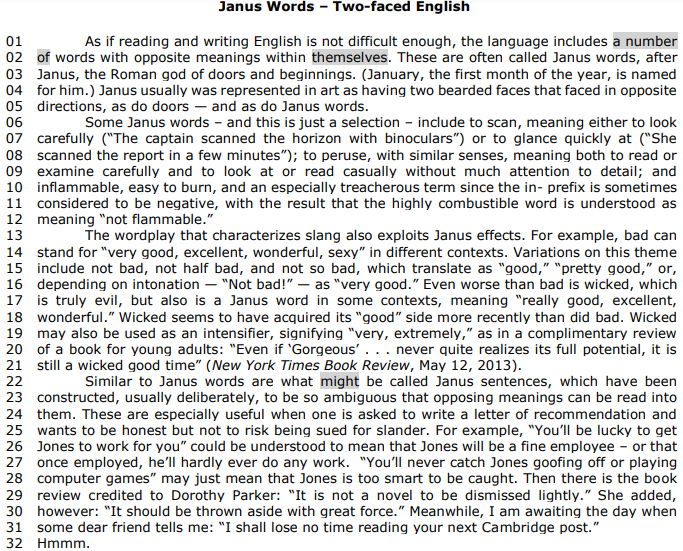
(Avalaible in: https://dictionaryblog.cambridge.org/2013/07/01/janus-words-two-faced-english/#more-2382 –
text especially adapted for this test).
Based on the text above, judge the following item.
In “Unqualified teachers may have misconceptions about
phonological phenomena” (second paragraph), the word
“may” could be correctly replaced with might.
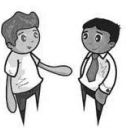
Bill: Why aren’t you coming out tonight? Zachary: Because I don’t have any money. If I ______, I with you Bill: Well, what about the movies tomorrow? Zachary: It depends. If my parents _____ me some money, ______ I . Bill: You always have an excuse! Why didn’t you come to Josh?s party last week? Zachary: I didn’t come because I lost my wallet and all my money. If I _____ my wallet, of course I _____ !

Use the image to answer the question.

From Internet.
In relation to Mother Teresa's famous sentence:
I-It´s a sentence in the second conditional.
II-OUR and US are personal pronouns.
III-There is at least one modal verb.
IV-To sweep it´s necessary a hoe.
It was Maria’s first day at school, her first week in the United States. Her middle school in San Francisco was the biggest building she’d ever seen. It was bigger than the entire Best Buy store she’d walked through in awe on her first day in the city.
CRIMINALS HAVE SMALLER BRAIN SIZE, SAYS STUDY
A new study has found that antisocial people are more likely to have smaller areas of their brain. Researchers said criminals' brains had a different structure to the brains of people who followed the law. The study is published in the journal "Lancet Psychiatry". Researchers used data from 672 people born in 1972-73. They looked at records of the people's antisocial behaviour between the ages of seven and 26. At the age of 45, the researchers scanned the people's brains. Eighty of the people had a history of criminal and antisocial behaviour from being early teenagers. Researchers found that the areas of the brain linked to emotions, motivation and behaviour control were smaller in the long-term criminals' brains.
Professor Terrie Moffitt, a co-author of the research, said the research could help doctors understand what is behind long-term antisocial behaviour. She said the antisocial people in the study may have behaved badly because of their brain structure. She said: "They are actually operating under some [disability] at the level of the brain." She added that because of this, we needed to care for these people in a kinder way. Lead author Dr Christina Carlisi said: "Differences in brain structure might make it difficult for people to develop social skills. This may prevent them from engaging in antisocial behaviour. These people could benefit from more support throughout their lives."
Available on: https://breakingnewsenglish.com/2002/200221-brain-size.html Accessed on: March, 20th 2020.

( ) The pronoun “it” in the first paragraph refers to the word “illness”. ( ) The modal verb “would”, in the excerpt “fewer patients would arrive at the hospital each day”, adds the idea of possibility to the sentence. ( ) The expressions “showing up”, “look like” and “keep up” are examples of phrasal verbs used in the text. ( ) If the text was all written using Past Simple Tense, none of the words become, have, cause, refer and show would be written using the suffix ed. ( ) The pronoun “them” in the last paragraph refers to “supplies, beds and health care providers”.
Choose the alternative with the correct sequence:
I- The words causes, refers and slow, in the text, are classified as verbs. II- In the first paragraph, the letter i in the word quarantine is pronounced differently compared to any letter i in the word distancing. III- The words could and would are examples of modal verbs used in the text. IV- In the text, the words very, severely and roughly are classified as adverbs.
Choose the alternative with the correct answer:
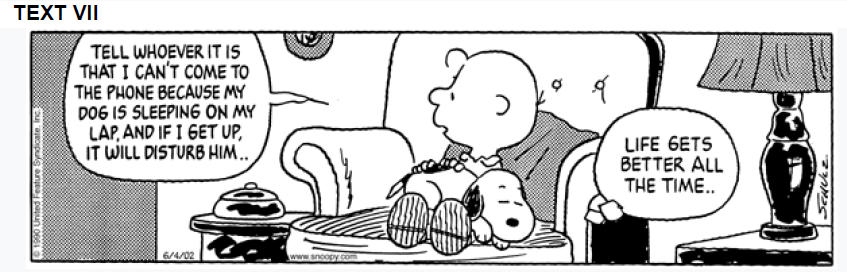
Based on the comic, analyze the words and the expressions: “WHOEVER”; … “CAN’T COME”; “MY DOG IS SLEEPING”; “… AND IF I GET UP...”
Choose the RIGHT alternative regarding the highlighted words above.

 Conheça nossos planos