Questões de Concurso
Sobre substantivos contáveis e incontáveis | countable and uncountable em inglês
Foram encontradas 97 questões


Julgue o item que se segue.
In the sentence “Susan looked at herself in the mirror”, the
subject and the object are the same.
Julgue o item subsequente.
Nouns, as essential components of language, categorize
and name entities, encompassing both tangible and
abstract concepts. The proper understanding of noun
classifications—common, proper, concrete,
abstract—facilitates precise and effective communication,
as nouns serve as the foundation for constructing
meaningful sentences.
Julgue o item subsequente.
Collective nouns, like “team” or “family,” present a
challenge in determining whether to treat them as
singular or plural. The context and intended emphasis
guide the decision, reflecting the collective unit's unity or
the individuality of its members. Mastery of collective
noun usage refines language precision and clarity.
Julgue o item subsequente.
Countable and uncountable nouns present distinct
challenges in English grammar. Countable nouns refer to
individual items that can be enumerated, while
uncountable nouns denote substances or concepts
without clear boundaries. Mastery of these distinctions is
crucial for accurate article usage and grammatical
agreement.
Julgue o item subsequente.
The zero article, the absence of any article, is used in
specific contexts, such as with plural and uncountable
nouns or when referring to things in general.
Understanding when to omit articles is essential for
precise communication in American English.
(1) Countable. (2) Uncountable.
( ) The children are playing at the park. ( ) Hot water is always good for sore muscles. ( ) Our research is going to be groundbreaking, I bet. ( ) My heart is set on this, I can’t change it.
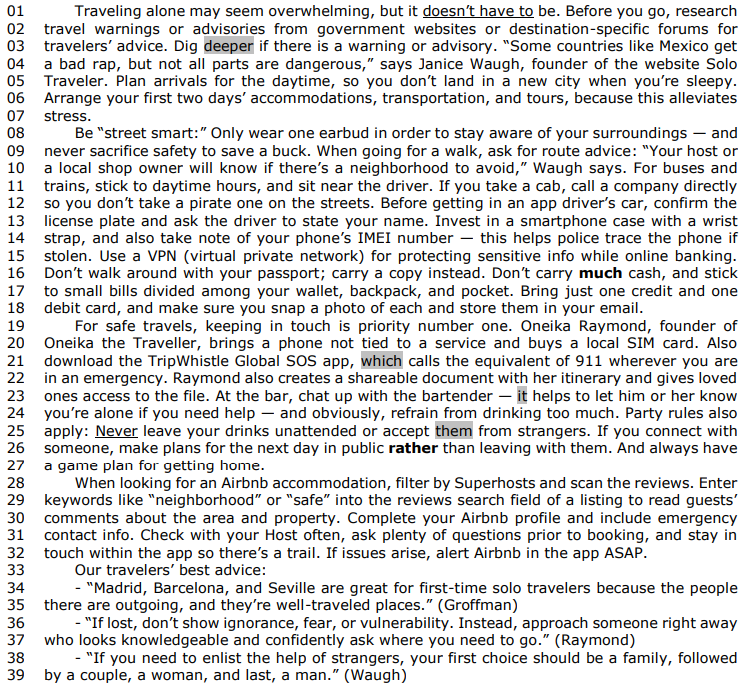
Try these expert tips for a safer solo trip
(Available at: https://news.airbnb.com/try-these-expert-tips-for-a-safer-solo-trip/ – text especially adapted for
this text).
I. It expresses a small amount. II. Its use is correct because it precedes an uncountable noun. III. It would be grammatically correct to replace the word by “many”.
Which ones are correct?
I – nationalist, example, world, empire, program. II – process, culture, power, product, information. III – decolonization, information, power, education, advice. IV – institution, decolonization, advice, system, model.
B. Considering the classification between countable and uncountable nouns, in which groups do all the words share the same type of nouns?
( ) That building is a piece of art! It’s made mainly of glass. ( ) Can you please hand me those clothes? ( ) I have so much work to do today, I’m already tired. ( ) Have you noticed how many new butters are available at the store? ( ) You know I love coffee!
The correct order of filling the parentheses, from top to bottom, is:
Julgue o item subsequente.
I. Tesla seemed to have a high level of intelligence. II. Let’s get rid of the old luggages. III. Please clean your equipment every day. IV. They have a lot of money.
Mark the option that ONLY contains uncountable nouns.
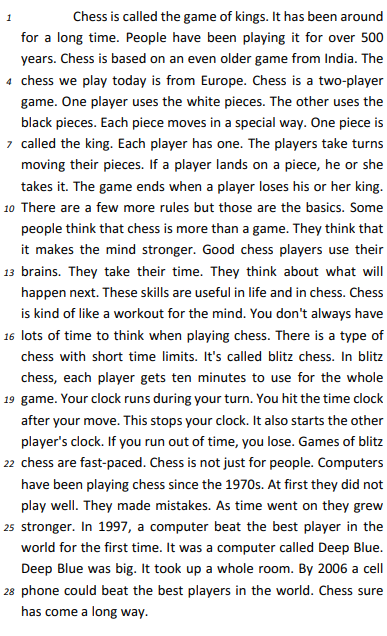
Internet: <www.nortechplus.com>.
Education
Education encompasses both the teaching and learning of knowledge, proper conduct, and technical competency. It thus focuses on the cultivation of skills, trades or professions, as well as mental, moral & aesthetic development.
Formal education consists of systematic instruction, teaching and training by professional teachers. This consists of the application of pedagogy and the development of curricula.
The right to education is a fundamental human right. Since 1952, Article 2 of the first Protocol to the European Convention on Human Rights obliges all signatory parties to guarantee the right to education. At world level, the United Nations’ International Covenant on Economic, Social and Cultural Rights of 1966 guarantees this right under its Article 13.
Educational systems are established to provide education and training, often for children and the young. A curriculum defines what students should know, understand and be able to do as the result of education. A teaching profession delivers teaching which enables learning, and a system of policies, regulations, examinations, structures and funding enables teachers to teach to the best of their abilities.
Primary (or elementary) education consists of the first
years of formal, structured education. In general, primary education consists of six or seven years of schooling starting at the age of 5 or 6, although this varies
between, and sometimes within, countries. Globally,
around 70% of primary-age children are enrolled in
primary education, and this proportion is rising.
In most contemporary educational systems of the world, secondary education consists of the second years of formal education that occur during adolescence. It is characterized by transition from the typically compulsory, comprehensive primary education for minors, to the optional, selective tertiary, “post-secondary”, or “higher” education (e.g., university, vocational school) for adults.
Higher education, also called tertiary, third stage, or
post secondary education, is the non-compulsory
educational level that follows the completion of a
school providing a secondary education, such as a
high school or secondary school. Tertiary education is
normally taken to include undergraduate and postgraduate education, as well as vocational education and
training. Colleges and universities are the main institutions that provide tertiary education. Collectively,
these are sometimes known as tertiary institutions.
Tertiary education generally results in the receipt of
certificates, diplomas, or academic degrees.
I drink ____________ coffee. I prefer tea. The town is very quiet at night. __________ people go out. The weather here is very dry in summer. There is _____ rain.
Choose the correct alternative:
Note the countable and uncountable nouns and mark the correct alternative according to the sentences.
I. In the ocean, there are many living waters.
II. Mr. Smith bought much planks of wood last year.
III. I can´t eat many salt.
IV. I found much stones in my house.

 Conheça nossos planos