Questões de Concurso
Sobre substantivos contáveis e incontáveis | countable and uncountable em inglês
Foram encontradas 97 questões


Escolha a opção que complete corretamente a frase, levando em conta o uso de substantivos contáveis e incontáveis.
After the meeting, we’ll need to gather some __________ to make a decision. However, a few __________ in the report seem to be missing.
Considering the lexical-grammatical aspects of the English language, evaluate the following item.
The word "advice" is countable, so it's correct to say "an advice" when referring to a piece of advice.
Read Text I and answer question

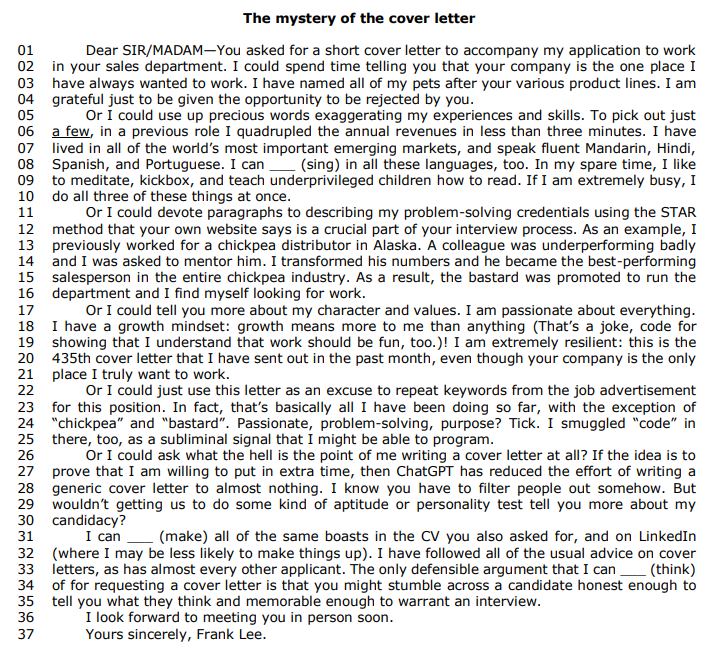
(Available at: https://www.economist.com/business/2024/09/05/the-mystery-of-the-cover-letter – text specially adapted for this test).
Judge the next item, about the semantics and morphosyntax of the English language.
The sentence "The committee is deciding on the new
policies" demonstrates a case of collective noun agreement, where "committee" is treated as singular
despite referring to a group
I. Her aunt will be vacating next week.
II. That toy on the shelf is mine.
III. Did you do it yourself?
IV. She is the girl I was talking to you about.
V. I am going home today evening.
VI. All my friends are coming home for my birthday party.
In the order they were respectively underlined and written in bold letters, the pronouns written in the sentences above have specific functions, check the answer whose pronouns types are correspondent to the ones read above.
Having analysed the words in the group, and taking into account words’ formation processes, there is correct data applicable to all of the group components in:
endanger- kilometre-outnumber-telescope-polyglot-misunderstood-prewar-
maltreat-photosynthesis-archbishop-deforestation-enable-rewind-absent
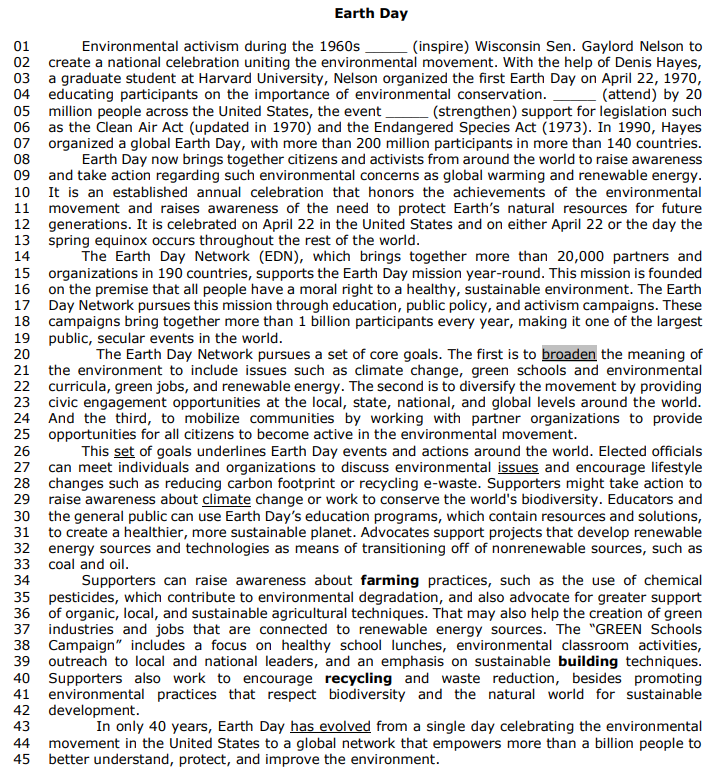
(Available at: education.nationalgeographic.org/resource/earth-day/– text specially adapted for this test).
I. The noun “set” (l. 26) is countable, just as in the sentence “There are two sets of pens over the table, take one to your office”.
II. The word “issues” (l. 27) is uncountable, just as in the sentence “Have you seen the latest issue of the paper? I’m sure it arrived this morning”.
III. The word “climate” (l. 29) is uncountable, just as in the sentence “A climate of uncertainty took over the room”.
Which ones are correct?
( ) They don’t have a distinction between singular and plural and cannot be counted because they cannot be easily divided. ( ) Some uncountable nouns are used only in the singular, like information or furniture. News is always plural. ( ) They can use the determiner "a" or "an", and if you want to ask about the their quantity, you ask "How many?".
Based on the preceding text, judge the item that follow.
The passenger who sued the airline company because of an incident that happened during his flight is Colombian.
Agronomists need to pay attention to the growth and development of the crops.
The word “crop” is mentioned several times in the text. One of its meanings can be expressed as the produce of cultivated plants, especially cereals, vegetables, and fruit.
Julgue o item que se segue.
The nouns information, furniture, advice, and loaf are
uncountable.

 Conheça nossos planos