Questões de Concurso
Sobre sinônimos | synonyms em inglês
Foram encontradas 1.586 questões


Performance and accountability:
Making government work


Performance and accountability:
Making government work
Read the following text and answer question based on the text
A Potential Solution: Farm Vertically
Complete the question below:
Use in a sentence have got is the same as using:
Read the following text and choose the answer which best fits the ideas in the text:
“Executive secretaries are responsible for maintaining their manager’s schedules and organizing calendars. They schedule departmental meetings and arrange for conference rooms to be used. Depending on the executive, secretaries may also be tasked with setting some of their manager’s personal appointments as well.”
(by Heather Eastridge from http:// www.ehow.com/facts_5256675_executive-secretary-duties-res)
Para responder a questão, considere o texto a seguir:
Environmental law in Brazil
BRAZIL’S gridlocked Congress often ends up passing contentious laws only after the combatants collapse in exhaustion. So it is with the revision of the Forest Code, a set of rules that, ...A... the name, apply to all privately owned rural land, not just plots in wooded areas. The code, originally approved in 1965, requires owners to keep native vegetation on parts of their land − 80% in the Amazon, less elsewhere − and in erosion-prone and biodiverse areas such as riverbanks and mangrove swamps. But it was long ignored.
Since harsher penalties and enforcement were introduced in the late 1990s the ruralistas, as Brazil’s powerful farming lobby is known, have been trying to revise the code. On April 25th, after 13 years of arguments, rewrites and stalling, the final text landed on the desk of the president, Dilma Rousseff. It was far from the version she wanted. Two government defeats in the ruralista-packed lower house meant it contained few of her own previous revisions or those of the more green-friendly Senate.
The president faced a difficult choice: to scrap the text and start again − which would probably be taken as a declaration of war by the ruralistas − or to make the best of a bad job. She chose the latter. On May 25th ministers went to Congress to say that the president would veto 12 of the new code’s 84 articles and make 32 smaller cuts. The resulting holes would be backfilled in a separate executive decree. Only on May 28th were the details published.
Under Ms Rousseff’s veto, the amnesty sought by ruralistas will apply only to smallholders, who will still have to replant 20% of their plots. Everyone else will have five years to right past wrongs and add their properties to a new Rural Environmental Register. Holdouts will be denied bank loans and face prosecution.
Rubens Ricupero, one of ten former environment ministers consulted by the president before the veto, praises her attempt to strike a balance. Treating small landowners more leniently was both practical, he thinks − they account for 90% of rural properties by number but just 24% by area − and socially just: few could afford much replanting.
(Adapted from http://www.economist.com/node/21556245?zid=305&ah=417bd5664dc76da5d98af4f7a640fd8a)
By Sally Kane, About.com Guide
Born in the mid-1980's and later, Generation Y legal professionals are in their 20s and are just entering the workforce. With numbers estimated as high as 70 million, Generation Y (also -1- as the Millennials) is the fastest growing segment of today's workforce. As law firms compete for available talent, employers cannot ignore the needs, desires and attitudes of this vast generation. Below are a few common traits that define Generation Y.
Tech-Savvy: Generation Y grew up with technology and rely on it to perform their jobs better. Armed with BlackBerrys, laptops, cellphones and other gadgets, Generation Y is plugged-in 24 hours a day, 7 days a week. This generation prefers to communicate through e-mail and text messaging rather than face-to-face contact and -2- webinars and online technology to traditional lecture-based presentations.
Family-Centric: The fast-track has lost much of its appeal for Generation Y who is willing to trade high pay for fewer billable hours, flexible schedules and a better work/life balance. While older generations may view this attitude as narcissistic or lacking commitment, discipline and drive, Generation Y legal professionals have a different vision of workplace expectations and prioritize family over work.
Achievement-Oriented: Nurtured and pampered -3- parents who did not want to make the mistakes of the previous generation, Generation Y is confident, ambitious and achievement-oriented. They have high expectations of their employers, seek out new challenges and are not afraid to question authority. Generation Y wants meaningful work and a solid learning curve
Team-Oriented: As children, Generation Y participated in team sports, play groups and other group activities. They value teamwork and seek the input and affirmation of others. Part of a no-person-left-behind generation, Generation Y is loyal, committed and wants to be included and involved.
Attention-Craving: Generation Y craves attention in the forms of feedback and guidance. They appreciate being kept in the loop and seek frequent praise and reassurance. Generation Y may benefit greatly from mentors who can help guide and develop their young careers.
Font: http://legalcareers.about.com/od/practicetips/a/Ge...

“fray" (L.19) is synonymous with fighting.
“surreptitious” (5.16) is synonymous with concealed.

The phrasal verb “lay out” (5.6) could be correctly replaced in the text by avoid.

In the text, “outperform” (5.25) is synonymous with surpass.

Hedge Fund Manager Donates $100 Million for
Central Park
ceremony at the fountain.
When asked at the news conference what prompted the gift, Mr. Paulson said: "Walking through the
park in different seasons, it kept coming back that in my mind Central Park is the most deserving of ali of New York's cultural institutions. And I wanted the amount to make a difference. The park is very large, and its endowment is relatively small."
The park's current endowment stands at $144 million. Half of Mr. Paulson's gift will go to the endowment, while the other half will be used for capital improvements. Mr. Paulson mentioned that he considered important: Restoring the park's North Woods, and sprucing up the Merchanfs Gate entrance at the park's Southwest comer, the most heavily used entrance.
Mr. Paulson has been a supporter of the Central Park Conservancy for 20 years, but this is his first major gift to the park. He joined the conservancy's board in June.
Two former parks commissioners, Henry Stern and Adrian Benepe, were at the news conference on Tuesday. It was also attended by Elizabeth Barlow Rogers and Richard Gilder, key figures in the conservancy's founding.
The announcement was made under cloudy skies in a ceremony attended by hundreds of employees of the Central Park Conservancy in their gray sweatshirts, as well as the conservancy's board. Doug Blonsky, the president and chief executive officer of the conservancy, which operates Central Park for the city, hailed the gift as "transformational," saying that it would break the cycle of restoration and decline that has marked the park throughout its 153-year history.
(h ttp ://www. nytimes. com)


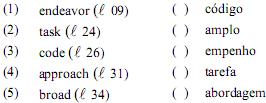
Assinale a alternativa que indica a sequência correta.
Lawsuits claim Knoedler made huge profits on fakes
For more than a dozen years the Upper East Side gallery Knoedler & Company was “substantially dependent” on profits it made from selling a mysterious collection of artwork that is at the center of a federal forgery investigation, former clients of this former gallery have charged in court papers. The analysis is based on financial records turned over as part of a lawsuit against the gallery filed by Domenico and Eleanore De Sole, who in 2004 paid $8.3 million for a painting attributed to Mark Rothko that they now say is a worthless fake. The Rothko is one of approximately 40 works that Knoedler, which closed last year, obtained from Glafira Rosales, a littleknown dealer whose collection of works attributed to Modernist masters has no documented provenance and is the subject of an F.B.I. investigation. Between 1996 and 2008, the suit asserts, Knoedler earned approximately $60 million from works that Ms. Rosales provided on consignment or sold outright to the gallery and cleared $40 million in profits. In one year, 2002, for example, the complaint says the gallery’s entire profit — $5.6 million — was derived from the sale of Ms. Rosales’s works. “Knoedler’s viability as a business was substantially — and, in some years, almost entirely — dependent on sales from the Rosales Collection,” the De Soles claimed last month in an amended version of the suit they filed this year. While the forgery allegations are well known and have been the subject of three federal lawsuits against Knoedler, the recent filings expand the known number of Rosales artworks that were handled by the gallery, which was in business for 165 years, and assert that they played a pivotal role in the gallery’s success. After the F.B.I. issued subpoenas to the gallery in the fall of 2009, Michael Hammer, Knoedler’s owner, halted the sale of any Rosales works. Knoedler ended up losing money that year and in 2010, the court papers say. http://www.nytimes.com/2012/10/22/arts/design/knoe...
Lawsuits claim Knoedler made huge profits on fakes
For more than a dozen years the Upper East Side gallery Knoedler & Company was “substantially dependent” on profits it made from selling a mysterious collection of artwork that is at the center of a federal forgery investigation, former clients of this former gallery have charged in court papers. The analysis is based on financial records turned over as part of a lawsuit against the gallery filed by Domenico and Eleanore De Sole, who in 2004 paid $8.3 million for a painting attributed to Mark Rothko that they now say is a worthless fake. The Rothko is one of approximately 40 works that Knoedler, which closed last year, obtained from Glafira Rosales, a littleknown dealer whose collection of works attributed to Modernist masters has no documented provenance and is the subject of an F.B.I. investigation. Between 1996 and 2008, the suit asserts, Knoedler earned approximately $60 million from works that Ms. Rosales provided on consignment or sold outright to the gallery and cleared $40 million in profits. In one year, 2002, for example, the complaint says the gallery’s entire profit — $5.6 million — was derived from the sale of Ms. Rosales’s works. “Knoedler’s viability as a business was substantially — and, in some years, almost entirely — dependent on sales from the Rosales Collection,” the De Soles claimed last month in an amended version of the suit they filed this year. While the forgery allegations are well known and have been the subject of three federal lawsuits against Knoedler, the recent filings expand the known number of Rosales artworks that were handled by the gallery, which was in business for 165 years, and assert that they played a pivotal role in the gallery’s success. After the F.B.I. issued subpoenas to the gallery in the fall of 2009, Michael Hammer, Knoedler’s owner, halted the sale of any Rosales works. Knoedler ended up losing money that year and in 2010, the court papers say. http://www.nytimes.com/2012/10/22/arts/design/knoe...


 Conheça nossos planos