Questões de Concurso Comentadas sobre sinônimos | synonyms em inglês

Questões Discursivas

Foram encontradas 1.059 questões

Q2482230 Inglês

Julgue o item subsequente.


If subject of a sentence is a collective noun, the verb can either agree with the singular noun as a single unit or with the plural sense of the collective noun, depending on the context and intended meaning.

Alternativas
Q2459375 Inglês

Read Text I and answer the fourteen questions that follow it


 Text I The “literacy turn” in education: reexamining 

what it means to be literate


In response to the phenomena of mass migration and the emergence of digital communications media that defined the last decade of the 20th century, the New London Group (NLG) called for a broader view of literacy and literacy teaching in its 1996 manifesto, A Pedagogy of Multiliteracies: Designing Social Futures. The group argued that literacy pedagogy in education must (1) reflect the increasing cultural and linguistic diversity of the contemporary globalized world, and (2) account for the new kinds of texts and textual engagement that have emerged in the wake of new information and multimedia technologies. In order to better capture the plurality of discourses, languages, and media, they proposed the term ‘multiliteracies’.

Within the NLG’s pedagogy of multiliteracies, language and other modes of communication are viewed as dynamic resources for meaning making that undergo constant changes in the dynamics of language use as learners attempt to achieve their own purposes. Within this broader view of literacy and literacy teaching, learners are no longer “users as decoders of language” but rather “designers of meaning.” Meaning is not viewed as something that resides in texts; rather, deriving meaning is considered an active and dynamic process in which learners combine and creatively apply both linguistic and other semiotic resources (e.g., visual, gesture, sound, etc.) with an awareness of “the sets of conventions connected with semiotic activity [...] in a given social space” (NLG, 1996, p. 74).

Grounded within the view that learning develops in social, cultural, and material contexts as a result of collaborative interactions, NLG argued that instantiating literacy-based teaching in classrooms calls on the complex integration and interaction of four pedagogical components that are neither hierarchical nor linear and can at times overlap: situated practice, overt instruction, critical framing, and transformed practice. […]

Although the NLG’s pedagogy of multiliteracies was conceived as a “statement of general principle” (1996, p. 89) for schools, the group’s call for educators to recognize the diversity and social situatedness of literacy has had a lasting impact on foreign language (FL) teaching and learning. The reception of the group’s work along with that of other scholars from critical pedagogy appeared at a time when the field was becoming less solidly anchored in theories of L2 acquisition and more interested in the social practice of FL education itself. In the section that follows, we describe the current state of FL literacy studies as it has developed in recent years, before finally turning to some very recent emerging trends that we are likely to see develop going forward.

(Adapted from: https://www.colorado.edu/center/altec/sites/default/files/ attachedfiles/moving_toward_multiliteracies_in_foreign_language_teaching.pdf)

In “can at times overlap” (3rd paragraph), “at times” may be replaced without significant change in meaning by
Alternativas
Q2459373 Inglês

Read Text I and answer the fourteen questions that follow it


 Text I The “literacy turn” in education: reexamining 

what it means to be literate


In response to the phenomena of mass migration and the emergence of digital communications media that defined the last decade of the 20th century, the New London Group (NLG) called for a broader view of literacy and literacy teaching in its 1996 manifesto, A Pedagogy of Multiliteracies: Designing Social Futures. The group argued that literacy pedagogy in education must (1) reflect the increasing cultural and linguistic diversity of the contemporary globalized world, and (2) account for the new kinds of texts and textual engagement that have emerged in the wake of new information and multimedia technologies. In order to better capture the plurality of discourses, languages, and media, they proposed the term ‘multiliteracies’.

Within the NLG’s pedagogy of multiliteracies, language and other modes of communication are viewed as dynamic resources for meaning making that undergo constant changes in the dynamics of language use as learners attempt to achieve their own purposes. Within this broader view of literacy and literacy teaching, learners are no longer “users as decoders of language” but rather “designers of meaning.” Meaning is not viewed as something that resides in texts; rather, deriving meaning is considered an active and dynamic process in which learners combine and creatively apply both linguistic and other semiotic resources (e.g., visual, gesture, sound, etc.) with an awareness of “the sets of conventions connected with semiotic activity [...] in a given social space” (NLG, 1996, p. 74).

Grounded within the view that learning develops in social, cultural, and material contexts as a result of collaborative interactions, NLG argued that instantiating literacy-based teaching in classrooms calls on the complex integration and interaction of four pedagogical components that are neither hierarchical nor linear and can at times overlap: situated practice, overt instruction, critical framing, and transformed practice. […]

Although the NLG’s pedagogy of multiliteracies was conceived as a “statement of general principle” (1996, p. 89) for schools, the group’s call for educators to recognize the diversity and social situatedness of literacy has had a lasting impact on foreign language (FL) teaching and learning. The reception of the group’s work along with that of other scholars from critical pedagogy appeared at a time when the field was becoming less solidly anchored in theories of L2 acquisition and more interested in the social practice of FL education itself. In the section that follows, we describe the current state of FL literacy studies as it has developed in recent years, before finally turning to some very recent emerging trends that we are likely to see develop going forward.

(Adapted from: https://www.colorado.edu/center/altec/sites/default/files/ attachedfiles/moving_toward_multiliteracies_in_foreign_language_teaching.pdf)

The expression “in the wake of” in “in the wake of new information” (1st paragraph) can be replaced without change of meaning by
Alternativas
Q2453840 Inglês
Predicting the unpredictable


Some years ago, a devastating earthquake struck the Italian town of L’Aquila. More than 300 people lost their lives, over 1,500 people were injured, and many buildings were destroyed. Two years later, seven earthquake experts were involved in a court case: Did they adequately warn the public after the initial tremors began? At the heart of the debate is whether they could have predicted a disaster like this.


Although a lot of scientists are working to improve our ability to predict natural disasters, so far no one has come up with a reliable method to forecast earthquakes or volcanic eruptions, days or weeks beforehand. Most of the research focuses on the areas most likely to experience seismic activity – but even our knowledge about where these areas are, is very limited. One reason for this is that human beings have only been around for a very small part of the Earth’s history. In geological terms, we all arrived on the scene very recently. Records from the past 2,000 years are incomplete, and the biggest earthquakes nearly always happen in areas where there have been no earthquakes in recorded history.


So, is there any hope for improving our ability to predict disasters? A solution may come from an unexpected source. Four years ago, a team of US physicists at Rutgers University in New Jersey were studying why pharmaceutical powders stick together. They observed that the powder stuck together when placed in a spinning cylinder, but then developed cracks and collapsed. Just before the cracks developed, an electric signal, like a small bolt of lightning, was created. The scientists repeated the experiment with a wide range of different materials, and they got similar results every time.


This phenomenon might also exist in nature. Some scientists believe that rocks may become electrically charged under unusual pressure, such as before an earthquake. This electric charge then causes changes in the surrounding air or water, which animals may be able to sense before humans do. For example, while biologists were studying a colony of frogs in a pond near L’Aquila, they noticed that nearly all the animals left the water days before the earthquake. A similar thing happened in China, when snakes were hibernating for the winter in caves, but escaped just before a large earthquake. The same kind of electric charge, like the small bolt of lightning felt in the experiment at Rutgers, may have been responsible.


At the moment, there is no reliable way ............ using such findings to predict earthquakes, and further studies may be necessary to give us a better understanding of the interactions involved, but one day, the technology may be used ............ predict future catastrophes. For example, two science institutions in Russia and Britain are already developing a new micro-satellite, which could detect these electric signals and help rescue people ................ natural disasters in time. Scientists are planning to launch the first of these satellites ............... space. Will these satellites be the solution? Only time will tell. For the time being, the best defense is to be prepared.
Mark the alternative which contains the correct meaning of the underlined words from the text.
Alternativas
Q2443648 Inglês

Planes top 800 mph as near-record winds sweep high over Mid-Atlantic
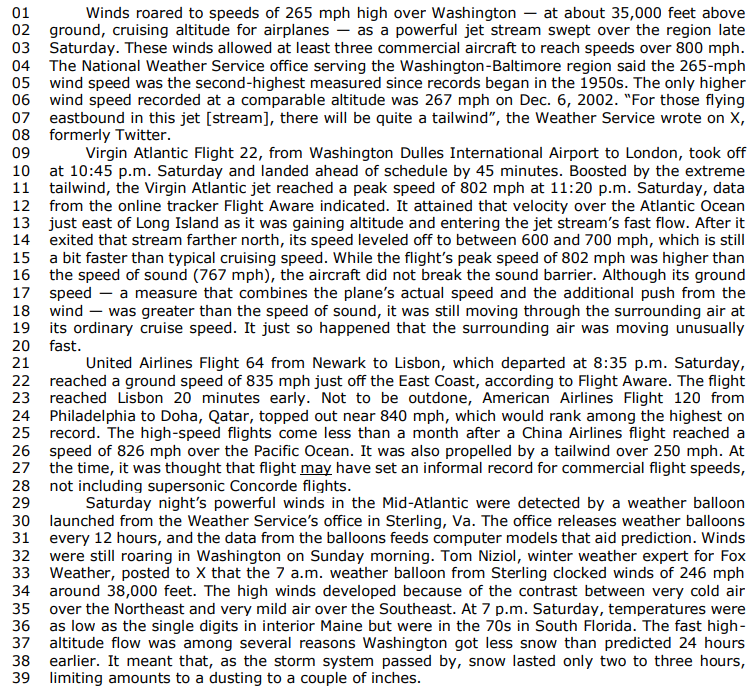


(Available at: www.washingtonpost.com/weather/2024/02/18/record-jet-stream-winds-dc-flights/ – text specially adapted for this test)

In which of the following excerpts from the text the structure in bold means “the same”? 
Alternativas
Q2415253 Inglês
        Back in October 2011, Stanford professors launched three free online courses, open to the public. One by one, these courses went massive, with enrollments topping 100.000 students each. Soon the media was calling these courses MOOCs, short for massive open online courses.
         Since then, more than 1.200 universities around the world have launched free online courses. In addition to the larger global MOOC platforms, many national governments around the world have launched their own country-specific MOOC platforms, including India, Italy, Israel, Mexico and Thailand.
            After a decade of popularization, in 2021, over 220 million students had signed up for at least one course on one of these platforms, and 40 million did so in 2021 alone. MOOCs and MOOC platforms are still growing, even after the crazy “Year of the MOOC” prompted by the pandemic and travel restrictions.
            At Class Central, we try to catalog as many MOOCs as possible, and our listing currently includes more than 150.000 of them, from MOOC platforms and other online learning platforms. But due to limited resources, we cannot index every single one. If you’re looking for MOOCs from around the world, this list is our best attempt to catalog all different MOOC platforms that are out there.

Internet:<https://classcentral.coom>  (adapted)

Keeping in mind the ideas expressed above and the linguistic aspects of the text, judge the following item. 


The phrase “short for massive open online courses” (in the last sentence of the first paragraph) can be correctly replaced with which stands for massive open online courses.

Alternativas
Q2392591 Inglês
Text 02 - (Types of social practices) Linguistics


The language spoken is one of the characteristics that most differentiate us from other animals on the planet. According to the experts, its appearance was one of the main causes of our development as a species; This is because the use of the language caused our brain to increase in capacity.


Therefore, linguistic social practices are a fundamental part of each culture. They include elements such as the language spoken, expressions and phrases made, or the importance given to certain words.


[...]


Social practices of language


Within all types of social practices that exist some of the most influencing a given society are those that have to do with their linguistic expression.


Due to the way in which language modifies the brain and the individual experience of people, the social practices of language take on great importance when it comes to understanding the customs and ways of seeing the world proper to a given society.


Even several studies have shown that bilingual people change their personality depending on the language they are speaking. So, what are the social practices of language?


These are ways of interacting that include both spoken and written language, in addition to all those activities that surround the communication process through it. Depending on the context in which we find ourselves and what we want to transmit, these practices will be different.


Also adapted from: https://www.lifepersona.com/social-practices-types-and-practices-of-language, accessed on July 17th, 2023. 
In “Within all types of social practices that exist some of the most influencing a given society are those that have to do with their linguistic expression.”, the word “a” refers to: 
Alternativas
Q2383642 Inglês

Text 18A3-I 


    The roar of a waterfall suggests the power of water. Rampaging floodwaters can uproot strong trees and twist railroad tracks. When the power of water is harnessed, however, it can do useful work for humans. 


    Since ancient times, people have put the energy in the flow of water to work. They first made water work for them with the waterwheel, a wheel with paddles around its rim. Flowing water rotated the waterwheel, which in turn ran machinery that was linked to it. Today, new kinds of waterwheels — turbines — spin generators that produce electricity. Electricity from water-turned generators is known as hydroelectricity. 


    By building a dam across a river, the natural upstream water level is elevated and a difference in head is created that can be used to drive turbines and generate electricity. A large upstream reservoir may balance seasonal water flow; rain or melted snow can be stored in the reservoir during the wet season to provide electricity during dry seasons. 


    Waterpower is distributed unevenly among the continents and nations of the world. Europe and North America have developed much of their waterpower. Asia, South America, and Africa have abundant waterpower potential, but while countries such as China and Brazil have become leading hydroelectric producers, much of the waterpower resource on those continents remains undeveloped. 


Elizabeth Lachner. Hydroelectricity. Rosen Publishing Group, 2018 (adapted). 

Maintaining the original meaning of text 18A3-I, the fragment “Today, new kinds of waterwheels — turbines — spin generators that produce electricity” (fourth sentence of the second paragraph) could be correctly replaced with 
Alternativas
Q2383638 Inglês

Text 18A3-I 


    The roar of a waterfall suggests the power of water. Rampaging floodwaters can uproot strong trees and twist railroad tracks. When the power of water is harnessed, however, it can do useful work for humans. 


    Since ancient times, people have put the energy in the flow of water to work. They first made water work for them with the waterwheel, a wheel with paddles around its rim. Flowing water rotated the waterwheel, which in turn ran machinery that was linked to it. Today, new kinds of waterwheels — turbines — spin generators that produce electricity. Electricity from water-turned generators is known as hydroelectricity. 


    By building a dam across a river, the natural upstream water level is elevated and a difference in head is created that can be used to drive turbines and generate electricity. A large upstream reservoir may balance seasonal water flow; rain or melted snow can be stored in the reservoir during the wet season to provide electricity during dry seasons. 


    Waterpower is distributed unevenly among the continents and nations of the world. Europe and North America have developed much of their waterpower. Asia, South America, and Africa have abundant waterpower potential, but while countries such as China and Brazil have become leading hydroelectric producers, much of the waterpower resource on those continents remains undeveloped. 


Elizabeth Lachner. Hydroelectricity. Rosen Publishing Group, 2018 (adapted). 

The expression “The roar of a waterfall” (first sentence of text 18A3-I), is more closely related to the sense of 
Alternativas
Q2382861 Inglês

Text 19A4-II 


        Photo exhibitions are great opportunities for excited and ambitious photographers to showcase their work beyond just the safety of their friends and family. They’re also a stellar opportunity to develop a thicker skin, as your work will be subject to critique, but that’s all part of the territory that comes with getting more exposure as a photographer, which is what all artists should strive for. Beyond that, they’re a great way to advertise yourself as a photographer, both your talents and your availability. Think of it almost as the artist’s equivalent to having a booth at a trade show when you’re selling a product. 


        First-timers to an exhibition will likely find themselves a bit unsure of what to do and somewhat nervous. Here’s a series of surefire tips to make any exhibition a success. Before you do anything else, it’s imperative that you make up your mind about what you’ll be showcasing at your exhibition. You only have two choices, when you think about it: brand-new work that you’ll shoot especially for the exhibition or archival stuff that you’ll just pull out for the exhibition. Also, being creative when finding the exhibition location is as important as the showcase itself. 


Internet: <https://contrastly.com> (adapted). 

In text 19A4-II, the word “likely” (first sentence of the second paragraph) conveys the idea of 
Alternativas
Q2382860 Inglês

Text 19A4-I 


        It is a universal fact that cinema is a visual medium. Films have the power to overwhelm our senses as well as our minds, subjecting us to a variety of experiences that can range from the sublime to the devastating. Colours play a crucial role in this interesting phenomenon, forming an integral part of the composition of each frame and dictating how the viewer perceives the spectacle on the screen. Apart from the cinematic medium, colours have always been a part of our experience and how we make sense of the vastly nuanced world around us. Although science has definitively explained what colours are in terms of light, they have always mystified artists and philosophers like Arthur Schopenhauer and Ludwig Wittgenstein, who tried to understand their importance in anthropological frameworks. 


        More notably, the famous German poet and artist Johann Wolfgang von Goethe published a seminal exploration of colours in his 1810 work Theory of Colours. In it, he examined how each colour corresponds to various psychological states in the minds of human beings. He wrote, “Light and darkness, brightness and obscurity, or if a more general expression is preferred, light and its absence, are necessary to the production of colour… Colour itself is a degree of darkness.” Goethe’s theories might seem baselessly romantic in the 21st century but the underlying ideas have been implemented by filmmakers and cinematographers to curate the voyeuristic experiences of their audiences. Famed cinematographer Vittorio Storaro has based his artistic vision on Goethe’s work, insisting that colours do have a direct connection to the mind of the viewer. 


Internet: <https://faroutmagazine.co.uk> (adapted).
Maintaining the original meaning of text 19A4-I, the excerpt “Vittorio Storaro has based his artistic vision on Goethe’s work”, in the last sentence of the last paragraph, can be correctly rephrased as 
Alternativas
Q2380308 Inglês
Text I

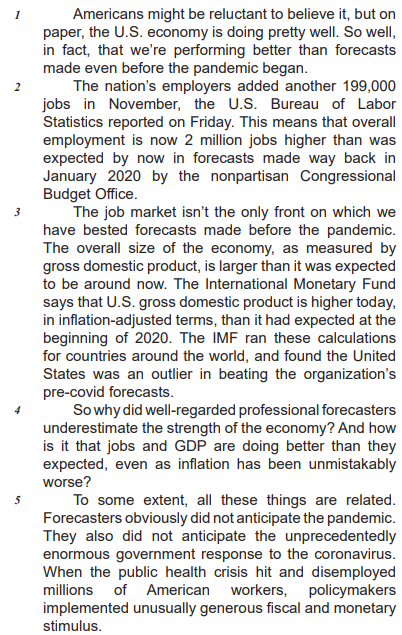
How good is the U.S. economy? It’s beating pre-pandemic predictions.


Available at: https://www.washingtonpost.com/opinions/
2023/12/08/jobs-report-economy-beats-pandemic
predictions/. Retrieved on: Dec. 12, 2023. Adapted.
In the sentence “I probably would have guessed the public would be pretty content” (Text I, paragraph 7), the expression pretty content can be rewritten, with no change in meaning, by
Alternativas
Q2380307 Inglês
Text I

How good is the U.S. economy? It’s beating pre-pandemic predictions.


Available at: https://www.washingtonpost.com/opinions/
2023/12/08/jobs-report-economy-beats-pandemic
predictions/. Retrieved on: Dec. 12, 2023. Adapted.
In the sentence “Forecasters obviously did not anticipate the pandemic” (Text I, paragraph 5) the term anticipate could be replaced, with no change in meaning, by
Alternativas
Q2364876 Inglês
Text 41A1-I


      Tapioca is the starch extracted from the cassava root. Cassava is a native vegetable of South America that grows in tropical and subtropical regions. In addition to providing daily nutrition for millions of people around the globe, tapioca has become a popular substitute for wheat flour in gluten-free baking. It is also very easy to digest, so it’s a good choice for people with irritable bowel syndrome and other digestive issues.

      The minerals in tapioca can provide important health benefits. For example, calcium is important for keeping your bones strong and preventing the development of osteoporosis. Tapioca also contains iron, an essential mineral we need to help transport oxygen throughout the body. In addition, tapioca contains no saturated fat. Reducing saturated fat has been found to lower the risk of heart disease. Tapioca starch contains no fat or cholesterol, which makes it a healthy choice for those watching their dietary cholesterol and saturated fat intake.

      Tapioca is also very low in sodium.


Internet: <webmd.com> (adapted).
A suitable synonym for the word “intake” (last sentence of the second paragraph of text 41A1-I) is
Alternativas
Q4205820 Inglês
Your Brain Could Be Controlling How Sick You Get - And How You Recover

        Hundreds of scientists around the world are looking for ways to treat heart attacks. But few started where Hedva Haykin has: in the brain. Doctor Haykin wants to know whether stimulating a region of the brain involved in positive emotion and motivation can influence how the heart heals.
    
        Late last year, in a small, ____________ microscope room, she pulled out slides from a thin black box, one by one. On them were slices of hearts, no bigger than pumpkin seeds, from mice that had experienced heart attacks. Under a microscope, some of the samples were clearly marred by scars left in the aftermath of the infarction. Others showed mere ____________ of damage visible among streaks of healthy, red-stained cells.
    
        The difference in the hearts’ appearance originated in the brain, Haykin explains. The healthier-looking samples came from mice that had received stimulation of a brain area involved in positive emotion and motivation. Those marked with scars were from unstimulated mice. On the basis of her experiments so far, which have not yet been published, activation of this brain reward centre — called the ventral tegmental area (VTA) — seems to trigger immune changes that contribute to the reduction of scar __________.

(Fonte: Scientific American - adaptado.)
In “Doctor Haykin wants to know whether stimulating a region of the brain involved in positive emotion and motivation can influence how the heart heals”, the underlined word can be substituted without loss of meaning by:
Alternativas
Q4204830 Inglês
Life just might exist on Mars after all


    The red planet may have once been home to an abundance of microbes. New studies suggest it's possible that some hardy microbes managed to survive underground in a frozen state.

    About 3.5 billion years ago, two of the planets that orbited the sun may have had biospheres of similar bulk. One, Earth, evolved in a way that allowed life to flourish and splinter into endless forms most beautiful. Mars, the other world, followed a different path.

    Today the Martian surface is hostile to life as we know it, but as this scientific story goes, Mars may have once hosted a rich abundance of microbes. Residing in the planet’s briny underworld and shielded from the lethal radiation that bathes the surface, these organisms could have grown in nooks and ____________, multiplying until their collective heft rivaled Earth’s cache of life. Called methanogens, Mars’s microbes would have inhaled atmospheric hydrogen and carbon dioxide and exhaled methane gas - and in a twist, they may have turned out to be their own worst enemy.

    Over time, their growing, insatiable appetite would have robbed the Martian atmosphere of hydrogen - a powerful greenhouse gas during the planet’s early days - ultimately casting a deadly freeze over the planet and driving microbial populations into deeper, warmer crannies. How long those burrowing microbes could have survived in the deep is unknown. It’s possible they were only a shortlived flash of life on an otherwise sterile world.

    “Maybe extinction is the cosmic default of life in the universe,” says Boris Sauterey of the Institut de Biologie de l’Ecole Normale Supérieure in Paris. “It’s not the process of life ____________ that is limiting; it’s life maintaining itself that is limiting.”

    But perhaps, more than 30 feet beneath the surface and encased in ice, these ancient single-celled organisms achieved a state of dormancy - a sort of cryopreserved slumber, ready to perk up when more life-friendly conditions arise.

    The Martian interior may not be as lifeless as its face. It could host a world of alien organisms that are capable of waiting thousands of years between each turn of their metabolic engines.

    This ____________ may sound farfetched, but recent results from scientists modeling the habitability of ancient Mars and studying the hardiness of microbes in labs and beneath our own planet’s surface all point in the same direction: It’s a long shot, but it’s possible life evolved on Mars and still exists. And scientists may just find signs of that life when meteors barrel into Mars and excavate buried layers of ice, or when new spacecraft arrive to plumb this underground realm.


(Fonte: National Geographic - adaptado.)
In “It could host a world of alien organisms...”, the underlined word can be substituted without loss of meaning by:
Alternativas
Q4198362 Inglês
Leia o texto para responder à questão.

Information Security (InfoSec) defined

Information security, often abbreviated InfoSec, is a set of security procedures and tools that broadly protect sensitive enterprise information from misuse, unauthorized access, disruption, or destruction. InfoSec encompasses physical and environmental security, access control, and cybersecurity. It often includes technologies like cloud access security brokers (CASB), deception tools, endpoint detection and response (EDR), and security testing for DevOps (DevSecOps), among others.

Key elements of information security


InfoSec comprises a range of security tools, solutions, and processes that keep enterprise information secure across devices and locations, helping to protect against cyberattacks or other disruptive events.

•  Application security - Policies, procedures, tools, and best practices enacted to protect applications and their data.w
•  Cloud security - Policies, procedures, tools, and best practices enacted to protect all aspects of the cloud, including systems, data, applications, and infrastructure.
•  Cryptography - An algorithm-based method of securing communication meant to ensure only intended recipients of a specific message can view and decipher it.
•  Disaster recovery - A method to reestablish functional technological systems in the wake of an event like a natural disaster, cyberattack, or another disruptive event.
•  Incident response - An organization’s plan for responding to, remediating, and managing the aftermath of a cyberattack, data breach, or another disruptive event.
•  Infrastructure security - Security that encompasses an organization’s entire technological infrastructure, including both hardware and software systems.
•  Vulnerability management - The process an organization takes to identify, assess, and remediate vulnerabilities in its endpoints, software, and systems.


Three pillars of information security: the CIA triad

Confidentiality, integrity, and availability make up the cornerstones of strong information protection, creating the basis for an enterprise’s security infrastructure. The CIA triad offers these three concepts as guiding principles for implementing an InfoSec plan.


Confidentiality

Privacy is a major component of InfoSec, and organizations should enact measures that allow only authorized users access to information. Data encryption, multi-factor authentication, and data loss prevention are some of the tools enterprises can employ to help ensure data confidentiality.

Integrity

Enterprises must maintain data’s integrity across its entire lifecycle. Enterprises with strong InfoSec will recognize the importance of accurate, reliable data, and permit no unauthorized user to access, alter, or otherwise interfere with it. Tools like file permissions, identity management, and user access controls help ensure data integrity.

Availability

InfoSec involves consistently maintaining physical hardware and regularly completing system upgrades to guarantee that authorized users have dependable, consistent access to data as they need it.


(www.microsoft.com/en-ww/security/business/security-101/ what-is-information-security-infosec#:~:text=Information%20 security%2C%20often%20abbreviated%20(InfoSec,access%2C%20 disruption%2C%20or%20destruction. Adaptado.)

No trecho do item Availability “authorized users have dependable, consistent access to data as they need it”, o termo destacado em negrito pode ser substituído, sem alteração de sentido, por
Alternativas
Q4198360 Inglês
Leia o texto para responder à questão.

Information Security (InfoSec) defined

Information security, often abbreviated InfoSec, is a set of security procedures and tools that broadly protect sensitive enterprise information from misuse, unauthorized access, disruption, or destruction. InfoSec encompasses physical and environmental security, access control, and cybersecurity. It often includes technologies like cloud access security brokers (CASB), deception tools, endpoint detection and response (EDR), and security testing for DevOps (DevSecOps), among others.

Key elements of information security


InfoSec comprises a range of security tools, solutions, and processes that keep enterprise information secure across devices and locations, helping to protect against cyberattacks or other disruptive events.

•  Application security - Policies, procedures, tools, and best practices enacted to protect applications and their data.w
•  Cloud security - Policies, procedures, tools, and best practices enacted to protect all aspects of the cloud, including systems, data, applications, and infrastructure.
•  Cryptography - An algorithm-based method of securing communication meant to ensure only intended recipients of a specific message can view and decipher it.
•  Disaster recovery - A method to reestablish functional technological systems in the wake of an event like a natural disaster, cyberattack, or another disruptive event.
•  Incident response - An organization’s plan for responding to, remediating, and managing the aftermath of a cyberattack, data breach, or another disruptive event.
•  Infrastructure security - Security that encompasses an organization’s entire technological infrastructure, including both hardware and software systems.
•  Vulnerability management - The process an organization takes to identify, assess, and remediate vulnerabilities in its endpoints, software, and systems.


Three pillars of information security: the CIA triad

Confidentiality, integrity, and availability make up the cornerstones of strong information protection, creating the basis for an enterprise’s security infrastructure. The CIA triad offers these three concepts as guiding principles for implementing an InfoSec plan.


Confidentiality

Privacy is a major component of InfoSec, and organizations should enact measures that allow only authorized users access to information. Data encryption, multi-factor authentication, and data loss prevention are some of the tools enterprises can employ to help ensure data confidentiality.

Integrity

Enterprises must maintain data’s integrity across its entire lifecycle. Enterprises with strong InfoSec will recognize the importance of accurate, reliable data, and permit no unauthorized user to access, alter, or otherwise interfere with it. Tools like file permissions, identity management, and user access controls help ensure data integrity.

Availability

InfoSec involves consistently maintaining physical hardware and regularly completing system upgrades to guarantee that authorized users have dependable, consistent access to data as they need it.


(www.microsoft.com/en-ww/security/business/security-101/ what-is-information-security-infosec#:~:text=Information%20 security%2C%20often%20abbreviated%20(InfoSec,access%2C%20 disruption%2C%20or%20destruction. Adaptado.)

Leia a parte do texto Three pillars of information security: the CIA triad para responder à questão.


No trecho do item Confidentiality “organizations should enact measures”, o termo destacado em negrito pode ser substituído, sem alteração de sentido, por

Alternativas
Q4197926 Inglês

Advantages of wireless technology


Wireless communications offer several cost and connectivity benefits for organizations. The rapid rise of remote work – fuelled in part by the pandemic that began in 2020 – has created an environment where employees demand high-performance access to network resources regardless of where they might be.

Wireless networks can be less expensive to build and maintain since they require fewer switches and other components required by wired infrastructures. New wireless standards – especially among them multiuser, multiple input and multiple output – enable physical Access Points (APs) to serve a greater number of users, further reducing costs.

Wireless technologies also support novel services, among them location tracking, Internet of Things (IoT) deployments and remote diagnostics. Finally, advances in wireless performance enable organizations to stress mobility as a primary benefit, thus helping them redefine how they design their offices and workgroups.

(www.techtarget.com/searchmobilecomputing/definition/wireless. Adaptado)

No trecho do primeiro parágrafo “ where they might be”, o termo destacado em negrito pode ser substituído, sem alteração de sentido, por
Alternativas
Q4162850 Inglês

Dutch government bans phones in schools The Dutch government has announced a ban ______01 mobile phones, tablets, and smartwatches in classrooms starting ______02 January 1, 2024.


The aim is to reduce distractions ______03 lessons and promote better concentration and studying opportunities for students. ______04, devices


_______________05 if they are specifically required for digital skills lessons, for medical reasons, or students with disabilities.


Education Minister Robbert Dijkgraaf ______06 that ______07 mobile phones are a significant part of ______08 lives, they are not suitable for the classroom, and scientific research ______09 this view.


The ban is the result of an agreement between the ministry, schools, and related organizations. Schools have the flexibility to implement the ban in their way, but if the desired outcomes ______10 achieved by the summer of 2024, legal rules ______11 enforced.


Source: https://www.newsinlevels.com/products/dutch government-bans-phones-in-schools-level-3/. 

The underlined word “suitable” (3rd paragraph) could be replaced in the sentence CORRECTLY and without any major change in meaning for: 
Alternativas
Respostas
261: C
262: D
263: C
264: E
265: E
266: C
267: C
268: D
269: B
270: E
271: B
272: B
273: B
274: E
275: C
276: B
277: B
278: A
279: A
280: D