Questões de Concurso Sobre inglês
Foram encontradas 26.019 questões


1. Literacy Cycle 2. Interdisciplinary Cycle 3. Authoring Cycle
( ) Recognize instructions that indicate body movements (EF01LI09; p. 75); ( ) Recognize the difference between layouts of texts from various media, according to the context (EF07LI06, p.85); ( ) Recognize words in English looking at images in games such as bingo and tic-tac-toe (EF04LI10, p.80); ( ) Recognize narrative elements such as characters, plot, time and space in a group work situation (EF03LI04; p.77); ( ) Recognize language variation as a manifestation of different ways of thinking and expressing the world (EF07LI25, p.87).
The item with the correct sequence is:
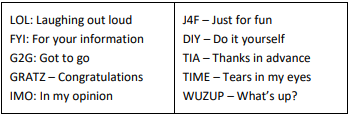
Adapted from: https://preply.com/en/blog/the-most-used-internet-abbreviationsfor-texting-and-tweeting/
If a person is in a hurry, the abbreviation that will be used will be
Text II
Hi, did two shifts tonite and am off to bed. But still fancy the film tomoz. Ur still ok for this right? How about meet up at I dunno 6 or something outside the Chinese take away.
Adapted from Carter, R. & Goddard, A. How to Analyse Texts. A toolkit for students
of English. London: Routledge, 2016, p. 154.
Text II
Hi, did two shifts tonite and am off to bed. But still fancy the film tomoz. Ur still ok for this right? How about meet up at I dunno 6 or something outside the Chinese take away.
Adapted from Carter, R. & Goddard, A. How to Analyse Texts. A toolkit for students
of English. London: Routledge, 2016, p. 154.
Text I
Nurturing Multimodalism
[…]
New learning collaborations call on the teacher as learner, and the learner as teacher. The teacher is a lifelong learner; this is simply more apparent in the Information Age. In instances of best practice, collaborative learning partnerships are forged between and among teachers for strategic, bottom-up, in-house professional development. This allows teachers to share in reflective, on-going, contextualized learning, tailored to their collective knowledge. This sharing also includes the learner as teacher. ELT typically employs learner-centered activities: these can include learners sharing their knowledge of strategic digital literacies with others in the classrooms.
The digital universe, so threatening to adult notions of socially sanctioned literacies, is intuitive to children, who have been socialized into it, and for whom digital literacies are exploratory play. Adults may find new ways of communicating digitally to be quite baffling and confronting of our communicative expertise; children do not. Instant messaging systems, such as MSN, AOL, ICQ, for example, provide as natural a medium for communicating to them as telephones did for the baby-boomer generation. It is not fair for the teacher to treat Information and Communication Technologies as auxiliary communication with learners for whom it is mainstream and primary.
Learning spaces are important. Although teachers seldom have much individual say in the layout of teaching spaces, collaborative relationships may help to encourage integrated digitization, where computers are not segregated in laboratories but are interspersed throughout the school environment. In digitally infused curricula, postmodern literacies do not supplant but complement modern literacies, so that access to information is driven by purpose and content rather than by the media available.
Adapted from: LOTHERINGTON, H. From literacy to multiliteracies in ELT. In:
CUMMINS, J.; DAVISON, C. (Eds.) International Handbook of English Language
Teaching. New York: Springer, 2007, p. 820. Available at:
https://www.researchgate.net/publication/226802846_From_Literacy_to_Multiliter
acies_in_ELT
Text I
Nurturing Multimodalism
[…]
New learning collaborations call on the teacher as learner, and the learner as teacher. The teacher is a lifelong learner; this is simply more apparent in the Information Age. In instances of best practice, collaborative learning partnerships are forged between and among teachers for strategic, bottom-up, in-house professional development. This allows teachers to share in reflective, on-going, contextualized learning, tailored to their collective knowledge. This sharing also includes the learner as teacher. ELT typically employs learner-centered activities: these can include learners sharing their knowledge of strategic digital literacies with others in the classrooms.
The digital universe, so threatening to adult notions of socially sanctioned literacies, is intuitive to children, who have been socialized into it, and for whom digital literacies are exploratory play. Adults may find new ways of communicating digitally to be quite baffling and confronting of our communicative expertise; children do not. Instant messaging systems, such as MSN, AOL, ICQ, for example, provide as natural a medium for communicating to them as telephones did for the baby-boomer generation. It is not fair for the teacher to treat Information and Communication Technologies as auxiliary communication with learners for whom it is mainstream and primary.
Learning spaces are important. Although teachers seldom have much individual say in the layout of teaching spaces, collaborative relationships may help to encourage integrated digitization, where computers are not segregated in laboratories but are interspersed throughout the school environment. In digitally infused curricula, postmodern literacies do not supplant but complement modern literacies, so that access to information is driven by purpose and content rather than by the media available.
Adapted from: LOTHERINGTON, H. From literacy to multiliteracies in ELT. In:
CUMMINS, J.; DAVISON, C. (Eds.) International Handbook of English Language
Teaching. New York: Springer, 2007, p. 820. Available at:
https://www.researchgate.net/publication/226802846_From_Literacy_to_Multiliter
acies_in_ELT
Text I
Nurturing Multimodalism
[…]
New learning collaborations call on the teacher as learner, and the learner as teacher. The teacher is a lifelong learner; this is simply more apparent in the Information Age. In instances of best practice, collaborative learning partnerships are forged between and among teachers for strategic, bottom-up, in-house professional development. This allows teachers to share in reflective, on-going, contextualized learning, tailored to their collective knowledge. This sharing also includes the learner as teacher. ELT typically employs learner-centered activities: these can include learners sharing their knowledge of strategic digital literacies with others in the classrooms.
The digital universe, so threatening to adult notions of socially sanctioned literacies, is intuitive to children, who have been socialized into it, and for whom digital literacies are exploratory play. Adults may find new ways of communicating digitally to be quite baffling and confronting of our communicative expertise; children do not. Instant messaging systems, such as MSN, AOL, ICQ, for example, provide as natural a medium for communicating to them as telephones did for the baby-boomer generation. It is not fair for the teacher to treat Information and Communication Technologies as auxiliary communication with learners for whom it is mainstream and primary.
Learning spaces are important. Although teachers seldom have much individual say in the layout of teaching spaces, collaborative relationships may help to encourage integrated digitization, where computers are not segregated in laboratories but are interspersed throughout the school environment. In digitally infused curricula, postmodern literacies do not supplant but complement modern literacies, so that access to information is driven by purpose and content rather than by the media available.
Adapted from: LOTHERINGTON, H. From literacy to multiliteracies in ELT. In:
CUMMINS, J.; DAVISON, C. (Eds.) International Handbook of English Language
Teaching. New York: Springer, 2007, p. 820. Available at:
https://www.researchgate.net/publication/226802846_From_Literacy_to_Multiliter
acies_in_ELT
Text I
Nurturing Multimodalism
[…]
New learning collaborations call on the teacher as learner, and the learner as teacher. The teacher is a lifelong learner; this is simply more apparent in the Information Age. In instances of best practice, collaborative learning partnerships are forged between and among teachers for strategic, bottom-up, in-house professional development. This allows teachers to share in reflective, on-going, contextualized learning, tailored to their collective knowledge. This sharing also includes the learner as teacher. ELT typically employs learner-centered activities: these can include learners sharing their knowledge of strategic digital literacies with others in the classrooms.
The digital universe, so threatening to adult notions of socially sanctioned literacies, is intuitive to children, who have been socialized into it, and for whom digital literacies are exploratory play. Adults may find new ways of communicating digitally to be quite baffling and confronting of our communicative expertise; children do not. Instant messaging systems, such as MSN, AOL, ICQ, for example, provide as natural a medium for communicating to them as telephones did for the baby-boomer generation. It is not fair for the teacher to treat Information and Communication Technologies as auxiliary communication with learners for whom it is mainstream and primary.
Learning spaces are important. Although teachers seldom have much individual say in the layout of teaching spaces, collaborative relationships may help to encourage integrated digitization, where computers are not segregated in laboratories but are interspersed throughout the school environment. In digitally infused curricula, postmodern literacies do not supplant but complement modern literacies, so that access to information is driven by purpose and content rather than by the media available.
Adapted from: LOTHERINGTON, H. From literacy to multiliteracies in ELT. In:
CUMMINS, J.; DAVISON, C. (Eds.) International Handbook of English Language
Teaching. New York: Springer, 2007, p. 820. Available at:
https://www.researchgate.net/publication/226802846_From_Literacy_to_Multiliter
acies_in_ELT
Text I
Nurturing Multimodalism
[…]
New learning collaborations call on the teacher as learner, and the learner as teacher. The teacher is a lifelong learner; this is simply more apparent in the Information Age. In instances of best practice, collaborative learning partnerships are forged between and among teachers for strategic, bottom-up, in-house professional development. This allows teachers to share in reflective, on-going, contextualized learning, tailored to their collective knowledge. This sharing also includes the learner as teacher. ELT typically employs learner-centered activities: these can include learners sharing their knowledge of strategic digital literacies with others in the classrooms.
The digital universe, so threatening to adult notions of socially sanctioned literacies, is intuitive to children, who have been socialized into it, and for whom digital literacies are exploratory play. Adults may find new ways of communicating digitally to be quite baffling and confronting of our communicative expertise; children do not. Instant messaging systems, such as MSN, AOL, ICQ, for example, provide as natural a medium for communicating to them as telephones did for the baby-boomer generation. It is not fair for the teacher to treat Information and Communication Technologies as auxiliary communication with learners for whom it is mainstream and primary.
Learning spaces are important. Although teachers seldom have much individual say in the layout of teaching spaces, collaborative relationships may help to encourage integrated digitization, where computers are not segregated in laboratories but are interspersed throughout the school environment. In digitally infused curricula, postmodern literacies do not supplant but complement modern literacies, so that access to information is driven by purpose and content rather than by the media available.
Adapted from: LOTHERINGTON, H. From literacy to multiliteracies in ELT. In:
CUMMINS, J.; DAVISON, C. (Eds.) International Handbook of English Language
Teaching. New York: Springer, 2007, p. 820. Available at:
https://www.researchgate.net/publication/226802846_From_Literacy_to_Multiliter
acies_in_ELT
Text I
Nurturing Multimodalism
[…]
New learning collaborations call on the teacher as learner, and the learner as teacher. The teacher is a lifelong learner; this is simply more apparent in the Information Age. In instances of best practice, collaborative learning partnerships are forged between and among teachers for strategic, bottom-up, in-house professional development. This allows teachers to share in reflective, on-going, contextualized learning, tailored to their collective knowledge. This sharing also includes the learner as teacher. ELT typically employs learner-centered activities: these can include learners sharing their knowledge of strategic digital literacies with others in the classrooms.
The digital universe, so threatening to adult notions of socially sanctioned literacies, is intuitive to children, who have been socialized into it, and for whom digital literacies are exploratory play. Adults may find new ways of communicating digitally to be quite baffling and confronting of our communicative expertise; children do not. Instant messaging systems, such as MSN, AOL, ICQ, for example, provide as natural a medium for communicating to them as telephones did for the baby-boomer generation. It is not fair for the teacher to treat Information and Communication Technologies as auxiliary communication with learners for whom it is mainstream and primary.
Learning spaces are important. Although teachers seldom have much individual say in the layout of teaching spaces, collaborative relationships may help to encourage integrated digitization, where computers are not segregated in laboratories but are interspersed throughout the school environment. In digitally infused curricula, postmodern literacies do not supplant but complement modern literacies, so that access to information is driven by purpose and content rather than by the media available.
Adapted from: LOTHERINGTON, H. From literacy to multiliteracies in ELT. In:
CUMMINS, J.; DAVISON, C. (Eds.) International Handbook of English Language
Teaching. New York: Springer, 2007, p. 820. Available at:
https://www.researchgate.net/publication/226802846_From_Literacy_to_Multiliter
acies_in_ELT
Text I
Nurturing Multimodalism
[…]
New learning collaborations call on the teacher as learner, and the learner as teacher. The teacher is a lifelong learner; this is simply more apparent in the Information Age. In instances of best practice, collaborative learning partnerships are forged between and among teachers for strategic, bottom-up, in-house professional development. This allows teachers to share in reflective, on-going, contextualized learning, tailored to their collective knowledge. This sharing also includes the learner as teacher. ELT typically employs learner-centered activities: these can include learners sharing their knowledge of strategic digital literacies with others in the classrooms.
The digital universe, so threatening to adult notions of socially sanctioned literacies, is intuitive to children, who have been socialized into it, and for whom digital literacies are exploratory play. Adults may find new ways of communicating digitally to be quite baffling and confronting of our communicative expertise; children do not. Instant messaging systems, such as MSN, AOL, ICQ, for example, provide as natural a medium for communicating to them as telephones did for the baby-boomer generation. It is not fair for the teacher to treat Information and Communication Technologies as auxiliary communication with learners for whom it is mainstream and primary.
Learning spaces are important. Although teachers seldom have much individual say in the layout of teaching spaces, collaborative relationships may help to encourage integrated digitization, where computers are not segregated in laboratories but are interspersed throughout the school environment. In digitally infused curricula, postmodern literacies do not supplant but complement modern literacies, so that access to information is driven by purpose and content rather than by the media available.
Adapted from: LOTHERINGTON, H. From literacy to multiliteracies in ELT. In:
CUMMINS, J.; DAVISON, C. (Eds.) International Handbook of English Language
Teaching. New York: Springer, 2007, p. 820. Available at:
https://www.researchgate.net/publication/226802846_From_Literacy_to_Multiliter
acies_in_ELT
I. In recent collaborative teaching, learners and teachers may exchange roles. II. The goals of digitally oriented curricula should conform to the media at hand. III. It is quite straining for children to get a grasp of digital communication.
Choose the correct answer:
Text I
Nurturing Multimodalism
[…]
New learning collaborations call on the teacher as learner, and the learner as teacher. The teacher is a lifelong learner; this is simply more apparent in the Information Age. In instances of best practice, collaborative learning partnerships are forged between and among teachers for strategic, bottom-up, in-house professional development. This allows teachers to share in reflective, on-going, contextualized learning, tailored to their collective knowledge. This sharing also includes the learner as teacher. ELT typically employs learner-centered activities: these can include learners sharing their knowledge of strategic digital literacies with others in the classrooms.
The digital universe, so threatening to adult notions of socially sanctioned literacies, is intuitive to children, who have been socialized into it, and for whom digital literacies are exploratory play. Adults may find new ways of communicating digitally to be quite baffling and confronting of our communicative expertise; children do not. Instant messaging systems, such as MSN, AOL, ICQ, for example, provide as natural a medium for communicating to them as telephones did for the baby-boomer generation. It is not fair for the teacher to treat Information and Communication Technologies as auxiliary communication with learners for whom it is mainstream and primary.
Learning spaces are important. Although teachers seldom have much individual say in the layout of teaching spaces, collaborative relationships may help to encourage integrated digitization, where computers are not segregated in laboratories but are interspersed throughout the school environment. In digitally infused curricula, postmodern literacies do not supplant but complement modern literacies, so that access to information is driven by purpose and content rather than by the media available.
Adapted from: LOTHERINGTON, H. From literacy to multiliteracies in ELT. In:
CUMMINS, J.; DAVISON, C. (Eds.) International Handbook of English Language
Teaching. New York: Springer, 2007, p. 820. Available at:
https://www.researchgate.net/publication/226802846_From_Literacy_to_Multiliter
acies_in_ELT
( ) In the digital era, modern literacies have been swept away by postmodern perspectives. ( ) Learners are to be stimulated to share their digital knowledge with teacher and peers. ( ) A digitally infused curriculum requires a restricted area in the school for working with computers.
The statements are, respectively,
Text 5 (for question)
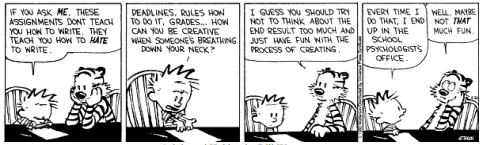
Calvin and Hobbes by Bill Watterson.
Disponível em: https://web.mit.edu/manoli/mood/www/calvin-full.html. Acesso em 27/ 11/2022.)
Text 5 (for question)
Calvin and Hobbes by Bill Watterson.
Disponível em: https://web.mit.edu/manoli/mood/www/calvin-full.html. Acesso em 27/ 11/2022.)
Write the missing words according to the pictures. Then choose the CORRECT sequence of words below.
I. A ________of cards 
II. A _________ of wine 
III. A __________ of biscuits 
IV. A __________ of milk 
V. A __________ of tea 
The sequence that correctly complete the gaps is
Text 4 (for questions 42, 43, 44, 45, and 46)
Social networks
Going into the small room at the end of the corridor, Roberta sat down _______ 1 the computer. It was the computer she had bought when her old one’s hard disk had started to go wrong. Her new computer was a laptop with a lot of extra features and she needed it for her online work _______ 2 her students. Roberta had started to worry that her students would be bored unless she used modern technology in her teaching.
She turned_______ 3 the switch at the back of her computer. She looked at the email messages waiting for her answer, but she ignored them. Then she looked at the homework posted on a special site she created for the students, but she didn’t feel like correcting it. Instead she went to her favorite social network site and looked at the news about her friends. She sent messages to her favorite people and she had many online conversations _______ 4 teaching and other things. She posted some new messages on her own web page and then watched a film clip on a video site which her friend had told her about.
_______ 5 now, it was late and she realized that she had spent too much time talking to her friends online. She was very tired. She would have to do all her work in the morning.
(HARMER, J. Essential Teacher Knowledge: core concepts in English language teaching, p. 42. Harlow: Pearson Education Limited, 2012.
Adaptado.)
“Then she looked at the homework posted on a special site she created for the students, but she didn’t feel like correcting it.”
The phrasal verb underlined in the excerpt can be translated into Portuguese as
Text 4 (for questions 42, 43, 44, 45, and 46)
Social networks
Going into the small room at the end of the corridor, Roberta sat down _______ 1 the computer. It was the computer she had bought when her old one’s hard disk had started to go wrong. Her new computer was a laptop with a lot of extra features and she needed it for her online work _______ 2 her students. Roberta had started to worry that her students would be bored unless she used modern technology in her teaching.
She turned_______ 3 the switch at the back of her computer. She looked at the email messages waiting for her answer, but she ignored them. Then she looked at the homework posted on a special site she created for the students, but she didn’t feel like correcting it. Instead she went to her favorite social network site and looked at the news about her friends. She sent messages to her favorite people and she had many online conversations _______ 4 teaching and other things. She posted some new messages on her own web page and then watched a film clip on a video site which her friend had told her about.
_______ 5 now, it was late and she realized that she had spent too much time talking to her friends online. She was very tired. She would have to do all her work in the morning.
(HARMER, J. Essential Teacher Knowledge: core concepts in English language teaching, p. 42. Harlow: Pearson Education Limited, 2012.
Adaptado.)
As palavras que completam o trecho corretamente são:
Text 4 (for questions 42, 43, 44, 45, and 46)
Social networks
Going into the small room at the end of the corridor, Roberta sat down _______ 1 the computer. It was the computer she had bought when her old one’s hard disk had started to go wrong. Her new computer was a laptop with a lot of extra features and she needed it for her online work _______ 2 her students. Roberta had started to worry that her students would be bored unless she used modern technology in her teaching.
She turned_______ 3 the switch at the back of her computer. She looked at the email messages waiting for her answer, but she ignored them. Then she looked at the homework posted on a special site she created for the students, but she didn’t feel like correcting it. Instead she went to her favorite social network site and looked at the news about her friends. She sent messages to her favorite people and she had many online conversations _______ 4 teaching and other things. She posted some new messages on her own web page and then watched a film clip on a video site which her friend had told her about.
_______ 5 now, it was late and she realized that she had spent too much time talking to her friends online. She was very tired. She would have to do all her work in the morning.
(HARMER, J. Essential Teacher Knowledge: core concepts in English language teaching, p. 42. Harlow: Pearson Education Limited, 2012.
Adaptado.)
Text 4 (for questions 42, 43, 44, 45, and 46)
Social networks
Going into the small room at the end of the corridor, Roberta sat down _______ 1 the computer. It was the computer she had bought when her old one’s hard disk had started to go wrong. Her new computer was a laptop with a lot of extra features and she needed it for her online work _______ 2 her students. Roberta had started to worry that her students would be bored unless she used modern technology in her teaching.
She turned_______ 3 the switch at the back of her computer. She looked at the email messages waiting for her answer, but she ignored them. Then she looked at the homework posted on a special site she created for the students, but she didn’t feel like correcting it. Instead she went to her favorite social network site and looked at the news about her friends. She sent messages to her favorite people and she had many online conversations _______ 4 teaching and other things. She posted some new messages on her own web page and then watched a film clip on a video site which her friend had told her about.
_______ 5 now, it was late and she realized that she had spent too much time talking to her friends online. She was very tired. She would have to do all her work in the morning.
(HARMER, J. Essential Teacher Knowledge: core concepts in English language teaching, p. 42. Harlow: Pearson Education Limited, 2012.
Adaptado.)
Text 4 (for questions 42, 43, 44, 45, and 46)
Social networks
Going into the small room at the end of the corridor, Roberta sat down _______ 1 the computer. It was the computer she had bought when her old one’s hard disk had started to go wrong. Her new computer was a laptop with a lot of extra features and she needed it for her online work _______ 2 her students. Roberta had started to worry that her students would be bored unless she used modern technology in her teaching.
She turned_______ 3 the switch at the back of her computer. She looked at the email messages waiting for her answer, but she ignored them. Then she looked at the homework posted on a special site she created for the students, but she didn’t feel like correcting it. Instead she went to her favorite social network site and looked at the news about her friends. She sent messages to her favorite people and she had many online conversations _______ 4 teaching and other things. She posted some new messages on her own web page and then watched a film clip on a video site which her friend had told her about.
_______ 5 now, it was late and she realized that she had spent too much time talking to her friends online. She was very tired. She would have to do all her work in the morning.
(HARMER, J. Essential Teacher Knowledge: core concepts in English language teaching, p. 42. Harlow: Pearson Education Limited, 2012.
Adaptado.)

 Conheça nossos planos