Questões de Concurso Sobre inglês
Foram encontradas 26.001 questões


(A) The Natural Order hypothesis.
(B) The Affective Filter hypothesis.
(C) The Acquisition-Learning hypothesis
(D) The Monitor hypothesis
(E) The Input hypothesis
( ) This hypothesis reinforces that our ability to produce statements in another language is the result of unconscious knowledge and that conscious knowledge has the function of editing and correcting the output (oral productions).
( ) According to this hypothesis, learners who are poorly motivated, insecure, anxious and with low self-esteem would be prevented from connecting the input with the LAD (Language Acquisition Device).
( ) This hypothesis predicts that there is only one way to acquire the language: understanding messages.
( ) This hypothesis predicts that there are two ways to develop a second language. The first one would be unconscious and the second one would be conscious.
( ) This hypothesis suggests that we acquire the rules of a language regardless of how these rules are taught in the classroom.
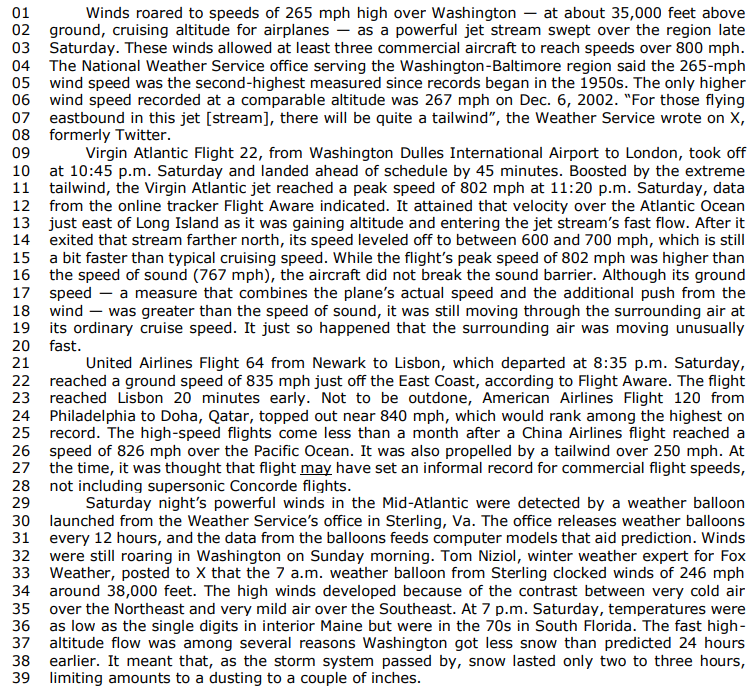
Planes top 800 mph as near-record winds sweep high over Mid-Atlantic
(Available at: www.washingtonpost.com/weather/2024/02/18/record-jet-stream-winds-dc-flights/ – text
specially adapted for this test)
Planes top 800 mph as near-record winds sweep high over Mid-Atlantic
(Available at: www.washingtonpost.com/weather/2024/02/18/record-jet-stream-winds-dc-flights/ – text
specially adapted for this test)
Planes top 800 mph as near-record winds sweep high over Mid-Atlantic
(Available at: www.washingtonpost.com/weather/2024/02/18/record-jet-stream-winds-dc-flights/ – text
specially adapted for this test)
Planes top 800 mph as near-record winds sweep high over Mid-Atlantic
(Available at: www.washingtonpost.com/weather/2024/02/18/record-jet-stream-winds-dc-flights/ – text
specially adapted for this test)
Planes top 800 mph as near-record winds sweep high over Mid-Atlantic
(Available at: www.washingtonpost.com/weather/2024/02/18/record-jet-stream-winds-dc-flights/ – text
specially adapted for this test)
Text CB1A7
Whenever a global economic transformation takes place, a single city usually drives it forward. Ghent, in modern-day Belgium, was at the core of the burgeoning global wool trade in the 13th century. The first initial public offering took place in Amsterdam in 1602. London was the financial centre of the first wave of globalisation during the 19th century. Today the city is San Francisco.
California’s commercial capital has no serious rival in generative artificial intelligence (AI), a breakthrough technology that has caused a bull market in American stocks and which, many economists hope, will power a global productivity surge. Almost all big AI start-up companies are based in the Bay Area, which comprises the city of San Francisco and Silicon Valley (largely based in Santa Clara county, to the south). OpenAI is there, of course; so are Anthropic, Databricks and Scale AI. Tech giants, including Meta and Microsoft, are also spending big on AI in San Francisco. According to Brookings Metro, a think tank, last year San Francisco accounted for close to a tenth of generative AI job postings in America, more than any other city of the country. New York, with four times as many residents, was second.
Internet: <www.economist.com> (adapted).
Text CB1A7
Whenever a global economic transformation takes place, a single city usually drives it forward. Ghent, in modern-day Belgium, was at the core of the burgeoning global wool trade in the 13th century. The first initial public offering took place in Amsterdam in 1602. London was the financial centre of the first wave of globalisation during the 19th century. Today the city is San Francisco.
California’s commercial capital has no serious rival in generative artificial intelligence (AI), a breakthrough technology that has caused a bull market in American stocks and which, many economists hope, will power a global productivity surge. Almost all big AI start-up companies are based in the Bay Area, which comprises the city of San Francisco and Silicon Valley (largely based in Santa Clara county, to the south). OpenAI is there, of course; so are Anthropic, Databricks and Scale AI. Tech giants, including Meta and Microsoft, are also spending big on AI in San Francisco. According to Brookings Metro, a think tank, last year San Francisco accounted for close to a tenth of generative AI job postings in America, more than any other city of the country. New York, with four times as many residents, was second.
Internet: <www.economist.com> (adapted).
Text CB1A7
Whenever a global economic transformation takes place, a single city usually drives it forward. Ghent, in modern-day Belgium, was at the core of the burgeoning global wool trade in the 13th century. The first initial public offering took place in Amsterdam in 1602. London was the financial centre of the first wave of globalisation during the 19th century. Today the city is San Francisco.
California’s commercial capital has no serious rival in generative artificial intelligence (AI), a breakthrough technology that has caused a bull market in American stocks and which, many economists hope, will power a global productivity surge. Almost all big AI start-up companies are based in the Bay Area, which comprises the city of San Francisco and Silicon Valley (largely based in Santa Clara county, to the south). OpenAI is there, of course; so are Anthropic, Databricks and Scale AI. Tech giants, including Meta and Microsoft, are also spending big on AI in San Francisco. According to Brookings Metro, a think tank, last year San Francisco accounted for close to a tenth of generative AI job postings in America, more than any other city of the country. New York, with four times as many residents, was second.
Internet: <www.economist.com> (adapted).
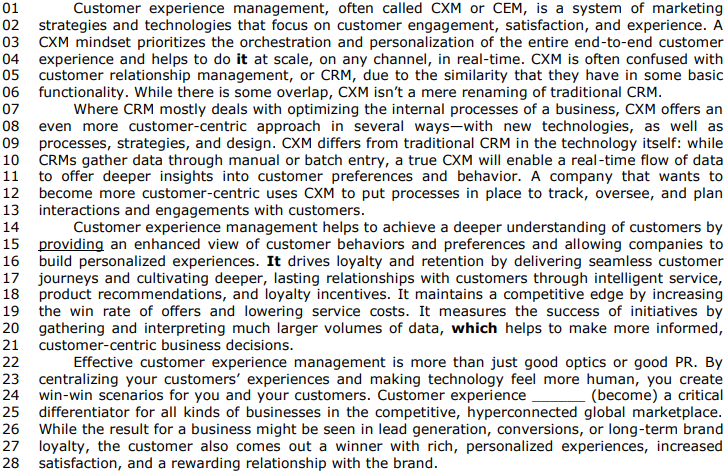
What is customer experience management?
(Available at: www.dynamics.microsoft.com/en-us/marketing/what-is-customer-experience-management-cxm/
– text specially adapted for this test).
What is customer experience management?
(Available at: www.dynamics.microsoft.com/en-us/marketing/what-is-customer-experience-management-cxm/
– text specially adapted for this test).
What is customer experience management?
(Available at: www.dynamics.microsoft.com/en-us/marketing/what-is-customer-experience-management-cxm/
– text specially adapted for this test).

 Conheça nossos planos