Questões de Concurso Sobre inglês
Foram encontradas 26.001 questões


Ano: 2024
Banca:
Ápice Consultoria
Órgão:
Prefeitura de São João do Tigre - PB
Prova:
Ápice Consultoria - 2024 - Prefeitura de São João do Tigre - PB - Professor B - Letras/Inglês |
Q3403865
Inglês
Texto associado
Read Text II for the question:
TEXT II
It’s hard to overstate the benefits of a night’s rest
for human memory, and neuroscientists are just
beginning to understand why.
Jakke Tamminen has plenty of students who
do that very studenty thing of staying up all night right
before an exam, in the hope of stuffing in as much
knowledge as they can. But “that’s the worst thing
you can do”, the psychology lecturer at the UK’s
Royal Holloway University warns them.
He should know. Tamminen is an expert on
how sleep affects memory, specifically the recall
needed for language. Sleep learning – another idea
beloved of students, in the hope that, say, playing
a language-learning recording during sleep would
imprint itself into the brain subliminally and they’d
wake up speaking Latin – is a myth. But sleep itself
is essential for embedding knowledge in the brain,
and the research of Tamminen and others shows us
why that is.
In Tamminen’s ongoing research project,
participants learn new vocabulary, then stay awake
all night.
Tamminen compares their memory of those
words after a few nights, and then after a week.
Even after several nights of recovery sleep, there is a
substantial difference in how quickly they recall those
words compared to the control group of participants
who didn’t face sleep deprivation. “Sleep is really
a central part of learning,” he says. “Even though
you’re not studying when you sleep, your brain is still
studying. It’s almost like it’s working on your behalf.
You can’t really get the full impact of the time you put
into your studies unless you sleep.”
[…]
But more critical to Tamminen’s current
research – and to sleep’s role in language
development more generally – is a non-REM phase
of deep sleep known as slow-wave sleep (SWS).
SWS is important for forming and retaining memories,
whether of vocabulary, grammar, or other knowledge.
The interaction of different parts of the brain is key
here. During SWS, the hippocampus, which is good
at quick learning, is in constant communication with
the neocortex, to consolidate it for long term recall.
So the hippocampus might initially encode
a new word learned earlier that day, but to truly
consolidate that knowledge – spotting patterns and
finding connections with other ideas that allow for
creative problem-solving – the neocortical system
needs to get involved.
This information expressway between the
hippocampus and the neocortex is populated by
sleep spindles – spikes in brain activity that are no
more than three seconds long.
“Sleep spindles are somehow associated with
linking new information with existing information,”
Tamminen says. And the data from his research
participants suggests that people with more sleep
spindles have more consolidation of the words they
have learned.
[…]
Children have more slow-wave sleep than
adults – which may be one factor explaining how
quickly kids learn, in both language and other areas. The child sleep lab at Germany’s University
of Tuebingen investigates the role of sleep in
consolidating children’s memory. Monitoring what
happens in children’s brains during sleep, and
how much information they retain before and after
sleep, shows that sleep helps with accessing implicit
knowledge (procedural memory) and making it
explicit (declarative memory).
“The effects are stronger in early childhood
because the brain is developing,” says Dominique
Petit, the coordinator of the Canadian Sleep and
Circadian Network, who has also explored the
circadian rhythm in children. In practical terms, this
means that “children need to sleep during the day to
remember everything that they have to learn”.
“Daytime naps in young children have
been shown to be really important for vocabulary
growth, generalization of the meaning of words and
abstraction in language learning,” she says. “Sleep
continues to be important for memory and learning
throughout the lifetime, though.”
[…]
Not only does sleep help with accessing this
information, it also changes the way this information
is accessed. This makes brains more flexible at
retrieving information (or able to access it in more
ways).
But it also makes them better at extracting
the most significant parts of it.
“It’s actually an active process of strengthening
and changing the memory trace,” Zinke says.
“Memory gets transferred in a way that the most
important information (the gist) is remembered.”
Clearly, for children as well as adults,
prolonged sleep isn’t a sign of laziness in a language
learner. It’s critical for our brains’ connections and
our bodies’ rhythms.
Available at: https://www.bbc.com/future/
article/20180815-why-sleep-should-be-everystudents-priority (adapted)
What is the main topic of this passage?
Ano: 2024
Banca:
Ápice Consultoria
Órgão:
Prefeitura de São João do Tigre - PB
Prova:
Ápice Consultoria - 2024 - Prefeitura de São João do Tigre - PB - Professor B - Letras/Inglês |
Q3403864
Inglês
Choose the word or phrase that best completes
the sentence:
She is interested in ________ for the new project proposal.
She is interested in ________ for the new project proposal.
Ano: 2024
Banca:
Ápice Consultoria
Órgão:
Prefeitura de São João do Tigre - PB
Prova:
Ápice Consultoria - 2024 - Prefeitura de São João do Tigre - PB - Professor B - Letras/Inglês |
Q3403863
Inglês
Texto associado
Read Text I to answer the question:
TEXT I
“Fundamental breakthroughs in the neurosciences,
combined with technical innovations for measuring
brain activity, are shedding new light on the neural
basis of second language (L2) processing, and
on its relationship to native language processing
(L1). The long-held assumption that L1 and L2 are
necessarily represented in different brain regions in
bilinguals has not been confirmed. On the contrary,
the available evidence indicates that L1 and L2 are
processed by the same neural devices. The neural
differences in L1 and L2 representations are only
related to the specific computational demands, which
vary according to the age of acquisition, the degree of
mastery and the level of exposure to each language.
Finally, the acquisition of L2 could be considered
as a dynamic process, requiring additional neural
resources in specific circumstances.”
Available at: https://www.sciencedirect.com/science/article/abs/pii/S0959438805000395
(adapted)
Identify the underlined word or phrase that needs
to be changed for the sentence to be correct:
The athlete, along with his coach, are planning a rigorous training schedule.
The athlete, along with his coach, are planning a rigorous training schedule.
Ano: 2024
Banca:
Ápice Consultoria
Órgão:
Prefeitura de São João do Tigre - PB
Prova:
Ápice Consultoria - 2024 - Prefeitura de São João do Tigre - PB - Professor B - Letras/Inglês |
Q3403862
Inglês
Texto associado
Read Text I to answer the question:
TEXT I
“Fundamental breakthroughs in the neurosciences,
combined with technical innovations for measuring
brain activity, are shedding new light on the neural
basis of second language (L2) processing, and
on its relationship to native language processing
(L1). The long-held assumption that L1 and L2 are
necessarily represented in different brain regions in
bilinguals has not been confirmed. On the contrary,
the available evidence indicates that L1 and L2 are
processed by the same neural devices. The neural
differences in L1 and L2 representations are only
related to the specific computational demands, which
vary according to the age of acquisition, the degree of
mastery and the level of exposure to each language.
Finally, the acquisition of L2 could be considered
as a dynamic process, requiring additional neural
resources in specific circumstances.”
Available at: https://www.sciencedirect.com/science/article/abs/pii/S0959438805000395
(adapted)
In the passage, the term “neural basis” refers
to:
Ano: 2024
Banca:
Ápice Consultoria
Órgão:
Prefeitura de São João do Tigre - PB
Prova:
Ápice Consultoria - 2024 - Prefeitura de São João do Tigre - PB - Professor B - Letras/Inglês |
Q3403861
Inglês
Texto associado
Read Text I to answer the question:
TEXT I
“Fundamental breakthroughs in the neurosciences,
combined with technical innovations for measuring
brain activity, are shedding new light on the neural
basis of second language (L2) processing, and
on its relationship to native language processing
(L1). The long-held assumption that L1 and L2 are
necessarily represented in different brain regions in
bilinguals has not been confirmed. On the contrary,
the available evidence indicates that L1 and L2 are
processed by the same neural devices. The neural
differences in L1 and L2 representations are only
related to the specific computational demands, which
vary according to the age of acquisition, the degree of
mastery and the level of exposure to each language.
Finally, the acquisition of L2 could be considered
as a dynamic process, requiring additional neural
resources in specific circumstances.”
Available at: https://www.sciencedirect.com/science/article/abs/pii/S0959438805000395
(adapted)
What does the term “breakthroughs” most
closely mean in the context of this text?
Ano: 2024
Banca:
Ápice Consultoria
Órgão:
Prefeitura de São João do Tigre - PB
Prova:
Ápice Consultoria - 2024 - Prefeitura de São João do Tigre - PB - Professor B - Letras/Inglês |
Q3403860
Inglês
Texto associado
Read Text I to answer the question:
TEXT I
“Fundamental breakthroughs in the neurosciences,
combined with technical innovations for measuring
brain activity, are shedding new light on the neural
basis of second language (L2) processing, and
on its relationship to native language processing
(L1). The long-held assumption that L1 and L2 are
necessarily represented in different brain regions in
bilinguals has not been confirmed. On the contrary,
the available evidence indicates that L1 and L2 are
processed by the same neural devices. The neural
differences in L1 and L2 representations are only
related to the specific computational demands, which
vary according to the age of acquisition, the degree of
mastery and the level of exposure to each language.
Finally, the acquisition of L2 could be considered
as a dynamic process, requiring additional neural
resources in specific circumstances.”
Available at: https://www.sciencedirect.com/science/article/abs/pii/S0959438805000395
(adapted)
Considering the extract: “Finally, the acquisition
of L2 could be considered as a dynamic
process, requiring additional neural resources
in specific circumstances” it is CORRECT to
infer that the acquisition of L2 in the text:
Ano: 2024
Banca:
Avança SP
Órgão:
Prefeitura de Caçapava - SP
Prova:
Avança SP - 2024 - Prefeitura de Caçapava - SP - Professor II Substituto - Inglês |
Q3403559
Inglês
“I wish it need not have happened in my time," said Frodo. "So do I," said Gandalf, "and so do all who
live to see such times. But that is not for them to decide. All we have to decide is what to do with the
time that is given us.”
― J.R.R. Tolkien, The Fellowship of the Ring
Based on the premise in the dialogue between Frodo and Gandalf in J.R.R. Tolkien's "The Fellowship of the Ring", which of the following best describes the moral lesson conveyed?
― J.R.R. Tolkien, The Fellowship of the Ring
Based on the premise in the dialogue between Frodo and Gandalf in J.R.R. Tolkien's "The Fellowship of the Ring", which of the following best describes the moral lesson conveyed?
Ano: 2024
Banca:
Avança SP
Órgão:
Prefeitura de Caçapava - SP
Prova:
Avança SP - 2024 - Prefeitura de Caçapava - SP - Professor II Substituto - Inglês |
Q3403558
Inglês
Select the option that completes the dialogue with appropriate vocabulary and syntax:
A: "Could you explain the difference between 'effect' and 'affect'?"
B: "Certainly. ___________ is usually a noun, meaning the result of something, while ___________is a verb meaning to influence something. For example, 'The drug has no known side __________.'
A: "Could you explain the difference between 'effect' and 'affect'?"
B: "Certainly. ___________ is usually a noun, meaning the result of something, while ___________is a verb meaning to influence something. For example, 'The drug has no known side __________.'
Ano: 2024
Banca:
Avança SP
Órgão:
Prefeitura de Caçapava - SP
Prova:
Avança SP - 2024 - Prefeitura de Caçapava - SP - Professor II Substituto - Inglês |
Q3403557
Inglês
In the realm of educational psychology, consider the following statements about learning theories.
I. Constructivism posits that learners construct their own understanding and knowledge of the world, through experiencing things and reflecting on those experiences.
II. Behaviorism asserts that learning is largely invisible, focusing on internal thought processes, and emphasizes how students think and feel about the learning process.
III. Social Learning Theory suggests that people learn from one another, via observation, imitation, and modeling.
Which of the statements above is(are) correctly described?
I. Constructivism posits that learners construct their own understanding and knowledge of the world, through experiencing things and reflecting on those experiences.
II. Behaviorism asserts that learning is largely invisible, focusing on internal thought processes, and emphasizes how students think and feel about the learning process.
III. Social Learning Theory suggests that people learn from one another, via observation, imitation, and modeling.
Which of the statements above is(are) correctly described?
Ano: 2024
Banca:
Avança SP
Órgão:
Prefeitura de Caçapava - SP
Prova:
Avança SP - 2024 - Prefeitura de Caçapava - SP - Professor II Substituto - Inglês |
Q3403556
Inglês
Identify the sentence that correctly uses a third conditional structure, which is used to talk about
impossible past situations and their hypothetical results.
Ano: 2024
Banca:
Avança SP
Órgão:
Prefeitura de Caçapava - SP
Prova:
Avança SP - 2024 - Prefeitura de Caçapava - SP - Professor II Substituto - Inglês |
Q3403555
Inglês
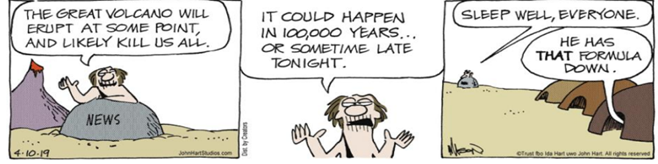
Available at: https://www.gocomics.com/bc/2019/04/10
What does the use of the word "likely" in the phrase "and likely kill us all" suggest about the event's certainty?
Ano: 2024
Banca:
Avança SP
Órgão:
Prefeitura de Caçapava - SP
Prova:
Avança SP - 2024 - Prefeitura de Caçapava - SP - Professor II Substituto - Inglês |
Q3403554
Inglês
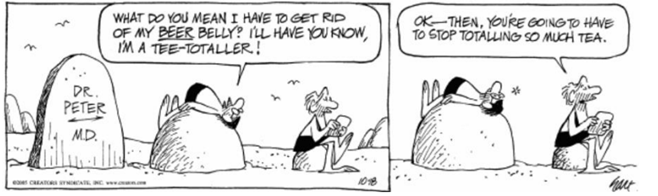
Available at: https://www.gocomics.com/bc/2005/10/18
The comic strip presents a humorous misunderstanding based on the phrase "beer belly". What does the phrasal verb "get rid of" mean in this context?
Ano: 2024
Banca:
Avança SP
Órgão:
Prefeitura de Caçapava - SP
Prova:
Avança SP - 2024 - Prefeitura de Caçapava - SP - Professor II Substituto - Inglês |
Q3403553
Inglês
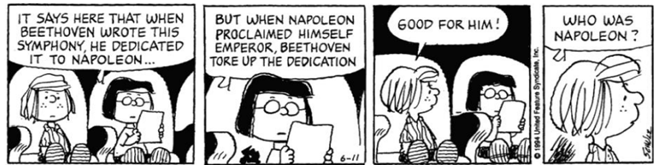
Available at: https://www.gocomics.com/peanuts/1994/06/11
Identify the correct past participle form of the verb used in the second panel "tore up":
Ano: 2024
Banca:
Avança SP
Órgão:
Prefeitura de Caçapava - SP
Prova:
Avança SP - 2024 - Prefeitura de Caçapava - SP - Professor II Substituto - Inglês |
Q3403552
Inglês
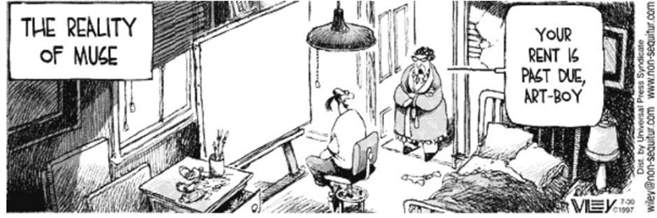
Available at: https://www.gocomics.com/nonsequitur/2001/07/30
Based on the context of the second sentence in the comic strip, what does the phrase "past due" imply?
Ano: 2024
Banca:
Avança SP
Órgão:
Prefeitura de Caçapava - SP
Prova:
Avança SP - 2024 - Prefeitura de Caçapava - SP - Professor II Substituto - Inglês |
Q3403551
Inglês
Identify the sentence that correctly employs the present perfect continuous tense:
Ano: 2024
Banca:
Avança SP
Órgão:
Prefeitura de Caçapava - SP
Prova:
Avança SP - 2024 - Prefeitura de Caçapava - SP - Professor II Substituto - Inglês |
Q3403550
Inglês
Choose the option that correctly fills the gap in the following sentence:
"By the time the conference __________ next month, the new policy __________ effect."
"By the time the conference __________ next month, the new policy __________ effect."
Ano: 2024
Banca:
Avança SP
Órgão:
Prefeitura de Caçapava - SP
Prova:
Avança SP - 2024 - Prefeitura de Caçapava - SP - Professor II Substituto - Inglês |
Q3403549
Inglês
Fill in the blanks with the correct sequence of prepositions:
I - The cat is _______ the table.
II - We will meet you _______ 3 PM.
III - He walked _______ the room to greet his friend.
I - The cat is _______ the table.
II - We will meet you _______ 3 PM.
III - He walked _______ the room to greet his friend.
Ano: 2024
Banca:
Avança SP
Órgão:
Prefeitura de Caçapava - SP
Prova:
Avança SP - 2024 - Prefeitura de Caçapava - SP - Professor II Substituto - Inglês |
Q3403548
Inglês
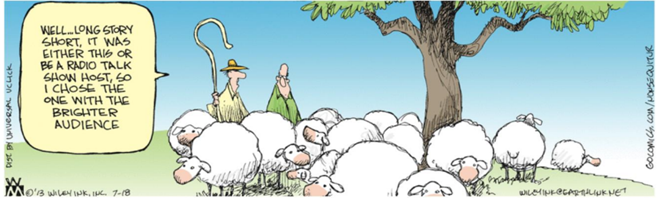
Available at: https://www.gocomics.com/nonsequitur/2013/07/18
What is the underlying reason for the shepherd's comment in the comic?
Ano: 2024
Banca:
Avança SP
Órgão:
Prefeitura de Caçapava - SP
Prova:
Avança SP - 2024 - Prefeitura de Caçapava - SP - Professor II Substituto - Inglês |
Q3403547
Inglês
"This American-born poet, playwright, and literary critic, born at the end of the 19th century, is
considered one of the most significant figures in 20th-century modernist literature. After moving to
England early in his adult life, he became a British citizen in 1927, deeply embedding himself in the
literary scene there. His work is known for its complex symbolism, deep exploration of human despair,
and innovative use of language and form. Perhaps his most famous work is a long poem that presents
a haunting vision of post-World War I society. He was awarded the Nobel Prize in Literature in 1948
for his outstanding, pioneer contribution to present-day poetry. This writer is best known for being a
leader of the Modernist movement in poetry and as the author of such works as The Waste Land (1922)
and Four Quartets (1943)."
About the author described, choose the correct alternative:
About the author described, choose the correct alternative:
Ano: 2024
Banca:
Avança SP
Órgão:
Prefeitura de Caçapava - SP
Prova:
Avança SP - 2024 - Prefeitura de Caçapava - SP - Professor II Substituto - Inglês |
Q3403546
Inglês
“The only artists I have ever known who are personally delightful are bad artists. Good artists exist
simply in what they make, and consequently are perfectly uninteresting in what they are. A great poet,
a really great poet, is the most unpoetical of all creatures. But inferior poets are absolutely fascinating.
The worse their rhymes are, the more picturesque they look. The mere fact of having published a book
of second-rate sonnets makes a man quite irresistible. He lives the poetry that he cannot write. The
others write the poetry that they dare not realize.”
― Oscar Wilde, The Picture of Dorian Gray
In this sentence, the word "consequently" suggests a relationship between the first and the second part of the sentence. What is this relationship?
― Oscar Wilde, The Picture of Dorian Gray
In this sentence, the word "consequently" suggests a relationship between the first and the second part of the sentence. What is this relationship?

 Conheça nossos planos