Questões de Concurso Sobre inglês
Foram encontradas 25.999 questões


Choose the prefix that correctly forms the opposite of the word below.
The opposite of ‘possible’ is ______.
Read the text to answer the question.
A recent Executive Order by President Biden emphasized the link between racial equity, education, and artificial intelligence (AI). It stated that the Federal Government must both pursue educational equity and eliminate bias in the design and use of new technologies, such as AI.
The U.S. Department of Education’s report Advancing Digital Equity for All defines digital equity as the condition in which individuals and technological communities capacity needed have the for full participation in society and the economy.
Concerns about racial equity and bias are central to the debate on AI in education. AI systems rely on datasets, and when these datasets are non-representative or contain biased patterns, the resulting models may behave unfairly. Such systematic unfairness in automated decisions is known as algorithmic bias, which can lead to discrimination and undermine equity at scale.
Bias is intrinsic to how AI algorithms are trained on historical data. When these biases sustain unjust or discriminatory practices in education, they must be identified and addressed. For instance, algorithms used for admissions, early intervention, or exam monitoring should be regularly evaluated for evidence of unfair bias, not only during design but also as they are deployed in real educational contexts.
U.S. Department of Education, Office of Educational
Technology. (2023). Artificial Intelligence and the Future of
Teaching and Learning: Insights and Recommendations.
Washington, DC: U.S.
Read the text to answer the question.
A recent Executive Order by President Biden emphasized the link between racial equity, education, and artificial intelligence (AI). It stated that the Federal Government must both pursue educational equity and eliminate bias in the design and use of new technologies, such as AI.
The U.S. Department of Education’s report Advancing Digital Equity for All defines digital equity as the condition in which individuals and technological communities capacity needed have the for full participation in society and the economy.
Concerns about racial equity and bias are central to the debate on AI in education. AI systems rely on datasets, and when these datasets are non-representative or contain biased patterns, the resulting models may behave unfairly. Such systematic unfairness in automated decisions is known as algorithmic bias, which can lead to discrimination and undermine equity at scale.
Bias is intrinsic to how AI algorithms are trained on historical data. When these biases sustain unjust or discriminatory practices in education, they must be identified and addressed. For instance, algorithms used for admissions, early intervention, or exam monitoring should be regularly evaluated for evidence of unfair bias, not only during design but also as they are deployed in real educational contexts.
U.S. Department of Education, Office of Educational
Technology. (2023). Artificial Intelligence and the Future of
Teaching and Learning: Insights and Recommendations.
Washington, DC: U.S.
Read the text to answer the question.
A recent Executive Order by President Biden emphasized the link between racial equity, education, and artificial intelligence (AI). It stated that the Federal Government must both pursue educational equity and eliminate bias in the design and use of new technologies, such as AI.
The U.S. Department of Education’s report Advancing Digital Equity for All defines digital equity as the condition in which individuals and technological communities capacity needed have the for full participation in society and the economy.
Concerns about racial equity and bias are central to the debate on AI in education. AI systems rely on datasets, and when these datasets are non-representative or contain biased patterns, the resulting models may behave unfairly. Such systematic unfairness in automated decisions is known as algorithmic bias, which can lead to discrimination and undermine equity at scale.
Bias is intrinsic to how AI algorithms are trained on historical data. When these biases sustain unjust or discriminatory practices in education, they must be identified and addressed. For instance, algorithms used for admissions, early intervention, or exam monitoring should be regularly evaluated for evidence of unfair bias, not only during design but also as they are deployed in real educational contexts.
U.S. Department of Education, Office of Educational
Technology. (2023). Artificial Intelligence and the Future of
Teaching and Learning: Insights and Recommendations.
Washington, DC: U.S.
Read the text to answer the question.
A recent Executive Order by President Biden emphasized the link between racial equity, education, and artificial intelligence (AI). It stated that the Federal Government must both pursue educational equity and eliminate bias in the design and use of new technologies, such as AI.
The U.S. Department of Education’s report Advancing Digital Equity for All defines digital equity as the condition in which individuals and technological communities capacity needed have the for full participation in society and the economy.
Concerns about racial equity and bias are central to the debate on AI in education. AI systems rely on datasets, and when these datasets are non-representative or contain biased patterns, the resulting models may behave unfairly. Such systematic unfairness in automated decisions is known as algorithmic bias, which can lead to discrimination and undermine equity at scale.
Bias is intrinsic to how AI algorithms are trained on historical data. When these biases sustain unjust or discriminatory practices in education, they must be identified and addressed. For instance, algorithms used for admissions, early intervention, or exam monitoring should be regularly evaluated for evidence of unfair bias, not only during design but also as they are deployed in real educational contexts.
U.S. Department of Education, Office of Educational
Technology. (2023). Artificial Intelligence and the Future of
Teaching and Learning: Insights and Recommendations.
Washington, DC: U.S.
Read the text to answer the question.
A recent Executive Order by President Biden emphasized the link between racial equity, education, and artificial intelligence (AI). It stated that the Federal Government must both pursue educational equity and eliminate bias in the design and use of new technologies, such as AI.
The U.S. Department of Education’s report Advancing Digital Equity for All defines digital equity as the condition in which individuals and technological communities capacity needed have the for full participation in society and the economy.
Concerns about racial equity and bias are central to the debate on AI in education. AI systems rely on datasets, and when these datasets are non-representative or contain biased patterns, the resulting models may behave unfairly. Such systematic unfairness in automated decisions is known as algorithmic bias, which can lead to discrimination and undermine equity at scale.
Bias is intrinsic to how AI algorithms are trained on historical data. When these biases sustain unjust or discriminatory practices in education, they must be identified and addressed. For instance, algorithms used for admissions, early intervention, or exam monitoring should be regularly evaluated for evidence of unfair bias, not only during design but also as they are deployed in real educational contexts.
U.S. Department of Education, Office of Educational
Technology. (2023). Artificial Intelligence and the Future of
Teaching and Learning: Insights and Recommendations.
Washington, DC: U.S.
Leia o diálogo a seguir.
A: What were you doing yesterday when I called you?
B: I didn’t hear the phone. I was taking a shower.
Com base no diálogo, o tempo verbal da frase “I was taking a shower” expressa o quê em relação à ligação telefônica?
Durante uma atividade de conversação em inglês, os alunos mostram um objeto e dizem:
“This book is mine.”
“Is that pen yours?”
Essa atividade ajuda principalmente os alunos a praticarem
Leia o texto a seguir.
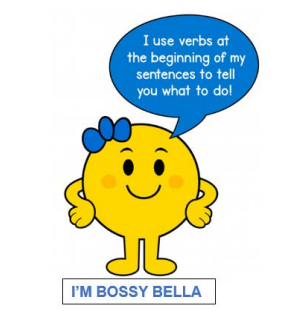
A ilustração apresentada mostra uma atividade de sala de aula que utiliza a personagem Bossy Bella para ajudar os alunos a compreenderem o uso dos verbos para:
Leia o texto a seguir.
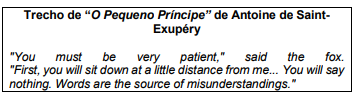
EXUPÉRY, Antoine de Saint-. The Little Prince. New York: Reynal & Hitchcock, 1943. (Tradução livre e adaptação do trecho original.)
No trecho apresentado, o verbo modal must é usado para expressar
Leia o texto a seguir.
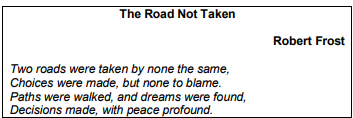
Texto inspirado em FROST, Robert. The Road Not Taken. (1916). [Adaptado].
No trecho apresentado, o uso da Passive Voice (voz passiva) contribui para mostrar que:
Observe a imagem a seguir.

Na frase apresentada, a estrutura had done é formada por

 Conheça nossos planos