Questões de Concurso Sobre inglês
Foram encontradas 25.431 questões


Ano: 2009
Banca:
COSEAC
Órgão:
DATAPREV
Provas:
COSEAC - 2009 - DATAPREV - Analista de Tecnologia da Informação - Ambiente Operacional
|
COSEAC - 2009 - DATAPREV - Analista de Tecnologia da Informação - Banco de Dados |
COSEAC - 2009 - DATAPREV - Analista de Tecnologia da Informação - Desenvolvimento de Sistemas |
COSEAC - 2009 - DATAPREV - Analista de Tecnologia da Informação - Análise de Informações |
Q112897
Inglês
Texto associado
GadgetDesigners Push the Limits of Size, Safety
By Brian X. Chen, August 28, 2008
Just as small, fast-moving mammals replaced lumbering
dinosaurs, pocketable gadgets are evolving to fill niches that
larger, deskbound computers can't reach. But as they shrink,
these gadgets are faced with problems mammals face, too,
such as efficiently dissipating heat.
The recent example of Apple's first-generation iPod nanos
causing fires in Japan raises the question of whether
increasingly innovative product designs are impinging on
safety. The nano incident illustrates how risk can increase as
devices decrease in size, says Roger Kay, an analyst at
EndpointTechnologies.
"As [gadgets] get smaller, the tradeoffs become more difficult,
the balance becomes more critical and there's less room for
error," Kay said. "I'm not surprised it's happening to the nano
because that's the small one. You're asking it to do a lot in a
very, very small package and that's pushing the envelope.”
There's no question that industrial designers' jobs have
become much more difficult as the industry demands ever
more powerful and smaller gadgets. With paper-thin
subnotebooks, ultrasmall MP3 players, and pinkie finger-
sized Bluetooth headsets becoming increasingly popular, it's
questionable where exactly designers draw the line between
innovation and safety.
By Brian X. Chen, August 28, 2008
Just as small, fast-moving mammals replaced lumbering
dinosaurs, pocketable gadgets are evolving to fill niches that
larger, deskbound computers can't reach. But as they shrink,
these gadgets are faced with problems mammals face, too,
such as efficiently dissipating heat.
The recent example of Apple's first-generation iPod nanos
causing fires in Japan raises the question of whether
increasingly innovative product designs are impinging on
safety. The nano incident illustrates how risk can increase as
devices decrease in size, says Roger Kay, an analyst at
EndpointTechnologies.
"As [gadgets] get smaller, the tradeoffs become more difficult,
the balance becomes more critical and there's less room for
error," Kay said. "I'm not surprised it's happening to the nano
because that's the small one. You're asking it to do a lot in a
very, very small package and that's pushing the envelope.”
There's no question that industrial designers' jobs have
become much more difficult as the industry demands ever
more powerful and smaller gadgets. With paper-thin
subnotebooks, ultrasmall MP3 players, and pinkie finger-
sized Bluetooth headsets becoming increasingly popular, it's
questionable where exactly designers draw the line between
innovation and safety.
The title of the text let us know that there must be a close relation between…
Ano: 2009
Banca:
FUNIVERSA
Órgão:
SEPLAG-DF
Provas:
FUNIVERSA - 2009 - SEPLAG-DF - Analista - Planejamento e Orçamento
|
FUNIVERSA - 2009 - SEPLAG-DF - Analista - Tecnologia da Informação |
Q95224
Inglês
Texto associado
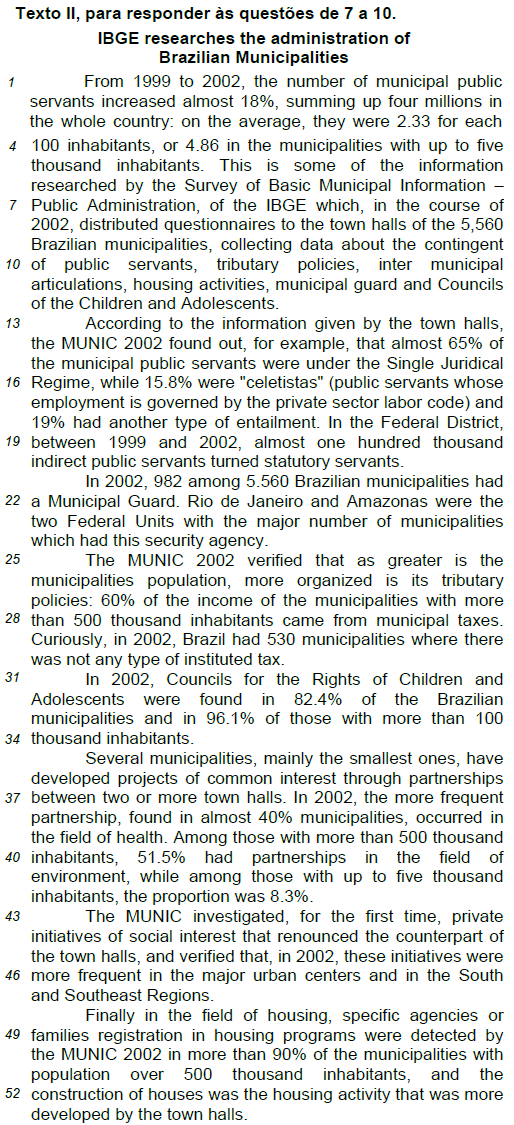
Internet: <http://www.ibge.gov.br/english/presidencia/noticias/noticia_impressao.php?id_noticia=345> (with adaptations).
According to the text II and your background knowledge, which alternative is not a possible definition to “tax”?
Ano: 2009
Banca:
FUNIVERSA
Órgão:
SEPLAG-DF
Provas:
FUNIVERSA - 2009 - SEPLAG-DF - Analista - Planejamento e Orçamento
|
FUNIVERSA - 2009 - SEPLAG-DF - Analista - Tecnologia da Informação |
Q95223
Inglês
Texto associado
Internet: <http://www.ibge.gov.br/english/presidencia/noticias/noticia_impressao.php?id_noticia=345> (with adaptations).
Considering the context, in the sentence “collecting data about the contingent of public servants” the word “data” cannot be understood as a synonym with
Ano: 2009
Banca:
FUNIVERSA
Órgão:
SEPLAG-DF
Provas:
FUNIVERSA - 2009 - SEPLAG-DF - Analista - Planejamento e Orçamento
|
FUNIVERSA - 2009 - SEPLAG-DF - Analista - Tecnologia da Informação |
Q95222
Inglês
Texto associado
Internet: <http://www.ibge.gov.br/english/presidencia/noticias/noticia_impressao.php?id_noticia=345> (with adaptations).
Taking into consideration the pieces of information and numbers provided by the text, mark the incorrect alternative.
Ano: 2009
Banca:
FUNIVERSA
Órgão:
SEPLAG-DF
Provas:
FUNIVERSA - 2009 - SEPLAG-DF - Analista - Planejamento e Orçamento
|
FUNIVERSA - 2009 - SEPLAG-DF - Analista - Tecnologia da Informação |
Q95221
Inglês
Texto associado
Internet: <http://www.ibge.gov.br/english/presidencia/noticias/noticia_impressao.php?id_noticia=345> (with adaptations).
Based on the text II, mark the correct alternative.
Q95206
Inglês
Texto associado
We can help you save energy in the home…
There are lots of things you can do to save energy at home, from simple things like washing at 30 °C, saving water and
recycling, to insulating your loft and cavity walls. By saving energy you’ll be reducing your home’s carbon dioxide ( ) emissions
and helping to fight climate change.
Why should you save energy?
Over 40 per cent of the UK’s man-made emissions actually come from energy we use every day – at home and when
we travel. To generate that energy, we burn fossil fuels (coal, oil and gas) that produce ‘greenhouse’ gases – in particular –
–
which are changing our climate and damaging the environment.
The greenhouse effect
 and various other gases wrap the Earth in an invisible ‘blanket’, helping to prevent heat from escaping. Without this
greenhouse effect, the average temperature on Earth would be around -18 ºC, compared with the current average of around +15
ºC. This blanket of gases has remained at a constant concentration for many thousands of years. Since the Industrial Revolution
began around 200 years ago, people have been burning more fossil fuels. This has increased the heating effect of the ‘blanket’,
trapping more of the sun’s energy inside our atmosphere. In turn the Earth’s temperature has increased more rapidly in a shorter
period of time than it has for thousands of years.
The impact of climate change
People sometimes think that climate change will be a positive thing for the UK, giving us warmer summers and fewer cold
winters. But hotter summers and less rain in the south and east will mean water shortages, forest fires and damage to crops and
wildlife. In the north and west there could be much heavier rain and more flooding. As the polar ice caps continue to melt, rising sea
levels will threaten many coastal communities. Overall, the cost to society, the environment, our health and the economy is likely to
far outweigh any benefits.
Make a difference
The average UK household creates around six tonnes of every year – that’s 6,000 kg – to heat and power their home.
Making your home more energy efficient could save you up to £340 a year and reduce your home’s emissions by up to 1,500–
2,000 kg. You could save even more by switching to renewable energy sources, by walking, cycling or using public transport
whenever possible, and by driving more efficiently.
(Texto introdutório ao manual “A guide to energy saving in the home”, disponível em: http://www.energysavingtrust.org.uk/Resources/Publications.)
There are lots of things you can do to save energy at home, from simple things like washing at 30 °C, saving water and
recycling, to insulating your loft and cavity walls. By saving energy you’ll be reducing your home’s carbon dioxide (
) emissions and helping to fight climate change.
Why should you save energy?
Over 40 per cent of the UK’s man-made
emissions actually come from energy we use every day – at home and when we travel. To generate that energy, we burn fossil fuels (coal, oil and gas) that produce ‘greenhouse’ gases – in particular
– which are changing our climate and damaging the environment.
The greenhouse effect
and various other gases wrap the Earth in an invisible ‘blanket’, helping to prevent heat from escaping. Without this greenhouse effect, the average temperature on Earth would be around -18 ºC, compared with the current average of around +15
ºC. This blanket of gases has remained at a constant concentration for many thousands of years. Since the Industrial Revolution
began around 200 years ago, people have been burning more fossil fuels. This has increased the heating effect of the ‘blanket’,
trapping more of the sun’s energy inside our atmosphere. In turn the Earth’s temperature has increased more rapidly in a shorter
period of time than it has for thousands of years.
The impact of climate change
People sometimes think that climate change will be a positive thing for the UK, giving us warmer summers and fewer cold
winters. But hotter summers and less rain in the south and east will mean water shortages, forest fires and damage to crops and
wildlife. In the north and west there could be much heavier rain and more flooding. As the polar ice caps continue to melt, rising sea
levels will threaten many coastal communities. Overall, the cost to society, the environment, our health and the economy is likely to
far outweigh any benefits.
Make a difference
The average UK household creates around six tonnes of
every year – that’s 6,000 kg – to heat and power their home. Making your home more energy efficient could save you up to £340 a year and reduce your home’s
emissions by up to 1,500–2,000 kg. You could save even more by switching to renewable energy sources, by walking, cycling or using public transport
whenever possible, and by driving more efficiently.
(Texto introdutório ao manual “A guide to energy saving in the home”, disponível em: http://www.energysavingtrust.org.uk/Resources/Publications.)
The sentence “Overall, the cost to society, the environment, our health and the economy is likely to far outweigh any benefits” (paragraph 4) means that:
Q95205
Inglês
Texto associado
We can help you save energy in the home…
There are lots of things you can do to save energy at home, from simple things like washing at 30 °C, saving water and
recycling, to insulating your loft and cavity walls. By saving energy you’ll be reducing your home’s carbon dioxide () emissions
and helping to fight climate change.
Why should you save energy?
Over 40 per cent of the UK’s man-made emissions actually come from energy we use every day – at home and when
we travel. To generate that energy, we burn fossil fuels (coal, oil and gas) that produce ‘greenhouse’ gases – in particular –
which are changing our climate and damaging the environment.
The greenhouse effect
and various other gases wrap the Earth in an invisible ‘blanket’, helping to prevent heat from escaping. Without this
greenhouse effect, the average temperature on Earth would be around -18 ºC, compared with the current average of around +15
ºC. This blanket of gases has remained at a constant concentration for many thousands of years. Since the Industrial Revolution
began around 200 years ago, people have been burning more fossil fuels. This has increased the heating effect of the ‘blanket’,
trapping more of the sun’s energy inside our atmosphere. In turn the Earth’s temperature has increased more rapidly in a shorter
period of time than it has for thousands of years.
The impact of climate change
People sometimes think that climate change will be a positive thing for the UK, giving us warmer summers and fewer cold
winters. But hotter summers and less rain in the south and east will mean water shortages, forest fires and damage to crops and
wildlife. In the north and west there could be much heavier rain and more flooding. As the polar ice caps continue to melt, rising sea
levels will threaten many coastal communities. Overall, the cost to society, the environment, our health and the economy is likely to
far outweigh any benefits.
Make a difference
The average UK household creates around six tonnes of every year – that’s 6,000 kg – to heat and power their home.
Making your home more energy efficient could save you up to £340 a year and reduce your home’s emissions by up to 1,500–
2,000 kg. You could save even more by switching to renewable energy sources, by walking, cycling or using public transport
whenever possible, and by driving more efficiently.
(Texto introdutório ao manual “A guide to energy saving in the home”, disponível em: http://www.energysavingtrust.org.uk/Resources/Publications.)
There are lots of things you can do to save energy at home, from simple things like washing at 30 °C, saving water and
recycling, to insulating your loft and cavity walls. By saving energy you’ll be reducing your home’s carbon dioxide (
) emissions and helping to fight climate change.
Why should you save energy?
Over 40 per cent of the UK’s man-made
emissions actually come from energy we use every day – at home and when we travel. To generate that energy, we burn fossil fuels (coal, oil and gas) that produce ‘greenhouse’ gases – in particular
– which are changing our climate and damaging the environment.
The greenhouse effect
and various other gases wrap the Earth in an invisible ‘blanket’, helping to prevent heat from escaping. Without this greenhouse effect, the average temperature on Earth would be around -18 ºC, compared with the current average of around +15
ºC. This blanket of gases has remained at a constant concentration for many thousands of years. Since the Industrial Revolution
began around 200 years ago, people have been burning more fossil fuels. This has increased the heating effect of the ‘blanket’,
trapping more of the sun’s energy inside our atmosphere. In turn the Earth’s temperature has increased more rapidly in a shorter
period of time than it has for thousands of years.
The impact of climate change
People sometimes think that climate change will be a positive thing for the UK, giving us warmer summers and fewer cold
winters. But hotter summers and less rain in the south and east will mean water shortages, forest fires and damage to crops and
wildlife. In the north and west there could be much heavier rain and more flooding. As the polar ice caps continue to melt, rising sea
levels will threaten many coastal communities. Overall, the cost to society, the environment, our health and the economy is likely to
far outweigh any benefits.
Make a difference
The average UK household creates around six tonnes of
every year – that’s 6,000 kg – to heat and power their home. Making your home more energy efficient could save you up to £340 a year and reduce your home’s
emissions by up to 1,500–2,000 kg. You could save even more by switching to renewable energy sources, by walking, cycling or using public transport
whenever possible, and by driving more efficiently.
(Texto introdutório ao manual “A guide to energy saving in the home”, disponível em: http://www.energysavingtrust.org.uk/Resources/Publications.)
Check the alternative with the item that is NOT mentioned as a cause of greenhouse effect:
Q95204
Inglês
Texto associado
We can help you save energy in the home…
There are lots of things you can do to save energy at home, from simple things like washing at 30 °C, saving water and
recycling, to insulating your loft and cavity walls. By saving energy you’ll be reducing your home’s carbon dioxide () emissions
and helping to fight climate change.
Why should you save energy?
Over 40 per cent of the UK’s man-made emissions actually come from energy we use every day – at home and when
we travel. To generate that energy, we burn fossil fuels (coal, oil and gas) that produce ‘greenhouse’ gases – in particular –
which are changing our climate and damaging the environment.
The greenhouse effect
and various other gases wrap the Earth in an invisible ‘blanket’, helping to prevent heat from escaping. Without this
greenhouse effect, the average temperature on Earth would be around -18 ºC, compared with the current average of around +15
ºC. This blanket of gases has remained at a constant concentration for many thousands of years. Since the Industrial Revolution
began around 200 years ago, people have been burning more fossil fuels. This has increased the heating effect of the ‘blanket’,
trapping more of the sun’s energy inside our atmosphere. In turn the Earth’s temperature has increased more rapidly in a shorter
period of time than it has for thousands of years.
The impact of climate change
People sometimes think that climate change will be a positive thing for the UK, giving us warmer summers and fewer cold
winters. But hotter summers and less rain in the south and east will mean water shortages, forest fires and damage to crops and
wildlife. In the north and west there could be much heavier rain and more flooding. As the polar ice caps continue to melt, rising sea
levels will threaten many coastal communities. Overall, the cost to society, the environment, our health and the economy is likely to
far outweigh any benefits.
Make a difference
The average UK household creates around six tonnes of every year – that’s 6,000 kg – to heat and power their home.
Making your home more energy efficient could save you up to £340 a year and reduce your home’s emissions by up to 1,500–
2,000 kg. You could save even more by switching to renewable energy sources, by walking, cycling or using public transport
whenever possible, and by driving more efficiently.
(Texto introdutório ao manual “A guide to energy saving in the home”, disponível em: http://www.energysavingtrust.org.uk/Resources/Publications.)
There are lots of things you can do to save energy at home, from simple things like washing at 30 °C, saving water and
recycling, to insulating your loft and cavity walls. By saving energy you’ll be reducing your home’s carbon dioxide (
) emissions and helping to fight climate change.
Why should you save energy?
Over 40 per cent of the UK’s man-made
emissions actually come from energy we use every day – at home and when we travel. To generate that energy, we burn fossil fuels (coal, oil and gas) that produce ‘greenhouse’ gases – in particular
– which are changing our climate and damaging the environment.
The greenhouse effect
and various other gases wrap the Earth in an invisible ‘blanket’, helping to prevent heat from escaping. Without this greenhouse effect, the average temperature on Earth would be around -18 ºC, compared with the current average of around +15
ºC. This blanket of gases has remained at a constant concentration for many thousands of years. Since the Industrial Revolution
began around 200 years ago, people have been burning more fossil fuels. This has increased the heating effect of the ‘blanket’,
trapping more of the sun’s energy inside our atmosphere. In turn the Earth’s temperature has increased more rapidly in a shorter
period of time than it has for thousands of years.
The impact of climate change
People sometimes think that climate change will be a positive thing for the UK, giving us warmer summers and fewer cold
winters. But hotter summers and less rain in the south and east will mean water shortages, forest fires and damage to crops and
wildlife. In the north and west there could be much heavier rain and more flooding. As the polar ice caps continue to melt, rising sea
levels will threaten many coastal communities. Overall, the cost to society, the environment, our health and the economy is likely to
far outweigh any benefits.
Make a difference
The average UK household creates around six tonnes of
every year – that’s 6,000 kg – to heat and power their home. Making your home more energy efficient could save you up to £340 a year and reduce your home’s
emissions by up to 1,500–2,000 kg. You could save even more by switching to renewable energy sources, by walking, cycling or using public transport
whenever possible, and by driving more efficiently.
(Texto introdutório ao manual “A guide to energy saving in the home”, disponível em: http://www.energysavingtrust.org.uk/Resources/Publications.)
According to the text, some impacts of climate change in the UK could be:
Q95203
Inglês
Texto associado
We can help you save energy in the home…
There are lots of things you can do to save energy at home, from simple things like washing at 30 °C, saving water and
recycling, to insulating your loft and cavity walls. By saving energy you’ll be reducing your home’s carbon dioxide () emissions
and helping to fight climate change.
Why should you save energy?
Over 40 per cent of the UK’s man-made emissions actually come from energy we use every day – at home and when
we travel. To generate that energy, we burn fossil fuels (coal, oil and gas) that produce ‘greenhouse’ gases – in particular –
which are changing our climate and damaging the environment.
The greenhouse effect
and various other gases wrap the Earth in an invisible ‘blanket’, helping to prevent heat from escaping. Without this
greenhouse effect, the average temperature on Earth would be around -18 ºC, compared with the current average of around +15
ºC. This blanket of gases has remained at a constant concentration for many thousands of years. Since the Industrial Revolution
began around 200 years ago, people have been burning more fossil fuels. This has increased the heating effect of the ‘blanket’,
trapping more of the sun’s energy inside our atmosphere. In turn the Earth’s temperature has increased more rapidly in a shorter
period of time than it has for thousands of years.
The impact of climate change
People sometimes think that climate change will be a positive thing for the UK, giving us warmer summers and fewer cold
winters. But hotter summers and less rain in the south and east will mean water shortages, forest fires and damage to crops and
wildlife. In the north and west there could be much heavier rain and more flooding. As the polar ice caps continue to melt, rising sea
levels will threaten many coastal communities. Overall, the cost to society, the environment, our health and the economy is likely to
far outweigh any benefits.
Make a difference
The average UK household creates around six tonnes of every year – that’s 6,000 kg – to heat and power their home.
Making your home more energy efficient could save you up to £340 a year and reduce your home’s emissions by up to 1,500–
2,000 kg. You could save even more by switching to renewable energy sources, by walking, cycling or using public transport
whenever possible, and by driving more efficiently.
(Texto introdutório ao manual “A guide to energy saving in the home”, disponível em: http://www.energysavingtrust.org.uk/Resources/Publications.)
There are lots of things you can do to save energy at home, from simple things like washing at 30 °C, saving water and
recycling, to insulating your loft and cavity walls. By saving energy you’ll be reducing your home’s carbon dioxide (
) emissions and helping to fight climate change.
Why should you save energy?
Over 40 per cent of the UK’s man-made
emissions actually come from energy we use every day – at home and when we travel. To generate that energy, we burn fossil fuels (coal, oil and gas) that produce ‘greenhouse’ gases – in particular
– which are changing our climate and damaging the environment.
The greenhouse effect
and various other gases wrap the Earth in an invisible ‘blanket’, helping to prevent heat from escaping. Without this greenhouse effect, the average temperature on Earth would be around -18 ºC, compared with the current average of around +15
ºC. This blanket of gases has remained at a constant concentration for many thousands of years. Since the Industrial Revolution
began around 200 years ago, people have been burning more fossil fuels. This has increased the heating effect of the ‘blanket’,
trapping more of the sun’s energy inside our atmosphere. In turn the Earth’s temperature has increased more rapidly in a shorter
period of time than it has for thousands of years.
The impact of climate change
People sometimes think that climate change will be a positive thing for the UK, giving us warmer summers and fewer cold
winters. But hotter summers and less rain in the south and east will mean water shortages, forest fires and damage to crops and
wildlife. In the north and west there could be much heavier rain and more flooding. As the polar ice caps continue to melt, rising sea
levels will threaten many coastal communities. Overall, the cost to society, the environment, our health and the economy is likely to
far outweigh any benefits.
Make a difference
The average UK household creates around six tonnes of
every year – that’s 6,000 kg – to heat and power their home. Making your home more energy efficient could save you up to £340 a year and reduce your home’s
emissions by up to 1,500–2,000 kg. You could save even more by switching to renewable energy sources, by walking, cycling or using public transport
whenever possible, and by driving more efficiently.
(Texto introdutório ao manual “A guide to energy saving in the home”, disponível em: http://www.energysavingtrust.org.uk/Resources/Publications.)
In the sentence “This has increased the heating effect of the ‘blanket’” (paragraph 3), the underlined word refers to the:
Q95202
Inglês
Texto associado
We can help you save energy in the home…
There are lots of things you can do to save energy at home, from simple things like washing at 30 °C, saving water and
recycling, to insulating your loft and cavity walls. By saving energy you’ll be reducing your home’s carbon dioxide () emissions
and helping to fight climate change.
Why should you save energy?
Over 40 per cent of the UK’s man-made emissions actually come from energy we use every day – at home and when
we travel. To generate that energy, we burn fossil fuels (coal, oil and gas) that produce ‘greenhouse’ gases – in particular –
which are changing our climate and damaging the environment.
The greenhouse effect
and various other gases wrap the Earth in an invisible ‘blanket’, helping to prevent heat from escaping. Without this
greenhouse effect, the average temperature on Earth would be around -18 ºC, compared with the current average of around +15
ºC. This blanket of gases has remained at a constant concentration for many thousands of years. Since the Industrial Revolution
began around 200 years ago, people have been burning more fossil fuels. This has increased the heating effect of the ‘blanket’,
trapping more of the sun’s energy inside our atmosphere. In turn the Earth’s temperature has increased more rapidly in a shorter
period of time than it has for thousands of years.
The impact of climate change
People sometimes think that climate change will be a positive thing for the UK, giving us warmer summers and fewer cold
winters. But hotter summers and less rain in the south and east will mean water shortages, forest fires and damage to crops and
wildlife. In the north and west there could be much heavier rain and more flooding. As the polar ice caps continue to melt, rising sea
levels will threaten many coastal communities. Overall, the cost to society, the environment, our health and the economy is likely to
far outweigh any benefits.
Make a difference
The average UK household creates around six tonnes of every year – that’s 6,000 kg – to heat and power their home.
Making your home more energy efficient could save you up to £340 a year and reduce your home’s emissions by up to 1,500–
2,000 kg. You could save even more by switching to renewable energy sources, by walking, cycling or using public transport
whenever possible, and by driving more efficiently.
(Texto introdutório ao manual “A guide to energy saving in the home”, disponível em: http://www.energysavingtrust.org.uk/Resources/Publications.)
There are lots of things you can do to save energy at home, from simple things like washing at 30 °C, saving water and
recycling, to insulating your loft and cavity walls. By saving energy you’ll be reducing your home’s carbon dioxide (
) emissions and helping to fight climate change.
Why should you save energy?
Over 40 per cent of the UK’s man-made
emissions actually come from energy we use every day – at home and when we travel. To generate that energy, we burn fossil fuels (coal, oil and gas) that produce ‘greenhouse’ gases – in particular
– which are changing our climate and damaging the environment.
The greenhouse effect
and various other gases wrap the Earth in an invisible ‘blanket’, helping to prevent heat from escaping. Without this greenhouse effect, the average temperature on Earth would be around -18 ºC, compared with the current average of around +15
ºC. This blanket of gases has remained at a constant concentration for many thousands of years. Since the Industrial Revolution
began around 200 years ago, people have been burning more fossil fuels. This has increased the heating effect of the ‘blanket’,
trapping more of the sun’s energy inside our atmosphere. In turn the Earth’s temperature has increased more rapidly in a shorter
period of time than it has for thousands of years.
The impact of climate change
People sometimes think that climate change will be a positive thing for the UK, giving us warmer summers and fewer cold
winters. But hotter summers and less rain in the south and east will mean water shortages, forest fires and damage to crops and
wildlife. In the north and west there could be much heavier rain and more flooding. As the polar ice caps continue to melt, rising sea
levels will threaten many coastal communities. Overall, the cost to society, the environment, our health and the economy is likely to
far outweigh any benefits.
Make a difference
The average UK household creates around six tonnes of
every year – that’s 6,000 kg – to heat and power their home. Making your home more energy efficient could save you up to £340 a year and reduce your home’s
emissions by up to 1,500–2,000 kg. You could save even more by switching to renewable energy sources, by walking, cycling or using public transport
whenever possible, and by driving more efficiently.
(Texto introdutório ao manual “A guide to energy saving in the home”, disponível em: http://www.energysavingtrust.org.uk/Resources/Publications.)
Before the Industrial Revolution:
Q95201
Inglês
Texto associado
We can help you save energy in the home…
There are lots of things you can do to save energy at home, from simple things like washing at 30 °C, saving water and
recycling, to insulating your loft and cavity walls. By saving energy you’ll be reducing your home’s carbon dioxide () emissions
and helping to fight climate change.
Why should you save energy?
Over 40 per cent of the UK’s man-made emissions actually come from energy we use every day – at home and when
we travel. To generate that energy, we burn fossil fuels (coal, oil and gas) that produce ‘greenhouse’ gases – in particular –
which are changing our climate and damaging the environment.
The greenhouse effect
and various other gases wrap the Earth in an invisible ‘blanket’, helping to prevent heat from escaping. Without this
greenhouse effect, the average temperature on Earth would be around -18 ºC, compared with the current average of around +15
ºC. This blanket of gases has remained at a constant concentration for many thousands of years. Since the Industrial Revolution
began around 200 years ago, people have been burning more fossil fuels. This has increased the heating effect of the ‘blanket’,
trapping more of the sun’s energy inside our atmosphere. In turn the Earth’s temperature has increased more rapidly in a shorter
period of time than it has for thousands of years.
The impact of climate change
People sometimes think that climate change will be a positive thing for the UK, giving us warmer summers and fewer cold
winters. But hotter summers and less rain in the south and east will mean water shortages, forest fires and damage to crops and
wildlife. In the north and west there could be much heavier rain and more flooding. As the polar ice caps continue to melt, rising sea
levels will threaten many coastal communities. Overall, the cost to society, the environment, our health and the economy is likely to
far outweigh any benefits.
Make a difference
The average UK household creates around six tonnes of every year – that’s 6,000 kg – to heat and power their home.
Making your home more energy efficient could save you up to £340 a year and reduce your home’s emissions by up to 1,500–
2,000 kg. You could save even more by switching to renewable energy sources, by walking, cycling or using public transport
whenever possible, and by driving more efficiently.
(Texto introdutório ao manual “A guide to energy saving in the home”, disponível em: http://www.energysavingtrust.org.uk/Resources/Publications.)
There are lots of things you can do to save energy at home, from simple things like washing at 30 °C, saving water and
recycling, to insulating your loft and cavity walls. By saving energy you’ll be reducing your home’s carbon dioxide (
) emissions and helping to fight climate change.
Why should you save energy?
Over 40 per cent of the UK’s man-made
emissions actually come from energy we use every day – at home and when we travel. To generate that energy, we burn fossil fuels (coal, oil and gas) that produce ‘greenhouse’ gases – in particular
– which are changing our climate and damaging the environment.
The greenhouse effect
and various other gases wrap the Earth in an invisible ‘blanket’, helping to prevent heat from escaping. Without this greenhouse effect, the average temperature on Earth would be around -18 ºC, compared with the current average of around +15
ºC. This blanket of gases has remained at a constant concentration for many thousands of years. Since the Industrial Revolution
began around 200 years ago, people have been burning more fossil fuels. This has increased the heating effect of the ‘blanket’,
trapping more of the sun’s energy inside our atmosphere. In turn the Earth’s temperature has increased more rapidly in a shorter
period of time than it has for thousands of years.
The impact of climate change
People sometimes think that climate change will be a positive thing for the UK, giving us warmer summers and fewer cold
winters. But hotter summers and less rain in the south and east will mean water shortages, forest fires and damage to crops and
wildlife. In the north and west there could be much heavier rain and more flooding. As the polar ice caps continue to melt, rising sea
levels will threaten many coastal communities. Overall, the cost to society, the environment, our health and the economy is likely to
far outweigh any benefits.
Make a difference
The average UK household creates around six tonnes of
every year – that’s 6,000 kg – to heat and power their home. Making your home more energy efficient could save you up to £340 a year and reduce your home’s
emissions by up to 1,500–2,000 kg. You could save even more by switching to renewable energy sources, by walking, cycling or using public transport
whenever possible, and by driving more efficiently.
(Texto introdutório ao manual “A guide to energy saving in the home”, disponível em: http://www.energysavingtrust.org.uk/Resources/Publications.)
In the sentence “To generate that energy, we burn fossil fuels…” (paragraph 2), the underlined expression refers to:
Q95200
Inglês
Texto associado
We can help you save energy in the home…
There are lots of things you can do to save energy at home, from simple things like washing at 30 °C, saving water and
recycling, to insulating your loft and cavity walls. By saving energy you’ll be reducing your home’s carbon dioxide () emissions
and helping to fight climate change.
Why should you save energy?
Over 40 per cent of the UK’s man-made emissions actually come from energy we use every day – at home and when
we travel. To generate that energy, we burn fossil fuels (coal, oil and gas) that produce ‘greenhouse’ gases – in particular –
which are changing our climate and damaging the environment.
The greenhouse effect
and various other gases wrap the Earth in an invisible ‘blanket’, helping to prevent heat from escaping. Without this
greenhouse effect, the average temperature on Earth would be around -18 ºC, compared with the current average of around +15
ºC. This blanket of gases has remained at a constant concentration for many thousands of years. Since the Industrial Revolution
began around 200 years ago, people have been burning more fossil fuels. This has increased the heating effect of the ‘blanket’,
trapping more of the sun’s energy inside our atmosphere. In turn the Earth’s temperature has increased more rapidly in a shorter
period of time than it has for thousands of years.
The impact of climate change
People sometimes think that climate change will be a positive thing for the UK, giving us warmer summers and fewer cold
winters. But hotter summers and less rain in the south and east will mean water shortages, forest fires and damage to crops and
wildlife. In the north and west there could be much heavier rain and more flooding. As the polar ice caps continue to melt, rising sea
levels will threaten many coastal communities. Overall, the cost to society, the environment, our health and the economy is likely to
far outweigh any benefits.
Make a difference
The average UK household creates around six tonnes of every year – that’s 6,000 kg – to heat and power their home.
Making your home more energy efficient could save you up to £340 a year and reduce your home’s emissions by up to 1,500–
2,000 kg. You could save even more by switching to renewable energy sources, by walking, cycling or using public transport
whenever possible, and by driving more efficiently.
(Texto introdutório ao manual “A guide to energy saving in the home”, disponível em: http://www.energysavingtrust.org.uk/Resources/Publications.)
There are lots of things you can do to save energy at home, from simple things like washing at 30 °C, saving water and
recycling, to insulating your loft and cavity walls. By saving energy you’ll be reducing your home’s carbon dioxide (
) emissions and helping to fight climate change.
Why should you save energy?
Over 40 per cent of the UK’s man-made
emissions actually come from energy we use every day – at home and when we travel. To generate that energy, we burn fossil fuels (coal, oil and gas) that produce ‘greenhouse’ gases – in particular
– which are changing our climate and damaging the environment.
The greenhouse effect
and various other gases wrap the Earth in an invisible ‘blanket’, helping to prevent heat from escaping. Without this greenhouse effect, the average temperature on Earth would be around -18 ºC, compared with the current average of around +15
ºC. This blanket of gases has remained at a constant concentration for many thousands of years. Since the Industrial Revolution
began around 200 years ago, people have been burning more fossil fuels. This has increased the heating effect of the ‘blanket’,
trapping more of the sun’s energy inside our atmosphere. In turn the Earth’s temperature has increased more rapidly in a shorter
period of time than it has for thousands of years.
The impact of climate change
People sometimes think that climate change will be a positive thing for the UK, giving us warmer summers and fewer cold
winters. But hotter summers and less rain in the south and east will mean water shortages, forest fires and damage to crops and
wildlife. In the north and west there could be much heavier rain and more flooding. As the polar ice caps continue to melt, rising sea
levels will threaten many coastal communities. Overall, the cost to society, the environment, our health and the economy is likely to
far outweigh any benefits.
Make a difference
The average UK household creates around six tonnes of
every year – that’s 6,000 kg – to heat and power their home. Making your home more energy efficient could save you up to £340 a year and reduce your home’s
emissions by up to 1,500–2,000 kg. You could save even more by switching to renewable energy sources, by walking, cycling or using public transport
whenever possible, and by driving more efficiently.
(Texto introdutório ao manual “A guide to energy saving in the home”, disponível em: http://www.energysavingtrust.org.uk/Resources/Publications.)
According to the text, it is important to save energy:
1. because we spend less money.
2. because a great part of the produced by humans is a result of energy used at home and when travelling.
3. because the world does not have enough fossil fuels.
4. because fossil fuels are too expensive.
5. to fight climate change.
Based on the statements above, choose ONE alternative:
1. because we spend less money.
2. because a great part of the
produced by humans is a result of energy used at home and when travelling. 3. because the world does not have enough fossil fuels.
4. because fossil fuels are too expensive.
5. to fight climate change.
Based on the statements above, choose ONE alternative:
Q95199
Inglês
Texto associado
We can help you save energy in the home…
There are lots of things you can do to save energy at home, from simple things like washing at 30 °C, saving water and
recycling, to insulating your loft and cavity walls. By saving energy you’ll be reducing your home’s carbon dioxide () emissions
and helping to fight climate change.
Why should you save energy?
Over 40 per cent of the UK’s man-made emissions actually come from energy we use every day – at home and when
we travel. To generate that energy, we burn fossil fuels (coal, oil and gas) that produce ‘greenhouse’ gases – in particular –
which are changing our climate and damaging the environment.
The greenhouse effect
and various other gases wrap the Earth in an invisible ‘blanket’, helping to prevent heat from escaping. Without this
greenhouse effect, the average temperature on Earth would be around -18 ºC, compared with the current average of around +15
ºC. This blanket of gases has remained at a constant concentration for many thousands of years. Since the Industrial Revolution
began around 200 years ago, people have been burning more fossil fuels. This has increased the heating effect of the ‘blanket’,
trapping more of the sun’s energy inside our atmosphere. In turn the Earth’s temperature has increased more rapidly in a shorter
period of time than it has for thousands of years.
The impact of climate change
People sometimes think that climate change will be a positive thing for the UK, giving us warmer summers and fewer cold
winters. But hotter summers and less rain in the south and east will mean water shortages, forest fires and damage to crops and
wildlife. In the north and west there could be much heavier rain and more flooding. As the polar ice caps continue to melt, rising sea
levels will threaten many coastal communities. Overall, the cost to society, the environment, our health and the economy is likely to
far outweigh any benefits.
Make a difference
The average UK household creates around six tonnes of every year – that’s 6,000 kg – to heat and power their home.
Making your home more energy efficient could save you up to £340 a year and reduce your home’s emissions by up to 1,500–
2,000 kg. You could save even more by switching to renewable energy sources, by walking, cycling or using public transport
whenever possible, and by driving more efficiently.
(Texto introdutório ao manual “A guide to energy saving in the home”, disponível em: http://www.energysavingtrust.org.uk/Resources/Publications.)
There are lots of things you can do to save energy at home, from simple things like washing at 30 °C, saving water and
recycling, to insulating your loft and cavity walls. By saving energy you’ll be reducing your home’s carbon dioxide (
) emissions and helping to fight climate change.
Why should you save energy?
Over 40 per cent of the UK’s man-made
emissions actually come from energy we use every day – at home and when we travel. To generate that energy, we burn fossil fuels (coal, oil and gas) that produce ‘greenhouse’ gases – in particular
– which are changing our climate and damaging the environment.
The greenhouse effect
and various other gases wrap the Earth in an invisible ‘blanket’, helping to prevent heat from escaping. Without this greenhouse effect, the average temperature on Earth would be around -18 ºC, compared with the current average of around +15
ºC. This blanket of gases has remained at a constant concentration for many thousands of years. Since the Industrial Revolution
began around 200 years ago, people have been burning more fossil fuels. This has increased the heating effect of the ‘blanket’,
trapping more of the sun’s energy inside our atmosphere. In turn the Earth’s temperature has increased more rapidly in a shorter
period of time than it has for thousands of years.
The impact of climate change
People sometimes think that climate change will be a positive thing for the UK, giving us warmer summers and fewer cold
winters. But hotter summers and less rain in the south and east will mean water shortages, forest fires and damage to crops and
wildlife. In the north and west there could be much heavier rain and more flooding. As the polar ice caps continue to melt, rising sea
levels will threaten many coastal communities. Overall, the cost to society, the environment, our health and the economy is likely to
far outweigh any benefits.
Make a difference
The average UK household creates around six tonnes of
every year – that’s 6,000 kg – to heat and power their home. Making your home more energy efficient could save you up to £340 a year and reduce your home’s
emissions by up to 1,500–2,000 kg. You could save even more by switching to renewable energy sources, by walking, cycling or using public transport
whenever possible, and by driving more efficiently.
(Texto introdutório ao manual “A guide to energy saving in the home”, disponível em: http://www.energysavingtrust.org.uk/Resources/Publications.)
The main idea of the text is:
Ano: 2009
Banca:
FUNIVERSA
Órgão:
IPHAN
Provas:
FUNIVERSA - 2009 - IPHAN - Analista - Contabilidade
|
FUNIVERSA - 2009 - IPHAN - Analista - Tecnologia da Informação |
FUNIVERSA - 2009 - IPHAN - Técnico - Arquitetura e Urbanismo |
FUNIVERSA - 2009 - IPHAN - Técnico - Engenharia Civil |
Q94522
Inglês


The text IV deals with
Ano: 2009
Banca:
FUNIVERSA
Órgão:
IPHAN
Provas:
FUNIVERSA - 2009 - IPHAN - Analista - Contabilidade
|
FUNIVERSA - 2009 - IPHAN - Analista - Tecnologia da Informação |
FUNIVERSA - 2009 - IPHAN - Técnico - Arquitetura e Urbanismo |
FUNIVERSA - 2009 - IPHAN - Técnico - Engenharia Civil |
Q94521
Inglês
Based on the text IV, mark the correct alternative.
Ano: 2009
Banca:
FUNIVERSA
Órgão:
IPHAN
Provas:
FUNIVERSA - 2009 - IPHAN - Analista - Contabilidade
|
FUNIVERSA - 2009 - IPHAN - Analista - Tecnologia da Informação |
FUNIVERSA - 2009 - IPHAN - Técnico - Arquitetura e Urbanismo |
FUNIVERSA - 2009 - IPHAN - Técnico - Engenharia Civil |
Q94520
Inglês
According to the text IV, mark the correct alternative.
Q77869
Inglês
Texto associado
Para responder às questões de números 46 a 50, considere o texto abaixo.


Segundo o texto, os dois candidatos à presidência dos Estados Unidos têm pontos de vista divergentes em relação
Q77868
Inglês
Texto associado
Para responder às questões de números 46 a 50, considere o texto abaixo.
O trecho American leadership has been sorely lacking for the past eight years significa que a liderança americana
Q77867
Inglês
Texto associado
Para responder às questões de números 46 a 50, considere o texto abaixo.
According to the text,
Q77866
Inglês
Texto associado
Para responder às questões de números 46 a 50, considere o texto abaixo.
Segundo o texto,

 Conheça nossos planos