Questões de Concurso Comentadas sobre inglês
Foram encontradas 19.377 questões


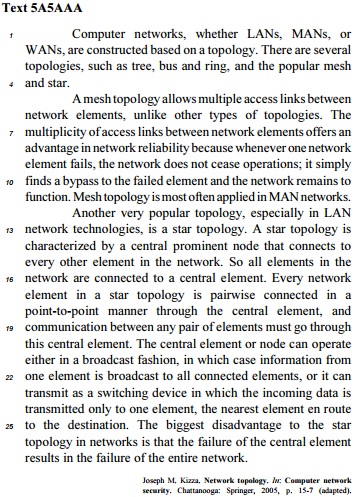
In the text 5A5AAA,
“en route” ( .24) can be replaced by on the way without any
change in the meaning of the sentence.
.24) can be replaced by on the way without any
change in the meaning of the sentence.
In the text 5A5AAA,
“it” ( .9) refers to “network element” (
 . 8 and 9).
Judge the following item according to text 5A5AAA.
Star topologies have a leading node connecting network
elements discretely.
Judge the following item according to text 5A5AAA.
Having many access links makes a network more trustworthy compared to other kinds of networks.Judge the following item according to text 5A5AAA.
Mesh topologies differ from others because the failure of the central element results in the failure of the whole network.Atenção: Para responder à questão, considere o texto abaixo.
The sole proprietor of a plumbing shop was sentenced to 13 months in prison, three years of supervised release for tax evasion and ordered to pay approximately $130,000 in restitution to the IRS. The business owner willfully attempted to evade paying his federal income taxes by skimming gross receipts of his plumbing business and paying personal expenses from his business accounts and claiming them as business expenses.
As part of his tax evasion scheme, he instructed several of his employees to solicit checks from clients payable in his name, rather than in the name of the business. He then cashed these checks and did not deposit the monies into his business’ bank account. Since this money was not recorded on the books of the business, nor deposited into the business’ account, he did not include these gross receipts on his income tax return. He also deducted personal expenses as business expenses thereby substantially reducing his tax for tax years 2003 through 2006.
(Adapted from http://www.bizfilings.com/toolkit/sbg/tax-info/fed-taxes/tax-avoidance-and-tax-evasion.aspx)
Atenção: Para responder à questão, considere o texto abaixo.
The sole proprietor of a plumbing shop was sentenced to 13 months in prison, three years of supervised release for tax evasion and ordered to pay approximately $130,000 in restitution to the IRS. The business owner willfully attempted to evade paying his federal income taxes by skimming gross receipts of his plumbing business and paying personal expenses from his business accounts and claiming them as business expenses.
As part of his tax evasion scheme, he instructed several of his employees to solicit checks from clients payable in his name, rather than in the name of the business. He then cashed these checks and did not deposit the monies into his business’ bank account. Since this money was not recorded on the books of the business, nor deposited into the business’ account, he did not include these gross receipts on his income tax return. He also deducted personal expenses as business expenses thereby substantially reducing his tax for tax years 2003 through 2006.
(Adapted from http://www.bizfilings.com/toolkit/sbg/tax-info/fed-taxes/tax-avoidance-and-tax-evasion.aspx)
Atenção: Para responder à questão, considere o texto abaixo.
The sole proprietor of a plumbing shop was sentenced to 13 months in prison, three years of supervised release for tax evasion and ordered to pay approximately $130,000 in restitution to the IRS. The business owner willfully attempted to evade paying his federal income taxes by skimming gross receipts of his plumbing business and paying personal expenses from his business accounts and claiming them as business expenses.
As part of his tax evasion scheme, he instructed several of his employees to solicit checks from clients payable in his name, rather than in the name of the business. He then cashed these checks and did not deposit the monies into his business’ bank account. Since this money was not recorded on the books of the business, nor deposited into the business’ account, he did not include these gross receipts on his income tax return. He also deducted personal expenses as business expenses thereby substantially reducing his tax for tax years 2003 through 2006.
(Adapted from http://www.bizfilings.com/toolkit/sbg/tax-info/fed-taxes/tax-avoidance-and-tax-evasion.aspx)
Atenção: Para responder à questão, considere o texto abaixo.
The sole proprietor of a plumbing shop was sentenced to 13 months in prison, three years of supervised release for tax evasion and ordered to pay approximately $130,000 in restitution to the IRS. The business owner willfully attempted to evade paying his federal income taxes by skimming gross receipts of his plumbing business and paying personal expenses from his business accounts and claiming them as business expenses.
As part of his tax evasion scheme, he instructed several of his employees to solicit checks from clients payable in his name, rather than in the name of the business. He then cashed these checks and did not deposit the monies into his business’ bank account. Since this money was not recorded on the books of the business, nor deposited into the business’ account, he did not include these gross receipts on his income tax return. He also deducted personal expenses as business expenses thereby substantially reducing his tax for tax years 2003 through 2006.
(Adapted from http://www.bizfilings.com/toolkit/sbg/tax-info/fed-taxes/tax-avoidance-and-tax-evasion.aspx)
Atenção: Para responder à questão, considere o texto abaixo.
In the United States of America, an income tax audit is the examination of a business or individual tax return by the Internal Revenue Service (IRS) or state tax authority. The IRS and various state revenue departments use the terms audit, examination, review, and notice to describe various aspects of enforcement and administration of the tax laws.
The purpose of a tax audit or a return examination is to determine  reports filed with the taxing authorities are correct. The
tax agencies identify and resolve taxpayer errors.
reports filed with the taxing authorities are correct. The
tax agencies identify and resolve taxpayer errors.
There are several different methods used to select individuals and businesses for examination.
Employers and financial institutions, among other organizations, are required by law to send documentation (W-2's and 1099's, for example) to the IRS. The IRS uses software to ensure that the numbers on a tax return match the numbers the IRS receives from third parties. If the documentation does not match, the return may be examined.
When a tax return is filed, the IRS uses computer software called the Discriminant Index Function System (DIF) to analyze the return for oddities and discrepancies. Once the return has been processed through DIF, it is given a score. If the DIF score is high enough (i.e. a large amount of oddities or discrepancies are found), that tax return may be selected for examination. The formulas the IRS use to create the DIF software and analysis are a closely guarded secret.
Filed tax returns are also subjected to an evaluation called the UIDIF, or the Unreported Income Discriminant Function System. This evaluation involves the analysis of tax returns based on a series of factors to determine a tax return's potential for unreported income. Returns that are found to have a high UIDIF score (i.e. the likelihood of unreported income) and a high DIF score may be selected for examination. The IRS formulas used to calculate UDIF are secret, but it is commonly thought that the IRS uses statistical comparisons between returns to determine UIDIF potential.
The IRS selects a certain amount of income tax returns to be audited each year through random selection. No errors need to be found for the Enforcement branch to examine a tax return. Random selection exams tend to be more extensive and time-consuming than other forms of review.
The practice of random selection has been a source of controversy for many years. The practice was suspended for a short time in the early 2000s amid criticism that the audits were too burdensome and intrusive. The IRS revived the practice in the fall of 2006.
(Adapted from https://en.wikipedia.org/wiki/Income_tax_audit)
Atenção: Para responder à questão, considere o texto abaixo.
In the United States of America, an income tax audit is the examination of a business or individual tax return by the Internal Revenue Service (IRS) or state tax authority. The IRS and various state revenue departments use the terms audit, examination, review, and notice to describe various aspects of enforcement and administration of the tax laws.
The purpose of a tax audit or a return examination is to determine reports filed with the taxing authorities are correct. The
tax agencies identify and resolve taxpayer errors.
There are several different methods used to select individuals and businesses for examination.
Employers and financial institutions, among other organizations, are required by law to send documentation (W-2's and 1099's, for example) to the IRS. The IRS uses software to ensure that the numbers on a tax return match the numbers the IRS receives from third parties. If the documentation does not match, the return may be examined.
When a tax return is filed, the IRS uses computer software called the Discriminant Index Function System (DIF) to analyze the return for oddities and discrepancies. Once the return has been processed through DIF, it is given a score. If the DIF score is high enough (i.e. a large amount of oddities or discrepancies are found), that tax return may be selected for examination. The formulas the IRS use to create the DIF software and analysis are a closely guarded secret.
Filed tax returns are also subjected to an evaluation called the UIDIF, or the Unreported Income Discriminant Function System. This evaluation involves the analysis of tax returns based on a series of factors to determine a tax return's potential for unreported income. Returns that are found to have a high UIDIF score (i.e. the likelihood of unreported income) and a high DIF score may be selected for examination. The IRS formulas used to calculate UDIF are secret, but it is commonly thought that the IRS uses statistical comparisons between returns to determine UIDIF potential.
The IRS selects a certain amount of income tax returns to be audited each year through random selection. No errors need to be found for the Enforcement branch to examine a tax return. Random selection exams tend to be more extensive and time-consuming than other forms of review.
The practice of random selection has been a source of controversy for many years. The practice was suspended for a short time in the early 2000s amid criticism that the audits were too burdensome and intrusive. The IRS revived the practice in the fall of 2006.
(Adapted from https://en.wikipedia.org/wiki/Income_tax_audit)
Atenção: Para responder à questão, considere o texto abaixo.
In the United States of America, an income tax audit is the examination of a business or individual tax return by the Internal Revenue Service (IRS) or state tax authority. The IRS and various state revenue departments use the terms audit, examination, review, and notice to describe various aspects of enforcement and administration of the tax laws.
The purpose of a tax audit or a return examination is to determine reports filed with the taxing authorities are correct. The
tax agencies identify and resolve taxpayer errors.
There are several different methods used to select individuals and businesses for examination.
Employers and financial institutions, among other organizations, are required by law to send documentation (W-2's and 1099's, for example) to the IRS. The IRS uses software to ensure that the numbers on a tax return match the numbers the IRS receives from third parties. If the documentation does not match, the return may be examined.
When a tax return is filed, the IRS uses computer software called the Discriminant Index Function System (DIF) to analyze the return for oddities and discrepancies. Once the return has been processed through DIF, it is given a score. If the DIF score is high enough (i.e. a large amount of oddities or discrepancies are found), that tax return may be selected for examination. The formulas the IRS use to create the DIF software and analysis are a closely guarded secret.
Filed tax returns are also subjected to an evaluation called the UIDIF, or the Unreported Income Discriminant Function System. This evaluation involves the analysis of tax returns based on a series of factors to determine a tax return's potential for unreported income. Returns that are found to have a high UIDIF score (i.e. the likelihood of unreported income) and a high DIF score may be selected for examination. The IRS formulas used to calculate UDIF are secret, but it is commonly thought that the IRS uses statistical comparisons between returns to determine UIDIF potential.
The IRS selects a certain amount of income tax returns to be audited each year through random selection. No errors need to be found for the Enforcement branch to examine a tax return. Random selection exams tend to be more extensive and time-consuming than other forms of review.
The practice of random selection has been a source of controversy for many years. The practice was suspended for a short time in the early 2000s amid criticism that the audits were too burdensome and intrusive. The IRS revived the practice in the fall of 2006.
(Adapted from https://en.wikipedia.org/wiki/Income_tax_audit)
Atenção: Para responder à questão, considere o texto abaixo.
In the United States of America, an income tax audit is the examination of a business or individual tax return by the Internal Revenue Service (IRS) or state tax authority. The IRS and various state revenue departments use the terms audit, examination, review, and notice to describe various aspects of enforcement and administration of the tax laws.
The purpose of a tax audit or a return examination is to determine reports filed with the taxing authorities are correct. The
tax agencies identify and resolve taxpayer errors.
There are several different methods used to select individuals and businesses for examination.
Employers and financial institutions, among other organizations, are required by law to send documentation (W-2's and 1099's, for example) to the IRS. The IRS uses software to ensure that the numbers on a tax return match the numbers the IRS receives from third parties. If the documentation does not match, the return may be examined.
When a tax return is filed, the IRS uses computer software called the Discriminant Index Function System (DIF) to analyze the return for oddities and discrepancies. Once the return has been processed through DIF, it is given a score. If the DIF score is high enough (i.e. a large amount of oddities or discrepancies are found), that tax return may be selected for examination. The formulas the IRS use to create the DIF software and analysis are a closely guarded secret.
Filed tax returns are also subjected to an evaluation called the UIDIF, or the Unreported Income Discriminant Function System. This evaluation involves the analysis of tax returns based on a series of factors to determine a tax return's potential for unreported income. Returns that are found to have a high UIDIF score (i.e. the likelihood of unreported income) and a high DIF score may be selected for examination. The IRS formulas used to calculate UDIF are secret, but it is commonly thought that the IRS uses statistical comparisons between returns to determine UIDIF potential.
The IRS selects a certain amount of income tax returns to be audited each year through random selection. No errors need to be found for the Enforcement branch to examine a tax return. Random selection exams tend to be more extensive and time-consuming than other forms of review.
The practice of random selection has been a source of controversy for many years. The practice was suspended for a short time in the early 2000s amid criticism that the audits were too burdensome and intrusive. The IRS revived the practice in the fall of 2006.
(Adapted from https://en.wikipedia.org/wiki/Income_tax_audit)
 é
é 
 Conheça nossos planos