Questões de Concurso Comentadas sobre inglês
Foram encontradas 19.378 questões


Considering the ideas and the vocabulary presented in the text, mark the following items as right (C) or wrong (E).
Although conceived by a few local intellectuals and
elite members, Dutch culture exerted an appeal over
the rest of the country because the latter saw
themselves reflected by those artistic expressions.
Considering the ideas and the vocabulary presented in the text, mark the following items as right (C) or wrong (E).
The text admits that Dutch culture, understood as
“collective ways of seeing themselves, and the world
beyond”, in lines 5 and 6, was a conscious invention.
Considering the ideas and the vocabulary presented in the text, mark the following items as right (C) or wrong (E).
In line 9, the expression “propertied nation” refers to
the sovereignty of the Dutch nation.
Considering the ideas and the vocabulary presented in the text, mark the following items as right (C) or wrong (E).
The feeling that Dutch of all social conditions were
part of a common group, whose experience was
expressed by a common culture, was compromised by
the participation in war and by the burden of taxes
imposed by the Dutch government.
Considering the ideas and the vocabulary presented in the text, mark the following items as right (C) or wrong (E).
The text argues that the artistic expressions associated
with Dutch culture would have been a transient
phenomenon had it not been embraced by the non-elite
Dutch people.
Considering the ideas and the vocabulary presented in the text, mark the following items as right (C) or wrong (E).
In line 34, the word “allegiance” could be replaced
with loyalty without changing the meaning of the
sentence.
Considering the ideas and the vocabulary presented in the text, mark the following items as right (C) or wrong (E).
Dutch paintings depicting noble and common people
alongside in the winter reflected the consciously
invented vision of how the possessing classes wished
life in the Netherlands to be.
Considering the ideas and the vocabulary presented in the text, mark the following items as right (C) or wrong (E).
In line 21, the word “fancy” could be replaced with
whim without changing the meaning of the sentence.
( ) Unlike a computer, it is hard for our brain to classify objects according to a specific purpose.
( ) The author rules out the possibility that computers may emulate the human brain someday.
( ) The brain adapts as one both matures and becomes more knowledgeable.
The statements are, respectively:
Text for the items from.
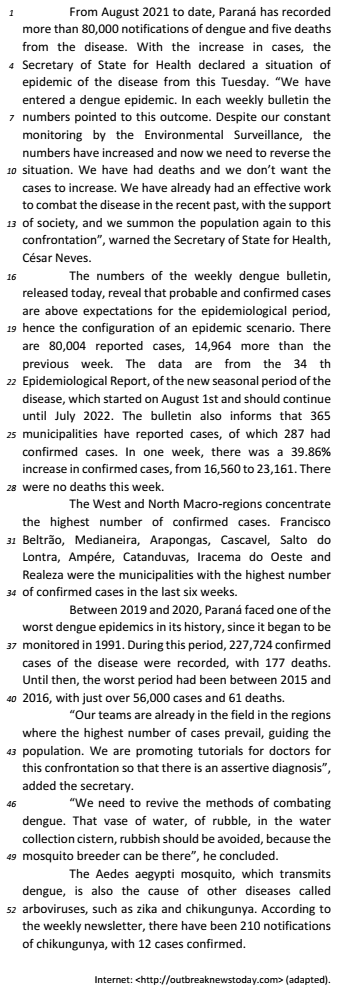
Judge the items from.
There were 61 deaths registered this week.
Text for the items from.
Judge the items from.
Dengue epidemics started to be monitored in the early 90s.
Text for the items from.
Judge the items from.
Tuesday (line 5) is a day of the week and it is the day after
Friday.
Text for the items from.
Judge the items from.
Arboviruses is the name of other diseases caused by
Aedes aegypti mosquito.
Text for the items from.
Judge the items from.
The government is not taking any precautions to combat
the dengue mosquito.
Text for the items from.
Judge the items from.
There are examples of the present simple and present
perfect in the following sentence: “The bulletin also
informs that 365 municipalities have reported cases, of
which 287 had confirmed cases” (lines from 24 to 26).
Text for the items from.
It would be grammatically correct and it would not change the meaning of the sentence if the preposition “above” was replaced by the preposition below in the sentence: The numbers of the weekly dengue bulletin, released today, reveal that probable and confirmed cases are below expectations for the epidemiological period.

 Conheça nossos planos