Questões de Concurso Comentadas sobre inglês
Foram encontradas 19.378 questões


Electrophysiology’s labs are always setup based on the same three main elements.
The term “however” (line 13) is an adverb and it means that something can be done in whatever way or manner.
The word “Occasionally” (line 17) is an adverbial adjunction which means that an action frequently happens within a short period of time.
The pronoun “their” (line 4) refers to “the molecular and cellular processes” (line 3).
The relative pronoun “that” (line 2) could be correctly replaced by which, without a change in meaning.

The sentence “regardless of education levels” (line 4) can be correctly rewritten as despite of education levels, without a change in meaning.
The term “resilient”, as used in line 13, means to be able to withstand adverse or challenging circumstances.
The term “who” (line 8) is a relative pronoun, as well as whom, which is the object form of who.
The term “can” (line 6), as a modal verb, changes the meaning of the whole sentence, not only the meaning of the main verb.
The expression “due to” (line 11) is used to introduce a cause to a situation previously mentioned.
The term “stall” (line 6) could be correctly replaced with stop, without this changing the meaning of the text.
The term “furthering” (line 2) is the Present Participle form of further and it is related to distance, since further is the comparative form of the adjective far.
In line 11, “has been” is an example of the Present Perfect tense, which is formed by the Present Simple form of the verb to have and the Present Perfect form of the main verb.
The text states that speaking one more language may lower the rates of dementia and memory problems in more advanced ages.
According to the text, people who learn a new language are free from developing mental diseases.
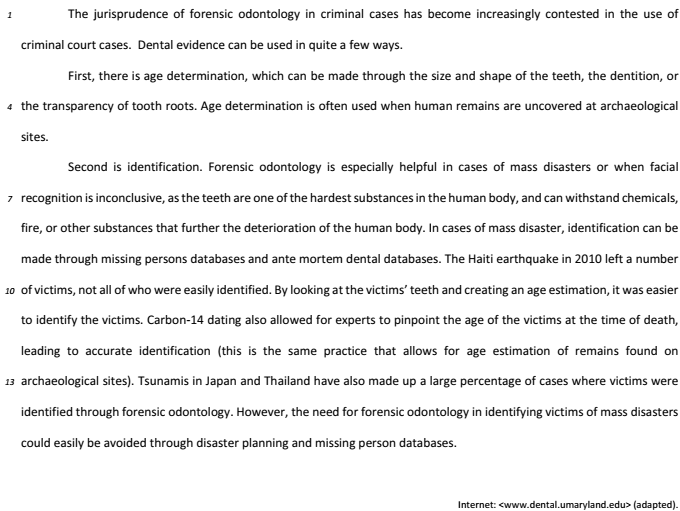
According to the text, judge the item.
The terms “especially” (line 6), “inconclusive” (line 7) and “substances” (line 7) are Portuguese false cognates.
According to the text, judge the item.
Without changing the meaning of the text, the term “which” (line 3) could be correctly replace by that, and the term
“that” (line 12) could be correctly replaced by which.
According to the text, judge the item.
The terms “easier” (line 10) and “further” (line 8) belong to the same word class: they are both examples of adjectives.
According to the text, judge the item.
The term “could” (line 15) is the past tense of can.
According to the text, judge the item.
Forensic odontology can determine the age and gender of a person based on the size and the shape of the teeth, while Carbon-14 dating determines the time of death.

 Conheça nossos planos