Questões de Concurso Comentadas sobre inglês
Foram encontradas 19.378 questões


I. Citing the example of 'The American dream' as an American cultural aspect is essential to an intercultural approach to English learning using the text as the basis.
II. Only when comparing Japanese, British and South African heroes in paragraph 3, the text moves into intercultural aspects of storytelling.
Choose the CORRECT answer:
I. In the sentence: 'Wow, this feels so Japanese', the word Japanese does not act as an adjective, since it's a nationality.
II. In the sentence: 'Maybe you’re familiar with "The American Dream", there's only one adjective, 'familiar'.
III. In the sentence: 'In Britain, heroes are often characterized by their honor, chivalry, and intelligence.', honor, chivalry and intelligence act as adjectives that describe heroes.
Choose the CORRECT answer:
I. Asking students to identify and discuss who their favorite heroes are and what makes them 'so Brazilian' in Portuguese is a way of valuing students' previous knowledge on the text's theme.
II. Asking students to look at pictures of Brazilian movies' protagonists/heroes and create sentences describing their physical appearance is a way of valuing students' cultural knowledge on the text's theme.
Choose the CORRECT answer:
Text 3
Benefits of a Bilingual Brain
¹ Language ability is typically measured in two active parts, speaking and writing, and two passive parts, listening and reading. While a balanced bilingual has near equal abilities in two languages, most bilinguals around the world know and use their languages in varying proportions. But recent advances in brain imaging technology have given neurolinguists a glimpse into how specific aspects of language learning affect the bilingual brain.
² It's well known that the brain's left hemisphere is more dominant and analytical in logical processes, while the right hemisphere is more active in emotional and social ones, though this is a matter of degree, not an absolute split. The fact that language involves both types of functions has led to the critical period hypothesis. According to this theory, children learn languages more easily because the plasticity of their developing brains lets them use both hemispheres in language acquisition, while in most adults, language is lateralized to one hemisphere, usually the left. If this is true, learning a language in childhood may give you a more holistic grasp of its social and emotional contexts.
³ Conversely, recent research showed that people who learned a second language in adulthood exhibit less emotional bias and a more rational approach when confronting problems in the second language than in their native one. But regardless of when you acquire additional languages, being multilingual gives your brain some remarkable advantages, such as higher density of the grey matter that contains most of your brain's neurons and synapses, and more activity in certain regions when engaging a second language. The strong workout a bilingual brain receives throughout its life can also help delay the onset of diseases, like Alzheimer's and dementia by as much as five years.
Source: Adapted from “Benefits of a bilingual brain” (Video),
by Mia Nacamuli for TED-ed, 2015. Available on:
https://www.youtube.com/watch?v=MMmOLN5zBLY with
subtitles.
I. In: "It is impossible for people to recall everything that they have ever done", the underlined word means “repeat”.
II. In: "The theme touched off an argument between the teacher and students", the underlined expression means “began”.
III. In: "She has an issue understanding that people judge her by her conduct.", the underlined word means “management”.
Choose the CORRECT answer:
Text 3
Benefits of a Bilingual Brain
¹ Language ability is typically measured in two active parts, speaking and writing, and two passive parts, listening and reading. While a balanced bilingual has near equal abilities in two languages, most bilinguals around the world know and use their languages in varying proportions. But recent advances in brain imaging technology have given neurolinguists a glimpse into how specific aspects of language learning affect the bilingual brain.
² It's well known that the brain's left hemisphere is more dominant and analytical in logical processes, while the right hemisphere is more active in emotional and social ones, though this is a matter of degree, not an absolute split. The fact that language involves both types of functions has led to the critical period hypothesis. According to this theory, children learn languages more easily because the plasticity of their developing brains lets them use both hemispheres in language acquisition, while in most adults, language is lateralized to one hemisphere, usually the left. If this is true, learning a language in childhood may give you a more holistic grasp of its social and emotional contexts.
³ Conversely, recent research showed that people who learned a second language in adulthood exhibit less emotional bias and a more rational approach when confronting problems in the second language than in their native one. But regardless of when you acquire additional languages, being multilingual gives your brain some remarkable advantages, such as higher density of the grey matter that contains most of your brain's neurons and synapses, and more activity in certain regions when engaging a second language. The strong workout a bilingual brain receives throughout its life can also help delay the onset of diseases, like Alzheimer's and dementia by as much as five years.
Source: Adapted from “Benefits of a bilingual brain” (Video),
by Mia Nacamuli for TED-ed, 2015. Available on:
https://www.youtube.com/watch?v=MMmOLN5zBLY with
subtitles.
I. There are various methods that could help an adult learner acquire a second language, for example communicative language teaching, task based learning or the direct method.
II. The Critical Period Hypothesis described in the ‘Text 3’ explains how children are more likely to learn a second language than an adult learner.
Choose the CORRECT answer:
Text 3
Benefits of a Bilingual Brain
¹ Language ability is typically measured in two active parts, speaking and writing, and two passive parts, listening and reading. While a balanced bilingual has near equal abilities in two languages, most bilinguals around the world know and use their languages in varying proportions. But recent advances in brain imaging technology have given neurolinguists a glimpse into how specific aspects of language learning affect the bilingual brain.
² It's well known that the brain's left hemisphere is more dominant and analytical in logical processes, while the right hemisphere is more active in emotional and social ones, though this is a matter of degree, not an absolute split. The fact that language involves both types of functions has led to the critical period hypothesis. According to this theory, children learn languages more easily because the plasticity of their developing brains lets them use both hemispheres in language acquisition, while in most adults, language is lateralized to one hemisphere, usually the left. If this is true, learning a language in childhood may give you a more holistic grasp of its social and emotional contexts.
³ Conversely, recent research showed that people who learned a second language in adulthood exhibit less emotional bias and a more rational approach when confronting problems in the second language than in their native one. But regardless of when you acquire additional languages, being multilingual gives your brain some remarkable advantages, such as higher density of the grey matter that contains most of your brain's neurons and synapses, and more activity in certain regions when engaging a second language. The strong workout a bilingual brain receives throughout its life can also help delay the onset of diseases, like Alzheimer's and dementia by as much as five years.
Source: Adapted from “Benefits of a bilingual brain” (Video),
by Mia Nacamuli for TED-ed, 2015. Available on:
https://www.youtube.com/watch?v=MMmOLN5zBLY with
subtitles.
I. By skimming the text, it is possible to say the main idea of the text is how bilingualism can make you smarter.
II. By scanning text 3, it is NOT possible to answer the question: "Are bilinguals the majority in the world?"
III. By inference, it is possible to say that people who learnt a second language in younger years show more emotional bias when confronting problems in their second language.
Choose the CORRECT answer:
Text 3
Benefits of a Bilingual Brain
¹ Language ability is typically measured in two active parts, speaking and writing, and two passive parts, listening and reading. While a balanced bilingual has near equal abilities in two languages, most bilinguals around the world know and use their languages in varying proportions. But recent advances in brain imaging technology have given neurolinguists a glimpse into how specific aspects of language learning affect the bilingual brain.
² It's well known that the brain's left hemisphere is more dominant and analytical in logical processes, while the right hemisphere is more active in emotional and social ones, though this is a matter of degree, not an absolute split. The fact that language involves both types of functions has led to the critical period hypothesis. According to this theory, children learn languages more easily because the plasticity of their developing brains lets them use both hemispheres in language acquisition, while in most adults, language is lateralized to one hemisphere, usually the left. If this is true, learning a language in childhood may give you a more holistic grasp of its social and emotional contexts.
³ Conversely, recent research showed that people who learned a second language in adulthood exhibit less emotional bias and a more rational approach when confronting problems in the second language than in their native one. But regardless of when you acquire additional languages, being multilingual gives your brain some remarkable advantages, such as higher density of the grey matter that contains most of your brain's neurons and synapses, and more activity in certain regions when engaging a second language. The strong workout a bilingual brain receives throughout its life can also help delay the onset of diseases, like Alzheimer's and dementia by as much as five years.
Source: Adapted from “Benefits of a bilingual brain” (Video),
by Mia Nacamuli for TED-ed, 2015. Available on:
https://www.youtube.com/watch?v=MMmOLN5zBLY with
subtitles.
I. The word ‘glimpse’ in paragraph 1 means a full view of the matter.
II. The word ‘plasticity’ in paragraph 2 means inconsistency or instability.
III. The word ‘regardless’ in paragraph 3 means with no respect for something.
Choose the CORRECT answer:
Text 3
Benefits of a Bilingual Brain
¹ Language ability is typically measured in two active parts, speaking and writing, and two passive parts, listening and reading. While a balanced bilingual has near equal abilities in two languages, most bilinguals around the world know and use their languages in varying proportions. But recent advances in brain imaging technology have given neurolinguists a glimpse into how specific aspects of language learning affect the bilingual brain.
² It's well known that the brain's left hemisphere is more dominant and analytical in logical processes, while the right hemisphere is more active in emotional and social ones, though this is a matter of degree, not an absolute split. The fact that language involves both types of functions has led to the critical period hypothesis. According to this theory, children learn languages more easily because the plasticity of their developing brains lets them use both hemispheres in language acquisition, while in most adults, language is lateralized to one hemisphere, usually the left. If this is true, learning a language in childhood may give you a more holistic grasp of its social and emotional contexts.
³ Conversely, recent research showed that people who learned a second language in adulthood exhibit less emotional bias and a more rational approach when confronting problems in the second language than in their native one. But regardless of when you acquire additional languages, being multilingual gives your brain some remarkable advantages, such as higher density of the grey matter that contains most of your brain's neurons and synapses, and more activity in certain regions when engaging a second language. The strong workout a bilingual brain receives throughout its life can also help delay the onset of diseases, like Alzheimer's and dementia by as much as five years.
Source: Adapted from “Benefits of a bilingual brain” (Video),
by Mia Nacamuli for TED-ed, 2015. Available on:
https://www.youtube.com/watch?v=MMmOLN5zBLY with
subtitles.
I. It is possible to assess an individual's language ability through the use of the four skills mentioned in the text either separately or in conjunction.
II. By saying that language ability is typically measured in two active parts and two passive parts, the author of the text implies there are other forms of evaluating language skills.
Choose the CORRECT answer:
I. In: "My favorite heroes are Superman and Batman.", the plural is correct, since "es" can be added to nouns that end in "o".
II. In: "People with a higher metabolic rate tend to be more attractive to mosquitoes", the plural is correct, since "es" can be added to nouns that end in "o".
III. In: "They left some memoes behind in the office for you", the plural is correct, since "es" can be added to nouns that end in "o".
Choose the CORRECT answer:
I. In: "So you stand by the board /Full of fear and intention", the pronoun ‘you’ probably refers to the pupils.
II. In: "And, if you think that they're listening / Well, you've got to be joking", the pronoun ‘they’ probably refers to the pupils.
III. In: "Say the wrong word to our children / We'll have you, oh yes, we'll have you", the pronouns ‘we/our’ are used to represent the voices of the teachers.
Choose the CORRECT answer:
I. Considering that the scenario described by Morissey in the song focuses on a negative teaching point of view, students do not suffer any psychological setbacks from this educational environment.
II. Considering the scenario in the song, it is possible to deduce that students might be reproducing their social circle's view on education, and this behavior could be changed through interactions in the school environment.
Choose the CORRECT answer:
I. In: "There's too many people / Planning your downfall / When your spirit's on trial / These nights can be frightening", there are no end rhymes.
II. In: "And somebody here / Will not be here next year", there are two rhymes with the first ‘here’ in the next verse.
III. It is fundamental to the song genre that words rhyme, in order to create an effect of harmony and rhythm. This concerns the study of prosody.
Choose the CORRECT answer:
I. In: "So you stand by the board / full of fear and intention",‘fear’ could be changed to 'self-respect' to match intention,as it introduces the teacher in class.
II. In: "Sleep transports sadness / to some other mid-brain",mid-brain could possibly mean 'to another place'.
Choose the CORRECT answer:
I. In: "Maria talked to her best friend in desperate need of a counsel", the use of the article is correct.
II. In: "Lucas went to a library in search of the Times Magazine", the use of articles is correct.
III. In: "Doctors recommend that children eat a bread every day.", the use of the article is incorrect.
Choose the CORRECT answer:
I. Mishmash, as said in the text, means a smooth mix of things and can be changed to 'hodgepodge'.
II. Seamlessly, as used in the text, means with no sudden changes or interruptions, and can be changed to ‘smoothly’.
Choose the CORRECT answer:
I. In: ‘Those around her understand her, at least most of the time.’, the repetition of her is necessary, since ‘those around her’ occupies the place of the subject in the sentence, while the other ‘her’ is the indirect object.
II. In: ‘The Silver Spring, Md., resident is the kind of young Hispanic voter attracting increasing attention from political operatives.’, the ‘Md.’ inserted between The Silver Spring and resident breaks syntax order by separating its nominal group.
Choose the CORRECT answer:
I. According to the text, Spanglish can be used when speakers change from English to Spanish completely in a conversation.
II. It can be inferred from the text that because there are more Hispanic speakers in the U.S now, Spanglish is also becoming more prominent.
III. It is said in the text that the political operatives are interested in the young Hispanic population only, since they want to meet the nation's changing demographics.
Choose the CORRECT answer:
I. The text is an example of a news article, as it contains factual information and it is written in third person.
II. In the opening paragraph, by introducing a real example of a Spanglish speaker, the author of the text probably attempted to support the relevance of the topic.
III. The sentence above the text: “In an effort to attract younger Hispanic voters, campaigns are turning to Spanglish” is a headline.
Choose the CORRECT answer:
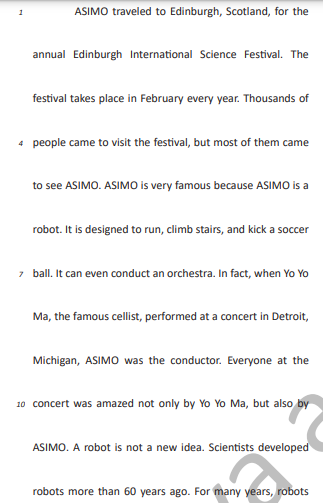

Concerning the text, judge the item.
The terms “However” (line 17) and “In addition” (lines
17 and 18) can be correctly replaced by Hence and
Therefore, respectively
Concerning the text, judge the item.
The subject pronoun in the sentence
“It is designed to run, climb stairs, and
kick a soccer ball” (lines 6 and 7) refers
to ASIMO.

 Conheça nossos planos