Questões de Concurso Sobre inglês
Foram encontradas 26.196 questões


No ensino da língua estrangeira, na abordagem comunicativa, é dado ênfase às quatro competências: Listening, Speaking, Reading, Writing (habilidade de ouvir, falar, ler e escrever).
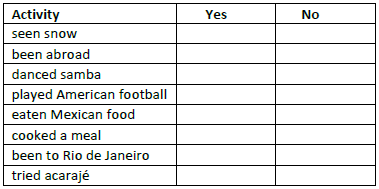
Analise a atividade abaixo e assinale a alternativa que apresente as habilidades que estão sendo enfocadas no seguinte exercício:
Exercise: Find someone who.... Walk around the class and talk to your friends. Ask them questions in order to find out who has already had these experiences. Take note of your answers. Use this: Have you ever……………………………………….?
After reading the text “ Coronavirus: who is most at risk?”, it is correct to state that:
Coronavirus: Who is most at-risk?
After the initial outbreak of the coronavirus in the Chinese city of Wuhan, medical professionals have examined what physiological archetypes and age groups might have a greater risk of contracting the disease, in an effort to educate the public.
Fox News spoke with Dr. Debra Chew, Assistant Professor of Medicine at Rutgers New Jersey Medical School, to gain a better understanding of the virus and how it behaves.
"Risks of contracting disease is based on epidemiologic exposure -- and therefore exposure to persons infected with the Wuhan Coronavirus, and those ill with respiratory symptoms who have travelled to Wuhan or neighbouring cities," she said. "This may expand with more cases and global travel.
(https://www.foxnews.com/health/coronavirus-who-is-most-atrisk)
“Atticus told me to delete the adjectives
and I'd have the facts” was removed from the book
“To Kill a Mockingbird” by Harper Lee.
Based on the quote from exercise 38, it is possible to state that:
– Atticus believes that adjectives are a disguise for the truth.
– Atticus believes that the facts are misled by the use of adjectives.
– Atticus suggested that, if you are looking for accuracy, adjectives should be taken into account.
– Once you acknowledge adjectives used to describe an event, you will have a raw understanding of the facts.
Which figure of speech is represented on the sentence:
"I think our country sinks beneath the yoke;
It weeps, it bleeds. IV. iii 39-40. (Macbeth, Shakespeare)
Australia fires: What's being done to fight the flames?
Large parts of Australia __________ (devastate) by the worst wildfires the country __________ (see) in decades, with huge blazes tearing through bush, woodland and national parks. Record-breaking temperatures and months of drought __________ (help) the fires burn an estimated 10 million hectares (100,000 sq km) of land since 1 July.
Bushfire conditions EASED over the weekend, giving fire crews a period of temporary respite. But authorities __________ (say) the huge fires will persist until there is substantial rainfall. More hot weather is __________ (expect) next week and the risk was far from over, they said. Thousands of firefighters are still battling blazes across large swathes of Australia - ranging in size from small fires to infernos burning across hectares of land. Entire towns have been engulfed and residents across several states have lost their homes. At least 28 people have died.
State and federal authorities have been working together to try to stem the spread. While they have managed to contain some within a matter of days, the biggest blazes have been burning for months.
At least 3,700 firefighters are on the ground at any one time across the country during the worst periods, according to the country's state fire services. Most are in the worst-hit states of New South Wales (NSW) and Victoria. When fires have been at their worst, about 2,700 firefighters have been battling the blazes at any one time in NSW alone. Ben Shepherd, of the NSW Rural Fire Service, said his colleagues had dealt with 4.2m hectares of burning land this season, compared with the typical 300,000 hectares. "It's been an incredibly long campaign," he said.
Fire crews across the country have been joined by 3,000 army, navy and air force reservists who are assisting with search and rescue and clean-up efforts. Further support coming from the US, Canada, and New Zealand, who have sent additional teams and equipment to help.
(https://www.bbc.com/news/world-australia-51008051 )
Off to 'big school'? Some pupils need extra support, says Ofsted
Primary schools should identify pupils whose behaviour may be at risk of deteriorating when they reach secondary school, a report for Ofsted suggests. Head teachers told Ofsted some pupils could struggle more than others with the move to "big school" and might benefit from extra support. This could be offered to help minimise the risk of such pupils misbehaving when they arrive, they said. It comes as thousands of pupils have just started secondary school. England's education watchdog, Ofsted, has announced a new push on behaviour management for teachers.
Ofsted says it will be adopting a new focus on behaviour management when it inspects teacher training providers. Its aim is to ensure that teachers are well trained in principles of behaviour management, so that all pupils can be offered quality education. Poor behaviour is increasingly seen as a communication of need, rather than a child simply being badly behaved.
Ofsted chief inspector Amanda Spielman said: "Positive behaviour needs to be taught as early on as possible, and expectations raised as children get older. “For some pupils, going from a relatively small primary community, where you're known by everyone and where you have a close relationship with a small number of teachers, to a much larger secondary school with several teachers, will be particularly challenging," she added. "The schools in our sample felt that it was important to identify pupils who were particularly at risk well before they started secondary school, so that they could provide appropriate support and prepare them for life in the 'big school'. "
The aim is to prevent pupils from falling behind as they struggle with the transition, which head teachers said could lead to a SPIKE in challenging behaviour. But the report was keen to point out that early identification of potential issues should not result in secondary schools discouraging entries from certain pupils. Ms Spielman is clear that good behaviour benefits everyone, by providing a positive setting for learning.
( hdttps://www.bbc.com/news/education-49661576 )
Based on the text decide whether the sentences below are true (T) or false (F):
– Ofsted claims that, once tracking student’s
behaviour in primary school, it will increase the
rate of challenging behaviour in secondary
school.
– The text supports that the move from primary to secondary school can be a difficult transition for all students.
– Poor behaviour is a way of asking for help and teachers should be trained to spot them.
– Going from a small and comfortable environment to a new school could lead to insecurities, which could cause bad behaviour and poor learning.
– Teachers are being trained to spot behaviour that could indicate possible transition difficulties in the future.
TEXT 2: Cold Front and Wild Fires Cause São Paulo to Go Dark during The Day
Darkness washed over São Paulo on Monday, around 3 pm, surprising residents. The phenomenon can be explained by the sum of the arrival of a cold front in the east of the state, with heavy clouds, and winds that have brought particulate matter originating from fires in Paraguay and Bolivia.
Franco Nadal Villela, a meteorologist of Inmet (National Institute of Meteorology), explained what happened in São Paulo on Monday:
"The darkening of the sky was quite intense. Two things working together caused it. First, the cold front from the east of São Paulo, bringing in a lot of moisture from the ocean. This cold front is bringing in cold air." said Villela, who then spoke about the effect of the fires. "There are wild fires of great magnitude happening in Paraguay, in the Pantanal region. Since the weekend, strong winds have brought (fine dust) from Mato Grosso do Sul, reaching São Paulo. The (fine dust) helps in the formation of clouds, and when they form together with it, the sky gets even darker, "he added. He said fires in the Bolivian region also contributed to the dark sky.
Adapted from: https://www1.folha.uol.com.br/internacional/e n/scienceandhealth/2019/08/cold-front-and wild-fires-cause-sao-paulo-to-go-dark-during the-day.shtml
According to the Text 2, the darkening of the sky:
I- Was due exclusively to a cold front that reached São Paulo;
II- Was intensified by the formation of clouds with the fine dust brought by the winds to São Paulo;
III- Can be explained by the sum of the arrival of a cold front in the east of the state, with heavy clouds, and winds that have brought particulate matter originating from fires in Paraguay and Bolivia.
TEXT 2: Cold Front and Wild Fires Cause São Paulo to Go Dark during The Day
Darkness washed over São Paulo on Monday, around 3 pm, surprising residents. The phenomenon can be explained by the sum of the arrival of a cold front in the east of the state, with heavy clouds, and winds that have brought particulate matter originating from fires in Paraguay and Bolivia.
Franco Nadal Villela, a meteorologist of Inmet (National Institute of Meteorology), explained what happened in São Paulo on Monday:
"The darkening of the sky was quite intense. Two things working together caused it. First, the cold front from the east of São Paulo, bringing in a lot of moisture from the ocean. This cold front is bringing in cold air." said Villela, who then spoke about the effect of the fires. "There are wild fires of great magnitude happening in Paraguay, in the Pantanal region. Since the weekend, strong winds have brought (fine dust) from Mato Grosso do Sul, reaching São Paulo. The (fine dust) helps in the formation of clouds, and when they form together with it, the sky gets even darker, "he added. He said fires in the Bolivian region also contributed to the dark sky.
Adapted from: https://www1.folha.uol.com.br/internacional/e n/scienceandhealth/2019/08/cold-front-and wild-fires-cause-sao-paulo-to-go-dark-during the-day.shtml
Consider the sentence: "“Food waste is actually a serious problem” and the words below:
I- Indeed;
II- Nowadays;
III- In fact;
IV- Currently.
In the sentence, the word “actually” has the same meaning of:
Choose the correct preposition for the sentence below:
“Sugar dissolves ____ water.”
Consider the following sentences:
I- “The news ____ on Channel Five at nine o’clock”.
II- “These loaves _____ really fresh”.
II- “These loaves _____ really fresh”. III- “I think that maths _____ the most difficult subject”.
The alternative that best completes the sentences I – II – III, in that order, is:

 Conheça nossos planos