🎯 Saiba o que estudar

Avançado com Treinador a partir de R$ 0,76/dia

Questões de Concurso Sobre inglês

Questões Discursivas

Foram encontradas 25.355 questões

Q1792136 Inglês

Instructions: answer the question based on the following text.

Source (adapted): https://www.bbc.com/news/worldafrica-50800864

Which lines provide information on the place where elephants live?
Alternativas
Q1792135 Inglês

Instructions: answer the question based on the following text.

Source (adapted): https://www.bbc.com/news/worldafrica-50800864

According with the text, what the hunters did to hide the evidence?
Alternativas
Q1792134 Inglês

Instructions: answer the question based on the following text.

Source (adapted): https://www.bbc.com/news/worldafrica-50800864

According with the text, when the committee recommended allowing hunting again?
Alternativas
Q1792133 Inglês

Instructions: answer the question based on the following text.

Source (adapted): https://www.bbc.com/news/worldafrica-50800864

Consider the sentence below from the text and the following assertives: “Elephants can be very destructive when they encroach onto farmland and move though villages - destroying crops and sometimes killing people.” (l. 49-52)
I. The word “farmland” could be translated as “terras agrícolas”. II. The word “very” can be a verb. III. The word “crops” could be replaced by “plague”. Which ones are correct?
Alternativas
Q1792132 Inglês

Instructions: answer the question based on the following text.

Source (adapted): https://www.bbc.com/news/worldafrica-50800864

Which one could be better for the title of the text?
Alternativas
Q1792131 Inglês

Instructions: answer the question based on the following text.

Source (adapted): https://www.bbc.com/news/worldafrica-50800864

" Botswana has cancelled the licenses of two professional hunters who shot dead a research elephant.” (l.1-3) Which verb tense the sentence above is?
Alternativas
Q1792130 Inglês

Instructions: answer the question based on the following text.

Source (adapted): https://www.bbc.com/news/worldafrica-50800864

“They realized” (l. 32) could be translated as
Alternativas
Q1792129 Inglês

Instructions: answer the question based on the following text.

Source (adapted): https://www.bbc.com/news/worldafrica-50800864

Mark the alternative that correctly fills in the blanks of lines 07, 14 and 21.
Alternativas
Q1791128 Inglês
“When does your bus leave?”
“Ten o’clock. They’ve just announced it the P.A. system.”
Alternativas
Q1791127 Inglês
“What did you ask Sarah?” “I asked if she wouldn’t please the left-side window.”
Alternativas
Q1791126 Inglês
“Is that Mary’s or Susan’s car out there?” “I don’t know it is.
Alternativas
Q1791125 Inglês
“Could you finish the test within the allotted time?” “Unfortunately not – it asked for too .”
Alternativas
Q1791124 Inglês
“You look so happy!” “You’re right! I just saw my grandmother, whom I haven’t for three years.”
Alternativas
Q1781442 Inglês
Instruction: answer the question based on the following text.

Why people are so obsessed with hygge, the cozy Danish lifestyle movement


Adapted from: https://www.cnbc.com/2019/11/23/what-is-hygge-and-why-are-people-so-obsessed-with-it.html
Decide whether the statements about the following sentence are true or false:
“Since the word entered the American lexicon, it has become a full-blown, Instagram-worthy lifestyle filled with warm blankets and glowing candles.” (l. 02-04).
( ) Warm blankets and glowing candles are representations of Instagram lifestyle. ( ) The word ‘lifestyle’ is a compound noun. ( ) The underlined phrase is an example of the present perfect verb tense. ( ) The word ‘since’ is used to describe the duration of an action, rather than the moment when the action begins.
Choose the alternative with the correct answers, in order.
Alternativas
Q1781441 Inglês
Instruction: answer the question based on the following text.

Why people are so obsessed with hygge, the cozy Danish lifestyle movement


Adapted from: https://www.cnbc.com/2019/11/23/what-is-hygge-and-why-are-people-so-obsessed-with-it.html
Consider the suggested changes to the sentence “But why are people so obsessed with it?” (l. 10-11).
I. But why are people so obsessed about it? II. But why are people obsessed by it? III. But why people obsess over it?
Which ones are correct?
Alternativas
Q1781440 Inglês
Instruction: answer the question based on the following text.

Why people are so obsessed with hygge, the cozy Danish lifestyle movement


Adapted from: https://www.cnbc.com/2019/11/23/what-is-hygge-and-why-are-people-so-obsessed-with-it.html
Consider the bold words in the text: it (l. 16); where (l. 19); themselves (l. 21); which (l. 21). Choose the alternative that states what the words refer to, in the order they are mentioned in the text.
Alternativas
Q1781439 Inglês
Instruction: answer the question based on the following text.

Why people are so obsessed with hygge, the cozy Danish lifestyle movement


Adapted from: https://www.cnbc.com/2019/11/23/what-is-hygge-and-why-are-people-so-obsessed-with-it.html
Nouns as ‘food’ (l. 06) may be countable or uncountable, depending on the context. The following nouns usually follow the same rule, EXCEPT:
Alternativas
Q1781438 Inglês
Instruction: answer the question based on the following text.

Why people are so obsessed with hygge, the cozy Danish lifestyle movement


Adapted from: https://www.cnbc.com/2019/11/23/what-is-hygge-and-why-are-people-so-obsessed-with-it.html
Choose the sentence with the same use of the –ing structure as in “it means socializing with loved ones” (l. 05).
Alternativas
Q1773434 Inglês

What is blended learning and how does it work? 
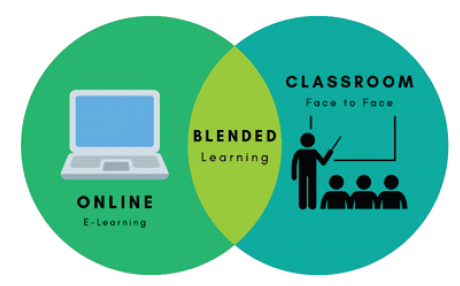

Image: https://www.tp.edu.sg/sii/individuals/blended-learning

Blended learning as an approach is not new. Indeed, the practice of combining (blending) different learning approaches and strategies is not new. Distance learning courses have long combined blended learning through a mix of self-access content (print/video/TV/ radio) and face-to-face/telephone support. 'Traditional' courses have always combined (and some still do) a variety of delivery modes that combine content such as lectures, seminars, tutorials, workshops and group work to give learners a range of learning opportunities. And of course, 'good teachers will always use more than one method or approach in their teaching, and good learners will always combine different strategies in their learning' (Marsh, 2012:3*).

So we could say that the term 'blended learning' refers to every time teachers mix different media (e.g. print, audio, and video) with classroom interaction, maximising authentic input in order to support learners' output and skills development. As such, blended learning has more or less always existed, although the term itself is a mere 15 years old at most, and is now understood to mean a rich, supportive learner-centred learning environment where the 'right blend' is synonymous with effective learning (and teaching).

 What is new is that today, technology combines all the different media within one environment: online. The online space facilitates learner–learner interaction, encourages incidental and exploratory learning and allows learners and teachers to stay connected outside the classroom, if they so wish. Learners can benefit from the fact that space and distance do not matter any more. Teachers and educationalists are now understanding more and more that, with the 'right blend', teachers can offer a much richer, supportive learning environment, learning opportunities increase, learning becomes more effective and the learning process becomes more enjoyable.

There are many definitions for blended learning, but they all have the following in common: they refer to two different learning environments — face-to-face (synchronous) and online (asynchronous); and they refer to combining those two learning environments in a complementary way to deliver a programme of study so that learners can be supported both within the classroom environment and outside of it. In other words, the term blended learning refers to any programme of study that is delivered by appropriately combining both synchronous interactive study (usually face-to-face) and asynchronous (individual) study (usually online).

We could go further and say, 'It's in the blend!' That is, the key to a successful blended learning approach is to use the strengths of each medium appropriately, combining the two different learning environments in an integrated way so that each medium complements one another: the classroom environment being used for what it does best, such as introducing new topics, explaining important language points or for meaningful communicative activities, and the online environment being used for what it does best, such as preparing for the next topic (by watching a video/reading a text, etc.), and/or practising and consolidating what has been learnt in class or for extra practice. Both modes of delivery put the learner at the centre of the learning process.
(…)

*Marsh, D. Blended Learning:Creating Learning Opportunities for Language Learners. Cambridge: Cambridge University Press, 2012.
(Adapted from: KING, A. Blended language learning: Part of the Cambridge Papers in ELTseries. [pdf] Cambridge: Cambridge University Press, 2016, p. 2.Available st at: http://languageresearch.cambridge.org/cambridge-papers-in-elt Accessed on October 31, 2019). 
In the first paragraph of the text, the verb tenses used are:
Alternativas
Q1773433 Inglês

What is blended learning and how does it work? 


Image: https://www.tp.edu.sg/sii/individuals/blended-learning

Blended learning as an approach is not new. Indeed, the practice of combining (blending) different learning approaches and strategies is not new. Distance learning courses have long combined blended learning through a mix of self-access content (print/video/TV/ radio) and face-to-face/telephone support. 'Traditional' courses have always combined (and some still do) a variety of delivery modes that combine content such as lectures, seminars, tutorials, workshops and group work to give learners a range of learning opportunities. And of course, 'good teachers will always use more than one method or approach in their teaching, and good learners will always combine different strategies in their learning' (Marsh, 2012:3*).

So we could say that the term 'blended learning' refers to every time teachers mix different media (e.g. print, audio, and video) with classroom interaction, maximising authentic input in order to support learners' output and skills development. As such, blended learning has more or less always existed, although the term itself is a mere 15 years old at most, and is now understood to mean a rich, supportive learner-centred learning environment where the 'right blend' is synonymous with effective learning (and teaching).

 What is new is that today, technology combines all the different media within one environment: online. The online space facilitates learner–learner interaction, encourages incidental and exploratory learning and allows learners and teachers to stay connected outside the classroom, if they so wish. Learners can benefit from the fact that space and distance do not matter any more. Teachers and educationalists are now understanding more and more that, with the 'right blend', teachers can offer a much richer, supportive learning environment, learning opportunities increase, learning becomes more effective and the learning process becomes more enjoyable.

There are many definitions for blended learning, but they all have the following in common: they refer to two different learning environments — face-to-face (synchronous) and online (asynchronous); and they refer to combining those two learning environments in a complementary way to deliver a programme of study so that learners can be supported both within the classroom environment and outside of it. In other words, the term blended learning refers to any programme of study that is delivered by appropriately combining both synchronous interactive study (usually face-to-face) and asynchronous (individual) study (usually online).

We could go further and say, 'It's in the blend!' That is, the key to a successful blended learning approach is to use the strengths of each medium appropriately, combining the two different learning environments in an integrated way so that each medium complements one another: the classroom environment being used for what it does best, such as introducing new topics, explaining important language points or for meaningful communicative activities, and the online environment being used for what it does best, such as preparing for the next topic (by watching a video/reading a text, etc.), and/or practising and consolidating what has been learnt in class or for extra practice. Both modes of delivery put the learner at the centre of the learning process.
(…)

*Marsh, D. Blended Learning:Creating Learning Opportunities for Language Learners. Cambridge: Cambridge University Press, 2012.
(Adapted from: KING, A. Blended language learning: Part of the Cambridge Papers in ELTseries. [pdf] Cambridge: Cambridge University Press, 2016, p. 2.Available st at: http://languageresearch.cambridge.org/cambridge-papers-in-elt Accessed on October 31, 2019). 
To King (2012), a successful blended learning approach mainly entails
Alternativas
Respostas
14441: B
14442: B
14443: C
14444: A
14445: D
14446: A
14447: E
14448: A
14449: E
14450: A
14451: D
14452: E
14453: B
14454: A
14455: E
14456: C
14457: B
14458: D
14459: C
14460: B
