Questões de Concurso Sobre inglês
Foram encontradas 25.352 questões


EMI courses in Brazil grow to more than 1,000
(Posted on Sep 25, 2018 by Viggo Stacey)
Agrowing number of Higher Education Institutions (HEIs) in Brazil are recognising the importance of offering English as Medium of Instruction courses, as the number of EMI courses rose from 671 in 2016 to over 1,000 in the first semester 2018, according to a new report.

(Photo: gabyps/Pixabay)
The Brazilian Association for International Education (FAUBAI) and the British Council, which surveyed 84 HEIs in Brazil, said the data reflects the sustained growth in activities offered in English as well as Portuguese for foreigners.
“Internationalisation is growing and increasing in the whole country and it's on the agenda of all universities,” explained Renata Archanjo, UFRN international relations deputy officer. “We are a country [that is becoming] more and more globalised.”
Executive director of FAUBAI Renée Zicman highlighted that of Brazil's 2,400 HEIs, many do not offer international activities, but that number is increasing and the organisation has been promoting the internationalisation of the country's universities.
“We have been [telling] universities that by offering opportunities in English [they will] be able to receive international students,” she said, adding that it is important to point out that EMI courses are being offered in all five regions of the country, including the Amazon region.
“Our universities are very concentrated in certain regions of the country, but we have all sorts of universities and HEIs doing this in all regions of the country, public and private. It means the whole system has understood.
“The idea is not just to offer opportunities to take classes in English or participate in activities in English, but also to be able to live in this beautiful country and be able to share Brazilian culture and learn Portuguese,” Zicman added. […]
(Adapted from: https://thepienews.com/news/over-1000-emi-courses-in-brazil-in-2018/ Accessed on Oct 1 , 2020)
English in Brazil: Insights from the Analysis of Language Policies, Internationalization Programs and the CLIL Approach
Abstract: The paper proposes a reflection on the role of English in the globalized world and its teaching/learning in Brazil. With that aim, the study reviews language policies and internationalization programs in Brazil regarding the role of foreign languages in general and of English in particular. The theoretical framework includes a review of an English language teaching (ELT) approach used mainly in Europe, as a result of globalization and internationalization, the Content and Language Integrated Approach (CLIL). In order to support this reflection, a case study was carried out to examine pre-service English teachers’ beliefs on the use of CLIL in Brazil. The results of study show that pre-service English teachers understand the importance of the CLIL approach though they are aware of the various obstacles to its implementation in that context. The study suggests a review of language policies in Brazil so as to ensure a convergence between them and internationalization policies and approaches, at all levels of education. Regarding the ELT approach analyzed, the study concludes that despite the difficulties associated with the implementation of CLIL in Brazil, it represents a relevant alternative in that context.
Keywords: English language teaching (ELT), Content and Language Integrated Learning (CLIL), Language policies, Internationalization, Brazil
Source:
FINARDI, Kyria; LEÃO, Roberta; PINHEIRO, Livia Melina. English in Brazil: Insights from the Analysis of Language Policies, Internationalization Programs and the CLILApproach. In: Education and Linguistics Research, 2016, Vol. 2, No. 1. Available at:
https://www.researchgate.net/profile/Kyria_Finardi/publication/297653683_English_in_Brazil_Insights_from_the_Analysis_of_Language_Policies_Internationaliz
ation_Programs_and_the_CLIL_Approach/links/5814871508aeffbed6bdf5ba/English-in-Brazil-Insights-from-the-Analysis-of-Language-Policiesth Internationalization-Programs-and-the-CLIL-Approach.pdf . Accessed on September 29th , 2020.
English in Brazil: Insights from the Analysis of Language Policies, Internationalization Programs and the CLIL Approach
Abstract: The paper proposes a reflection on the role of English in the globalized world and its teaching/learning in Brazil. With that aim, the study reviews language policies and internationalization programs in Brazil regarding the role of foreign languages in general and of English in particular. The theoretical framework includes a review of an English language teaching (ELT) approach used mainly in Europe, as a result of globalization and internationalization, the Content and Language Integrated Approach (CLIL). In order to support this reflection, a case study was carried out to examine pre-service English teachers’ beliefs on the use of CLIL in Brazil. The results of study show that pre-service English teachers understand the importance of the CLIL approach though they are aware of the various obstacles to its implementation in that context. The study suggests a review of language policies in Brazil so as to ensure a convergence between them and internationalization policies and approaches, at all levels of education. Regarding the ELT approach analyzed, the study concludes that despite the difficulties associated with the implementation of CLIL in Brazil, it represents a relevant alternative in that context.
Keywords: English language teaching (ELT), Content and Language Integrated Learning (CLIL), Language policies, Internationalization, Brazil
Source:
FINARDI, Kyria; LEÃO, Roberta; PINHEIRO, Livia Melina. English in Brazil: Insights from the Analysis of Language Policies, Internationalization Programs and the CLILApproach. In: Education and Linguistics Research, 2016, Vol. 2, No. 1. Available at:
https://www.researchgate.net/profile/Kyria_Finardi/publication/297653683_English_in_Brazil_Insights_from_the_Analysis_of_Language_Policies_Internationaliz
ation_Programs_and_the_CLIL_Approach/links/5814871508aeffbed6bdf5ba/English-in-Brazil-Insights-from-the-Analysis-of-Language-Policiesth Internationalization-Programs-and-the-CLIL-Approach.pdf . Accessed on September 29th , 2020.
Based on Text IV, analyze the following sentences and check True (T) or False (F).
( ) In-service English teachers are aware of the importance of the CLIL approach as well as of the obstacles to its implementation in that context.
( ) The study suggests a review of language and internalization policies in Brazil to ensure a convergence between them and internationalization policies and approaches, mainly at higher education.
( ) Globalization and internationalization have influenced the use of CLIL as an ELT approach.
Choose the alternative with the CORRECT sequence:
English in Brazil: Insights from the Analysis of Language Policies, Internationalization Programs and the CLIL Approach
Abstract: The paper proposes a reflection on the role of English in the globalized world and its teaching/learning in Brazil. With that aim, the study reviews language policies and internationalization programs in Brazil regarding the role of foreign languages in general and of English in particular. The theoretical framework includes a review of an English language teaching (ELT) approach used mainly in Europe, as a result of globalization and internationalization, the Content and Language Integrated Approach (CLIL). In order to support this reflection, a case study was carried out to examine pre-service English teachers’ beliefs on the use of CLIL in Brazil. The results of study show that pre-service English teachers understand the importance of the CLIL approach though they are aware of the various obstacles to its implementation in that context. The study suggests a review of language policies in Brazil so as to ensure a convergence between them and internationalization policies and approaches, at all levels of education. Regarding the ELT approach analyzed, the study concludes that despite the difficulties associated with the implementation of CLIL in Brazil, it represents a relevant alternative in that context.
Keywords: English language teaching (ELT), Content and Language Integrated Learning (CLIL), Language policies, Internationalization, Brazil
Source:
FINARDI, Kyria; LEÃO, Roberta; PINHEIRO, Livia Melina. English in Brazil: Insights from the Analysis of Language Policies, Internationalization Programs and the CLILApproach. In: Education and Linguistics Research, 2016, Vol. 2, No. 1. Available at:
https://www.researchgate.net/profile/Kyria_Finardi/publication/297653683_English_in_Brazil_Insights_from_the_Analysis_of_Language_Policies_Internationaliz
ation_Programs_and_the_CLIL_Approach/links/5814871508aeffbed6bdf5ba/English-in-Brazil-Insights-from-the-Analysis-of-Language-Policiesth Internationalization-Programs-and-the-CLIL-Approach.pdf . Accessed on September 29th , 2020.

(Available at: https://elearninginfographics.com/4-signs-you-have-real-flipped-classroom-infographic/
th Accessed on September 25 , 2020)
(Available at: https://elearninginfographics.com/4-signs-you-have-real-flipped-classroom-infographic/
th Accessed on September 25 , 2020)
The order of different verb tenses used in this paragraph is, respectively:
(Available at: https://elearninginfographics.com/4-signs-you-have-real-flipped-classroom-infographic/
th Accessed on September 25 , 2020)

Available at: https://www.inquirer.com/opinion/cartoons/coronavirus-schools-education-equity-virtual-learning-20200329.html. Accessed on September 22 , 2020)
Available at: https://www.inquirer.com/opinion/cartoons/coronavirus-schools-education-equity-virtual-learning-20200329.html. Accessed on September 22 , 2020)
How teachers are trying to reach English language learners during pandemic
(Apr 29, 2020 4:23 pm – by Jo Napolitano, The Hechinger Report)
Administrators at Dorchester School District Two in suburban Summerville, South Carolina, were well aware of the digital divide when they decided to give students both paper and online resources after shuttering schools because of coronavirus. But even their best efforts have some educators worried, especially those who teach English to speakers of other languages (ESOL).
Katie Crook, Newington Elementary School’s only ESOL teacher, didn’t hear back from many of the parents she texted early on. Many of her students, she said, were born in the United States and live in Spanish-speaking homes. So she tried a decidedly old-school means of communication: letter writing.
Crook began each note with a joyful “Hello!” before telling students how much she missed them. “I am so sad that school is closed and we can’t work together right now,” she wrote. “If you want, you can write me back and tell me how you are and what you have been up to. Love, Mrs. Crook.” The veteran teacher included a self-addressed stamped envelope along with every card.

“Their lives have been totally turned upside down. There is so much goodness in school that they are missing out on. I want them to know their teachers love them and miss them and are really excited about when they get to see them again,” she said.
Crook received her first response April 9, and she was so thrilled by the correspondence that she tore it open right away. The letter, written on a blank piece of computer paper, was just a few sentences long — it began with, “Hi Mrs. Crook, I miss you to (sic)” — but was more than enough to prove her effort was worth it.
Among the more than 55 million students forced to stay home because of coronavirus-related school closures are at least 4.9 million English-language learners (ELLs). These students made up 9.6 percent of all school-age children in the fall of 2016, the last year for which such data is available. The number has likely risen, according to experts.
By law, schools must ensure ELLs “can participate meaningfully and equally in educational programs,” according to the U.S. Department of Justice, Civil Rights Division, and the U.S. Department of Education’s Office of Civil Rights. And they must communicate with families in a language they understand.
Schools often fell short of these requirements, even before the current crisis.
Tim Boals, executive director of WIDA, a group that provides educational resources for multilingual learners, worries the shutdowns will result in an even greater marginalization of those students. “I think schools are struggling now to serve all their kids, so there is no doubt in my mind that this is an issue,” he said. (…)
(Adapted from: https://www.pbs.org/newshour/education/how-teachers-are-trying-to-reach-english-language-learners-during-pandemic. Accessed on September
th 30 , 2020)
How teachers are trying to reach English language learners during pandemic
(Apr 29, 2020 4:23 pm – by Jo Napolitano, The Hechinger Report)
Administrators at Dorchester School District Two in suburban Summerville, South Carolina, were well aware of the digital divide when they decided to give students both paper and online resources after shuttering schools because of coronavirus. But even their best efforts have some educators worried, especially those who teach English to speakers of other languages (ESOL).
Katie Crook, Newington Elementary School’s only ESOL teacher, didn’t hear back from many of the parents she texted early on. Many of her students, she said, were born in the United States and live in Spanish-speaking homes. So she tried a decidedly old-school means of communication: letter writing.
Crook began each note with a joyful “Hello!” before telling students how much she missed them. “I am so sad that school is closed and we can’t work together right now,” she wrote. “If you want, you can write me back and tell me how you are and what you have been up to. Love, Mrs. Crook.” The veteran teacher included a self-addressed stamped envelope along with every card.
“Their lives have been totally turned upside down. There is so much goodness in school that they are missing out on. I want them to know their teachers love them and miss them and are really excited about when they get to see them again,” she said.
Crook received her first response April 9, and she was so thrilled by the correspondence that she tore it open right away. The letter, written on a blank piece of computer paper, was just a few sentences long — it began with, “Hi Mrs. Crook, I miss you to (sic)” — but was more than enough to prove her effort was worth it.
Among the more than 55 million students forced to stay home because of coronavirus-related school closures are at least 4.9 million English-language learners (ELLs). These students made up 9.6 percent of all school-age children in the fall of 2016, the last year for which such data is available. The number has likely risen, according to experts.
By law, schools must ensure ELLs “can participate meaningfully and equally in educational programs,” according to the U.S. Department of Justice, Civil Rights Division, and the U.S. Department of Education’s Office of Civil Rights. And they must communicate with families in a language they understand.
Schools often fell short of these requirements, even before the current crisis.
Tim Boals, executive director of WIDA, a group that provides educational resources for multilingual learners, worries the shutdowns will result in an even greater marginalization of those students. “I think schools are struggling now to serve all their kids, so there is no doubt in my mind that this is an issue,” he said. (…)
(Adapted from: https://www.pbs.org/newshour/education/how-teachers-are-trying-to-reach-english-language-learners-during-pandemic. Accessed on September
th 30 , 2020)
How teachers are trying to reach English language learners during pandemic
(Apr 29, 2020 4:23 pm – by Jo Napolitano, The Hechinger Report)
Administrators at Dorchester School District Two in suburban Summerville, South Carolina, were well aware of the digital divide when they decided to give students both paper and online resources after shuttering schools because of coronavirus. But even their best efforts have some educators worried, especially those who teach English to speakers of other languages (ESOL).
Katie Crook, Newington Elementary School’s only ESOL teacher, didn’t hear back from many of the parents she texted early on. Many of her students, she said, were born in the United States and live in Spanish-speaking homes. So she tried a decidedly old-school means of communication: letter writing.
Crook began each note with a joyful “Hello!” before telling students how much she missed them. “I am so sad that school is closed and we can’t work together right now,” she wrote. “If you want, you can write me back and tell me how you are and what you have been up to. Love, Mrs. Crook.” The veteran teacher included a self-addressed stamped envelope along with every card.
“Their lives have been totally turned upside down. There is so much goodness in school that they are missing out on. I want them to know their teachers love them and miss them and are really excited about when they get to see them again,” she said.
Crook received her first response April 9, and she was so thrilled by the correspondence that she tore it open right away. The letter, written on a blank piece of computer paper, was just a few sentences long — it began with, “Hi Mrs. Crook, I miss you to (sic)” — but was more than enough to prove her effort was worth it.
Among the more than 55 million students forced to stay home because of coronavirus-related school closures are at least 4.9 million English-language learners (ELLs). These students made up 9.6 percent of all school-age children in the fall of 2016, the last year for which such data is available. The number has likely risen, according to experts.
By law, schools must ensure ELLs “can participate meaningfully and equally in educational programs,” according to the U.S. Department of Justice, Civil Rights Division, and the U.S. Department of Education’s Office of Civil Rights. And they must communicate with families in a language they understand.
Schools often fell short of these requirements, even before the current crisis.
Tim Boals, executive director of WIDA, a group that provides educational resources for multilingual learners, worries the shutdowns will result in an even greater marginalization of those students. “I think schools are struggling now to serve all their kids, so there is no doubt in my mind that this is an issue,” he said. (…)
(Adapted from: https://www.pbs.org/newshour/education/how-teachers-are-trying-to-reach-english-language-learners-during-pandemic. Accessed on September
th 30 , 2020)
How teachers are trying to reach English language learners during pandemic
(Apr 29, 2020 4:23 pm – by Jo Napolitano, The Hechinger Report)
Administrators at Dorchester School District Two in suburban Summerville, South Carolina, were well aware of the digital divide when they decided to give students both paper and online resources after shuttering schools because of coronavirus. But even their best efforts have some educators worried, especially those who teach English to speakers of other languages (ESOL).
Katie Crook, Newington Elementary School’s only ESOL teacher, didn’t hear back from many of the parents she texted early on. Many of her students, she said, were born in the United States and live in Spanish-speaking homes. So she tried a decidedly old-school means of communication: letter writing.
Crook began each note with a joyful “Hello!” before telling students how much she missed them. “I am so sad that school is closed and we can’t work together right now,” she wrote. “If you want, you can write me back and tell me how you are and what you have been up to. Love, Mrs. Crook.” The veteran teacher included a self-addressed stamped envelope along with every card.
“Their lives have been totally turned upside down. There is so much goodness in school that they are missing out on. I want them to know their teachers love them and miss them and are really excited about when they get to see them again,” she said.
Crook received her first response April 9, and she was so thrilled by the correspondence that she tore it open right away. The letter, written on a blank piece of computer paper, was just a few sentences long — it began with, “Hi Mrs. Crook, I miss you to (sic)” — but was more than enough to prove her effort was worth it.
Among the more than 55 million students forced to stay home because of coronavirus-related school closures are at least 4.9 million English-language learners (ELLs). These students made up 9.6 percent of all school-age children in the fall of 2016, the last year for which such data is available. The number has likely risen, according to experts.
By law, schools must ensure ELLs “can participate meaningfully and equally in educational programs,” according to the U.S. Department of Justice, Civil Rights Division, and the U.S. Department of Education’s Office of Civil Rights. And they must communicate with families in a language they understand.
Schools often fell short of these requirements, even before the current crisis.
Tim Boals, executive director of WIDA, a group that provides educational resources for multilingual learners, worries the shutdowns will result in an even greater marginalization of those students. “I think schools are struggling now to serve all their kids, so there is no doubt in my mind that this is an issue,” he said. (…)
(Adapted from: https://www.pbs.org/newshour/education/how-teachers-are-trying-to-reach-english-language-learners-during-pandemic. Accessed on September
th 30 , 2020)
Text II
Pollution
Text II
Pollution
Text I
While viruses do not respect borders, their spread and their chances of survival have long depended greatly on the laws, policies and acts of states. However, not all states are up to the job, writes Adam Roberts.
A.J.P. Taylor often observed that great events can have very small causes. The 2020 COVID-19 pandemic is fresh evidence for this proposition. The cause is in all likelihood tiny and accidental: a genetic mutation in a virus, which then spreads into the human population. Like earlier epidemics throughout history, it could have happened with no human intentionality. Its consequences are already momentous and will be even more so before it is over.
The novel coronavirus can easily be seen as a profoundly anti-democratic force. In its first eight months, from early January to mid-August, it produced over 20 million cases of the COVID-19 disease. That disease has killed over 800,000 people and counting; put millions out of work; drastically curtailed travel; precipitated states of emergency; and caused citizens to be placed under detailed and intrusive administrative control, demonstrations to be banned, and elections to be rescheduled or postponed. Bitter disagreements have arisen about when and how to ease restrictions on movement. COVID-19 has generated a revival of conspiracy theories and unjustified recriminations, and prompted absurd denials of medical reality by certain political leaders. Among states, the pandemic has actually heightened some long-existing disputes, most notably those on trade and other matters between China and the United States. The capacity of the United Nations system to address epidemics has been called into question, not least in harsh American criticisms of the World Health Organization (WHO).
It is too simple to cast the pandemic crisis merely as a narrative of rampant authoritarianism versus embattled democracy. The long history of pandemics, earthquakes and other disasters reminds us of the enduring complexity of disaster management, and of the many controversies surrounding it, including the causes of and responses to plagues. States respond in different ways, raising questions regarding the relative effectiveness of democratic versus authoritarian states. International health organisations, especially the WHO, have important roles in dealing with epidemics, whether regional or global. Yet their formal powers are limited and their effectiveness depends on state cooperation. Epidemics, and action to control them, do sometimes play a part in increased authoritarianism, but they can also give rise to more positive initiatives of various kinds.
Adapted from: https://www.iiss.org/. Accessed on March 20, 2021.
Text I
While viruses do not respect borders, their spread and their chances of survival have long depended greatly on the laws, policies and acts of states. However, not all states are up to the job, writes Adam Roberts.
A.J.P. Taylor often observed that great events can have very small causes. The 2020 COVID-19 pandemic is fresh evidence for this proposition. The cause is in all likelihood tiny and accidental: a genetic mutation in a virus, which then spreads into the human population. Like earlier epidemics throughout history, it could have happened with no human intentionality. Its consequences are already momentous and will be even more so before it is over.
The novel coronavirus can easily be seen as a profoundly anti-democratic force. In its first eight months, from early January to mid-August, it produced over 20 million cases of the COVID-19 disease. That disease has killed over 800,000 people and counting; put millions out of work; drastically curtailed travel; precipitated states of emergency; and caused citizens to be placed under detailed and intrusive administrative control, demonstrations to be banned, and elections to be rescheduled or postponed. Bitter disagreements have arisen about when and how to ease restrictions on movement. COVID-19 has generated a revival of conspiracy theories and unjustified recriminations, and prompted absurd denials of medical reality by certain political leaders. Among states, the pandemic has actually heightened some long-existing disputes, most notably those on trade and other matters between China and the United States. The capacity of the United Nations system to address epidemics has been called into question, not least in harsh American criticisms of the World Health Organization (WHO).
It is too simple to cast the pandemic crisis merely as a narrative of rampant authoritarianism versus embattled democracy. The long history of pandemics, earthquakes and other disasters reminds us of the enduring complexity of disaster management, and of the many controversies surrounding it, including the causes of and responses to plagues. States respond in different ways, raising questions regarding the relative effectiveness of democratic versus authoritarian states. International health organisations, especially the WHO, have important roles in dealing with epidemics, whether regional or global. Yet their formal powers are limited and their effectiveness depends on state cooperation. Epidemics, and action to control them, do sometimes play a part in increased authoritarianism, but they can also give rise to more positive initiatives of various kinds.
Adapted from: https://www.iiss.org/. Accessed on March 20, 2021.
Text I
While viruses do not respect borders, their spread and their chances of survival have long depended greatly on the laws, policies and acts of states. However, not all states are up to the job, writes Adam Roberts.
A.J.P. Taylor often observed that great events can have very small causes. The 2020 COVID-19 pandemic is fresh evidence for this proposition. The cause is in all likelihood tiny and accidental: a genetic mutation in a virus, which then spreads into the human population. Like earlier epidemics throughout history, it could have happened with no human intentionality. Its consequences are already momentous and will be even more so before it is over.
The novel coronavirus can easily be seen as a profoundly anti-democratic force. In its first eight months, from early January to mid-August, it produced over 20 million cases of the COVID-19 disease. That disease has killed over 800,000 people and counting; put millions out of work; drastically curtailed travel; precipitated states of emergency; and caused citizens to be placed under detailed and intrusive administrative control, demonstrations to be banned, and elections to be rescheduled or postponed. Bitter disagreements have arisen about when and how to ease restrictions on movement. COVID-19 has generated a revival of conspiracy theories and unjustified recriminations, and prompted absurd denials of medical reality by certain political leaders. Among states, the pandemic has actually heightened some long-existing disputes, most notably those on trade and other matters between China and the United States. The capacity of the United Nations system to address epidemics has been called into question, not least in harsh American criticisms of the World Health Organization (WHO).
It is too simple to cast the pandemic crisis merely as a narrative of rampant authoritarianism versus embattled democracy. The long history of pandemics, earthquakes and other disasters reminds us of the enduring complexity of disaster management, and of the many controversies surrounding it, including the causes of and responses to plagues. States respond in different ways, raising questions regarding the relative effectiveness of democratic versus authoritarian states. International health organisations, especially the WHO, have important roles in dealing with epidemics, whether regional or global. Yet their formal powers are limited and their effectiveness depends on state cooperation. Epidemics, and action to control them, do sometimes play a part in increased authoritarianism, but they can also give rise to more positive initiatives of various kinds.
Adapted from: https://www.iiss.org/. Accessed on March 20, 2021.
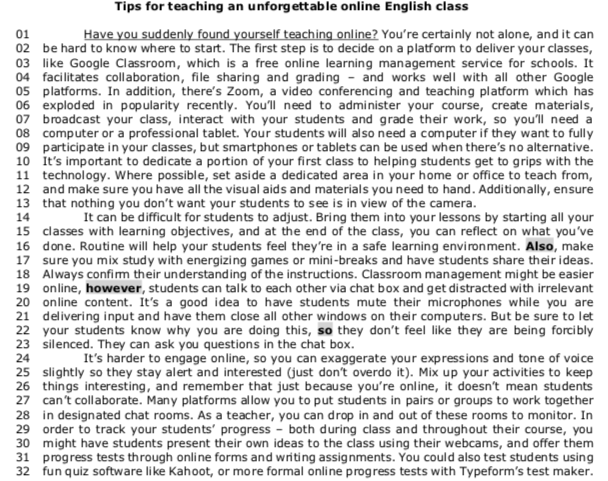
(Avaliable in: https://www.cambridgeenglish.org/blog/12-tips-for-teaching-an-online-english-class/ – text adapted specially for this test).
(Avaliable in: https://www.cambridgeenglish.org/blog/12-tips-for-teaching-an-online-english-class/ – text adapted specially for this test).

 Conheça nossos planos