Questões de Concurso Sobre inglês
Foram encontradas 26.151 questões


Instruction: answer question based on the following text.
4 easy ways to make your holidays more eco-friendly
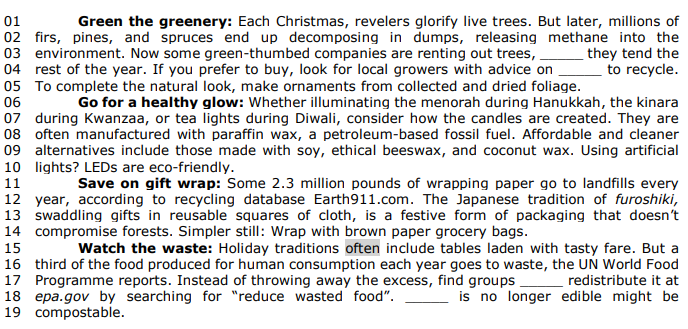
(Available at: https://www.nationalgeographic.com/environment/article/4-easy-ways-to-make-your-holidaysmore-eco-friendly – text especially adapted for this test).
I. Jane would have been a great architect if she had gone to the university. II. If you wake up late, you will miss the bus to school. III. I would go to medical school If I wasn’t afraid of blood. IV. If we let an ice cube under the sun it melts.
( ) Zero conditional ( ) First conditional ( ) Second conditional ( ) Third conditional
I. If I fall asleep, I will miss my favorite show. II. If water reaches a temperature of 212℉, it boils. III. If humans could fly, they would crash into each other in midair. IV. If the company mailed the check on time, he should get it on Monda.
( ) Zero conditional ( ) First conditional ( ) Second conditional ( ) Third conditional
I. Arthur has asked me to help him at the store. II. I was planning to get married in the autumn. III. On May 4th I arrived at a little town called Bistritz. IV. She had just left the room when the police arrived..
( ) Past Simple ( ) Past Continuous ( ) Past Perfect ( ) Present Perfect
I. I had read at least 50 books by the end of the semester. II. Jhon was looking for his wallet everywhere this morning. III. I have worked in this area for about 7 years now. IV. Last night she called me like a thousand times, that’s crazy.
( ) Past Simple ( ) Past Continuous ( ) Past Perfect ( ) Present Perfect
Use the following text to answer questions
TEXT
Homework: one word that makes the heart of many a parent sink and is guaranteed, at any given time, to be causing rows in homes around the world. The homework debate has raged for decades. How much homework should kids get? How involved should parents be? And does it really matter if it doesn't get done? Recent years have seen a swell of support for ditching homework altogether; more than one teacher has gone semi-viral for sharing a nohomework policy that prioritizes family time, outdoor play, and early bedtimes. And some schools have adopted no-homework programs, encouraging students to enjoy their evening free time and in some cases lengthening the school day to provide more classroom instruction.
Unbeknownst to many, there is an unofficial homework standard, the "10-minute rule" that was first proposed by Duke University psychology professor Harris Cooper and is supported by the National PTA and the National Education Association. It's simple: a daily maximum of 10 minutes of homework per grade level. (First graders do 10 minutes of homework each night; second graders do 20 minutes; third graders do 30 minutes, and so on.)
Cooper is responsible for the most comprehensive research on homework to date. His 2006 meta-analysis, published in the Review of Educational Research, found evidence that students who did homework performed better in school. However, the correlation was stronger for students in seventh through 12th grade. In earlier grades, the relationship between homework and performance was weak. But Cooper's analysis shows correlation, not causation. It begs the question: Does homework lead to achievement, or do high achievers simply do more homework? Undoubtedly, some kids are less likely to kick up a stink about doing homework than others. Others actually want to do homework. The point being, they're all different.
Complete the sentence below with the correct verbs. Choose the CORRECT answer.
“I _________ when the power _________ o
Complete the sentence below with the correct verbs. Choose the CORRECT answer.
“The tournament _________ when we _________ at the venue.”
“You are the last one to leave the house. Your mom writes you a note.”
What does it say?
“Luíza is a social worker. She _________ for an important NGO in Brazil.”
“My parents _________ to the supermarket. I don’t know when they are coming back.”

 Conheça nossos planos