Questões de Concurso Sobre inglês
Foram encontradas 26.151 questões


Read the Text II and answer the question that follow it.
Text II
Read the Text II and answer the question that follow it.
Text II
Read the Text II and answer the question that follow it.
Text II
( ) Evidence that plastics chemicals and different illnesses are closely related is scanty.
( ) Chemical mixtures in plastics may take unforeseen directions.
( ) Forthcoming documents ought to revamp earlier definitions of plastics.
The statements are, respectively,
Read the Text I and answer the question that follow it.
Text I
Correspondence
Human genome editing: potential seeds of conflict
Recently, The Lancet published an important declaration regarding the necessity of regulating and legislating for human genome editing. We agree with their opinions that the human genome editing technology and resulting research can have both positive and negative effects on human society. The use of genome editing for research and commercial purposes has sparked debates in both biological and political realms. However, most of them have mainly focused on the effects of human genome editing on the patients themselves, and little attention has been paid to their offspring.
Several films, such as Gattaca and Gundam SEED, have addressed the conflicts that arise from human genome editing. Such conflicts not only exist within the generation who have experienced editing but are also transmitted to their offspring. For example, in these films, the offspring of people without genome editing felt a sense of unfairness regarding the inferiority of their physical (or other non-edited domains) status, whereas the offspring of people with genome editing grew up in a biased, discriminated against, and ostracized environment. They could have lived in peace with a strong and well regulated government; however, when the tenuous grip of government weakens, jealousy and resentment can lead to ruins. Although these scenes still exist in films, they might become increasingly plausible in decades to come. Using the concept of preparedness, access, countermeasures, tools, and trust, we should prepare legitimate human genome editing, establish access to deal with imminent or potential discrimination, develop countermeasures and tools for prevention and resolution of conflict, and entrust future generations with the responsibility to use them wisely.
Bing-Yan Zeng, Ping-Tao Tseng, *Chih-Sung Liang
Adapted from: www.thelancet.com, vol. 401, June 24, 2023 at
https://www.thelancet.com/action/showPdf?pii=S0140-6736%2823%2901084-X
Read the Text I and answer the question that follow it.
Text I
Correspondence
Human genome editing: potential seeds of conflict
Recently, The Lancet published an important declaration regarding the necessity of regulating and legislating for human genome editing. We agree with their opinions that the human genome editing technology and resulting research can have both positive and negative effects on human society. The use of genome editing for research and commercial purposes has sparked debates in both biological and political realms. However, most of them have mainly focused on the effects of human genome editing on the patients themselves, and little attention has been paid to their offspring.
Several films, such as Gattaca and Gundam SEED, have addressed the conflicts that arise from human genome editing. Such conflicts not only exist within the generation who have experienced editing but are also transmitted to their offspring. For example, in these films, the offspring of people without genome editing felt a sense of unfairness regarding the inferiority of their physical (or other non-edited domains) status, whereas the offspring of people with genome editing grew up in a biased, discriminated against, and ostracized environment. They could have lived in peace with a strong and well regulated government; however, when the tenuous grip of government weakens, jealousy and resentment can lead to ruins. Although these scenes still exist in films, they might become increasingly plausible in decades to come. Using the concept of preparedness, access, countermeasures, tools, and trust, we should prepare legitimate human genome editing, establish access to deal with imminent or potential discrimination, develop countermeasures and tools for prevention and resolution of conflict, and entrust future generations with the responsibility to use them wisely.
Bing-Yan Zeng, Ping-Tao Tseng, *Chih-Sung Liang
Adapted from: www.thelancet.com, vol. 401, June 24, 2023 at
https://www.thelancet.com/action/showPdf?pii=S0140-6736%2823%2901084-X
I drink _________ coffee. I prefer tea. It is difficult to go to Maceió. There are ________ flights. Mark is very thin because he eats ________.
Choose the correct alternative:
Mary is away. She’s been away _____ Wednesday.
Read the text and answer the following question.
Do you assess your students or do you just test them?
[01] Assessment, evaluation, measurement, grades, tests, marks and so on. Different words to talk about the same issue. But, should they be used as synonyms?
[02] There are some terms that we often use synonymously, but actually they are not. When you assess your students, regardless of whether you use a test or not, you evaluate all the information in order to measure it and grade them.
[03] Let´s make it clear:
-Assessment implies gathering information and observing progress. We can document attitudes, knowledge and skills.
-Evaluation is the organisation of the data obtained during the assessment; for instance, using grids, checklist or diaries.
-Measurement is the scale we decide to use in order to measure the evaluation. We measure by marks, ranks or scores, among others.
-Grade is the number obtained in the measurement.
-Testing is a measuring tool. We can use a test, an examination or a quiz to challenge the student´s ability or knowledge.
[04] If you really want to assess your students and make it an active part of their own learning, promoting autonomy and metacognition, they have to know, from the very beginning, about the assessment, evaluation and grading criteria, as well as about the examinations, if there are going to be some.
[05] Assessment should be a continuous process, gathering information in every lesson and getting to know our students more and more each day, both their personal and academic profile. In order to evaluate this data, we can use simple checklists, a classroom diary, grids or similar instruments, as well as the activities themselves.
[06] When dealing with all of these tools you have to think carefully about how you are going to measure the information and how you are going to award the final grade. Moreover, you have to weigh up the benefits of testing your students with one or more quizzes and examinations.
[07] As we all know, changes are possible, and in many cases necessary, in order to adapt your theory to the actual development of the lessons. Nevertheless, all these aspects should be planned and clear from the very beginning, both for you and for your students. It could also be interesting to make them clear to the families, for instance using a classroom blog in which you can publish your evaluation methods and criteria.
[08] This could be a general example:
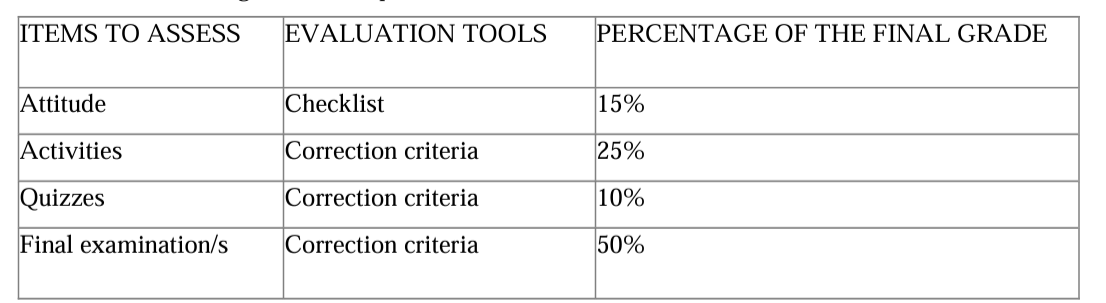
[09] From this general proposal, we would develop a checklist with items relating to attitude: participation, collaboration, deadline accomplishment, attendance, and so on. This is a progressive assessment.
[10] The activities should be corrected using different tools, depending on their nature. For example, it is not the same correcting a writing or a speaking activity (we can create grids for those, alone or with our students) than correcting a grammar exercise or a listening one (we can correct them using more traditional measuring scales or we could use peer evaluation). We would have to make all those criteria clear to our students before using them.
[11] Quizzes can be used in order to prepare our students for the final examination. We can use new technologies in order to introduce them, with tools such as Kahoot, Mentimeter, Socrative or Google Forms, among many others. They can create their own quizzes and games, in groups or individually in order to challenge their classmates.
[12] The final examination could be made up of more than one paper, for instance, we could divide it in two, or even in more items, in order to give them the opportunity to practise and avoid risking their final grade on just one exam.
[13] Apart from the possibility of dividing the final examination in two parts, another option would be to divide it according to different skills, for example, on the one hand, a test having to do with grammar, vocabulary, reading and writing and, on the other hand, another having to do with speaking and listening. Flipgrid could be a very useful tool to carry out your oral examinations in a less stressful way.
[14] Before I finish, although we haven´t given specific solutions to the complex problem of assessment, I would like to sum up with some general tips about the issue: -Necessity of an objective and continuous assessment.
-Necessity of an objective and continuous assessment.
-Use a variety of evaluation tools, not only for the exams, but also for the process: different types of activities, exams and corrections, to respond to every single student. That will make it less subjective.
-Make the evaluation and marking criteria clear to your students. You can make them part of the process, for example creating grids or checklists together.
-Introduce peer evaluation and self-asessment.
-Be prepared to adapt your planning when necessary.
[15] And remember, try to point out the positive aspects of your students´ achievements, don´t give them only feedback about their weak points, tell them about their strong points too and try to be quick in giving them back their exercises or exams results, otherwise they will have completely forgotten what they have written.
[16] The more you get to know your students, the more accurate your assessments will be, enabling them to obtain higher marks in your evaluations, tests, activities or examinations.
(Available at: https://www.teachingenglish.org.uk/professional-development/teachers/assessinglearners/magazine/do-you-assess-your-students-or-do-you Access on September 08, 2023)
Paragraph 12.
“The final examination could be made up of more than one paper, for instance, we could divide it in two, or even in more items, in order to give them the opportunity to practise and avoid risking their final grade on just one exam.”
The option that contains the correct synonyms replaced is:
Read the text and answer the following question.
Do you assess your students or do you just test them?
[01] Assessment, evaluation, measurement, grades, tests, marks and so on. Different words to talk about the same issue. But, should they be used as synonyms?
[02] There are some terms that we often use synonymously, but actually they are not. When you assess your students, regardless of whether you use a test or not, you evaluate all the information in order to measure it and grade them.
[03] Let´s make it clear:
-Assessment implies gathering information and observing progress. We can document attitudes, knowledge and skills.
-Evaluation is the organisation of the data obtained during the assessment; for instance, using grids, checklist or diaries.
-Measurement is the scale we decide to use in order to measure the evaluation. We measure by marks, ranks or scores, among others.
-Grade is the number obtained in the measurement.
-Testing is a measuring tool. We can use a test, an examination or a quiz to challenge the student´s ability or knowledge.
[04] If you really want to assess your students and make it an active part of their own learning, promoting autonomy and metacognition, they have to know, from the very beginning, about the assessment, evaluation and grading criteria, as well as about the examinations, if there are going to be some.
[05] Assessment should be a continuous process, gathering information in every lesson and getting to know our students more and more each day, both their personal and academic profile. In order to evaluate this data, we can use simple checklists, a classroom diary, grids or similar instruments, as well as the activities themselves.
[06] When dealing with all of these tools you have to think carefully about how you are going to measure the information and how you are going to award the final grade. Moreover, you have to weigh up the benefits of testing your students with one or more quizzes and examinations.
[07] As we all know, changes are possible, and in many cases necessary, in order to adapt your theory to the actual development of the lessons. Nevertheless, all these aspects should be planned and clear from the very beginning, both for you and for your students. It could also be interesting to make them clear to the families, for instance using a classroom blog in which you can publish your evaluation methods and criteria.
[08] This could be a general example:
[09] From this general proposal, we would develop a checklist with items relating to attitude: participation, collaboration, deadline accomplishment, attendance, and so on. This is a progressive assessment.
[10] The activities should be corrected using different tools, depending on their nature. For example, it is not the same correcting a writing or a speaking activity (we can create grids for those, alone or with our students) than correcting a grammar exercise or a listening one (we can correct them using more traditional measuring scales or we could use peer evaluation). We would have to make all those criteria clear to our students before using them.
[11] Quizzes can be used in order to prepare our students for the final examination. We can use new technologies in order to introduce them, with tools such as Kahoot, Mentimeter, Socrative or Google Forms, among many others. They can create their own quizzes and games, in groups or individually in order to challenge their classmates.
[12] The final examination could be made up of more than one paper, for instance, we could divide it in two, or even in more items, in order to give them the opportunity to practise and avoid risking their final grade on just one exam.
[13] Apart from the possibility of dividing the final examination in two parts, another option would be to divide it according to different skills, for example, on the one hand, a test having to do with grammar, vocabulary, reading and writing and, on the other hand, another having to do with speaking and listening. Flipgrid could be a very useful tool to carry out your oral examinations in a less stressful way.
[14] Before I finish, although we haven´t given specific solutions to the complex problem of assessment, I would like to sum up with some general tips about the issue: -Necessity of an objective and continuous assessment.
-Necessity of an objective and continuous assessment.
-Use a variety of evaluation tools, not only for the exams, but also for the process: different types of activities, exams and corrections, to respond to every single student. That will make it less subjective.
-Make the evaluation and marking criteria clear to your students. You can make them part of the process, for example creating grids or checklists together.
-Introduce peer evaluation and self-asessment.
-Be prepared to adapt your planning when necessary.
[15] And remember, try to point out the positive aspects of your students´ achievements, don´t give them only feedback about their weak points, tell them about their strong points too and try to be quick in giving them back their exercises or exams results, otherwise they will have completely forgotten what they have written.
[16] The more you get to know your students, the more accurate your assessments will be, enabling them to obtain higher marks in your evaluations, tests, activities or examinations.
(Available at: https://www.teachingenglish.org.uk/professional-development/teachers/assessinglearners/magazine/do-you-assess-your-students-or-do-you Access on September 08, 2023)
Paragraph 15.
“[...]And remember, try to point out the positive aspects of your students´ achievements [...]”
The term POINT (verb) + OUT (preposition) is a/na:
Read the text and answer the following question.
Do you assess your students or do you just test them?
[01] Assessment, evaluation, measurement, grades, tests, marks and so on. Different words to talk about the same issue. But, should they be used as synonyms?
[02] There are some terms that we often use synonymously, but actually they are not. When you assess your students, regardless of whether you use a test or not, you evaluate all the information in order to measure it and grade them.
[03] Let´s make it clear:
-Assessment implies gathering information and observing progress. We can document attitudes, knowledge and skills.
-Evaluation is the organisation of the data obtained during the assessment; for instance, using grids, checklist or diaries.
-Measurement is the scale we decide to use in order to measure the evaluation. We measure by marks, ranks or scores, among others.
-Grade is the number obtained in the measurement.
-Testing is a measuring tool. We can use a test, an examination or a quiz to challenge the student´s ability or knowledge.
[04] If you really want to assess your students and make it an active part of their own learning, promoting autonomy and metacognition, they have to know, from the very beginning, about the assessment, evaluation and grading criteria, as well as about the examinations, if there are going to be some.
[05] Assessment should be a continuous process, gathering information in every lesson and getting to know our students more and more each day, both their personal and academic profile. In order to evaluate this data, we can use simple checklists, a classroom diary, grids or similar instruments, as well as the activities themselves.
[06] When dealing with all of these tools you have to think carefully about how you are going to measure the information and how you are going to award the final grade. Moreover, you have to weigh up the benefits of testing your students with one or more quizzes and examinations.
[07] As we all know, changes are possible, and in many cases necessary, in order to adapt your theory to the actual development of the lessons. Nevertheless, all these aspects should be planned and clear from the very beginning, both for you and for your students. It could also be interesting to make them clear to the families, for instance using a classroom blog in which you can publish your evaluation methods and criteria.
[08] This could be a general example:
[09] From this general proposal, we would develop a checklist with items relating to attitude: participation, collaboration, deadline accomplishment, attendance, and so on. This is a progressive assessment.
[10] The activities should be corrected using different tools, depending on their nature. For example, it is not the same correcting a writing or a speaking activity (we can create grids for those, alone or with our students) than correcting a grammar exercise or a listening one (we can correct them using more traditional measuring scales or we could use peer evaluation). We would have to make all those criteria clear to our students before using them.
[11] Quizzes can be used in order to prepare our students for the final examination. We can use new technologies in order to introduce them, with tools such as Kahoot, Mentimeter, Socrative or Google Forms, among many others. They can create their own quizzes and games, in groups or individually in order to challenge their classmates.
[12] The final examination could be made up of more than one paper, for instance, we could divide it in two, or even in more items, in order to give them the opportunity to practise and avoid risking their final grade on just one exam.
[13] Apart from the possibility of dividing the final examination in two parts, another option would be to divide it according to different skills, for example, on the one hand, a test having to do with grammar, vocabulary, reading and writing and, on the other hand, another having to do with speaking and listening. Flipgrid could be a very useful tool to carry out your oral examinations in a less stressful way.
[14] Before I finish, although we haven´t given specific solutions to the complex problem of assessment, I would like to sum up with some general tips about the issue: -Necessity of an objective and continuous assessment.
-Necessity of an objective and continuous assessment.
-Use a variety of evaluation tools, not only for the exams, but also for the process: different types of activities, exams and corrections, to respond to every single student. That will make it less subjective.
-Make the evaluation and marking criteria clear to your students. You can make them part of the process, for example creating grids or checklists together.
-Introduce peer evaluation and self-asessment.
-Be prepared to adapt your planning when necessary.
[15] And remember, try to point out the positive aspects of your students´ achievements, don´t give them only feedback about their weak points, tell them about their strong points too and try to be quick in giving them back their exercises or exams results, otherwise they will have completely forgotten what they have written.
[16] The more you get to know your students, the more accurate your assessments will be, enabling them to obtain higher marks in your evaluations, tests, activities or examinations.
(Available at: https://www.teachingenglish.org.uk/professional-development/teachers/assessinglearners/magazine/do-you-assess-your-students-or-do-you Access on September 08, 2023)
Paragraph 14.
The passage below presents a _____________ tense structure.
“[...] we haven´t given specific solutions to the complex problem of assessment[...]”
Read the text and answer the following question.
Do you assess your students or do you just test them?
[01] Assessment, evaluation, measurement, grades, tests, marks and so on. Different words to talk about the same issue. But, should they be used as synonyms?
[02] There are some terms that we often use synonymously, but actually they are not. When you assess your students, regardless of whether you use a test or not, you evaluate all the information in order to measure it and grade them.
[03] Let´s make it clear:
-Assessment implies gathering information and observing progress. We can document attitudes, knowledge and skills.
-Evaluation is the organisation of the data obtained during the assessment; for instance, using grids, checklist or diaries.
-Measurement is the scale we decide to use in order to measure the evaluation. We measure by marks, ranks or scores, among others.
-Grade is the number obtained in the measurement.
-Testing is a measuring tool. We can use a test, an examination or a quiz to challenge the student´s ability or knowledge.
[04] If you really want to assess your students and make it an active part of their own learning, promoting autonomy and metacognition, they have to know, from the very beginning, about the assessment, evaluation and grading criteria, as well as about the examinations, if there are going to be some.
[05] Assessment should be a continuous process, gathering information in every lesson and getting to know our students more and more each day, both their personal and academic profile. In order to evaluate this data, we can use simple checklists, a classroom diary, grids or similar instruments, as well as the activities themselves.
[06] When dealing with all of these tools you have to think carefully about how you are going to measure the information and how you are going to award the final grade. Moreover, you have to weigh up the benefits of testing your students with one or more quizzes and examinations.
[07] As we all know, changes are possible, and in many cases necessary, in order to adapt your theory to the actual development of the lessons. Nevertheless, all these aspects should be planned and clear from the very beginning, both for you and for your students. It could also be interesting to make them clear to the families, for instance using a classroom blog in which you can publish your evaluation methods and criteria.
[08] This could be a general example:
[09] From this general proposal, we would develop a checklist with items relating to attitude: participation, collaboration, deadline accomplishment, attendance, and so on. This is a progressive assessment.
[10] The activities should be corrected using different tools, depending on their nature. For example, it is not the same correcting a writing or a speaking activity (we can create grids for those, alone or with our students) than correcting a grammar exercise or a listening one (we can correct them using more traditional measuring scales or we could use peer evaluation). We would have to make all those criteria clear to our students before using them.
[11] Quizzes can be used in order to prepare our students for the final examination. We can use new technologies in order to introduce them, with tools such as Kahoot, Mentimeter, Socrative or Google Forms, among many others. They can create their own quizzes and games, in groups or individually in order to challenge their classmates.
[12] The final examination could be made up of more than one paper, for instance, we could divide it in two, or even in more items, in order to give them the opportunity to practise and avoid risking their final grade on just one exam.
[13] Apart from the possibility of dividing the final examination in two parts, another option would be to divide it according to different skills, for example, on the one hand, a test having to do with grammar, vocabulary, reading and writing and, on the other hand, another having to do with speaking and listening. Flipgrid could be a very useful tool to carry out your oral examinations in a less stressful way.
[14] Before I finish, although we haven´t given specific solutions to the complex problem of assessment, I would like to sum up with some general tips about the issue: -Necessity of an objective and continuous assessment.
-Necessity of an objective and continuous assessment.
-Use a variety of evaluation tools, not only for the exams, but also for the process: different types of activities, exams and corrections, to respond to every single student. That will make it less subjective.
-Make the evaluation and marking criteria clear to your students. You can make them part of the process, for example creating grids or checklists together.
-Introduce peer evaluation and self-asessment.
-Be prepared to adapt your planning when necessary.
[15] And remember, try to point out the positive aspects of your students´ achievements, don´t give them only feedback about their weak points, tell them about their strong points too and try to be quick in giving them back their exercises or exams results, otherwise they will have completely forgotten what they have written.
[16] The more you get to know your students, the more accurate your assessments will be, enabling them to obtain higher marks in your evaluations, tests, activities or examinations.
(Available at: https://www.teachingenglish.org.uk/professional-development/teachers/assessinglearners/magazine/do-you-assess-your-students-or-do-you Access on September 08, 2023)
Read the text and answer the following question.
Cultural behaviour in business
Much of today's business is conducted across international borders, and while the majority of the global business community might _______ the use of English as a common language, the nuances and expectations of business communication might differ greatly from culture to culture. A lack of understanding of the cultural norms and practices of our business acquaintances can result in unfair judgments, misunderstandings and breakdowns in communication. Here are three basic areas of differences in business etiquette around the world that could help stand you in good stead when you next find yourself working with someone from a different culture.
Addressing someone
When discussing this topic in a training course, a German trainee and a British trainee got into a hot debate about _______ it was appropriate for someone with a doctorate to use the corresponding title on their business card. The British trainee maintained that anyone who wasn't a medical doctor expecting to be addressed as 'Dr' was disgustingly pompous and full of themselves. The German trainee, however, argued that the hard work and years of education put into earning that PhD should give them full rights to expect to be addressed as 'Dr'.
This stark difference in opinion over something that could be conceived as minor and thus easily _______ goes to show that we often attach meaning to even the most mundane practices. When things that we are used to are done differently, it could spark the strongest reactions in us. While many Continental Europeans and Latin Americans prefer to be addressed with a title, for example Mr or Ms and their surname when meeting someone in a business context for the first time, Americans, and increasingly the British, now tend to prefer using their first names. The best thing to do is to listen and observe how your conversation partner addresses you and, if you are still unsure, do not be afraid to ask them how they would like to be addressed.
Smiling
A famous Russian proverb states that 'a smile without reason is a sign of idiocy' and a so-called 'smile of respect' is seen as insincere and often regarded with suspicion in Russia. Yet in countries like the United States, Australia and Britain, smiling is often interpreted as a sign of openness, friendship and respect, and is frequently used to break the ice.
In a piece of research done on smiles across cultures, the researchers found that smiling individuals were considered more intelligent than non-smiling people in countries such as Germany, Switzerland, China and Malaysia. However, in countries like Russia, Japan, South Korea and Iran, pictures of smiling faces were rated as less intelligent than the non-smiling ones. Meanwhile, in countries like India, Argentina and the Maldives, smiling was associated with dishonesty.
Eye contact
An American or British person might be looking their client in the eye to show that they are paying full attention to what is being said, but if that client is from Japan or Korea, they might find the direct eye contact awkward or even disrespectful. In parts of South America and Africa, _______ eye contact could also be seen as challenging authority. In the Middle East, eye contact across genders is considered inappropriate, although eye contact within a gender could signify honesty and truthfulness.
Having an increased awareness of the possible differences in expectations and _______ can help us avoid cases of miscommunication, but it is vital that we also remember that cultural stereotypes can be detrimental to building good business relationships. Although national cultures could play a part in shaping the way we behave and think, we are also largely influenced by the region we come from, the communities we associate with, our age and gender, our corporate culture and our individual experiences of the world. The knowledge of the potential differences should therefore be something we keep at the back of our minds, rather than something that we use to pigeonhole the individuals of an entire nation.
(Available at: https://learnenglish.britishcouncil.org/skills/reading/c1-reading/cultural-behaviour-business, Accessed September, 2023)
Read the excerpt.
“The knowledge of the potential differences should therefore be something we keep at the back of our minds, rather than something that we use to pigeonhole the individuals of an entire nation.”
The synonym for “therefore” is:
Read the text and answer the following question.
Cultural behaviour in business
Much of today's business is conducted across international borders, and while the majority of the global business community might _______ the use of English as a common language, the nuances and expectations of business communication might differ greatly from culture to culture. A lack of understanding of the cultural norms and practices of our business acquaintances can result in unfair judgments, misunderstandings and breakdowns in communication. Here are three basic areas of differences in business etiquette around the world that could help stand you in good stead when you next find yourself working with someone from a different culture.
Addressing someone
When discussing this topic in a training course, a German trainee and a British trainee got into a hot debate about _______ it was appropriate for someone with a doctorate to use the corresponding title on their business card. The British trainee maintained that anyone who wasn't a medical doctor expecting to be addressed as 'Dr' was disgustingly pompous and full of themselves. The German trainee, however, argued that the hard work and years of education put into earning that PhD should give them full rights to expect to be addressed as 'Dr'.
This stark difference in opinion over something that could be conceived as minor and thus easily _______ goes to show that we often attach meaning to even the most mundane practices. When things that we are used to are done differently, it could spark the strongest reactions in us. While many Continental Europeans and Latin Americans prefer to be addressed with a title, for example Mr or Ms and their surname when meeting someone in a business context for the first time, Americans, and increasingly the British, now tend to prefer using their first names. The best thing to do is to listen and observe how your conversation partner addresses you and, if you are still unsure, do not be afraid to ask them how they would like to be addressed.
Smiling
A famous Russian proverb states that 'a smile without reason is a sign of idiocy' and a so-called 'smile of respect' is seen as insincere and often regarded with suspicion in Russia. Yet in countries like the United States, Australia and Britain, smiling is often interpreted as a sign of openness, friendship and respect, and is frequently used to break the ice.
In a piece of research done on smiles across cultures, the researchers found that smiling individuals were considered more intelligent than non-smiling people in countries such as Germany, Switzerland, China and Malaysia. However, in countries like Russia, Japan, South Korea and Iran, pictures of smiling faces were rated as less intelligent than the non-smiling ones. Meanwhile, in countries like India, Argentina and the Maldives, smiling was associated with dishonesty.
Eye contact
An American or British person might be looking their client in the eye to show that they are paying full attention to what is being said, but if that client is from Japan or Korea, they might find the direct eye contact awkward or even disrespectful. In parts of South America and Africa, _______ eye contact could also be seen as challenging authority. In the Middle East, eye contact across genders is considered inappropriate, although eye contact within a gender could signify honesty and truthfulness.
Having an increased awareness of the possible differences in expectations and _______ can help us avoid cases of miscommunication, but it is vital that we also remember that cultural stereotypes can be detrimental to building good business relationships. Although national cultures could play a part in shaping the way we behave and think, we are also largely influenced by the region we come from, the communities we associate with, our age and gender, our corporate culture and our individual experiences of the world. The knowledge of the potential differences should therefore be something we keep at the back of our minds, rather than something that we use to pigeonhole the individuals of an entire nation.
(Available at: https://learnenglish.britishcouncil.org/skills/reading/c1-reading/cultural-behaviour-business, Accessed September, 2023)
Read the excerpt.
“A lack of understanding of the cultural norms and practices of our business acquaintances can result in unfair judgments, misunderstandings and breakdowns in communication.” The word “ acquaintances”, according to its definition, refers to:
Read the text and answer the following question.
Cultural behaviour in business
Much of today's business is conducted across international borders, and while the majority of the global business community might _______ the use of English as a common language, the nuances and expectations of business communication might differ greatly from culture to culture. A lack of understanding of the cultural norms and practices of our business acquaintances can result in unfair judgments, misunderstandings and breakdowns in communication. Here are three basic areas of differences in business etiquette around the world that could help stand you in good stead when you next find yourself working with someone from a different culture.
Addressing someone
When discussing this topic in a training course, a German trainee and a British trainee got into a hot debate about _______ it was appropriate for someone with a doctorate to use the corresponding title on their business card. The British trainee maintained that anyone who wasn't a medical doctor expecting to be addressed as 'Dr' was disgustingly pompous and full of themselves. The German trainee, however, argued that the hard work and years of education put into earning that PhD should give them full rights to expect to be addressed as 'Dr'.
This stark difference in opinion over something that could be conceived as minor and thus easily _______ goes to show that we often attach meaning to even the most mundane practices. When things that we are used to are done differently, it could spark the strongest reactions in us. While many Continental Europeans and Latin Americans prefer to be addressed with a title, for example Mr or Ms and their surname when meeting someone in a business context for the first time, Americans, and increasingly the British, now tend to prefer using their first names. The best thing to do is to listen and observe how your conversation partner addresses you and, if you are still unsure, do not be afraid to ask them how they would like to be addressed.
Smiling
A famous Russian proverb states that 'a smile without reason is a sign of idiocy' and a so-called 'smile of respect' is seen as insincere and often regarded with suspicion in Russia. Yet in countries like the United States, Australia and Britain, smiling is often interpreted as a sign of openness, friendship and respect, and is frequently used to break the ice.
In a piece of research done on smiles across cultures, the researchers found that smiling individuals were considered more intelligent than non-smiling people in countries such as Germany, Switzerland, China and Malaysia. However, in countries like Russia, Japan, South Korea and Iran, pictures of smiling faces were rated as less intelligent than the non-smiling ones. Meanwhile, in countries like India, Argentina and the Maldives, smiling was associated with dishonesty.
Eye contact
An American or British person might be looking their client in the eye to show that they are paying full attention to what is being said, but if that client is from Japan or Korea, they might find the direct eye contact awkward or even disrespectful. In parts of South America and Africa, _______ eye contact could also be seen as challenging authority. In the Middle East, eye contact across genders is considered inappropriate, although eye contact within a gender could signify honesty and truthfulness.
Having an increased awareness of the possible differences in expectations and _______ can help us avoid cases of miscommunication, but it is vital that we also remember that cultural stereotypes can be detrimental to building good business relationships. Although national cultures could play a part in shaping the way we behave and think, we are also largely influenced by the region we come from, the communities we associate with, our age and gender, our corporate culture and our individual experiences of the world. The knowledge of the potential differences should therefore be something we keep at the back of our minds, rather than something that we use to pigeonhole the individuals of an entire nation.
(Available at: https://learnenglish.britishcouncil.org/skills/reading/c1-reading/cultural-behaviour-business, Accessed September, 2023)
Read the sentences below.
I. I’m ready to paint the town red with my best friends.
II. Being always busy is part and parcel of my occupation.
III. Don’t you call me a liar - that’s the pot calling the kettle black.
IV. I shouldn’t have trusted you my secret. You’ve let the cat out of the bag again!
V. He never wears his heart on his sleeve so it’s hard to tell what he’s feeling.
Now mark the option that contains the accordingly definition:
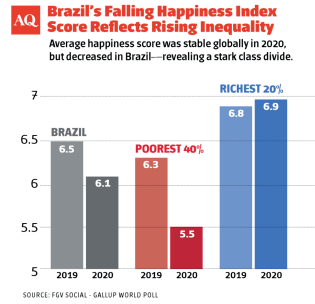
Disponível em: www.americasquarterly.org/article/inequality-is-
-brazils-achilles-heel/. Acesso em: 07 nov. 2023. (Adaptado)
Disponível em: www.americasquarterly.org/article/inequality-is-
-brazils-achilles-heel/. Acesso em: 07 nov. 2023. (Adaptado)

 Conheça nossos planos