Questões de Concurso Sobre inglês
Foram encontradas 26.136 questões


“There aren’t ______ chairs in the classroom, so some students will have to stand.”
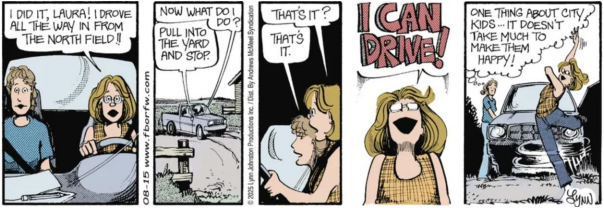
For Better or For Worse, August 15th, 2025, Available at: https://www.gocomics.com/forbetterorforworse/2025/08/15
In panel 4, Laura thinks: “One thing about city kids… it doesn’t take much to make them happy!” The expression “city kid” most nearly means:
“The department will buy 20 tablets for the field team.”
Choose the option that best replaces “buy” without changing the meaning.
MAHDAWI, Arwa. Tipping culture in the US is out of control – we’re even asked to tip self-checkouts. The Guardian, 16 ago. 2023. Disponível em: https://www.theguardian.com Acesso em: 18 ago. 2025.
According to US cultural norms, what is generally considered appropriate tipping behavior?
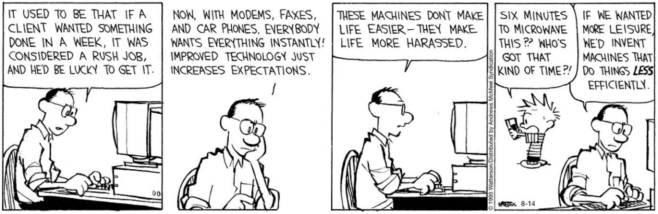 Watterson, Bill. “Calvin and Hobbes.” GoComics. https://www.gocomics.com/calvinandhobbes/2025/08/14. Accessed August 17,
 In “If we wanted more leisure, we’d invent machines that do things less efficiently,” which conditional structure is used?
Read the following news report to answer question.
Air Canada flights will resume on Sunday after the government ordered cabin crew to end a strike that caused hundreds of cancellations.
The Canadian Industrial Relations Board (CIRB) instructed staff to return to work and extended the collective agreement that had expired on 31 March until a new one is negotiated. Jobs Minister Patty Hajdu invoked Section 107 of the Canada Labour Code, imposing binding arbitration after more than 10,000 flight attendants walked out, leading to about 700 cancellations.
The union accused the government of “caving to corporate pressure” and reiterated demands for higher salaries and payment for ground duties. Air Canada said it had suspended all flights, including those operated by its budget arm Rouge, and warned that full normalization could take several days[...]
Hajdu stated that “stability and supply chains” had to be preserved, while the parties had been “unable to resolve their differences in a timely manner.”[...] The Canadian Union of Public Employees (CUPE) criticized the intervention as a violation of charter rights, claiming it would cause “incalculable damage” to workers’ interests.
BBC News. Air Canada flights to resume after union told to end strike. Published on August 17, 2025. Available at: BBC News. Accessed on August 17, 2025.
Read the following news report to answer question.
Air Canada flights will resume on Sunday after the government ordered cabin crew to end a strike that caused hundreds of cancellations.
The Canadian Industrial Relations Board (CIRB) instructed staff to return to work and extended the collective agreement that had expired on 31 March until a new one is negotiated. Jobs Minister Patty Hajdu invoked Section 107 of the Canada Labour Code, imposing binding arbitration after more than 10,000 flight attendants walked out, leading to about 700 cancellations.
The union accused the government of “caving to corporate pressure” and reiterated demands for higher salaries and payment for ground duties. Air Canada said it had suspended all flights, including those operated by its budget arm Rouge, and warned that full normalization could take several days[...]
Hajdu stated that “stability and supply chains” had to be preserved, while the parties had been “unable to resolve their differences in a timely manner.”[...] The Canadian Union of Public Employees (CUPE) criticized the intervention as a violation of charter rights, claiming it would cause “incalculable damage” to workers’ interests.
BBC News. Air Canada flights to resume after union told to end strike. Published on August 17, 2025. Available at: BBC News. Accessed on August 17, 2025.
Read the following news report to answer question.
Air Canada flights will resume on Sunday after the government ordered cabin crew to end a strike that caused hundreds of cancellations.
The Canadian Industrial Relations Board (CIRB) instructed staff to return to work and extended the collective agreement that had expired on 31 March until a new one is negotiated. Jobs Minister Patty Hajdu invoked Section 107 of the Canada Labour Code, imposing binding arbitration after more than 10,000 flight attendants walked out, leading to about 700 cancellations.
The union accused the government of “caving to corporate pressure” and reiterated demands for higher salaries and payment for ground duties. Air Canada said it had suspended all flights, including those operated by its budget arm Rouge, and warned that full normalization could take several days[...]
Hajdu stated that “stability and supply chains” had to be preserved, while the parties had been “unable to resolve their differences in a timely manner.”[...] The Canadian Union of Public Employees (CUPE) criticized the intervention as a violation of charter rights, claiming it would cause “incalculable damage” to workers’ interests.
BBC News. Air Canada flights to resume after union told to end strike. Published on August 17, 2025. Available at: BBC News. Accessed on August 17, 2025.
Read the following news report to answer question.
Air Canada flights will resume on Sunday after the government ordered cabin crew to end a strike that caused hundreds of cancellations.
The Canadian Industrial Relations Board (CIRB) instructed staff to return to work and extended the collective agreement that had expired on 31 March until a new one is negotiated. Jobs Minister Patty Hajdu invoked Section 107 of the Canada Labour Code, imposing binding arbitration after more than 10,000 flight attendants walked out, leading to about 700 cancellations.
The union accused the government of “caving to corporate pressure” and reiterated demands for higher salaries and payment for ground duties. Air Canada said it had suspended all flights, including those operated by its budget arm Rouge, and warned that full normalization could take several days[...]
Hajdu stated that “stability and supply chains” had to be preserved, while the parties had been “unable to resolve their differences in a timely manner.”[...] The Canadian Union of Public Employees (CUPE) criticized the intervention as a violation of charter rights, claiming it would cause “incalculable damage” to workers’ interests.
BBC News. Air Canada flights to resume after union told to end strike. Published on August 17, 2025. Available at: BBC News. Accessed on August 17, 2025.
Read the following news report to answer question.
Air Canada flights will resume on Sunday after the government ordered cabin crew to end a strike that caused hundreds of cancellations.
The Canadian Industrial Relations Board (CIRB) instructed staff to return to work and extended the collective agreement that had expired on 31 March until a new one is negotiated. Jobs Minister Patty Hajdu invoked Section 107 of the Canada Labour Code, imposing binding arbitration after more than 10,000 flight attendants walked out, leading to about 700 cancellations.
The union accused the government of “caving to corporate pressure” and reiterated demands for higher salaries and payment for ground duties. Air Canada said it had suspended all flights, including those operated by its budget arm Rouge, and warned that full normalization could take several days[...]
Hajdu stated that “stability and supply chains” had to be preserved, while the parties had been “unable to resolve their differences in a timely manner.”[...] The Canadian Union of Public Employees (CUPE) criticized the intervention as a violation of charter rights, claiming it would cause “incalculable damage” to workers’ interests.
BBC News. Air Canada flights to resume after union told to end strike. Published on August 17, 2025. Available at: BBC News. Accessed on August 17, 2025.
"The unhappiness of the restructured employees was predictable."
How many bound morphemes are present in this sentence?
"Although the research team had anticipated positive results, the data revealed significant anomalies that challenged their initial hypothesis."
This sentence exemplifies:

 Conheça nossos planos