Questões de Concurso Sobre inglês
Foram encontradas 25.478 questões


Q55457
Inglês
Texto associado
Answer questions 11, 12 and 13 based on the
newspaper article below.
Lessons in using the internet safely are set to
become a compulsory part of the curriculum for
primary school children in England from 2011.
The lessons are one element of a new government
strategy being unveiled called "Click Clever, Click Safe".
Children will also be encouraged to follow an online
"Green Cross Code" and block and report inappropriate
content.
"We must ensure that this virtual world is safe for our
children just as we try to ensure that the real world is,"
said Prime Minister Gordon Brown at the launch of the
campaign.
"The internet is a wonderful and powerful tool that is
changing the way we learn and the way we stay in touch,"
he added, "but unfortunately there are risks from those
intent on exploiting its benefits."
Fonte: http://news.bbc.co.uk/ December, 2009.
newspaper article below.
Lessons in using the internet safely are set to
become a compulsory part of the curriculum for
primary school children in England from 2011.
The lessons are one element of a new government
strategy being unveiled called "Click Clever, Click Safe".
Children will also be encouraged to follow an online
"Green Cross Code" and block and report inappropriate
content.
"We must ensure that this virtual world is safe for our
children just as we try to ensure that the real world is,"
said Prime Minister Gordon Brown at the launch of the
campaign.
"The internet is a wonderful and powerful tool that is
changing the way we learn and the way we stay in touch,"
he added, "but unfortunately there are risks from those
intent on exploiting its benefits."
Fonte: http://news.bbc.co.uk/ December, 2009.
The Direct Speech sentence said by Prime Minister Gordon Brown "The internet is a wonderful and powerful tool that is changing the way we learn and the way we stay in touch," is equivalent to which sentence in Indirect Speech? Choose from the options below.
Q55456
Inglês
Texto associado
Answer questions 11, 12 and 13 based on the
newspaper article below.
Lessons in using the internet safely are set to
become a compulsory part of the curriculum for
primary school children in England from 2011.
The lessons are one element of a new government
strategy being unveiled called "Click Clever, Click Safe".
Children will also be encouraged to follow an online
"Green Cross Code" and block and report inappropriate
content.
"We must ensure that this virtual world is safe for our
children just as we try to ensure that the real world is,"
said Prime Minister Gordon Brown at the launch of the
campaign.
"The internet is a wonderful and powerful tool that is
changing the way we learn and the way we stay in touch,"
he added, "but unfortunately there are risks from those
intent on exploiting its benefits."
Fonte: http://news.bbc.co.uk/ December, 2009.
newspaper article below.
Lessons in using the internet safely are set to
become a compulsory part of the curriculum for
primary school children in England from 2011.
The lessons are one element of a new government
strategy being unveiled called "Click Clever, Click Safe".
Children will also be encouraged to follow an online
"Green Cross Code" and block and report inappropriate
content.
"We must ensure that this virtual world is safe for our
children just as we try to ensure that the real world is,"
said Prime Minister Gordon Brown at the launch of the
campaign.
"The internet is a wonderful and powerful tool that is
changing the way we learn and the way we stay in touch,"
he added, "but unfortunately there are risks from those
intent on exploiting its benefits."
Fonte: http://news.bbc.co.uk/ December, 2009.
The sentence "Lessons in using the internet safely" could be appropriately replaced by:
Ano: 2010
Banca:
FGV
Órgão:
CODESP-SP
Provas:
FGV - 2010 - CODESP-SP - Advogado - Tipo 1
|
FGV - 2010 - CODESP-SP - Analista de Sistemas - Tipo 1 |
FGV - 2010 - CODESP-SP - Administrador |
FGV - 2010 - CODESP-SP - Economista - Tipo 1 |
Q54797
Inglês
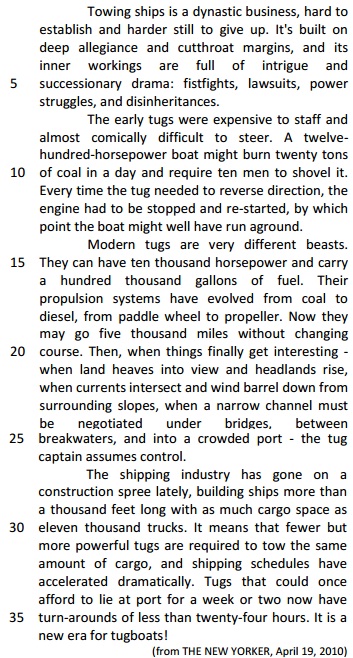
From the passage as a whole we infer that
Ano: 2010
Banca:
FGV
Órgão:
CODESP-SP
Provas:
FGV - 2010 - CODESP-SP - Advogado - Tipo 1
|
FGV - 2010 - CODESP-SP - Analista de Sistemas - Tipo 1 |
FGV - 2010 - CODESP-SP - Administrador |
FGV - 2010 - CODESP-SP - Economista - Tipo 1 |
Q54796
Inglês
According to paragraph 4,
Ano: 2010
Banca:
FGV
Órgão:
CODESP-SP
Provas:
FGV - 2010 - CODESP-SP - Advogado - Tipo 1
|
FGV - 2010 - CODESP-SP - Analista de Sistemas - Tipo 1 |
FGV - 2010 - CODESP-SP - Administrador |
FGV - 2010 - CODESP-SP - Economista - Tipo 1 |
Q54795
Inglês
According to paragraph 3, when things finally get interesting, the tug captain
Ano: 2010
Banca:
FGV
Órgão:
CODESP-SP
Provas:
FGV - 2010 - CODESP-SP - Advogado - Tipo 1
|
FGV - 2010 - CODESP-SP - Analista de Sistemas - Tipo 1 |
FGV - 2010 - CODESP-SP - Administrador |
FGV - 2010 - CODESP-SP - Economista - Tipo 1 |
Q54794
Inglês
In the passage, breakwaters (line 25) means
Ano: 2010
Banca:
FGV
Órgão:
CODESP-SP
Provas:
FGV - 2010 - CODESP-SP - Advogado - Tipo 1
|
FGV - 2010 - CODESP-SP - Analista de Sistemas - Tipo 1 |
FGV - 2010 - CODESP-SP - Administrador |
FGV - 2010 - CODESP-SP - Economista - Tipo 1 |
Q54792
Inglês
According to lines 20 to 26, we apprehend that things finally get interesting when the land and headlands
Ano: 2010
Banca:
FGV
Órgão:
CODESP-SP
Provas:
FGV - 2010 - CODESP-SP - Advogado - Tipo 1
|
FGV - 2010 - CODESP-SP - Analista de Sistemas - Tipo 1 |
FGV - 2010 - CODESP-SP - Administrador |
FGV - 2010 - CODESP-SP - Economista - Tipo 1 |
Q54791
Inglês
According to paragraph 2, the first tugs
Ano: 2010
Banca:
FGV
Órgão:
CODESP-SP
Provas:
FGV - 2010 - CODESP-SP - Advogado - Tipo 1
|
FGV - 2010 - CODESP-SP - Analista de Sistemas - Tipo 1 |
FGV - 2010 - CODESP-SP - Administrador |
FGV - 2010 - CODESP-SP - Economista - Tipo 1 |
Q54790
Inglês
From paragraph 2 we deduce that
Ano: 2010
Banca:
FGV
Órgão:
CODESP-SP
Provas:
FGV - 2010 - CODESP-SP - Advogado - Tipo 1
|
FGV - 2010 - CODESP-SP - Analista de Sistemas - Tipo 1 |
FGV - 2010 - CODESP-SP - Administrador |
FGV - 2010 - CODESP-SP - Economista - Tipo 1 |
Q54789
Inglês
According to lines 1 to 6, all the following issues are likely to be inherent in the tugboating business, EXCEPT
Ano: 2010
Banca:
FGV
Órgão:
CODESP-SP
Provas:
FGV - 2010 - CODESP-SP - Advogado - Tipo 1
|
FGV - 2010 - CODESP-SP - Analista de Sistemas - Tipo 1 |
FGV - 2010 - CODESP-SP - Administrador |
FGV - 2010 - CODESP-SP - Economista - Tipo 1 |
Q54788
Inglês
From lines 1 to 6 we infer that towing ships is a business which
Ano: 2010
Banca:
ESAF
Órgão:
MPO
Prova:
ESAF - 2010 - MPOG - Analista de Planejamento e Orçamento - Prova 1 |
Q45365
Inglês
Texto associado
Text 3
Source: http://www.forbes.com/2009/10/12/brazil-etf-emerging-intelligentinvesting-markets.html
Buy Into Brazil
David Serchuk [For bes Magazine]
There's a lot to like about South America's biggest
economy. Hosting the Olympics and World Cup doesn't
hurt either.
Suddenly everyone is talking about Brazil. This makes sense considering that the colossus of South America out-hustled President Obama and his hometown of Chicago to land the 2016 Olympics. It has also benefi ted by being the "B" part of the BRIC group of emerging nations, in addition to Russia, India and China. It's an emerging power that some investors have just learned about, though the pros have been hip to it for some time.
From 2003 through 2007, Brazil ran record trade surpluses, and its gross domestic product, at $1.99 trillion, is the 10th largest in the world. It has large and well- developed agricultural, mining, manufacturing and service sectors, and its conomy is bigger than all other nations in South America combined. Brazil is expanding its presence in world markets and, as we have seen, the world's playing fi elds.
There are also some signifi cant drawbacks to Brazil. Despite its potent GDP, rampant income inequality means that its per capita wealth is 102nd in the world, slightly behind the global average and noted powerhouse Serbia. Brazil's richest 10% reaps 43% of its wealth; in the U.S. that number is 30%. Brazil's bottom 10% earns a minuscule 1.1%. Still, there is a lot to like here, and our industry observers are ready to buy.
Source: http://www.forbes.com/2009/10/12/brazil-etf-emerging-intelligentinvesting-markets.html
Buy Into Brazil
David Serchuk [For bes Magazine]
There's a lot to like about South America's biggest
economy. Hosting the Olympics and World Cup doesn't
hurt either.
Suddenly everyone is talking about Brazil. This makes sense considering that the colossus of South America out-hustled President Obama and his hometown of Chicago to land the 2016 Olympics. It has also benefi ted by being the "B" part of the BRIC group of emerging nations, in addition to Russia, India and China. It's an emerging power that some investors have just learned about, though the pros have been hip to it for some time.
From 2003 through 2007, Brazil ran record trade surpluses, and its gross domestic product, at $1.99 trillion, is the 10th largest in the world. It has large and well- developed agricultural, mining, manufacturing and service sectors, and its conomy is bigger than all other nations in South America combined. Brazil is expanding its presence in world markets and, as we have seen, the world's playing fi elds.
There are also some signifi cant drawbacks to Brazil. Despite its potent GDP, rampant income inequality means that its per capita wealth is 102nd in the world, slightly behind the global average and noted powerhouse Serbia. Brazil's richest 10% reaps 43% of its wealth; in the U.S. that number is 30%. Brazil's bottom 10% earns a minuscule 1.1%. Still, there is a lot to like here, and our industry observers are ready to buy.
Calling Brazil "the "B" part of the BRIC group of emerging nations" [paragraph 1 line 4], indicates that
Ano: 2010
Banca:
ESAF
Órgão:
MPO
Prova:
ESAF - 2010 - MPOG - Analista de Planejamento e Orçamento - Prova 1 |
Q45364
Inglês
Texto associado
Text 3
Source: http://www.forbes.com/2009/10/12/brazil-etf-emerging-intelligentinvesting-markets.html
Buy Into Brazil
David Serchuk [For bes Magazine]
There's a lot to like about South America's biggest
economy. Hosting the Olympics and World Cup doesn't
hurt either.
Suddenly everyone is talking about Brazil. This makes sense considering that the colossus of South America out-hustled President Obama and his hometown of Chicago to land the 2016 Olympics. It has also benefi ted by being the "B" part of the BRIC group of emerging nations, in addition to Russia, India and China. It's an emerging power that some investors have just learned about, though the pros have been hip to it for some time.
From 2003 through 2007, Brazil ran record trade surpluses, and its gross domestic product, at $1.99 trillion, is the 10th largest in the world. It has large and well- developed agricultural, mining, manufacturing and service sectors, and its conomy is bigger than all other nations in South America combined. Brazil is expanding its presence in world markets and, as we have seen, the world's playing fi elds.
There are also some signifi cant drawbacks to Brazil. Despite its potent GDP, rampant income inequality means that its per capita wealth is 102nd in the world, slightly behind the global average and noted powerhouse Serbia. Brazil's richest 10% reaps 43% of its wealth; in the U.S. that number is 30%. Brazil's bottom 10% earns a minuscule 1.1%. Still, there is a lot to like here, and our industry observers are ready to buy.
Source: http://www.forbes.com/2009/10/12/brazil-etf-emerging-intelligentinvesting-markets.html
Buy Into Brazil
David Serchuk [For bes Magazine]
There's a lot to like about South America's biggest
economy. Hosting the Olympics and World Cup doesn't
hurt either.
Suddenly everyone is talking about Brazil. This makes sense considering that the colossus of South America out-hustled President Obama and his hometown of Chicago to land the 2016 Olympics. It has also benefi ted by being the "B" part of the BRIC group of emerging nations, in addition to Russia, India and China. It's an emerging power that some investors have just learned about, though the pros have been hip to it for some time.
From 2003 through 2007, Brazil ran record trade surpluses, and its gross domestic product, at $1.99 trillion, is the 10th largest in the world. It has large and well- developed agricultural, mining, manufacturing and service sectors, and its conomy is bigger than all other nations in South America combined. Brazil is expanding its presence in world markets and, as we have seen, the world's playing fi elds.
There are also some signifi cant drawbacks to Brazil. Despite its potent GDP, rampant income inequality means that its per capita wealth is 102nd in the world, slightly behind the global average and noted powerhouse Serbia. Brazil's richest 10% reaps 43% of its wealth; in the U.S. that number is 30%. Brazil's bottom 10% earns a minuscule 1.1%. Still, there is a lot to like here, and our industry observers are ready to buy.
Paragraph 1 of the text refers to Brazil's hosting of the 2016 Olympic Games as
Ano: 2010
Banca:
ESAF
Órgão:
MPO
Prova:
ESAF - 2010 - MPOG - Analista de Planejamento e Orçamento - Prova 1 |
Q45363
Inglês
Texto associado
Text 3
Source: http://www.forbes.com/2009/10/12/brazil-etf-emerging-intelligentinvesting-markets.html
Buy Into Brazil
David Serchuk [For bes Magazine]
There's a lot to like about South America's biggest
economy. Hosting the Olympics and World Cup doesn't
hurt either.
Suddenly everyone is talking about Brazil. This makes sense considering that the colossus of South America out-hustled President Obama and his hometown of Chicago to land the 2016 Olympics. It has also benefi ted by being the "B" part of the BRIC group of emerging nations, in addition to Russia, India and China. It's an emerging power that some investors have just learned about, though the pros have been hip to it for some time.
From 2003 through 2007, Brazil ran record trade surpluses, and its gross domestic product, at $1.99 trillion, is the 10th largest in the world. It has large and well- developed agricultural, mining, manufacturing and service sectors, and its conomy is bigger than all other nations in South America combined. Brazil is expanding its presence in world markets and, as we have seen, the world's playing fi elds.
There are also some signifi cant drawbacks to Brazil. Despite its potent GDP, rampant income inequality means that its per capita wealth is 102nd in the world, slightly behind the global average and noted powerhouse Serbia. Brazil's richest 10% reaps 43% of its wealth; in the U.S. that number is 30%. Brazil's bottom 10% earns a minuscule 1.1%. Still, there is a lot to like here, and our industry observers are ready to buy.
Source: http://www.forbes.com/2009/10/12/brazil-etf-emerging-intelligentinvesting-markets.html
Buy Into Brazil
David Serchuk [For bes Magazine]
There's a lot to like about South America's biggest
economy. Hosting the Olympics and World Cup doesn't
hurt either.
Suddenly everyone is talking about Brazil. This makes sense considering that the colossus of South America out-hustled President Obama and his hometown of Chicago to land the 2016 Olympics. It has also benefi ted by being the "B" part of the BRIC group of emerging nations, in addition to Russia, India and China. It's an emerging power that some investors have just learned about, though the pros have been hip to it for some time.
From 2003 through 2007, Brazil ran record trade surpluses, and its gross domestic product, at $1.99 trillion, is the 10th largest in the world. It has large and well- developed agricultural, mining, manufacturing and service sectors, and its conomy is bigger than all other nations in South America combined. Brazil is expanding its presence in world markets and, as we have seen, the world's playing fi elds.
There are also some signifi cant drawbacks to Brazil. Despite its potent GDP, rampant income inequality means that its per capita wealth is 102nd in the world, slightly behind the global average and noted powerhouse Serbia. Brazil's richest 10% reaps 43% of its wealth; in the U.S. that number is 30%. Brazil's bottom 10% earns a minuscule 1.1%. Still, there is a lot to like here, and our industry observers are ready to buy.
The writer's attitude to investment in Brazil is
Ano: 2010
Banca:
ESAF
Órgão:
MPO
Prova:
ESAF - 2010 - MPOG - Analista de Planejamento e Orçamento - Prova 1 |
Q45362
Inglês
Texto associado
Text 2
Source: The New York Times November 11, 2009 [slightly adapted]
Trucks, Trains and Trees
By THOMAS L. FRIEDMAN
No matter how many times you hear them, there are some statistics that just bowl you over. The one that always stuns me is this: Imagine if you took all the cars, trucks, planes, trains and ships in the world and added up their exhaust every year. The amount of carbon dioxide, or CO2, all those cars, trucks, planes, trains and ships collectively emit into the atmosphere is actually less than the carbon emissions every year that result from the chopping down and clearing of tropical forests in places like Brazil, Indonesia and the Congo. We are now losing a tropical forest the size of New York State every year, and the carbon that releases into the atmosphere now accounts for roughly 17 percent of all global emissions contributing to climate change. [.]
"You need a new model of economic development - one that is based on raising people's standards of living by maintaining their natural capital, not just by converting that natural capital to ranching or industrial farming or logging," said José María Silva, a conservation expert. Right now people protecting the rainforest are paid a pittance - compared with those who strip it - even though we now know that the rainforest provides everything from keeping CO2 out of the atmosphere to maintaining the fl ow of freshwater into rivers.
The good news is that Brazil has put in place all the elements of a system to compensate its forest-dwellers for maintaining the forests. Brazil has already set aside 43 percent of the Amazon rainforest for conservation and for indigenous peoples. Another 19 percent of the Amazon, though, has already been deforested by farmers and ranchers.
Source: The New York Times November 11, 2009 [slightly adapted]
Trucks, Trains and Trees
By THOMAS L. FRIEDMAN
No matter how many times you hear them, there are some statistics that just bowl you over. The one that always stuns me is this: Imagine if you took all the cars, trucks, planes, trains and ships in the world and added up their exhaust every year. The amount of carbon dioxide, or CO2, all those cars, trucks, planes, trains and ships collectively emit into the atmosphere is actually less than the carbon emissions every year that result from the chopping down and clearing of tropical forests in places like Brazil, Indonesia and the Congo. We are now losing a tropical forest the size of New York State every year, and the carbon that releases into the atmosphere now accounts for roughly 17 percent of all global emissions contributing to climate change. [.]
"You need a new model of economic development - one that is based on raising people's standards of living by maintaining their natural capital, not just by converting that natural capital to ranching or industrial farming or logging," said José María Silva, a conservation expert. Right now people protecting the rainforest are paid a pittance - compared with those who strip it - even though we now know that the rainforest provides everything from keeping CO2 out of the atmosphere to maintaining the fl ow of freshwater into rivers.
The good news is that Brazil has put in place all the elements of a system to compensate its forest-dwellers for maintaining the forests. Brazil has already set aside 43 percent of the Amazon rainforest for conservation and for indigenous peoples. Another 19 percent of the Amazon, though, has already been deforested by farmers and ranchers.
The writer 's view of Brazilian action shows
Ano: 2010
Banca:
ESAF
Órgão:
MPO
Prova:
ESAF - 2010 - MPOG - Analista de Planejamento e Orçamento - Prova 1 |
Q45361
Inglês
Texto associado
Text 2
Source: The New York Times November 11, 2009 [slightly adapted]
Trucks, Trains and Trees
By THOMAS L. FRIEDMAN
No matter how many times you hear them, there are some statistics that just bowl you over. The one that always stuns me is this: Imagine if you took all the cars, trucks, planes, trains and ships in the world and added up their exhaust every year. The amount of carbon dioxide, or CO2, all those cars, trucks, planes, trains and ships collectively emit into the atmosphere is actually less than the carbon emissions every year that result from the chopping down and clearing of tropical forests in places like Brazil, Indonesia and the Congo. We are now losing a tropical forest the size of New York State every year, and the carbon that releases into the atmosphere now accounts for roughly 17 percent of all global emissions contributing to climate change. [.]
"You need a new model of economic development - one that is based on raising people's standards of living by maintaining their natural capital, not just by converting that natural capital to ranching or industrial farming or logging," said José María Silva, a conservation expert. Right now people protecting the rainforest are paid a pittance - compared with those who strip it - even though we now know that the rainforest provides everything from keeping CO2 out of the atmosphere to maintaining the fl ow of freshwater into rivers.
The good news is that Brazil has put in place all the elements of a system to compensate its forest-dwellers for maintaining the forests. Brazil has already set aside 43 percent of the Amazon rainforest for conservation and for indigenous peoples. Another 19 percent of the Amazon, though, has already been deforested by farmers and ranchers.
Source: The New York Times November 11, 2009 [slightly adapted]
Trucks, Trains and Trees
By THOMAS L. FRIEDMAN
No matter how many times you hear them, there are some statistics that just bowl you over. The one that always stuns me is this: Imagine if you took all the cars, trucks, planes, trains and ships in the world and added up their exhaust every year. The amount of carbon dioxide, or CO2, all those cars, trucks, planes, trains and ships collectively emit into the atmosphere is actually less than the carbon emissions every year that result from the chopping down and clearing of tropical forests in places like Brazil, Indonesia and the Congo. We are now losing a tropical forest the size of New York State every year, and the carbon that releases into the atmosphere now accounts for roughly 17 percent of all global emissions contributing to climate change. [.]
"You need a new model of economic development - one that is based on raising people's standards of living by maintaining their natural capital, not just by converting that natural capital to ranching or industrial farming or logging," said José María Silva, a conservation expert. Right now people protecting the rainforest are paid a pittance - compared with those who strip it - even though we now know that the rainforest provides everything from keeping CO2 out of the atmosphere to maintaining the fl ow of freshwater into rivers.
The good news is that Brazil has put in place all the elements of a system to compensate its forest-dwellers for maintaining the forests. Brazil has already set aside 43 percent of the Amazon rainforest for conservation and for indigenous peoples. Another 19 percent of the Amazon, though, has already been deforested by farmers and ranchers.
The new model of economic development advocated in the text involves
Ano: 2010
Banca:
ESAF
Órgão:
MPO
Prova:
ESAF - 2010 - MPOG - Analista de Planejamento e Orçamento - Prova 1 |
Q45360
Inglês
Texto associado
Text 2
Source: The New York Times November 11, 2009 [slightly adapted]
Trucks, Trains and Trees
By THOMAS L. FRIEDMAN
No matter how many times you hear them, there are some statistics that just bowl you over. The one that always stuns me is this: Imagine if you took all the cars, trucks, planes, trains and ships in the world and added up their exhaust every year. The amount of carbon dioxide, or CO2, all those cars, trucks, planes, trains and ships collectively emit into the atmosphere is actually less than the carbon emissions every year that result from the chopping down and clearing of tropical forests in places like Brazil, Indonesia and the Congo. We are now losing a tropical forest the size of New York State every year, and the carbon that releases into the atmosphere now accounts for roughly 17 percent of all global emissions contributing to climate change. [.]
"You need a new model of economic development - one that is based on raising people's standards of living by maintaining their natural capital, not just by converting that natural capital to ranching or industrial farming or logging," said José María Silva, a conservation expert. Right now people protecting the rainforest are paid a pittance - compared with those who strip it - even though we now know that the rainforest provides everything from keeping CO2 out of the atmosphere to maintaining the fl ow of freshwater into rivers.
The good news is that Brazil has put in place all the elements of a system to compensate its forest-dwellers for maintaining the forests. Brazil has already set aside 43 percent of the Amazon rainforest for conservation and for indigenous peoples. Another 19 percent of the Amazon, though, has already been deforested by farmers and ranchers.
Source: The New York Times November 11, 2009 [slightly adapted]
Trucks, Trains and Trees
By THOMAS L. FRIEDMAN
No matter how many times you hear them, there are some statistics that just bowl you over. The one that always stuns me is this: Imagine if you took all the cars, trucks, planes, trains and ships in the world and added up their exhaust every year. The amount of carbon dioxide, or CO2, all those cars, trucks, planes, trains and ships collectively emit into the atmosphere is actually less than the carbon emissions every year that result from the chopping down and clearing of tropical forests in places like Brazil, Indonesia and the Congo. We are now losing a tropical forest the size of New York State every year, and the carbon that releases into the atmosphere now accounts for roughly 17 percent of all global emissions contributing to climate change. [.]
"You need a new model of economic development - one that is based on raising people's standards of living by maintaining their natural capital, not just by converting that natural capital to ranching or industrial farming or logging," said José María Silva, a conservation expert. Right now people protecting the rainforest are paid a pittance - compared with those who strip it - even though we now know that the rainforest provides everything from keeping CO2 out of the atmosphere to maintaining the fl ow of freshwater into rivers.
The good news is that Brazil has put in place all the elements of a system to compensate its forest-dwellers for maintaining the forests. Brazil has already set aside 43 percent of the Amazon rainforest for conservation and for indigenous peoples. Another 19 percent of the Amazon, though, has already been deforested by farmers and ranchers.
The main message of the fi rst paragraph is that
Ano: 2010
Banca:
ESAF
Órgão:
MPO
Prova:
ESAF - 2010 - MPOG - Analista de Planejamento e Orçamento - Prova 1 |
Q45359
Inglês
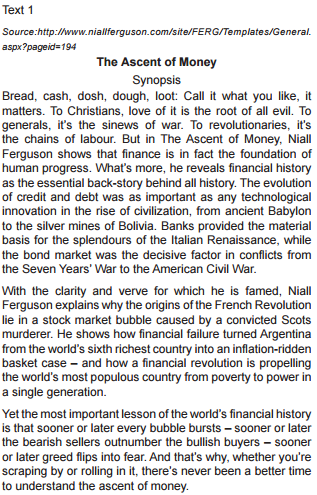
The writer of the book attempts to prove that money is
Ano: 2010
Banca:
ESAF
Órgão:
MPO
Prova:
ESAF - 2010 - MPOG - Analista de Planejamento e Orçamento - Prova 1 |
Q45358
Inglês
The pronoun 'it' in paragraph 3 line 5 refers to
Ano: 2010
Banca:
ESAF
Órgão:
MPO
Prova:
ESAF - 2010 - MPOG - Analista de Planejamento e Orçamento - Prova 1 |
Q45357
Inglês
The fi ve words that open the text [Bread, cash, dosh, dough, loot] in paragraph 1 line 1 are

 Conheça nossos planos