Questões de Concurso
Comentadas sobre pronomes interrogativos | question words em inglês
Foram encontradas 36 questões


Complete each sentence using where/whom/whose/who and choose the right answer below:
I - He doesn´t know the name of the dog to.........Ispoke yesterday night.
II - A house is a place.......people live togheter.
III - A humorista is a person.......believes that all the people are happy.
IV - An elephant is an animal........children are also very big.
V - The place........we spent our days was really wonderful.
The sentences below need to be completed with where/whom/whose/who. Choose the right answer:
I - He doesn´t know the age of the girl to.........he saw saturday night.
II - A church is a place.......... people pray a lot.
III - A doctor is a person .......... care the health of people.
IV - A father is a man.......... play the children a lot.
V - The school........I studied was really fantastic.
Complete each sentence using where/whom/whose/who and choose the right answer below:
I - She doesn´t know the name of the girl to.........I saw Monday night.
II - A library is a place.......... children read a lot.
III - A teacher is a professional.......... teach and learn all the time.
IV - A mother is a person.......... enjoy the life with the children.
V - The place........we studied everyday was really marvelous.
Read the sentence and choose the best alternative:
The book _______ you lent me is very interesting.
We have inducted a daily dump process ____ we are producing 800 kilograms to 1,000 kilograms of organic compost in our society.
Choose the best option that completes the context.
The song _______ he is playing is a waltz.
1. Q:__________ do you from? A: I´m from in Canada.
2. Q:__________ will you arrive in Brazil? A: Next week.
3. Q:__________ is your favorite fruit, banana or Orange? A: It´s banana.
4. Q:__________ telephone keeps ringing? A: It´s mine.
TEXT
REFERS TO QUESTION
The Literary Influences of Superstar Musician David Bowie
BY JOHN O'CONNELL ON 10/31/19 AT 5:00 AM EDT
TEXT
REFERS TO QUESTION
Lessons for Americans, From a Chines Classroom
Observing how Chinese 2- and 3-year-olds navigated a second language, I wondered whether I could have done this for my children.
SHANGHAI — We sat in toddler-size wooden chairs around an orderly circle of Chinese 2-year-olds, busy with circle time. As a parent of three children who collectively spent 15 years in American day care, I am very familiar with circle time.
But I was in this Shanghai classroom as a professor, with college students from many different countries in a class I’m teaching here on children and childhood.
We were observing in a private kindergarten, designed to provide young children — starting at age 2 — with a carefully structured, fully bilingual curriculum, especially important because English language skills are vital for educational success in China.
Visits to Chinese educational institutions allow the college students in my course to get a look at real children and the ways that they learn, while also thinking about Chinese society today. They get windows onto certain slices of this complex country: a high-end private bilingual program that starts with toddlers; a city high school for academically gifted students; a middle school created for the children of the rural migrants who have come by the millions from China’s poorer provinces to work in Shanghai, but whose rights to social benefits are severely limited in the city.
These visits offer the college students insights into many of the social issues facing China, and we spend time in class discussing questions like the huge role that the annual gaokao college entrance exam plays in determining a child’s educational destiny (English is one of the required subjects), the pressures on families that create a culture of cram schools, and the controversies over reserving spots in colleges for kids from rural areas.
But all of those questions have powerful resonances when you think about the issues of childhood education and child development, which have to be addressed in every country. As my college students discuss the different facets of childhood around the world, visiting the Chinese schools also helps them in remembering and thinking about what children look like at different ages, and how they play and interact and learn.
Available in : https://www.nytimes.com/2020/01/20/, accessed on February 26th, 2020. Adapted
Create a question for the following answer:
This course has four levels.
What alternative has the best question?
Complete the following setences with the correct question word.
I. _________ has got a pencil for me? Claudia has got one.
II. _________ is your birthday? In April.
III. _________ old is her son? Seven.
IV. _________ are your posters? Over my bed.
Mark the CORRECT arswer.
Consider the following conversation.
-____did Jonathan go to New York?
-Because he went on a tour with his family.
-____did they go?
-By ship.
Taking into account the use of interrogative pronouns, the option below that completes the conversation is
Can I help reduce energy consumption?
We have an important role to play right now. Energy conservation helps a lot in preserving our planet’s rich natural resources and promoting a healthy environment. Here you will find simple things that you can do to help reduce energy consumption.
· Turn–off non-essential lights and appliances. The electricity generated by fossil fuels for a single home puts more carbon dioxide into the air than two average cars.
· Avoid turning on large appliances such as washers, dryers, and electric ovens during peak energy hours: from 5:00 am to 9:00 am and 4: pm to 7:00 pm.
· Install white window curtains to reflect heat away from the house. Close them at night to reduce the amount of heat lost through windows. People who live in countries that have warm climates should do this during the day as well.
· Turn off the lights in any room you are not using and consider installing timers, photo cells, or occupancy sensors to reduce the amount of time your lights are on.
Information Systems (IS) is concerned with the information that computer systems can provide to aid a company, non-profit or governmental organization in defining and achieving its goals. It is also concerned with the processes that an enterprise can implement and improve using information technology. IS professionals must understand both technical and organizational factors , 5 and must be able to help an organization determine how information and technology-enabled business processes can provide a foundation for superior organizational performance. They serve as a bridge between the technical and management communities within an organization. What information does the enterprise need? How is that information generated? Is it delivered to the people who need it? Is it presented to them in ways that permit them to use it readily? 10 Is the organization structured to be able to use technology effectively? Are the business processes of the organization well designed? Do they use the opportunities created by information technology fully? Does the organization use the communication and collaboration capabilities of information technologies appropriately? Is the organization capable of adapting quickly enough to changing external circumstances? These are the important issues that businesses rely on IS people to 15 address. A majority of IS programs are located in business schools; however, they may have different names such as management information systems, computer information systems, or business information systems. All IS degrees combine business and computing topics, but the emphasis between technical and organizational issues varies among programs. For example, 20 programs differ substantially in the amount of programming required. Traditionally, many graduates of IS programs have functioned in roles that are similar to the roles for which IT programs explicitly prepare their students. Information systems graduates continue to fill these roles, but the new programs in information technology offer an alternative path to these positions. INFORMATION Systems. Disponível em: . Acesso em: 03 jan. 2011.
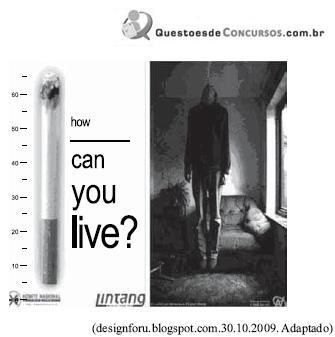
The blank in - how __________ can you live? - is correctly filled with

 Conheça nossos planos