Questões de Concurso
Comentadas sobre pronome possessivo adjetivo | possessive adjective em inglês
Foram encontradas 76 questões


Ano: 2016
Banca:
NUCEPE
Órgão:
Prefeitura de Teresina - PI
Prova:
NUCEPE - 2016 - Prefeitura de Teresina - PI - Professor - Língua Inglesa |
Q730070
Inglês
Texto associado
TEXT 06
The (in)appropriate speaker model?
"Anyone working in the field of English as
a Lingua Franca (henceforth ELF) has to
face sooner rather than later a serious
contradiction: that despite the widespread
acceptance of the extensive role of English
as an international lingua franca and its
increasing number of functions in this
respect, there is still an almost equally
widespread resistance to this lingua franca’s
forms. Given the well-established
sociolinguistic fact that languages are
shaped by their users, and that nowadays
“native speakers are in a minority for
[English] language use” (Brumfit 2001, 116),
it would make sense for English language
teaching to move away from its almost
exclusive focus on native varieties of
English. This suggestion always meets,
however, with strong resistance from many
quarters, and this is particularly so in the
case of accent. The result is that two
particular native speaker English accents,
Received Pronunciation (RP) and General
American (GA), continue to command
special status around the English speaking
world including international/lingua franca
communication contexts where
sociolinguistic common sense indicates that
they are inappropriate and irrelevant."
Source: adapted from: JENKINS, J. (Un)pleasant?
(In)correct? (Un)Intelligible? ELF Speakers'
perceptions of their accents. In: MAURANEN, Anna
and RANTA, Elina (Ed.).English as a Lingua
Franca:Studies and Findings. Newcastle upon Tyne:
Cambridge Scholars Publishing, 2009, p.10-35.
The pronoun "its", that occurs twice in the
passage "...that despite the widespread
acceptance of the extensive role of English
as an international lingua franca and its
increasing number of functions in this
respect, there is still an almost equally
widespread resistance to this lingua franca’s
forms. Given the well-established
sociolinguistic fact that languages are
shaped by their users, and that nowadays
“native speakers are in a minority for
[English] language use” (Brumfit 2001, 116),
it would make sense for English language
teaching to move away from its almost
exclusive focus on native varieties of
English." (lines 04 to 18) refers, respectively
to:
Ano: 2016
Banca:
IF-SE
Órgão:
IF-SE
Provas:
IF-SE - 2016 - IF-SE - Analista de Tecnologia da Informação - Desenvolvimento
|
IF-SE - 2016 - IF-SE - Analista de Tecnologia da Informação - Suporte em Infraestrutura e Redes |
Q623532
Inglês
Texto associado
Microsoft’s Project Natick brings data centers underwater
Jordan Novet January 31, 2016 9:11 PM
Microsoft today unveiled Project Natick, a fascinating research
initiative that could bring cloud computing infrastructure closer to
big cities near large bodies of water — by putting data centers
underwater
Microsoft isn‘t running any web services, like Office 365, through
the data center infrastructure inside of these capsules. But
Microsoft did build one (named the Leona Philpot, after the Halo
character) and set it 30 feet underwater off of the California coast
for four months in 2015. The capsules could have their computing
hardware replaced every five years, but eventually they could well
be kept underwater, without people onsite, for 20 years or more.
And they could be powered by renewable energy, too.
"Project Natick reflects Microsoft‘s ongoing quest for cloud
datacenter solutions that offer rapid provisioning, lower costs,
high responsiveness, and are more environmentally sustainable,‖
Microsoft explained on the website for the project.
It‘s an unusual and forward-looking way for a company at
Microsoft‘s scale — or any scale, really — to operate its core data
center infrastructure. It‘s reminiscent of the Google barge that
some people suspected had been intended to house data center
hardware. (Other reports suggested it could be used for retail
purposes.) But that project has been forgotten. Major web
companies like Google and Facebook are now focusing on using
aircraft to deliver the Internet to people, which has taken up some
of the spotlight on research into new or better ways to deliver services. But the servers, storage, and networking equipment
have got to live somewhere.
One might think putting data centers in the ocean might have
environmental repercussions. But Microsoft is indicating that
nothing untoward happened in the initial experiment.
"During our deployment of the Leona Philpot vessel, sea life in
the local vicinity quickly adapted to the presence of the vessel,‖
Microsoft said on the Project Natick website.
Now Microsoft is looking to advance the research by building
larger capsules. People working on the project have begun
devising one three times as large as the first, according to John
Markoff of the New York Times.
SOURCE: http://venturebeat.com/2016/01/31/microsofts-projectnatick-brings-data-centers-underwater/
accessed on 19/02/16 at
3:30 pm.
No extrato do texto “ During our development of the Leona
Philpot vessel,...” o adjetivo possessivo 'our‘ faz referência a
Ano: 2014
Banca:
CETRO
Órgão:
AEB
Prova:
CETRO - 2014 - AEB - Tecnologista Júnior - Desenvolvimento Tecnológico |
Q483832
Inglês
Texto associado
Gravity, review: “heartachingly tender”
Starring Sandra Bullock and George Clooney as astronauts adrift in
space, Alfonso Cuarón’s astonishing thriller is one of the films of
the year, says Robbie Collin
Watch an astronaut drifting through space for long enough and eventually you notice how much they look like a newborn baby. The oxygen helmet makes their head bigger, rounder and cuter; their hands grasp eagerly at whatever happens to be passing; their limbs are made fat and their movements simple by the spacesuit’s cuddly bulk. They tumble head-over-heels like tripping toddlers or simply bob there in amniotic suspension. Even the lifeline that keeps them tethered to their ship has a pulsing, umbilical aspect.
Gravity, the new Alfonso Cuarón picture, is a heart- achingly tender film about the miracle of motherhood, and the billion-to-one odds against any of us being here, astronauts or not. It’s also a totally absorbing, often overpowering spectacle - a $100 million 3D action movie in which Sandra Bullock and George Clooney play two Hollywood-handsome spacefarers, fighting for their lives 375 miles above the Earth’s crust.
A series of captions over the opening titles reminds us that this is a dead zone: no oxygen or air pressure, and nothing to carry sound. “Life in space is impossible,” the final message tells us, as the cinema shakes with Steven Price’s resonant score, and then suddenly falls quiet.
For Dr. Ryan Stone (Bullock), a mission specialist in orbit for the first time, the lack of noise is welcome. She’s a medical engineer called up by NASA to install new software on to the Hubble Telescope, but also a mother in mourning for her four- year-old daughter, whom she lost in a senseless accident, and the silence enfolds her like a comfort blanket.
Available in: http://www.telegraph.co.uk
Starring Sandra Bullock and George Clooney as astronauts adrift in
space, Alfonso Cuarón’s astonishing thriller is one of the films of
the year, says Robbie Collin
Watch an astronaut drifting through space for long enough and eventually you notice how much they look like a newborn baby. The oxygen helmet makes their head bigger, rounder and cuter; their hands grasp eagerly at whatever happens to be passing; their limbs are made fat and their movements simple by the spacesuit’s cuddly bulk. They tumble head-over-heels like tripping toddlers or simply bob there in amniotic suspension. Even the lifeline that keeps them tethered to their ship has a pulsing, umbilical aspect.
Gravity, the new Alfonso Cuarón picture, is a heart- achingly tender film about the miracle of motherhood, and the billion-to-one odds against any of us being here, astronauts or not. It’s also a totally absorbing, often overpowering spectacle - a $100 million 3D action movie in which Sandra Bullock and George Clooney play two Hollywood-handsome spacefarers, fighting for their lives 375 miles above the Earth’s crust.
A series of captions over the opening titles reminds us that this is a dead zone: no oxygen or air pressure, and nothing to carry sound. “Life in space is impossible,” the final message tells us, as the cinema shakes with Steven Price’s resonant score, and then suddenly falls quiet.
For Dr. Ryan Stone (Bullock), a mission specialist in orbit for the first time, the lack of noise is welcome. She’s a medical engineer called up by NASA to install new software on to the Hubble Telescope, but also a mother in mourning for her four- year-old daughter, whom she lost in a senseless accident, and the silence enfolds her like a comfort blanket.
Available in: http://www.telegraph.co.uk
Considering the text, read the sentence below and choose the alternative that presents the grammar function of the underlined words, respectively.
“The oxygen helmet makes their1 head bigger2 , rounder and cuter; their hands3 grasp eagerly at whatever happens to be passing; their limbs are made fat and their movements simple by the spacesuit’s cuddly bulk.”
“The oxygen helmet makes their1 head bigger2 , rounder and cuter; their hands3 grasp eagerly at whatever happens to be passing; their limbs are made fat and their movements simple by the spacesuit’s cuddly bulk.”
Ano: 2014
Banca:
FUMARC
Órgão:
AL-MG
Provas:
FUMARC - 2014 - AL-MG - Analista de Sistemas - Desenvolvimento
|
FUMARC - 2014 - AL-MG - Analista de Sistemas - Administração de Rede |
Q383668
Inglês
Texto associado
TEXT 2
Food Engineering
MAKE A DIFFERENCE BE A FOOD ENGINEER
Food engineering is the application of engineering principles to the storage, processing and distribution of food materials and _____ bio-products. It requires a sound engineering education, as well as fundamental training in chemistry and food science.
Food Engineers can make valuable contributions in various capacities of food chain such as design of processing, handling, packaging and storage equipment and systems; scale-up of prototype food processes, machinery, and equipment; product/process research and development; regulation and protection of the public health; and engineering and technical Sales.
Fonte: http://baen.tamu.edu/foodengineering/FEngr/FEngr.html Acesso em: 15/10/2013.
Food Engineering
MAKE A DIFFERENCE BE A FOOD ENGINEER
Food engineering is the application of engineering principles to the storage, processing and distribution of food materials and _____ bio-products. It requires a sound engineering education, as well as fundamental training in chemistry and food science.
Food Engineers can make valuable contributions in various capacities of food chain such as design of processing, handling, packaging and storage equipment and systems; scale-up of prototype food processes, machinery, and equipment; product/process research and development; regulation and protection of the public health; and engineering and technical Sales.
Fonte: http://baen.tamu.edu/foodengineering/FEngr/FEngr.html Acesso em: 15/10/2013.
The correct word to fill in the space provided in “food materials and ____ bio-products.” from text 2 is
Ano: 2013
Banca:
CESPE / CEBRASPE
Órgão:
Instituto Rio Branco
Prova:
CESPE - 2013 - Instituto Rio Branco - Diplomata - Prova 2 |
Q359330
Inglês
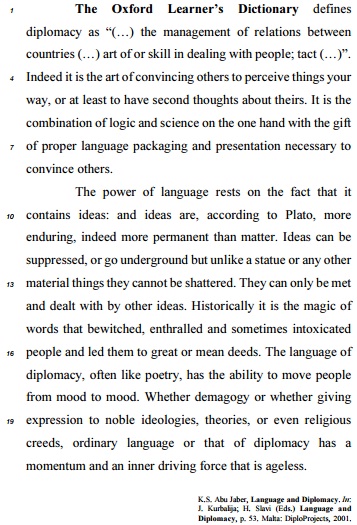
In relation to the pronouns shown in bold in the text above, judge if the items below are right (C) or wrong (E).
The pronoun “theirs” (l.5) refers to “others” (l.4).
The pronoun “theirs” (l.5) refers to “others” (l.4).
Ano: 2012
Banca:
Makiyama
Órgão:
CPTM
Provas:
Makiyama - 2012 - CPTM - Analista Administrativo Júnior
|
Makiyama - 2012 - CPTM - Analista de Recursos Humanos Júnior - Administração de Empresas |
Makiyama - 2012 - CPTM - Advogado Júnior |
Makiyama - 2012 - CPTM - Auditor Júnior |
Q328067
Inglês
Texto associado
Generation Y
By Sally Kane, About.com Guide
Born in the mid-1980's and later, Generation Y legal professionals are in their 20s and are just entering the workforce. With numbers estimated as high as 70 million, Generation Y (also -1- as the Millennials) is the fastest growing segment of today's workforce. As law firms compete for available talent, employers cannot ignore the needs, desires and attitudes of this vast generation. Below are a few common traits that define Generation Y.
Tech-Savvy: Generation Y grew up with technology and rely on it to perform their jobs better. Armed with BlackBerrys, laptops, cellphones and other gadgets, Generation Y is plugged-in 24 hours a day, 7 days a week. This generation prefers to communicate through e-mail and text messaging rather than face-to-face contact and -2- webinars and online technology to traditional lecture-based presentations.
Family-Centric: The fast-track has lost much of its appeal for Generation Y who is willing to trade high pay for fewer billable hours, flexible schedules and a better work/life balance. While older generations may view this attitude as narcissistic or lacking commitment, discipline and drive, Generation Y legal professionals have a different vision of workplace expectations and prioritize family over work.
Achievement-Oriented: Nurtured and pampered -3- parents who did not want to make the mistakes of the previous generation, Generation Y is confident, ambitious and achievement-oriented. They have high expectations of their employers, seek out new challenges and are not afraid to question authority. Generation Y wants meaningful work and a solid learning curve
Team-Oriented: As children, Generation Y participated in team sports, play groups and other group activities. They value teamwork and seek the input and affirmation of others. Part of a no-person-left-behind generation, Generation Y is loyal, committed and wants to be included and involved.
Attention-Craving: Generation Y craves attention in the forms of feedback and guidance. They appreciate being kept in the loop and seek frequent praise and reassurance. Generation Y may benefit greatly from mentors who can help guide and develop their young careers.
Font: http://legalcareers.about.com/od/practicetips/a/Ge...
By Sally Kane, About.com Guide
Born in the mid-1980's and later, Generation Y legal professionals are in their 20s and are just entering the workforce. With numbers estimated as high as 70 million, Generation Y (also -1- as the Millennials) is the fastest growing segment of today's workforce. As law firms compete for available talent, employers cannot ignore the needs, desires and attitudes of this vast generation. Below are a few common traits that define Generation Y.
Tech-Savvy: Generation Y grew up with technology and rely on it to perform their jobs better. Armed with BlackBerrys, laptops, cellphones and other gadgets, Generation Y is plugged-in 24 hours a day, 7 days a week. This generation prefers to communicate through e-mail and text messaging rather than face-to-face contact and -2- webinars and online technology to traditional lecture-based presentations.
Family-Centric: The fast-track has lost much of its appeal for Generation Y who is willing to trade high pay for fewer billable hours, flexible schedules and a better work/life balance. While older generations may view this attitude as narcissistic or lacking commitment, discipline and drive, Generation Y legal professionals have a different vision of workplace expectations and prioritize family over work.
Achievement-Oriented: Nurtured and pampered -3- parents who did not want to make the mistakes of the previous generation, Generation Y is confident, ambitious and achievement-oriented. They have high expectations of their employers, seek out new challenges and are not afraid to question authority. Generation Y wants meaningful work and a solid learning curve
Team-Oriented: As children, Generation Y participated in team sports, play groups and other group activities. They value teamwork and seek the input and affirmation of others. Part of a no-person-left-behind generation, Generation Y is loyal, committed and wants to be included and involved.
Attention-Craving: Generation Y craves attention in the forms of feedback and guidance. They appreciate being kept in the loop and seek frequent praise and reassurance. Generation Y may benefit greatly from mentors who can help guide and develop their young careers.
Font: http://legalcareers.about.com/od/practicetips/a/Ge...
The best example of a possessive pronoun is:
Ano: 2013
Banca:
CETRO
Órgão:
ANVISA
Prova:
CETRO - 2013 - ANVISA - Analista Administrativo - Conhecimentos Gerais - Todas as Áreas - Prova Anulada |
Q325553
Inglês

Read the sentence below and choose the alternative that correctly links the underlined words to the nouns they refer to.
An FDA advisory panel, (I) which gave preliminary approval to Allergan's application, wasn't entirely happy with the company's data supporting (II) its safety and efficacy claims for the Lap-Band— (III) its own 149-patient study and six other studies, at least three of (IV) which conducted by researchers with financial links to Allergan.
An FDA advisory panel, (I) which gave preliminary approval to Allergan's application, wasn't entirely happy with the company's data supporting (II) its safety and efficacy claims for the Lap-Band— (III) its own 149-patient study and six other studies, at least three of (IV) which conducted by researchers with financial links to Allergan.
Ano: 2013
Banca:
CESGRANRIO
Órgão:
BNDES
Prova:
CESGRANRIO - 2013 - BNDES - Técnico Administrativo |
Q300571
Inglês

In the excerpt of the text - “are especially critical for workers and managers in a globalized economy defined by its unpredictability and dynamism.” - (lines 39 - 41) the possessive pronoun its refers to
Ano: 2013
Banca:
CESPE / CEBRASPE
Órgão:
CNJ
Prova:
CESPE / CEBRASPE - 2013 - CNJ - Técnico Judiciário - Programação de Sistemas |
Q300327
Inglês
Texto associado

Judge the items according to the text above.
Judge the items according to the text above.
The word “its” in the first paragraph refers to “complaints”.
Ano: 2012
Banca:
UNEMAT
Órgão:
CEPROMAT
Prova:
UNEMAT - 2012 - CEPROMAT - Analista de Tecnologia da Informação |
Q299167
Inglês

Leia as assertivas abaixo:
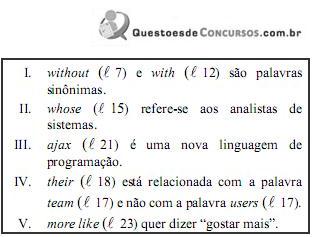
Assinale a alternativa correta.
Assinale a alternativa correta.
Q292637
Inglês
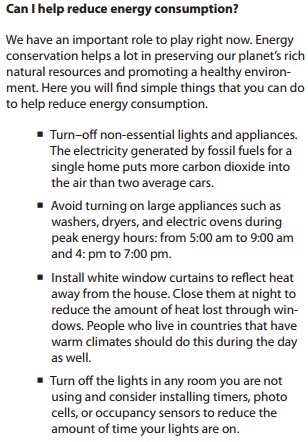
As palavras "We" e "Our" estão sendo usadas no texto como:
Ano: 2012
Banca:
CESGRANRIO
Órgão:
Innova
Provas:
CESGRANRIO - 2012 - Innova - Advogado Júnior
|
CESGRANRIO - 2012 - Innova - Analista de Sistemas Júnior |
CESGRANRIO - 2012 - Innova - Administrador Júnior |
CESGRANRIO - 2012 - Innova - Contador Júnior |
CESGRANRIO - 2012 - Innova - Médico do Trabalho Júnior |
CESGRANRIO - 2012 - Innova - Engenheiro de Equipamento Júnior - Mecânica |
CESGRANRIO - 2012 - Innova - Engenheiro de Equipamento Júnior - Elétrica |
Q276493
Inglês
Texto associado
Text II
The Underwater Centre secures its biggest ever contract – worth $1.3million - to train Russian saturation divers
Your Oil and Gas News Magazine The world's leading commercial diver and Remotely Operated Vehicle (ROV) training facility, based in the Scottish Highlands and Australia, has secured its biggest ever contract – worth US$ 1.3 million – to train Russian saturation divers.
The award cements its reputation as a major service provider for the growing worldwide oil and gas industry. The men, already experienced air divers, were trained on saturation procedures and techniques and will receive the Australian Diver Accreditation Scheme (ADAS) and the Closed Bell certification. More advanced than the ADAS, the Closed Bell is the certification appropriate to deep water dives of 60 meters / 200 feet, using a trimix tank with 16 percent oxygen (O2). During the training, divers lived in a chamber for up to 28 days, which was pressurized to the same pressure of the sea, exactly at the depth that they will be working at. Living and working at pressure mean that they can be transported quickly and efficiently to the work site under the water without decompression stops, allowing divers to work in much greater depths and for much longer periods of time. MRTS Managing Director Alexander Kolikov said: “Oil and gas firms in Russia are currently facing a skills shortage due to the rapidly increasing amount of exploration work underway at the moment. By investing in the training of our divers in saturation diving, we are addressing this need for experts in maintenance and repair activities vital to maintaining Russia's subsea infrastructure." Steve Ham, General Manager at the Fort William Centre said: “We were delighted when MRTS chose The Underwater Centre to train its divers in saturation diving, and I think this is testament to the hard work we have been putting in to ensure our reputation as a world-class training facility. Available at: . Retrieved on: 28 June 2012. Adapted.
The Underwater Centre secures its biggest ever contract – worth $1.3million - to train Russian saturation divers
Your Oil and Gas News Magazine The world's leading commercial diver and Remotely Operated Vehicle (ROV) training facility, based in the Scottish Highlands and Australia, has secured its biggest ever contract – worth US$ 1.3 million – to train Russian saturation divers.
The award cements its reputation as a major service provider for the growing worldwide oil and gas industry. The men, already experienced air divers, were trained on saturation procedures and techniques and will receive the Australian Diver Accreditation Scheme (ADAS) and the Closed Bell certification. More advanced than the ADAS, the Closed Bell is the certification appropriate to deep water dives of 60 meters / 200 feet, using a trimix tank with 16 percent oxygen (O2). During the training, divers lived in a chamber for up to 28 days, which was pressurized to the same pressure of the sea, exactly at the depth that they will be working at. Living and working at pressure mean that they can be transported quickly and efficiently to the work site under the water without decompression stops, allowing divers to work in much greater depths and for much longer periods of time. MRTS Managing Director Alexander Kolikov said: “Oil and gas firms in Russia are currently facing a skills shortage due to the rapidly increasing amount of exploration work underway at the moment. By investing in the training of our divers in saturation diving, we are addressing this need for experts in maintenance and repair activities vital to maintaining Russia's subsea infrastructure." Steve Ham, General Manager at the Fort William Centre said: “We were delighted when MRTS chose The Underwater Centre to train its divers in saturation diving, and I think this is testament to the hard work we have been putting in to ensure our reputation as a world-class training facility. Available at: . Retrieved on: 28 June 2012. Adapted.
In Text II, the possessive pronoun its (line 6) refers to
Ano: 2009
Banca:
MOVENS
Órgão:
MDIC
Provas:
MOVENS - 2009 - MDIC - Técnico Gerencial - Direito
|
MOVENS - 2009 - MDIC - Técnico Intelectual - Tecnologia da Informação |
Q128025
Inglês

In the text, the word “Its” (line 10) refers to
Q77846
Inglês
Texto associado
Para responder às questões de números 26 a 31, considere o texto abaixo.

In the text, their refers to
Q10841
Inglês


Mark the correct option concerning reference.
Ano: 2007
Banca:
CESGRANRIO
Órgão:
REFAP SA
Prova:
CESGRANRIO - 2007 - REFAP SA - Programador de computador |
Q9418
Inglês
Texto associado
Good Stuff? - A Consumption Manifesto:
The Top Ten Principles of Good Consumption
Consumption is one of life's great pleasures. Buying
things we desire, traveling to beautiful places, eating
delectable food: icing on the cake of life. But too often the
effects of our blissful consumption make for a sad story.
Giant cars exhaling dangerous exhaust, hog farms pumping
out harmful pollutants, toxic trash pestering poor
neighborhoods - none of this if there weren't something
to sell.
But there's no need to trade pleasure for guilt. With
thoughtfulness and commitment, consumption can be a force
for good. Through buying what we need, produced the way
we want, we can create the world we'd like to live in.
To that end and for the future, a Consumption Manifesto:
Principle One. Reduce, Reuse, Recycle. This brilliant triad
says it all. Reduce: Avoid buying what you don't need-
and when you do get that dishwasher/lawnmower/toilet,
spend the money up front for an efficient model. Re-use:
Buy used stuff, and wring the last drop of usefulness out of
most everything you own. Recycle: Do it, but know that
it's the last and least effective leg of the triad. (Ultimately,
recycling simply results in the manufacture of more things.)
Principle Two. Stay close to home. Work close to home
to shorten your commute; eat food grown nearby; support
local businesses; join local organizations. All of these will
improve the look, shape, smell, and feel of your community.
Principle Three. Internal combustion engines are polluting,
and their use should be minimized. Period.
Principle Four. Watch what you eat. Whenever possible,
avoid food grown with pesticides, in feedlots, or by
agribusiness. It's an easy way to use your dollars to vote
against the spread of toxins in our bodies, land, and water.
Principle Five. Private industries have very little incentive
to improve their environmental practices. Our consumption
choices must encourage and support good behavior; our
political choices must support government regulation.
Principle Six. Support thoughtful innovations in
manufacturing and production. Hint: Drilling for oil is no
longer an innovation.
Principle Seven. Prioritize. Think hardest when buying
large objects; don't drive yourself mad fretting over the small
ones. It's easy to be distracted by the paper bag puzzle,
but an energy-sucking refrigerator is much more worthy of
your attention. (Small electronics are an exception.)
Principle Eight. Vote. Political engagement enables the
spread of environmentally conscious policies. Without
public action, thoughtful individuals are swimming
upstream.
Principle Nine. Don't feel guilty. It only makes you sad.
Principle Ten. Enjoy what you have-the things that are
yours alone, and the things that belong to none of us. Both
are nice, but the latter are precious. Those things that we
cannot manufacture and should never own-water, air, birds,
trees-are the foundation of life's pleasures. Without them,
we're nothing. With us, there may be nothing left. It's our
choice.
Umbra Fisk, Grist Magazine.
Slightly adapted from: http://www.worldwatch.org/node/1470
Access on June 1, 2007.
The Top Ten Principles of Good Consumption
Consumption is one of life's great pleasures. Buying
things we desire, traveling to beautiful places, eating
delectable food: icing on the cake of life. But too often the
effects of our blissful consumption make for a sad story.
Giant cars exhaling dangerous exhaust, hog farms pumping
out harmful pollutants, toxic trash pestering poor
neighborhoods - none of this if there weren't something
to sell.
But there's no need to trade pleasure for guilt. With
thoughtfulness and commitment, consumption can be a force
for good. Through buying what we need, produced the way
we want, we can create the world we'd like to live in.
To that end and for the future, a Consumption Manifesto:
Principle One. Reduce, Reuse, Recycle. This brilliant triad
says it all. Reduce: Avoid buying what you don't need-
and when you do get that dishwasher/lawnmower/toilet,
spend the money up front for an efficient model. Re-use:
Buy used stuff, and wring the last drop of usefulness out of
most everything you own. Recycle: Do it, but know that
it's the last and least effective leg of the triad. (Ultimately,
recycling simply results in the manufacture of more things.)
Principle Two. Stay close to home. Work close to home
to shorten your commute; eat food grown nearby; support
local businesses; join local organizations. All of these will
improve the look, shape, smell, and feel of your community.
Principle Three. Internal combustion engines are polluting,
and their use should be minimized. Period.
Principle Four. Watch what you eat. Whenever possible,
avoid food grown with pesticides, in feedlots, or by
agribusiness. It's an easy way to use your dollars to vote
against the spread of toxins in our bodies, land, and water.
Principle Five. Private industries have very little incentive
to improve their environmental practices. Our consumption
choices must encourage and support good behavior; our
political choices must support government regulation.
Principle Six. Support thoughtful innovations in
manufacturing and production. Hint: Drilling for oil is no
longer an innovation.
Principle Seven. Prioritize. Think hardest when buying
large objects; don't drive yourself mad fretting over the small
ones. It's easy to be distracted by the paper bag puzzle,
but an energy-sucking refrigerator is much more worthy of
your attention. (Small electronics are an exception.)
Principle Eight. Vote. Political engagement enables the
spread of environmentally conscious policies. Without
public action, thoughtful individuals are swimming
upstream.
Principle Nine. Don't feel guilty. It only makes you sad.
Principle Ten. Enjoy what you have-the things that are
yours alone, and the things that belong to none of us. Both
are nice, but the latter are precious. Those things that we
cannot manufacture and should never own-water, air, birds,
trees-are the foundation of life's pleasures. Without them,
we're nothing. With us, there may be nothing left. It's our
choice.
Umbra Fisk, Grist Magazine.
Slightly adapted from: http://www.worldwatch.org/node/1470
Access on June 1, 2007.
Mark the correct statement concerning reference.

 Conheça nossos planos