Questões de Concurso
Sobre pronome objetivo | objective pronoun em inglês
Foram encontradas 105 questões


TEXT I
How music is the real language of political diplomacy
Forget guns and bombs, it is the power of melody that has changed the world
Marie Zawisza
Saturday 31 October 2015 10.00 GMT
Last modified on Tuesday 10 November 201513.19 GMT

An old man plays his cello at the foot of a crumbling wall. The notes of the sarabande of Bach’s Suite No 2 rise in the cold air, praising God for the “miracle” of the fall of the Berlin Wall, as Mstislav Rostropovich later put it. The photograph is seen around the world. The date is 11 November 1989, and the Russian virtuoso is marching to the beat of history.
Publicity stunt or political act? No doubt a bit of both – and proof, in any case, that music can have a political dimension. Yo-Yo Ma showed as much in September when the cellist opened the new season of the Philharmonie de Paris with the Boston Symphony Orchestra. As a “messenger of peace” for the United Nations, the Chinese American is the founder of Silk Road Project, which trains young musicians from a variety of cultures to listen to and improvise with each other and develop a common repertoire. “In this way, musicians create a dialogue and arrive at common policies,” says analyst Frédéric Ramel, a professor at the Institut d’Études Politiques in Paris. By having music take the place of speeches and peace talks, the hope is that it will succeed where diplomacy has failed.[…]
Curiously, the study of the role of music in international relations is still in its infancy. “Historians must have long seen it as something fanciful, because history has long been dominated by interpretations that stress economic, social and political factors,” says Anaïs Fléchet, a lecturer in contemporary history at the Université de Versailles-St-Quentin and co-editor of a book about music and globalisation.
“As for musicologists,” she adds, “until quite recently they were more interested in analysing musical scores than the actual context in which these were produced and how they were received.” In the 1990s came a cultural shift. Scholars were no longer interested solely in “hard power” – that is, in the balance of powers and in geopolitics – but also in “soft power”, where political issues are resolved by mutual support rather than force. […]

Gilberto Gil sings while then UN secretary general Kofi Annan plays percussion at a September 2003 concert at the UN headquarters honouring those killed by a bomb at a UN office in Baghdad a month earlier. Photograph: Zuma/Alamy
Since then, every embassy has a cultural attaché. The US engages in “audio diplomacy” by financing hip-hop festivals in the Middle East. China promotes opera in neighbouring states to project an image of harmony. Brazil has invested in culture to assert itself as a leader in Latin America, notably by establishing close collaboration between its ministries of foreign affairs and culture; musician Gilberto Gil was culture minister during Luiz Inácio Lula da Silva᾽s presidency from 2003 to 2008. He was involved in France’s Year of Brazil. As Fléchet recalls, “the free concert he gave on 13 July, 2005 at the Place de la Bastille was the pinnacle. That day, he sang La Marseillaise in the presence of presidents Lula and Jacques Chirac.” Two years earlier, in September 2003, Gil sang at the UN in honour of the victims of the 19 August bombing of the UN headquartes in Baghdad. He was delivering a message of peace, criticising the war on Iraq by the US: “There is no point in preaching security without giving a thought to respecting others,” he told his audience. Closing the concert, he invited then UN secretary general Kofi Annan on stage for a surprise appearance as a percussionist. “This highly symbolic image, which highlighted the conviction that culture can play a role in bringing people together, shows how music can become a political language,” Fléchet says.
(adapted from http://www.theguardian.com/music/2015/oct/31
/music-language-human-rights-political-diplomacy)
Leia o texto abaixo e responda às questões 37 e 38.
O espaço no texto deve ser preenchido pelo pronome:
Innovation is the new key to survival
[…]
At its most basic, innovation presents an optimal strategy for controlling costs. Companies that have invested in such technologies as remote mining, autonomous equipment and driverless trucks and trains have reduced expenses by orders of magnitude, while simultaneously driving up productivity.
Yet, gazing towards the horizon, it is rapidly becoming clear that innovation can do much more than reduce capital intensity. Approached strategically, it also has the power to reduce people and energy intensity, while increasing mining intensity.
Capturing the learnings
The key is to think of innovation as much more than research and development (R&D) around particular processes or technologies. Companies can, in fact, innovate in multiple ways, such as leveraging supplier knowledge around specific operational challenges, redefining their participation in the energy value chain or finding new ways to engage and partner with major stakeholders and constituencies.
To reap these rewards, however, mining companies must overcome their traditionally conservative tendencies. In many cases, miners struggle to adopt technologies proven to work at other mining companies, let alone those from other industries. As a result, innovation becomes less of a technology problem and more of an adoption problem.
By breaking this mindset, mining companies can free themselves to adapt practical applications that already exist in other industries and apply them to fit their current needs. For instance, the tunnel boring machines used by civil engineers to excavate the Chunnel can vastly reduce miners' reliance on explosives. Until recently, those machines were too large to apply in a mining setting. Some innovators, however, are now incorporating the underlying technology to build smaller machines—effectively adapting mature solutions from other industries to realize more rapid results.
Re-imagining the future
At the same time, innovation mandates companies to think in entirely new ways. Traditionally, for instance, miners have focused on extracting higher grades and achieving faster throughput by optimizing the pit, schedule, product mix and logistics. A truly innovative mindset, however, will see them adopt an entirely new design paradigm that leverages new information, mining and energy technologies to maximize value. […]
Approached in this way, innovation can drive more than cost reduction. It can help mining companies mitigate and manage risks, strengthen business models and foster more effective community and government relations. It can help mining services companies enhance their value to the industry by developing new products and services. Longer-term, it can even position organizations to move the needle on such endemic issues as corporate social responsibility, environmental performance and sustainability.
(http://www2.deloitte.com/content/dam/Deloitte/ru/Document s/energy-resources/ru_er_tracking_the_trends_2015_eng.pdf)
She has told _____ many stories about _____ life in Africa.

In reference to the content of the text, its vocabulary and syntactic structure, decide whether the following statements are right (C) or wrong (E).
In lines 4, 7 and 9, although with different syntactic functions,
the word it refers to the same thing: “the head of an enemy
which swung from the rafters” (l. 3 and 4).
How Telecommuting Works
Telecommuting, which is growing in popularity, allows
employees to avoid long commutes.
“Brring,” the alarm startles you out of a deep sleep. It’s
8 a.m. on Monday morning. Time to head to the office.
You roll out of bed, brush your teeth and stumble your
way to the kitchen to grab some coffee.
Moments later, you head to the office, still wearing
your pajamas and fluffy slippers. Luckily for you, you
don’t have to go far – you work at home.
Telecommuting, or working at home, has grown in
popularity over the last 20 years.
On an increasing basis, workers are saying “no” to
long commutes and opting to work at home. In fact,
the U.S. Census Bureau reports that the number of
employees working from home grew by 23 percent
from 1990 to 2000.
Telecommuting workers revel in making their own
schedule – allowing them to schedule work around
family and personal commitments. With the ready
availability of technology tools, like the Internet and
home computers, companies are more willing to let
employees work from home.
( Adaptedfrom : < http: //home.howstuffworks.com/telecommuting.htm>Access on 18th January, 2014)


In “tuck them up close” (l.40), “them” refers to “sixteen brown eggs” (l.49).


THERE ARE 10 QUESTIONS OF MULTIPLE CHOICE IN YOUR TEST. EACH QUESTION HAS 4 ALTERNATIVES (A, B, C, AND D) FROM WHICH ONLY ONE IS CORRECT. CHECK THE CORRECT ONE.
The pronoun them in “This may make them more likely to misunderstand speech and behavior without being aware that they may have misinterpreted the speaker's message” refers to
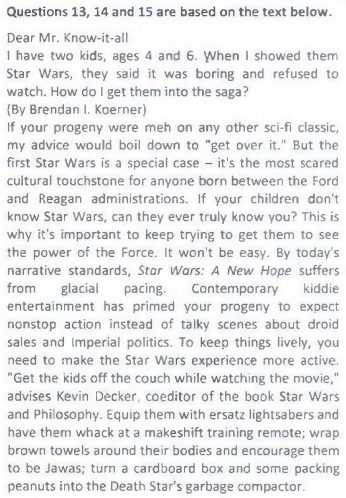
Read each of the sentences below.
I. The word "them" in " When I showed them Star Wars" means "that day".
II. The word "progeny in "If your progeny were meh on any other sci-fi classic" means "kids".
III. The text is a kind of letter to a philosopher.
We can say that:
We have to do something about pollution. _____ hurts all of _____.
_____ knows a lot of stories and the boy loves to listen to _____.


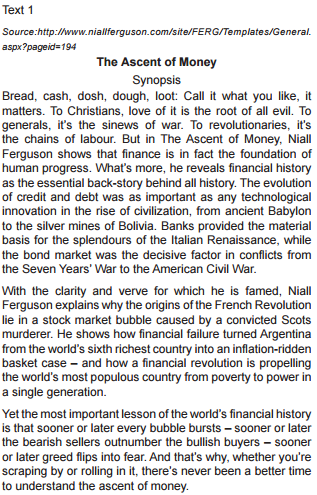
Mark the only alternative where the word ‘one’ functions as an indefinite personal pronoun.
O texto a seguir refere-se às questões 29, 30, 31 e 32.
Learning to quit
Jodi Hall started smoking at age 9.
By the time she was 16, she was up to a pack a day – and she wanted to quit. A couple of reasons: one, her health; two, a guy named Mony. “He said that when he kissed me, it was like kissing an ashtray”, Jodi says.
Earlier this year, Jodi, along with 25 of her classmates at Johnson High School, in Savannah, GA, enrolled in the school’s first stop-smoking class. During the eight-week Tobacco Free Teen class, they learned what smoking can do to their body, their wallet and their grades (some kids end up cutting class to satisfy their nicotine cravings). But it wasn’t just about scare tactics. The goal is behavior modification, not punishment, so students are taught techniques for handling stress and resisting the urge to light up even when friends or parents do.
According to the American Lung Association (ALA), which sponsors the class, about half the adults who smoke were regular smokers by age 18. “Theses numbers are only going to get worse,” says Kristine Lewis of the ALA. “The tobacco industry is turning to teens.”
How did the students do? Jodi has been cigaretteless for three months. But she’s the only one. Her classmate Adam Cushman is slowly putting his way back to three packs a day. The 16-year-old says he wants to stop, “but the way things are going, I doubt I’ll be able to.”
Seventeen, June 1996.
O pronome they em “they learned what smoking can do to…” refere-se a Jodi e:

 Conheça nossos planos