Questões de Concurso
Sobre pronome demonstrativo | demonstrative pronoun em inglês
Foram encontradas 64 questões


Instruction: answer the question based on the following text.
The Ultimate Packing List for Expatriates Moving Abroad
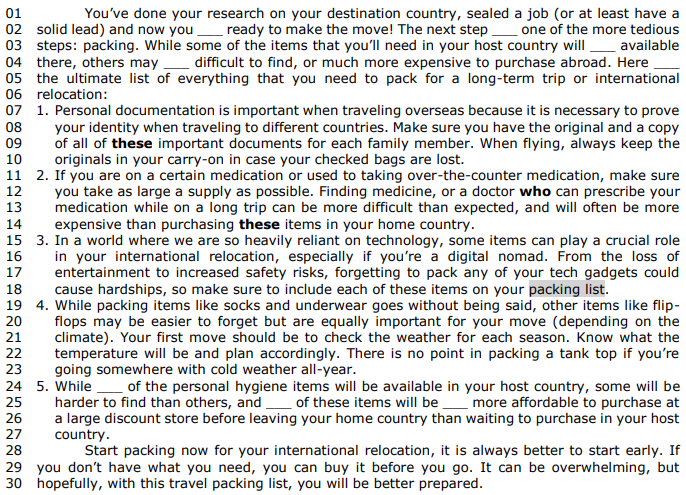
(Available in: https://www.internationalcitizens.com/moving-abroad/ultimate-packing-list.php – text specially adapted for this test).
Instruction: read the comic strip below and then answer question

Avaliable in: https://theawkwardyeti.com/comic/english/
Choose the correct statement about the character Gallbladder’s line.
Instruction: answer question based on the following text.
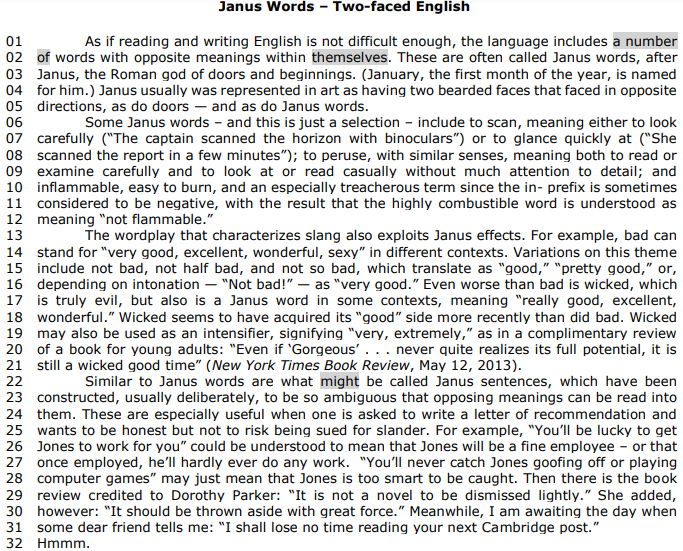
(Avalaible in: https://dictionaryblog.cambridge.org/2013/07/01/janus-words-two-faced-english/#more-2382 –
text especially adapted for this test).
Based on the previous text, judge the following item.
In the first paragraph, the word “It” (third sentence) refers to
“a source of standards” (second sentence).

Internet: <https://www.nytimes.com/>
Answers the question according to the text below.
TEXT I
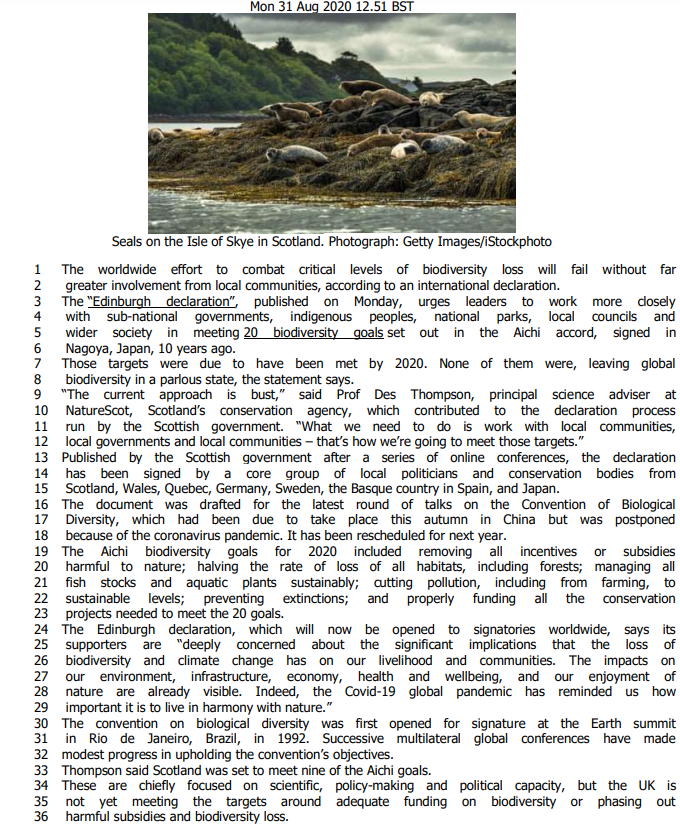
Available at:<https://www.theguardian.com/environment/2020/aug/31/involve-local-groups-in-protecting-biodiversityconservationists-urge> . Access on: 31st, Aug. 2020.
Analyze the sentences extracted from the article, then choose the alternative that best explains the underlined elements, respectively.
i. […] that’s how we’re going to meet those targets. (line 12) ii. These are chiefly focused on scientific, policymaking and political capacity […] (line 35)
Look at the picture. Based on what you can see, choose the CORRECT answer.

“_________ is our school.”
“Let’s face it: most of us were taught in classrooms where styles of teachings reflected the notion of a single norm of thought and experience, which we were encouraged to believe was universal. This has been just as true for nonwhite teachers as for white teachers.”
What does the demonstrative pronoun “this” highlighted above refer to?

Internet: <learnenglish.britishcouncil.org>
No que se refere ao texto anterior e a seus aspectos linguísticos, julgue o item a seguir.
In the sentence “You can find a lot of this online.” (ℓ. 17 and
18), the pronoun “this” refers to the word “Test” (ℓ.16).

Gil Ragsdale. Recipes for success in language learning.
Internet: <www.elgazette.com>
O texto relata uma experiência de aprendizagem de inglês e francês por meio da troca de receitas entre refugiados em um campo de refugiados de Calais. A respeito das ideias e informações do texto precedente e de seus aspectos linguísticos, julgue o item que se segue.
The pronoun “It”, in the sentence “It was very primitive” (ℓ.17)
refers to the Sudanese cooking.
Though the bright scene before us betrayed ____ words, I was nevertheless certain of ___ place on the calendar.
Identify the option that completes the context given.
 The fair trade movement, which aims
ensure that fair prices are paid to producers in
developing countries, is one of the true global success
stories recent decades. The International
Fairtrade Certification Mark, a guarantee that producers are getting a fair price, has become one of the
most recognizable logos the world, which
91 percent of customers associate positive
values. When the logo first appeared in the UK, the
country where the largest number of fair-trade products are sold, nobody expected that the number of
certified products would grow from only 3 to over
4,500 in just 18 years. In 2011, people around the
world spent more than 6.5 billion US dollars on fair-
-trade certified goods, signifying a 12 percent increase
in sales from the previous year. This was at a time
when most market segments in the developed world
were still shrinking or stagnating from the after effects
of the 2008 banking crisis. Over 1.2 million farmers
and workers living in 66 countries benefit from fair-
-trade certification by being able to sell their products
at competitive prices, to ensure sustainability.
The fair trade movement, which aims
ensure that fair prices are paid to producers in
developing countries, is one of the true global success
stories recent decades. The International
Fairtrade Certification Mark, a guarantee that producers are getting a fair price, has become one of the
most recognizable logos the world, which
91 percent of customers associate positive
values. When the logo first appeared in the UK, the
country where the largest number of fair-trade products are sold, nobody expected that the number of
certified products would grow from only 3 to over
4,500 in just 18 years. In 2011, people around the
world spent more than 6.5 billion US dollars on fair-
-trade certified goods, signifying a 12 percent increase
in sales from the previous year. This was at a time
when most market segments in the developed world
were still shrinking or stagnating from the after effects
of the 2008 banking crisis. Over 1.2 million farmers
and workers living in 66 countries benefit from fair-
-trade certification by being able to sell their products
at competitive prices, to ensure sustainability.
 Fair-trade initiatives have been growing steadily since the late 1960s, when the fair trade
movement started with only a handful of committed
individuals in the West who believed there was an
alternative to the exploitation of farmers and workers
in the developing world. Fair trade ensures fair prices
for suppliers, as well as payment of a premium that
can be reinvested in the local communities (for example, in schools or sanitation) or in improving productivity. In India, for instance, a group of rice farmers used
the premium to buy farm machinery, which meant a
30 percent improvement in production.
Fair-trade initiatives have been growing steadily since the late 1960s, when the fair trade
movement started with only a handful of committed
individuals in the West who believed there was an
alternative to the exploitation of farmers and workers
in the developing world. Fair trade ensures fair prices
for suppliers, as well as payment of a premium that
can be reinvested in the local communities (for example, in schools or sanitation) or in improving productivity. In India, for instance, a group of rice farmers used
the premium to buy farm machinery, which meant a
30 percent improvement in production.
 As consumers look for, and recognize, the logo
and purchase fair-trade products, they put
pressure on companies and governments to do more
for global welfare. They also put pressure on supermarkets to sell fair-trade goods at the same price as
conventional products, shifting the extra costs involved from consumers to the corporations that collect
the profits.
As consumers look for, and recognize, the logo
and purchase fair-trade products, they put
pressure on companies and governments to do more
for global welfare. They also put pressure on supermarkets to sell fair-trade goods at the same price as
conventional products, shifting the extra costs involved from consumers to the corporations that collect
the profits.
 Critics of the fair trade movement say it is still
not doing enough. They stress that the key to
long-term development is not in small local improvements, but in moving the developing world from
the production of raw materials into processing them,
which can bring in greater profit. There are already some signs of this happening. A group of tea growers
in Kenya recently set up a processing factory to deliver the final products directly to their customers in
the West. By switching from the export of raw tea to
boxed fair-trade products, they achieved 500 percent
higher profits.
Critics of the fair trade movement say it is still
not doing enough. They stress that the key to
long-term development is not in small local improvements, but in moving the developing world from
the production of raw materials into processing them,
which can bring in greater profit. There are already some signs of this happening. A group of tea growers
in Kenya recently set up a processing factory to deliver the final products directly to their customers in
the West. By switching from the export of raw tea to
boxed fair-trade products, they achieved 500 percent
higher profits.
 It is important to realize that, despite all of its
benefits, the fair trade movement has its limitations. Some of the poorest farmers can’t afford to pay
the certification fees required for each fair-trade initiative, while others work for big, multinational employers that are excluded from participating. Fair trade is
certainly a step in the right direction, but there is a lot
more we must continue to do in order to help people
in the world’s poorest regions.
It is important to realize that, despite all of its
benefits, the fair trade movement has its limitations. Some of the poorest farmers can’t afford to pay
the certification fees required for each fair-trade initiative, while others work for big, multinational employers that are excluded from participating. Fair trade is
certainly a step in the right direction, but there is a lot
more we must continue to do in order to help people
in the world’s poorest regions.
Based on the text, judge the following item.
The singular form of “These” (line 3) is either This or That.
Instruction: Answer question based on the following text.
Fake news: improved critical literacy skills are key to telling fact from fiction
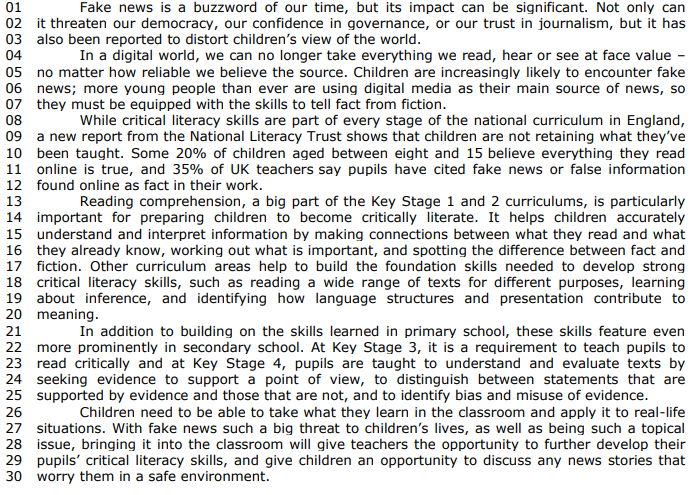
Adapted from https://www.theguardian.com/teacher-network/2017/oct/17/fake-news-improved-criticalliteracy-skills-teaching-young-people

Based on the text, judge the following items.
The singular form of “these” (line 11) can be this or that.


Choose the alternative that presents the plural form of the demonstrative pronoun “that" in the sentence given above.

 Conheça nossos planos