Questões de Concurso
Sobre presente progressivo | present continuous em inglês
Foram encontradas 89 questões


Reading before class is part of Julia’s routine. She usually enjoys studying in the library and is interested in learning new topics. Yesterday, she spent two hours preparing for an important exam. At the moment, Julia is reviewing her notes with a classmate.
(1) Continuous verbs
(2) Gerunds acting as nouns
(3) Adjectives
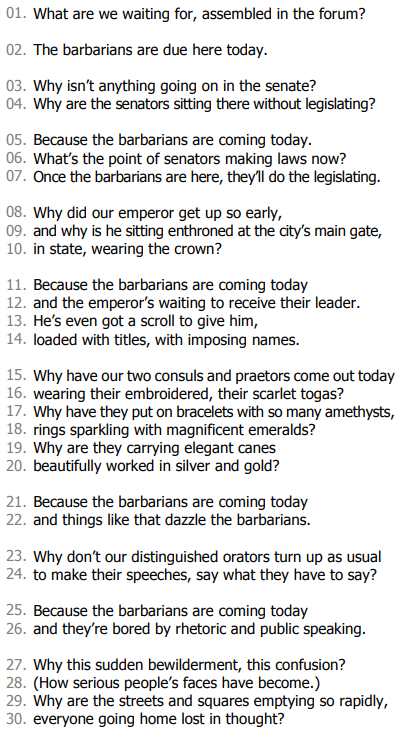
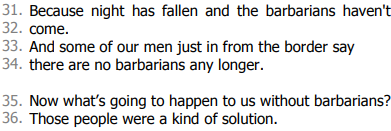
( ) “Why are the senators sitting there without legislating?” (l. 4)
( ) “Once the barbarians are here, they’ll do the legislating” (l. 7)
( ) “Why have they put on bracelets with so many amethysts, rings sparkling with magnificent emeralds?” (l. 17-18)
( ) “Now what’s going to happen to us without barbarians?” (l. 35)
( ) “loaded with titles, with imposing names.” (l. 14)
( ) “and they’re bored by rhetoric and public speaking” (l. 26)
Select the alternative with the correct sequence from top to bottom.
Column A
( 1 ) This fact relates to a gap in foreign language teaching policy documents.
( 2 ) […] and it is treating it as a tool for citizenship.
( 3 ) A recent reform in 2017 has added that English […]
( 4 ) Previous versions of LDB, however, did not mandate the teaching of English […]
Column B
( ) Present Perfect
( ) Present Continuous
( ) Present Simple
( ) Past Simple
"I am working on a new project."
English verb tenses are used to express actions that occur at different times and under different circumstances. Understanding the structure and function of each tense is essential for accurate communication and for teaching English effectively. Analyze the sentences in Column 01 and correlate them with the appropriate verb tense descriptions in Column 02.
Column 01
( )She loves classical music and attends concerts regularly.
(_)They are studying for their final exams at the moment.
( )He had finished the report before the manager arrived.
( )We will be traveling across Europe this time next month.
(__)She has lived in this city for more than ten years.
Column 02
I.Present Perfect Simple
II.Future Continuous
III.Simple Present
IV.Past Perfect Simple
V.Present Continuous
Correlate the columns according to the verb tense used in each sentence. Then, choose the alternative with the correct sequence.
Analyze the cartoon below by Ellis Rosen

(Available at: https://www.newyorker.com/gallery/and-the-oscar-goes-to – text specially adapted for this test).
The present continuous tense has the same use as in “They’re all looking at me” in which of the alternatives below?

1. Present Simple 2. Past Simple 3. Present Perfect 4. Past Perfect
( )"Sweden became the first nation outside Africa to report a case of the newer strain." (Lines 10-11)
( ) "Cases of other strains, or clades, of mpox have popped up in other countries." (Line 12)
( ) "The outbreak involves a newer strain primarily seen in African countries." (Line 1)
( ) "… in neighboring countries that had never reported countries of mpox before." (Lines 8-9)
The correct order of the numbers, from top to bottom, is:
TEXT:
Making homework count
By Stephanie Hirschman
October 8, 2024
Homework and independent study can make a massive contribution to students’ progress, particularly when classes don’t meet daily, or students aren’t living, working or studying in anglophone environments. There are several issues to consider when setting homework.
Why students are doing homework is a fundamental question which can cover a wide spectrum of reasons. The most obvious is that it offers both teachers and students a chance to check on learning and identify areas for further review and consolidation. Exam preparation courses make use of homework to consolidate and accelerate learning and deliver results. Finally, some institutions require teachers to set homework and some clients, for example parents, believe that a course with homework offers better value for money.
Whatever the reason behind setting homework, be clear with students about how they’ll benefit from the assignment, how to do it effectively, how long they should spend on it and how it will be marked.
The homework that many people expect from a language course is “more of the same” exercises, that is, those that offer extra opportunities to practice grammar or vocabulary from the lesson.
It is also possible to bring in practice from other online or print sources, but this can sometimes be problematic, especially for lower levels. Make sure that the resource you choose maps onto the lesson content without placing extra demands on students, for example, by introducing a completely different context or topic with unfamiliar vocabulary to practice a grammar point. You also need to make sure that terminology is consistent – students who are expecting to practice present continuous may not recognize that it is also called present progressive. With lower levels, go over the instructions and/or demonstrate one of the exercises so they know how to get started.
It's worth mentioning here that flipped learning may also be a useful approach to homework. This is where students preview part of the lesson plan (like a reading or listening task) or research a general topic independently before class in order to maximize opportunities for communicative activities during the lesson.
Other types of homework include semi-controlled practice of target language. Students could write personal sentences including vocabulary items or grammatical structures from the class – note that they may need training to do this. A sentence like, “The milk went off,” is not as effective for learning as, “We had no milk for the coffee this morning – it went off because we didn’t put it in the fridge last night.” You may wish to provide some question or example prompts as support.
An unusual and motivating type of speaking homework is a personalized bingo game. Students create their own bingo card, which might be a 4x4 grid. In each cell, they write a key word or structure from the lesson that they wish to practice during the next few days. They carry the card around in their pocket, and every time they use an item of target language, they can tick it off, aiming to complete a line. This is especially suitable for students who are living, working or studying in anglophone environments. Teachers can monitor progress regularly and even offer small prizes.
The question of what teachers actually do with homework also has multiple possible responses, which will depend on the teaching context. At one end of the spectrum, if there is good buy-in from the students, teachers may only need to point them towards a selected set of “more of the same” exercises and make sure the answers are accessible for self-checking. Make it clear that you welcome questions if anything isn’t clear and test regularly to check understanding.
Whatever choices you make about homework, here’s one final tip. It’s best to complete assignments the day after receiving them and not on the same day. Research on spaced repetition shows that reviewing information after around 24 hours, “just before you forget it,” is the most effective way to boost retention.
Adapted from: https://www.linguahouse.com/blog/post/makinghomework-count
Acesso em 25/10/2024
Check the sentences below:
I- She’s been sleeping.
II- She’s being tested.
III- She’s just finished her meeting.
What is the ’s a contraction of in each sentence, RESPECTIVELY?
I. They are travelling for hours.
II. She will finish her project by next week.
III. He is going to read a book right now.
IV. We had dinner at a new restaurant yesterday.
V. The meeting starts at 3 PM tomorrow. Verbal tense
A – Present Continuous
B – Immediate Future
C – Simple Past
D – Simple present
E – Simple Future
John: "What ___ (you/do) this Saturday?"
Mary: "I ___ (attend) a workshop on active learning methodologies."
Internet:<www.learnenglishteens.britishcouncil.org>
According to the text and general English knowledge answer the item.
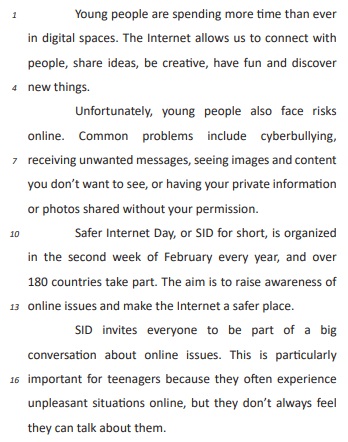
The words “receiving” (line 7), “seeing” (line 7)
and “having” (line 8) are examples of the present
continuous or present progressive tense.
MONACO, Emily. Gladstone's: The UK's only residential library. BBC. 22nd October 2023. https://www.bbc.com/travel/article/20231022- gladstones-the-uks-only-residential-library. [adapted]
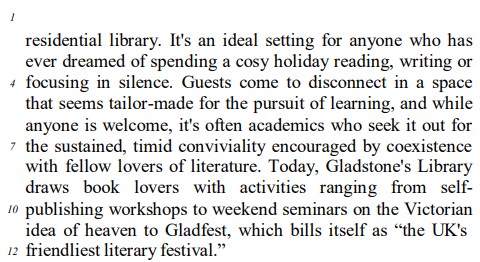
Based on the text, judge the following item.
Concerning the use of the present continuous, mark the CORRECT alternative:
He is ___________ a very good juice.

“She _________ a cake.”

 Conheça nossos planos