Questões de Concurso
Comentadas sobre preposições | prepositions em inglês
Foram encontradas 503 questões


Ano: 2023
Banca:
OBJETIVA
Órgão:
Prefeitura de Esperança do Sul - RS
Prova:
OBJETIVA - 2023 - Prefeitura de Esperança do Sul - RS - Professor – Inglês |
Q2293497
Inglês
Texto associado
Dogs will eat almost anything—cats, not so much. Here’s
why.
Why are cats such picky eaters when dogs seem
willing to wolf down just about anything they encounter? It’s
a question many pet parents likely ask themselves while
__________ their feline friend to swallow a pill or prying
another slobbery piece of mulch from their puppy’s mouth.
There’s still a lot scientists don’t know about animal
taste preferences. But, thanks to a small but growing body of
research, researchers are starting to unravel some of the
mysteries around our four-legged friends’ flavor fancies.
Here’s what we know so far.
Accidentally drop a cupcake on the ground and your
dog will probably scarf it down in one bite. Your cat, on the
other hand, may turn up her nose. One possible reason for
their ____________ behaviors? Cats can’t taste sweetness.
Since they couldn’t just ask cats directly,
researchers figured this out by analyzing their DNA. House
cats, tigers, and cheetahs have a “broken” version of the
gene Tas1r2, which works with another gene, Tas1r3, to
enable sweetness detection. Though Tas1r3 appears to
function perfectly fine in cats, Tas1r2 is an “unexpressed
pseudogene” that’s missing 247 letters. Without them,
Tas1r2 does not produce a crucial protein needed to form a
receptor for sweetness on cats’ taste buds.
To take the study a step further, they gave 25
felines the choice between a bowl of plain water and one
that’d been spiked with molecules that provide umami
flavor. As ___________, the cats strongly preferred the
umami water, and more specifically, water containing
umami compounds present in tuna. That may help explain
why felines love the saltwater fish so much.
(Source: National Geographic — adaptation.)
Concerning the parts of speech, the underlined word in
“Beside the old oak tree, there stood a small cottage.” is
classified as a/an:
Q2276170
Inglês
Texto associado
Internet: <www.britannica.com> (with adaptations).
Regarding the text and its linguistics aspects, judge the item below.
In the construction “whence the state derives its name.” (lines 5 and 6) “whence” means from where and its is a possessive adjective related to “the state”.
In the construction “whence the state derives its name.” (lines 5 and 6) “whence” means from where and its is a possessive adjective related to “the state”.
Q2276169
Inglês
Texto associado
Internet: <www.britannica.com> (with adaptations).
Regarding the text and its linguistics aspects, judge the item below.
In the first paragraph of the text the preposition “by” (lines 1 and 2) can be correctly substituted by the preposition from in all its occurrences.
In the first paragraph of the text the preposition “by” (lines 1 and 2) can be correctly substituted by the preposition from in all its occurrences.
Ano: 2023
Banca:
AMEOSC
Órgão:
Prefeitura de Bandeirante - SC
Prova:
AMEOSC - 2023 - Prefeitura de Bandeirante - SC - Professor de Inglês |
Q2272372
Inglês
Texto associado
Netherlands: Phone ban announced to stop school
disruptions
(1º§) Devices including mobile phones are set to be
banned from classrooms to stop them from disrupting
learning, the Dutch government has announced. The
initiative is being introduced in collaboration with schools
and is to take effect at the start of next year.
(2º§) There will be some exceptions, including for
students with medical needs or a disability, and for
classes focused on digital skills. The ban is not legally
enforceable but may become so in the future. "Even
though mobile phones are almost intertwined with our
lives, they do not belong in the classroom," said
Education Minister Robbert Dijkgraaf. "Students must be
able to concentrate there and be given every opportunity
to learn well. We know from scientific research that
mobile phones disrupt this."
(3º§) Various studies have found limiting children's
screen time is linked to improved cognition and
concentration. Other tech including tablets and
smartwatches are also included in the Dutch ban. The
government said it would be up to individual schools to
agree the exact rules with teachers, parents and pupils -
including whether they wanted to completely ban devices
__ schools.
(4º§) The scheme is the result of an agreement between
the ministry, schools and related organisations. It will be
reviewed at the end of the 2024/2025 school year to see
how well it had worked and whether a legal ban is
needed. The announcement follows a similar decision by
Finland last week.
(5º§) Its government announced it would change the law
to make it easier __ restrict the use of phones in schools.
Other countries, including England and France, have also
proposed banning mobile phones to improve learning.
https://www.bbc.com/news/world-europe-66107027
Choose the alternative that correctly fills in the blanks of
paragraphs 3º and 5º.
Ano: 2023
Banca:
CESPE / CEBRASPE
Órgão:
MPE-RO
Prova:
CESPE / CEBRASPE - 2023 - MPE-RO - Analista de Redes e Comunicação de Dados |
Q2238992
Inglês
Texto associado
Text 2A7
Artificial intelligence (AI) is arguably the most rapidly
advancing technology humans have ever developed. A year ago,
you wouldn’t often hear AI come up in a regular conversation,
but today it seems there’s constant talk about how generative AI
tools like ChatGPT and DALL-E will affect the future of work,
the spread of information, and more. A major question that has
thus far been almost entirely unexamined is how this
AI-dominated future will affect people’s minds.
There’s been some research into how using AI in their
jobs will affect people mentally, but there isn’t yet an
understanding of how simply living amongst so much
AI-generated content and systems will affect people’s sense of
the world. How is AI going to change individuals and society in
the not-too-distant future?
AI will obviously make it easier to produce
disinformation. That will affect people’s sense of trust as they’re
scrolling on social media. AI can also allow someone to imitate
your loved ones, which further erodes people’s general ability to
trust what was once unquestionable.
Internet: <wired.com> (adapted).
In the context of the first sentence of the second paragraph of
text 2A7, the word “understanding” is grammatically classified as
Ano: 2023
Banca:
FUNDATEC
Órgão:
Prefeitura de Espumoso - RS
Prova:
FUNDATEC - 2023 - Prefeitura de Espumoso - RS - Professor de Séries Finais - Língua Inglesa |
Q2210441
Inglês
Fill out the gaps below with one the following words: that / where / which / who.
1. That’s the store ___ they buy their shoes.
2. The book, ___ we’ve been reading at school, was written long ago.
3. These are the directors and movies ___ I like.
4. Marie Curie is the woman ___ discovered radium.
Mark the alternative that fills out, correctly and respectively, the gaps in the sentences above.
Ano: 2023
Banca:
FUNDATEC
Órgão:
Prefeitura de Espumoso - RS
Prova:
FUNDATEC - 2023 - Prefeitura de Espumoso - RS - Professor de Séries Finais - Língua Inglesa |
Q2210440
Inglês
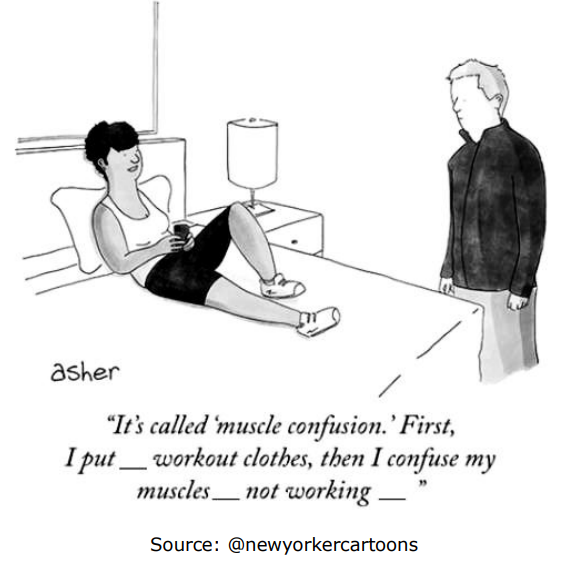
In the cartoon below we see two people, and the one on the bed is explaining to the
other: “It’s called ‘muscle confusion’. First, I put __ workout clothes, then I confuse my muscles __
not working __”.
Mark the alternative that fills out, correctly and respectively, the gaps in the sentences above.
Mark the alternative that fills out, correctly and respectively, the gaps in the sentences above.
Ano: 2023
Banca:
FUNDATEC
Órgão:
Prefeitura de Maçambará - RS
Prova:
FUNDATEC - 2023 - Prefeitura de Maçambara - RS - Professor Anos Finais do Ensino Fundamental – Inglês |
Q2209854
Inglês
Analyze the following sentences:
• Can you come __ Monday? • She's __ Korea for the holidays. • They can't work __ night this week. • I hate it when people are too excited early __ the morning.
Mark the alternative that fills out, correctly and respectively, the gaps in the sentences above.
• Can you come __ Monday? • She's __ Korea for the holidays. • They can't work __ night this week. • I hate it when people are too excited early __ the morning.
Mark the alternative that fills out, correctly and respectively, the gaps in the sentences above.
Ano: 2023
Banca:
FGV
Órgão:
Prefeitura de Jaboatão dos Guararapes - PE
Prova:
FGV - 2023 - Prefeitura de Jaboatão dos Guararapes - PE - Professor 2 - Língua inglesa |
Q2204975
Inglês
Texto associado
Text III
Teaching a child to read
Imagery first: the colors primary
Familiar as the sun; the purpose sure –
To hear, to smell, to feel, to taste, to see.
The mind will enter by another door.
The verb is next: we are the rain that falls,
The frog that sees a cricket as it leaps,
The robin that flaps its wings and calls,
The fish that swims, the animal that creeps.
The third is narrative, the moving spell
Of syntax that ad-libs the myths of time.
Alas, we learn before the wishing well
Has dried how words become a hill to climb.
The fourth is symbol: goodness, beauty, love.
This is the time of quarrel, tears and pain.
Sowing the dragons’ teeth, we bob and weave
Until we bring the simple back again.
By Allen Kanfer. Source: https://www.poetryfoundation.org/
poetrymagazine/browse?contentId=28478
Glossary: to ad-lib: If you ad-lib something in a play or a speech, you say something
which has not been planned or written beforehand.
(https://www.collinsdictionary.com/dictionary/english/ad-lib)
The opposite of the preposition in “we learn before the wishing
well/Has dried” is
Ano: 2023
Banca:
AMAUC
Órgão:
Prefeitura de Irani - SC
Prova:
AMAUC - 2023 - Prefeitura de Irani - SC - Professor de Inglês |
Q2204596
Inglês
Texto associado
O texto seguinte servirá de base para responder a questão.
(1º§) Arthritis and osteoporosis are long-term conditions
that affect your bones. Arthritis causes swelling and
inflammation. Osteoporosis develops as a result of
decreased bone mass and density, and can lead to
fractures.
(2º§) Jane Atkinson looks at ways to keep your bones
and joints healthy. Regular, low-impact exercise can help
in the battle against joint pain. Nuffield Health has
launched a free joint pain programme to help sufferers
lead a more independent life - and you don't even need
to be a paying member of the gym to join up. As well as
exercises, it offers lifestyle tips and uses relaxation
techniques to try to help with pain so those affected can
sleep.
(3º§) The programme, which lasts six months, has
proven results. Of those who completed it, 69 per cent
say they have improvements in mobility, pain, general
fitness levels and overall quality of life. Among
participants who were in such pain they couldn't work, 30
per cent were able to return after week 12. Working out
what supplements you need and how much you need is
not always easy.
(4º§) Osteo Complete is a bone health complex that
includes calcium, vitamin D3, zinc, boron and copper.
These elements work together to help maintain your
musculoskeletal system, which supports the body and its
movements. Vitamin D3 is crucial for the absorption of
calcium. The minerals magnesium and zinc contribute to
normal protein synthesis, while copper helps maintain
connective tissues.
(5º§) These very tasty vanilla-flavoured tablets are a
good alternative for people who do not like swallowing
pills as you can chew them. 240 chewable tablets,
£18.95, healthspan.co.uk.
(6º§) The world has gone mad for collagen. There are
different types, but for bone health the best is Type I. It
provides structure to your skin, bones, tendons and
ligaments. The change is not instant. Take it regularly
and it could take a year to achieve the full results, but if
you are persistent it does work. I like Correxiko Marine
Collagen Type I. It comes from the skin of deep-sea fish,
caught off the coast of Canada.
(7º§) It is an unflavoured powder that you bung in water
or a coffee. Lisa Snowdon says her menopausal and
age-related aches and pains have gone since she started
using it. £39.95 for a 42-day supply, correxiko.com.
(adapted) https://www.thesun.co.uk/health/22499522/we-test-p
ills-collagen-products-keep-bones-healthy/
(adapted) ts-keeeppboneeshealthy/
k/health/22499522/we-test-pills-collagen-products-keep-bones-healthy/
In the sentence "Of those who completed it, 69 percent
say they have improvements [...]" (3º§), the parts of
speech are as follows, EXCEPT:
Ano: 2023
Banca:
OBJETIVA
Órgão:
Prefeitura de Piratininga - SP
Prova:
OBJETIVA - 2023 - Prefeitura de Piratininga - SP - Professor - Educação Básica PEB II - Inglês |
Q2200710
Inglês
Texto associado
Why Easter is bad for ducks
On Christmas Eve, two Pekin ducks were found
frozen to a pond in Smithville, Ohio. They flapped their
wings and squawked, fruitlessly struggling to free
themselves until two locals, Maiara and Helder Bertolucci,
spotted them. The pair slid on their stomachs over razor-thin
ice and chiseled the animals free.
The rescued ducks—later named Olaf and Elsa, after
characters from Disney’s Frozen—were two of 109 domestic
ducks abandoned in a pond outside of a restaurant. A local
group ________ Good Sprout Rescue and Sanctuary rescued
the animals; two died, but the rest were rehomed to
sanctuaries or adopted. Every spring, the Barn Restaurant
would buy a hundred new babies for its patrons to enjoy—
but since this incident they’ve __________ not to do so
again.
Every year in springtime, particularly at Easter,
many people “impulse buy” ducklings as gifts, often for their
kids. But after the holiday, sometimes months later, animal
rescuers routinely see an uptick in abandoned adult ducks in
local parks and ponds, Di Leonardo says. There’s no
________ data on how often this happens, but he estimates
tens of thousands of domestic ducks are dumped each year
throughout the U.S. His organization rescues as many as 500
ducks per year in the New York City area alone.
Fonte: (National Geographic – adaptado.)
Concerning the parts of speech, the underlined word in
“This was intentionally explained” is classified as a/an:
Ano: 2023
Banca:
AMEOSC
Órgão:
Prefeitura de São João do Oeste - SC
Prova:
AMEOSC - 2023 - Prefeitura de São João do Oeste - SC - Professor de Inglês |
Q2189336
Inglês
Texto associado
La Mer lip balm is touted __ many celebs as a bit of a handbag necessity. But according to Mia, nothing beats a pot of good-old Vaseline. And while La Mer balm can set you back £58 ($75), Vaseline can be as cheap as a couple of pounds.
HOLY GRAIL I'm a dermatologist - here's how you get
can get rid of forehead wrinkles without Botox and
for under £10
(1º§)EACH passing day brings many moments that
cause you to furrow your brow. And the more face
scrunching you do, the more dreaded lines are likely to
emerge __ your forehead. But before you devote time
(and a decent amount of money) to fading those pesky
wrinkles, it's good idea to try and figure out what's really
causing your lines. If you're under 30, chances are your
forehead 'wrinkles' are in fact just dehydrated skin,
according to one medic.
(2º§)Dr Ivy Lee, a board-certified dermatologist practicing
in southern California, US, said dehydration lines can be
easily improved without splashing the cash on Botox.
She told Insider that unlike wrinkles caused by repetitive
muscle movement dehydration lines are finer and have a
"crepe paper-like texture when the affected skin is not
well hydrated." And while we may associate dehydration
with drinking water, the expert said drinking more water
does not have any added skin benefits. Instead, she
urges young people to use topical skin treatments.
What product should I use?
(3º§)Dr Ivy said you should look for moisturisers that
contain the following three ingredients:
Humectants, which attract water into the skin (eg:
hyaluronic acid)
Emollients, which repair the skin barrier and soften the
skin (ex: squalene and plant-derived oils).
Occlusives, which "trap moisture into the skin by creating
a seal," the expert said (ex: hydrated petroleum or
mineral oil).
(4º§) She recommended using CeraVe Moisturising
Cream - a 177ml tube from Boots costs will set up back
just £10.
Other cheap skincare products under £10
(5º§) There's no denying that luxury products contain
some premium ingredients and look pretty aesthetic, but
given the cost __ living crisis, affordable skincare is just
as important, especially when the products work just as
well. Some dermatologists have shared their favourite
skincare swaps for luxury products that they say work as
effectively as expensive versions.
(6º§)Vaseline vs La Mer lip balm
La Mer lip balm is touted __ many celebs as a bit of a handbag necessity. But according to Mia, nothing beats a pot of good-old Vaseline. And while La Mer balm can set you back £58 ($75), Vaseline can be as cheap as a couple of pounds.
(7º§)The INKEY List Vitamin C serum vs SkinCeuticals
Vitamin C creams and serums can brighten your skin
and, according to some studies, can reduce the signs of
ageing. But these products can be expensive, because
they can be tricky to make, Rebecca explained.
SkinCeuticals' C E ferulic vitamin C antioxidant serum is
an excellent product, she said - but it will set you back a
whopping £165 ($182). Instead, why not give the INKEY
List's own vitamin C a whirl, Mia suggested, which only
costs £9.99 ($15.99).
xwwwinkkesforehead/
co.uk/health/22190687/dermatologist-skincare-botox-wrinkles-forehead/
Choose the alternative that correctly fills in the blanks of
paragraphs 01, 05 and 06.
Ano: 2023
Banca:
IBFC
Órgão:
SEE-AC
Prova:
IBFC - 2023 - SEE-AC - PROFESSOR-PNS-P2 – LÍNGUA INGLESA |
Q2184932
Inglês
Texto associado
Text: The importance of the PowerPoint
as a classroom resource
(Text adapted from Teachers: 5 Tips for Creating Great
PowerPoint Presentations, retrieved
PowerPoint is a resource developed by Microsoft
and released initially in 1990. It is mainly used in
professional meeting presentations all over the
world.
One of these professions is in educational area:
teacher.
PowerPoint presentation is spread among
teachers because it is different from lecturing or
teaching with a textbook; it is also a way of sharing
content with students.
To produce a PowerPoint correctly, teachers need
to know how to put the slides together, it can be an
effective way of reinforcing content to students so
that they are better able to retain it. Otherwise,
teachers can print and distribute the PowerPoint
presentation or post it online, so students can go
back and access it as reference material. However,
if it is not put together correctly, a PowerPoint
presentation can disengage and make students
bored.
To develop PowerPoint presentation is simple and
it can also provide a fun time noticed by its
characteristics: basic, simple, and not distracting, it
can be focused on keywords; for instance, always
be sure to include a summary slide of what the
presentation is intending to accomplish as well as a
table of contents on the different topics that will be
covered in the program. The summary slide serves
as the main topic and what students should learn
after viewing the presentation. Then, at the end of
the PowerPoint presentation, teachers should
include another summary slide, going over
everything that was just covered and, again,
highlighting the main point.
Bottom line
PowerPoint presentations need to have a purpose
and the teacher must make sure that the purpose is
understood.
Add pictures
Teachers can reinforce the content with pictures,
charts, symbols, and other images. In fact,
sometimes it’s better to have more pictures than text
in a PowerPoint presentation, because images work
to reinforce a content main point.
Teachers typically will just share it with their
classes, so they can pull images straight from the
Internet. However, for teachers who are making
more public and widespread presentations,
copyright law needs to be considered (Brazil
Information Access Law nº 12.527; Art. 31;
paragraph 3; item II).
Add video
Pictures can help to reinforce a main point or
support content, as well as videos. Some research
affirm that students enjoy watching videos and
retain information from them well, especially if the
video is engaging, interesting and informative.
Teachers can embed videos right from YouTube or
from their desktops to complement a PowerPoint
presentation.
Practice
Nothing turns off a class like a poorly put together
PowerPoint presentation, so teachers should
always be sure to do a quick rehearsal before they
present it to the class. While testing it, make sure all
the images load up on the slides, videos load up
properly and audio works, too. Also, it’s important
for teachers to make sure that there’s a way to
connect their computer, or upload anything that’s
storing the PowerPoint presentation, to a larger TV
monitor or projector screen so the whole class does
not have to huddle around a computer screen to
view it. Teachers should also make sure that any
text can be read and understood. Be sure that the
color scheme is good.
Make it fun
A PowerPoint presentation can be an innovative
way of teaching. It’s a more interesting and
engaging way for students to learn than the typical
lecture. Teachers should embrace this teaching
resource and have fun with it. Throw in some jokes,
possibly some funny pictures and be sure to get
creative with presentations.
As we previously noted, the more students enjoy
a lecture, presentation, or activity, the more likely
they are to retain information.
Read these sentences and note the -ING suffix
formation analyses. Then choose the incorrect
alternative.
Ano: 2023
Banca:
OBJETIVA
Órgão:
Prefeitura de Sagrada Família - RS
Prova:
OBJETIVA - 2023 - Prefeitura de Sagrada Família - RS - Professor - Área II - Inglês |
Q2178063
Inglês
Concerning the use of preposition, check C for Correct
and I for Incorrect alternatives. After that, check the
alternative that presents the CORRECT sequence:
(_) The children are tired of going to the same place every summer. (_) She spoke for hours without use notes. (_) Thank you for coming.
(_) The children are tired of going to the same place every summer. (_) She spoke for hours without use notes. (_) Thank you for coming.
Ano: 2023
Banca:
UniRV - GO
Órgão:
Prefeitura de Rio Verde - GO
Prova:
UniRV - GO - 2023 - Prefeitura de Rio Verde - GO - Professor de Educação Básica II (PEB II) - Inglês |
Q2170182
Inglês
Assinale a alternativa correta quanto ao uso das preposições:
Ano: 2023
Banca:
IGEDUC
Órgão:
Prefeitura de Tupanatinga - PE
Prova:
IGEDUC - 2023 - Prefeitura de Tupanatinga - PE - Professor II Inglês |
Q2163898
Inglês
Texto associado
Julgue o item subsequente.
The preposition was adequately used in the sentence “My
nephew was born on April”.
Ano: 2023
Banca:
IGEDUC
Órgão:
Prefeitura de Tupanatinga - PE
Prova:
IGEDUC - 2023 - Prefeitura de Tupanatinga - PE - Professor II Inglês |
Q2163886
Inglês
Texto associado
Julgue o item subsequente.
The preposition is correct in the sentence “She is really
good at sports”.
Ano: 2023
Banca:
Avança SP
Órgão:
Prefeitura de São Miguel Arcanjo - SP
Prova:
Avança SP - 2023 - Prefeitura de São Miguel Arcanjo - SP - Professor Ensino Fundamental (6º ao 9º ano) Língua Portuguesa e Inglesa |
Q2131558
Inglês
Choose the correct option to complete the blank spaces:
“With the rapid development _____ modern technology, the space _____ information confrontation is no longer limited _____ land, sea, and the low altitude. Near space has also become a new battlefield _____ modern warfare and an important part of the national security system,”
“With the rapid development _____ modern technology, the space _____ information confrontation is no longer limited _____ land, sea, and the low altitude. Near space has also become a new battlefield _____ modern warfare and an important part of the national security system,”
Ano: 2023
Banca:
Avança SP
Órgão:
Prefeitura de São Miguel Arcanjo - SP
Prova:
Avança SP - 2023 - Prefeitura de São Miguel Arcanjo - SP - Professor Ensino Fundamental (6º ao 9º ano) Língua Portuguesa e Inglesa |
Q2131557
Inglês
Choose the correct option to complete the blank spaces:
“China has paid close attention _____ other countries’ developments _____ this region, which has been hailed _____ Chinese military experts _____ “a new front for militarization” and “an important field of competition among the world’s military powers.”.”
“China has paid close attention _____ other countries’ developments _____ this region, which has been hailed _____ Chinese military experts _____ “a new front for militarization” and “an important field of competition among the world’s military powers.”.”
Ano: 2023
Banca:
MSConcursos
Órgão:
Prefeitura de Turvelândia - GO
Prova:
MS CONCURSOS - 2023 - Prefeitura de Turvelândia - GO - Professor de Inglês |
Q2124434
Inglês
No parágrafo, falta uma preposição. Assinale a alternativa que completa corretamente a lacuna:
November has arrived. I finally have time to rest. ______________ the weekend, I will go surfing with my friends.

 Conheça nossos planos