Questões de Concurso
Comentadas sobre preposições | prepositions em inglês
Foram encontradas 503 questões


I- Karen could see someone running towards her. II- We spent an enjoyable evening on the movies. III- Michelle is not here at the moment. She is to the store. IV- Does this bus go in Ipanema?
The preposition is CORRECT in:
Text 1
Youth and Adult Literacy in Brazil:
learning from practice
The Concept of functional ILLITERACY
[…] A person is considered functionally literate....................he or she is capable..........using reading and writing skills..........meet the demands of his or her social context, using them to continue learning and developing over their lifetimes. With the expansion of the access to schooling beyond literacy, the focus was shifted to the quality of the educational process offered to all. The issue here is not simply whether people know how to read or write, but what they are capable of doing with those skills. This means that, besides the issue of illiteracy, a social problem that still persists in Brazil, there is also the issue of functional illiteracy; in other words, the inability to effectively use reading and writing skills in the various areas of social life after a certain number of years of schooling. According to census criteria, individuals with less than 4 years of schooling are considered functionally illiterate. […]
Source: https://unesdoc.unesco.org
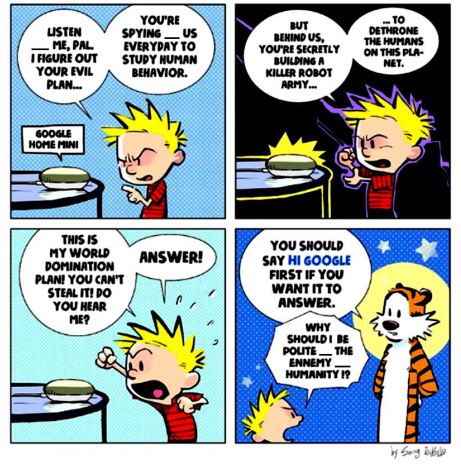
Which of the alternatives below correctly fills out the gaps in the dialogue, from top to bottom?
Crazy Horse
Crazy Horse (Tasunke Witko, 1840-1877) was an Oglala Lakota Sioux warrior and warband leader considered among the greatest defenders of Sioux lands against the forces of the US government in the 19th century. He is one of the most famous Native American figures in history and among the Sioux's most honored heroes. Although he is often referred to as a "chief", Crazy Horse was actually a "Shirt Wearer" – a kind of "subchief" – who carried out the decisions of the council and also served as a war chief of a given band of warriors. Even so, Crazy Horse inspired such devotion in his followers that he was regarded as a "chief" and is referenced as such by others.
His name, Tasunke Witko (Crazy Horse), is accurately translated as "His Crazy Horse" or "His Horse is Crazy" and was his father's and grandfather's name, seemingly referencing a horse that behaved erratically. According to Black Elk, however, the name correlated to Crazy Horse's famous vision in which he saw his horse dancing as though "made only of shadow" in a strange or "crazy" way.
Crazy Horse dedicated himself to opposing the US military as early as 1854 following the Grattan Fight (Grattan Massacre) and the subsequent massacre of Little Thunder's camp in 1855 by Colonel William S. Harney. He continued his resistance over the next eleven years and was named a "Shirt Wearer" in 1865. He fought in the Battle of Plate River Bridge (1865), Red Cloud's War (1866-1868), the Battle of the Rosebud (1876), and the Battle of the Little Bighorn (1876). His last full-scale engagement with US forces was the Battle of Wolf Mountain in January 1877.
World History Encyclopedia. Adaptation.
The artist focused intently ______ capturing the essence of the landscape ______ their painting, while the sun set slowly ______ the horizon.
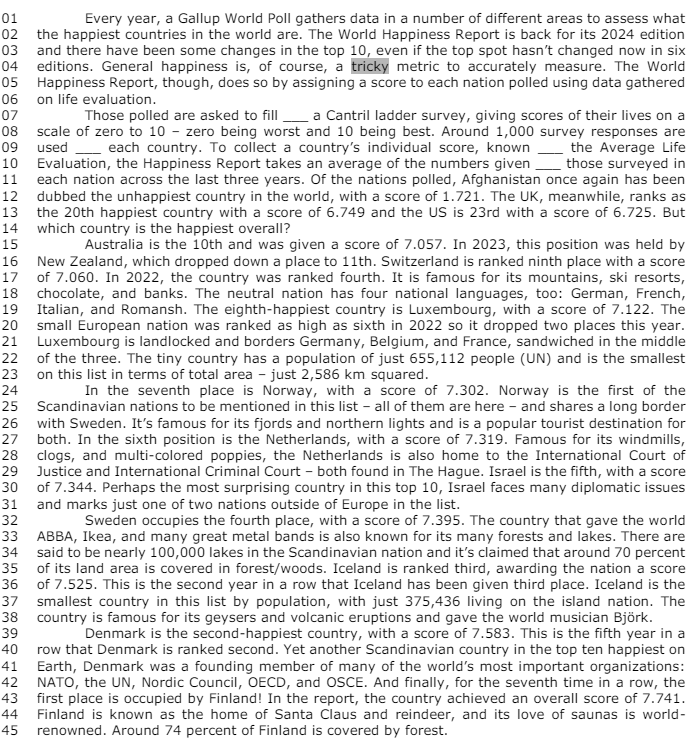
Julgue o item subsequente.
The sentence: "The sweetness of this cake is out of this
World!" shows "out of" as a good example of a complex
preposition.
Julgue o item subsequente.
In the sentence: "He suffers from terrible headaches in hot
weather", the word "from" can be excluded without
changing the meaning of the sentence.
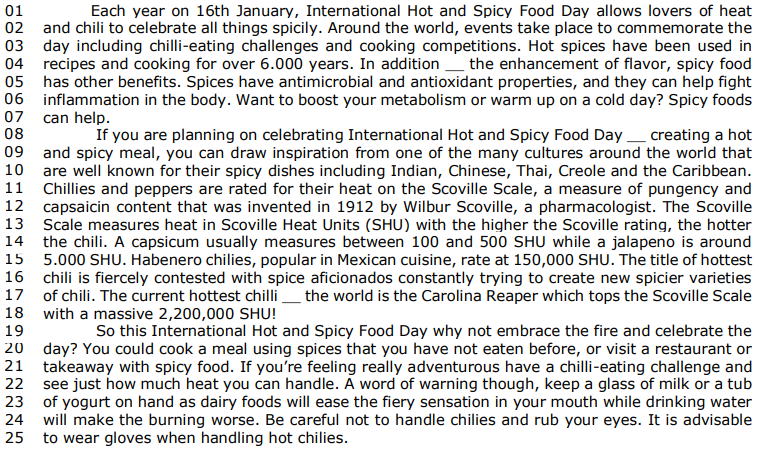
“As preposições devem ser usadas para conectar substantivos, pronomes ou ainda outras palavras em uma determinada oração. Para usá-las corretamente, é importante lembrar que elas cumprem uma função específica na frase, isto é, indicam uma relação de espaço, de tempo ou de direção.”
Adaptado de: <https://exercicios.brasilescola.uol.com.br/exercicios-ingles/exercicios-sobre-prepositions.htm> acesso em: 7 jun. 2023
Complete the sentence:
1. They Always go out ______ Fridays.
2. He is waiting for you ______ the living room.
3. My nephew was born ______ 2012.
4. My children usually go to bed _____ 11pm.
Instruction: answer questions 31 to 40 based on the following text. The highlights throughout the text are cited in the questions.
He donated blood and saved the lives of 2.4 million babies
01 Most people get a gold watch when they retire. James Harrison deserves so much more than
02 that. Known as the “Man With the Golden Arm,” Harrison has donated blood nearly every week
03 for 60 years, and after all those donations, the 81-year-old Australian man “retired” Friday.
04 According to the Australian Red Cross Blood Service, he has helped save the lives of more than
05 2.4 million Australian babies because his blood has unique, disease-fighting antibodies.
06 Harrison’s antibodies have been used to develop an injection called Anti-D, which helps
07 fight against rhesus disease. This disease is a condition where a pregnant woman has rhesus-
08 negative blood (RhD negative) and the baby in her womb has rhesus-positive blood (RhD
09 positive), inherited from its father. If the mother has been sensitized to rhesus-positive blood,
10 usually during a previous pregnancy with a rhesus-positive baby, she may produce antibodies
11 that destroy the baby’s “foreign” blood cells. In the worst cases, it can result in brain damage,
12 or death, for the babies.
13 Harrison’s remarkable gift of giving started when he had major chest surgery when he was
14 just 14. Blood donations saved his life, so he pledged to become a blood donor. A few years
15 later, doctors discovered his blood contained the antibody which could be used to create Anti-D
16 injections, so he switched over to making blood plasma donations to help as many people as
17 possible. Doctors aren’t exactly sure why Harrison has this rare blood type, but they think it
18 might be from the transfusions he received when he was 14, after his surgery. He’s one of no
19 more than 50 people in Australia known to have the antibodies, according to the blood service.
20 “In Australia, up until about 1967, there were literally thousands of babies dying each year,
21 doctors didn’t know why, and it was awful.” Jemma Falkenmire, of the Australian Red Cross
22 Blood Service, told CNN. “Australia was one of the first countries to discover a blood donor with
23 this antibody, so it was quite revolutionary at the time.”
24 The blood service estimates Harrison saved more than two million lives, and for that, he is
25 considered a national hero in Australia. He’s won numerous awards for his generosity, including
26 the Medal of the Order of Australia, one of the country’s most prestigious honors. Now that
27 Harrison has given his last blood donation (in Australia you can’t donate blood past the age of
28 81), Falkenmire and others hope people with similar antibodies in their blood will step up and
29 donate.
(Available at: https://edition.cnn.com/2018/05/11/health/james-harrison-blood-donor-retires-trnd/index.html – text especially adapted for this test).
Mark the correct alternative about the word “its” (line 09).
Giving Blood = Giving Life
Giving blood is an amazing thing a person can do. Why? Because people who have anaemia, cancer, blood disorders, sickle cell, and other illnesses need blood transfusion. Some people even need regular blood transfusion to live.
Think about it: giving blood as part ............ everyone’s life; something they done .............. a regular basis, like eating ........... a favourite restaurant. What kind of difference does that make? Well, a donation might make the difference between life and death for nearly five million people who receive blood transfusions every year.
Giving blood is simple and convenient. It only takes about an hour and you can make the donation at a donor center. Afterwards, you will feel good about yourself.
Most people don’t think they’ll never need a blood transfusion, but many do. Blood is something money can’t buy. One may give a newborn, a child, a mother or a father, a brother, or a sister another chance at life. In fact, this simple action may help to save lives.
The blood donation process is much quicker and easier than you think. Giving blood will not decrease your strength and it’s certainly the right thing to do.
Choose the alternative which presents the correct prepositions that are missing in the second paragraph:
Choose the alternative to correctly fill the blank:
“I went ____ the club last night”
Suzy: Have you ever __________to New York?
Jane: No, I ______________been there, Why?
Suzy: I'm planning a trip and I'd like some tips about what kind of clothes to take.
Jane: Oh really? My friend Josh _________ there for a year. I think he can _________ you.
Suzy: Thats amazing.
Choose the best option to complete the dialogue.
Leia o texto a seguir e responda às questões 45, 46 e 47.
(Título omitido propositadamente)
Often when mentoring, in a one-to-one session, it will be clear that the mentee’s worst critic is the one they see very regularly – daily, in fact. Often when they are tired and stressed. Often when they are at a low point. It’s the one they look (1)________ the mirror.
I mean most of the time, the worst critic lives inside people’s head. It might be the criticism that you heard at school or college. It might be the voice of so-called friends. It might be a parent or guardian, sibling or perfect cousin. You can’t always shut those voices up. No matter how much you want to. You can, however, recognise that they are internal voices and cultivate a strategy to counteract them.
If you can have an internal critic, you can also have an internal cheerleader. One technique is to give yourself advice that you would give your best friend in that situation. If you’re worrying about not being good (2)________ something, what would you say to your best friend in that state? You’d probably tell them that it would be alright, they’ll sail through it, that you believe (3)________ them. If you can do it for your best friend, you can do it for yourself.
Adapted from https://www.campaignlive.co.uk/article.
Choose the alternative with prepositions that respectively complete gaps (1), (2) and (3) in the correct way.

 Conheça nossos planos