Questões de Concurso
Sobre plural dos substantivos | plural of nouns em inglês
Foram encontradas 95 questões


Drug use has been prevalent for several decades in the United States. In general, the most used are tobacco, alcohol, opioids, marijuana, amphetamines, cocaine, and psychedelics, while among teens, alcohol, marijuana, and tobacco are the top three (Most Reported Substance Use among Adolescents Held Steady in 2022). Studies on the impact of smoking and vaping use in films have found evidence of increased risk among exposed children, indicating the process of causal association (Hassanein et al., 2022). Changes in recreational and medicinal regulation process have also brought modifications to some illicit substances, like marijuana and psychedelics, for those having gained legal status in states like California, Colorado, and Oregon. However, a study in Washington, a recreational state, illustrated no increases in marijuana use among 12th graders and a decrease of 22% in 10th graders. Despite these societal process change, cigarettes, marijuana, and alcohol still pose significant dangers to individuals, especially when abused. In recent years, the landscape of alcohol consumption has changed to include unsuspecting high-alcohol beverages like seltzers, marketing via social media, and businesses that historically did not provide, but now readily provide drinks, like movie theaters and “for here, or to go” off-premises sales. Alcohol abuse can result in a process of liver damage, impaired judgment, addiction, and increased risk of accidents and violence (Jones, 2020). Cigarettes contain harmful chemicals that can lead to severe respiratory issues, cardiovascular diseases, and various forms of cancer. Marijuana, although touted for its medicinal properties, can have adverse effects on the memorization process, concentration, and mental health, particularly among young users, therefore, these health concerns are deeper than ever, as marijuana potency has increased steadily over the last two decades.
(Available in: https://digitalcommons.unmc.edu/cgi/viewcontent. Adapted. Accessed on: January 2026.)
3The text presented for reading and comprehension work for its topic of general interest – drug consumption among youngsters – is part of a project aimed at connecting curricular areas. While providing vocabulary expansion and improving informational level, linguistic knowledge development was also sought, since students reviewed and applied content already studied. Based on the observation of the highlighted word, the alternative whose plural form follows the same rule is:
Considering the forms used, mark T, for true, and F, for false.
(__)"Fish" can occur with the same form after "one" and "two" in the examples.
(__)"Apples" marks plural through the addition of "-s."
(__)The expressions show that all English nouns form the plural through the same written change.
(__)Cardinal numerals such as "one" and "two" can contribute to the interpretation of quantity.
After analysis, select the alternative that presents the CORRECT sequence of the items above, from top to bottom.
Leia o texto a seguir.
The world cup debutants determined to prove nothing is impossible
When the 2026 FIFA World Cup kicks off on June 11 in Mexico City, it will set in motion a flurry of historic firsts.
A newly expanded 48-team tournament, three countries: the US, Canada and Mexico as hosts and we’ll also get to see four debutants in the shape of Curaçao, Jordan, Uzbekistan and Cape Verde.
It was in October of last year that Cape Verde, the African archipelago nation — with a population of just over half a million people — qualified for its first ever World Cup after beating Eswatini 3-0 to become the third-smallest country after Curaçao and Iceland eight years ago to make it through to football’s biggest stage.
It was a feat made even more impressive by the fact the Blue Sharks ended up four points ahead of traditional continental powerhouse Cameroon, topping their Confederation of African Football qualifying group in the process.
It’s no wonder the team’s head coach Pedro Leitão Brito — better known as Bubista — was beaming with pride when he dropped by the CNN studios in Atlanta recently as part of a visit to Mercedes-Benz stadium, where Cape Verde will begin their World Cup campaign on June 15 against the 2010 winners and reigning European champions, Spain.
“We are so excited. I think the people are so excited and we’re going to do our best for our people,” Bubista — a distinguished former captain and defender on the national team — told CNN Sports.
Bubista oversaw a truly history-making qualifying campaign. A sequence of results that included a highly impressive five straight wins, the highlight of which featured a never-to-be-forgotten 1-0 triumph over the Cameroonians in September 2025.
But it’s October 13, 2025, that will be indelibly etched into the memory of all who witnessed Cape Verde’s historic win against Eswatini. A victory that would spark frenzied celebrations of joy in the country’s capital city Praia.
“Our people are so excited and so happy. Our people in the world, it’s just so great for our qualification and now our people are so grateful for everything,” Bubista added.
Cape Verde may be about to play in a first ever World Cup, but the national team is no stranger to success when it comes to competing in the Africa Cup of Nations having reached the quarterfinals in 2013 and then again, a decade later. Bubista oversaw the latter campaign but now the head coach’s focus is fully on his team’s tournament opener against Spain.
“We know it’s a very difficult match … They have very good players. We will respect them but anything is possible. We’re going to do our best to show the world what we can do in football,” Bubista reflected.
“We know it’s a hard game, but we have our heart and team spirit and this is important for us. Our unity is our strength,” he added.
The Blue Sharks will arrive in the US with a talented squad including Villarreal’s Logan Costa, Paris Saint-Germain 18-year-old Fabio Domingos and 36-year-old Ryan Mendes, who is the country’s most-capped player — with more than 90 appearances for the national team — and is Cape Verde’s all-time leading goalscorer.
And then there’s the remarkable story of the Shamrock Rovers forward Roberto “Pico” Lopes who was born in Ireland, but when it comes to international football, represents Cape Verde, currently ranked 69th in the world.
Lopes had always wanted to play for Ireland but when that didn’t materialize, he ended up playing for his father’shomeland after famously being recruited through a LinkedIn message from then-team head coach Rui Águas. Initially Lopes ignored the first message sent in Portuguese as spam but not the second one sent a few months later in English.
Fonte: https://edition.cnn.com/sport/cape-verde-world-cup-debutants-nothing-isimpossible-spc. Excerto. Acessado em: 07/06/2026.
Brain rot
“Brain rot” is defined as “the supposed deterioration of a person’s mental or intellectual state, especially viewed as the result of overconsumption of material (now particularly online content) considered to be trivial or unchallenging. Also: something characterized as likely to lead to such deterioration”. The term gained new prominence as a term used to capture concerns about the impact of consuming excessive amounts of low-quality online content, especially on social media. The term increased in usage frequency by 230% between 2023 and 2024.
The first recorded use of “brain rot” was found in 1854 in Henry David Thoreau’s book Walden, which reports his experiences of living a simple lifestyle in the natural world. Thoreau criticizes society’s tendency to devalue complex ideas, or those that can be interpreted in multiple ways, in favour of simple ones, and sees this as indicative of a general decline in mental and intellectual effort: “While England endeavours to cure the potato rot, will not any endeavour to cure the brain-rot — which prevails so much more widely and fatally?”
The term has taken on new significance in the digital age. Initially gaining traction on social media platforms, the term is now seeing more widespread use, such as in mainstream journalism, amidst societal concerns about the negative impact of overconsuming online content.
Source: Oxford University Press. Adaptation.
Irregular nouns do not follow the standard pluralization rule. In light of this, analyze the following items.
I. You’ve got one feet in the wrong shoe.
II. Women are rethinking motherhood.
III. The hypotheses are being debunked.
It is CORRECT to state that:
I. The text uses the compound noun race meeting to describe the annual event, and it features a relative clause in the first paragraph (that hosts an annual horse racing meeting) which provides additional information about the beach.
II. The word attractions, in the third paragraph, is a countable noun used in the plural form to describe the features of Funtasia.
III. The phrasal verb cater for, in the first paragraph, is used incorrectly, standard English strictly requires the simple verb cater without the preposition for in this specific context.
Considering the statements above, which are CORRECT?
In which option does the noun ending in "f" have both regular (-s) and irregular (-ves) plurals?

I.The verb to have in the simple present tense is conjugated as has for all subjects.
II.The plural of the word child is childs.
III.In English, the adjective precedes the noun it describes.
The correct statements are:
Text
Reading skill will help you to improve your understanding of the language and build your vocabulary.
Read the text below carefully.
Social media, magazines and shop windows bombard people daily with things to buy, and British consumers are buying more clothes and shoes than ever before. Online shopping means it is easy for customers to buy without thinking, while major brands offer such cheap clothes that they can be treated like disposable items – worn two or three times and then thrown away
In Britain, the average person spends more than £1,000 on new clothes a year, which is around four per cent of their income. That might not sound like much, but that figure hides two far more worrying trends for society and for the environment. First, a lot of that consumer spending is via credit cards. British people currently owe approximately £670 per adult to credit card companies. That’s 66 per cent of the average wardrobe budget. Also, not only are people spending money they don’t have, they’re using it to buy things they don’t need. Britain throws away 300,000 tons of clothing a year, most of which goes into landfill sites.
People might not realize they are part of the disposable clothing problem because they donate their unwanted clothes to charities. But charity shops can’t sell all those unwanted clothes. Fast fashion goes out of fashion as quickly as it came in and is often too poor quality to recycle; people don’t want to buy it second-hand. Huge quantities end up being thrown away, and a lot of clothes that charities can’t sell are sent abroad, causing even more economic and environmental problems.
However, a different trend is springing up in opposition to consumerism – the ‘buy nothing’ trend. The idea originated in Canada in the early 1990s and then moved to the US, where it became a rejection of the overspending and overconsumption of Black Friday and Cyber Monday during Thanksgiving weekend. On Buy Nothing Day people organize various types of protests and cut up their credit cards. Throughout the year, Buy Nothing groups organize the exchange and repair of items they already own.
The trend has now reached influencers on social media who usually share posts of clothing and make- -up that they recommend for people to buy. Some YouTube stars now encourage their viewers not to buy anything at all for periods as long as a year. Two friends in Canada spent a year working towards buying only food. For the first three months they learned how to live without buying electrical goods, clothes or things for the house. For the next stage, they gave up services, for example haircuts, eating out at restaurants or buying petrol for their cars. In one year, they’d saved $55,000.
The changes they made meant two fewer cars on the roads, a reduction in plastic and paper packaging and a positive impact on the environment from all the energy saved. If everyone followed a similar plan, the results would be impressive. But even if you can’t manage a full year without going shopping, you can participate in the anti-consumerist movement by refusing to buy things you don’t need. Buy Nothing groups send a clear message to companies that people are no longer willing to accept the environmental and human cost of overconsumption.
source: learnenglish.britishcouncil.org
Read the sentences below and determine whether they are true ( T ) or false ( F ), according to structure and grammar use.
( ) The verbs worn and thrown (1st paragraph of the text) has its infinitive form as wear and throw.
( ) The underlined words in the text: nothing, anything and, everyone are examples of relative pronouns.
( ) The singular form of the following words from the text clothes and goods are, respectively cloth and good.
( ) The following sentence from the text: “Fast fashion goes out of fashion as quickly as it came in …” (3rd paragraph of the text). The words in bold are being used to compare things that are equal in some way.
( ) The negative form of the sentence “In one year, they’d saved $55,000.” (5th paragraph of the text), is “In one year, they hadn’t saved $55,000.”
Select the option that presents the correct sequence from top to bottom.
Text I
The BNCC and Twenty-First Century Skills
The most ambitious feature of the BNCC, which only appeared in the document’s third version, was to establish ten core competencies that all students should develop throughout basic education, starting in early childhood. These competencies include lifelong learning, critical thinking, aesthetic sensibilities, communication skills, digital literacy, entrepreneurship, self-care, empathy, citizenship and ethics. The core competencies broaden the goals of basic education well-beyond academic skills to twenty-first century skills widely regarded as essential to preparing the next generations for the challenges of the 4th industrial revolution.
As ambitious as it was, the BNCC was criticized for the lack of explicit links between the ten core competencies and the subject specific competencies and skills, leaving cities and states with the responsibility of making these links themselves. In addition to this, the core competencies are not generally integrated into teacher training programs and are often de-prioritized for the more basic literacy and numeracy needs. In this context, the Ministry of Education and its partners in the third sector have developed orientations, produced videos and online courses aimed at filling this gap, and helped cities and states integrate the ten core competencies in their curricula.
[…]
Ensuring all Brazilian students master the ten core competencies laid out by the BNCC by the end of high school is a long-term, extremely ambitious goal. Before we can set a timeframe for when we will be able to achieve this feat, we need to know where we stand. Due to the core competencies’ complexity, each involves several skills, attitudes and sometimes values, it is unclear whether we will be capable of measuring all ten of them and by when. Until then we are in the company of the OECD, which is already tackling this challenge and will likely pave the way for Brazil in this respect
Note: BNCC: Base Nacional Comum Curricular;
OECD: The Organization for Economic Cooperation and Development.
Adapted from https://link.springer.com/chapter/10.1007/978-3-030-41882-3_2
( ) Similar kinds of analyses can diagnose two other forms of complexity. (Times, Sunday Times, 2009). ( ) The sanctuary needed more humdrum fowl, more farmyard ducks and geese. (Ballard, J. G. Rushing to Paradise, 2002). ( ) The animals closely resemble wolfes, howl, and are more likely to be aggressive. (Times, Sunday Times, 2012). ( ) The iris of their eyes have an unusual lacy appearance. (Wills, C. The Runaway Brain: the Evolution of Human Uniqueness, 1993). ( ) Your older brother has been thrown in jail for his political beliefs. (Times, Sunday Times, 2007).
Assinale a alternativa que apresenta a sequência CORRETA.
Elephant Calf Separated From Herd in India is Reunited With Its Mother
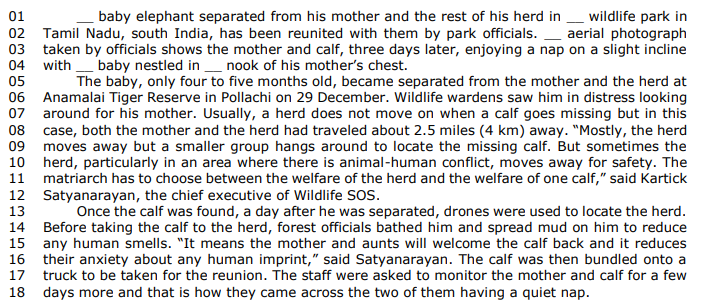
(Available at: https://www.theguardian.com/world/2024/jan/03/elephant-calf-separated-from-herd-in-india-isreunited-with-mother – text especially adapted for this test).

(Disponible in: https://www.quora.com)
Having the image’s clues as references, apostrophe use meets a compatible description in:
I. In: "My favorite heroes are Superman and Batman.", the plural is correct, since "es" can be added to nouns that end in "o".
II. In: "People with a higher metabolic rate tend to be more attractive to mosquitoes", the plural is correct, since "es" can be added to nouns that end in "o".
III. In: "They left some memoes behind in the office for you", the plural is correct, since "es" can be added to nouns that end in "o".
Choose the CORRECT answer:
Based on the preceding text, judge the item that follow.
The passenger who sued the airline company because of an incident that happened during his flight is Colombian.

 Conheça nossos planos