Questões de Concurso Comentadas sobre passado simples | simple past em inglês

Questões Discursivas

Foram encontradas 259 questões

Ano: 2018 Banca: IMA Órgão: Prefeitura de Raposa - MA
Q1190663 Inglês
 Complete the sentence below with the correct verbs. Choose the CORRECT answer. “I _________ to the supermarket before I _________ home.” 
Alternativas
Q1094233 Inglês

Text for the question.


The route to perfection
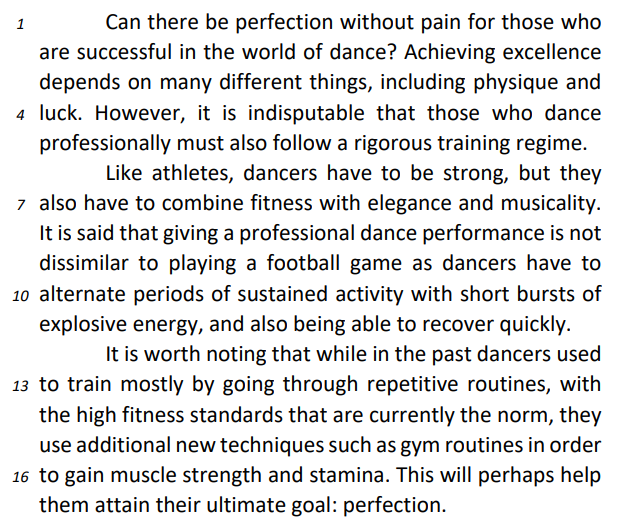


The past simple tense form of “must” in “must follow” (line 5) is
Alternativas
Q952138 Inglês

TEXT 1 below, retrieved and adapted from https://chroniclingamerica. loc.gov/lccn/sn83035487/1851-06-21/ed-1/seq-4/ on July 9th, 2018.


Text 1 


                    Women’s rights convention – Sojourner Truth


      One of the most unique and interesting speeches of the convention was made by Sojourner Truth, an emancipated slave. It is impossible to transfer it to paper or convey any adequate idea of the effect it produced upon the audience. Those only can appreciate it who saw her powerful form, her whole-souled, earnest gesture, and listened to her strong and truthful tones. She came forward to the platform and addressing the President said with great simplicity:

      "May I say a few words?" Receiving an affirmative answer, she proceeded: I want to say a few words about this matter. I am a woman's rights. I have as much muscle as any man and can do as much work as any man. I have plowed and reaped and husked and chopped and mowed, and can any man do more than that? I have heard much about the sexes being equal. I can carry as much as any man, and can eat as much too, if I can get it. I am as strong as any man that is now. As for intellect, all I can say is, if a woman has a pint, and a man a quart -- why can't she have her little pint full? You need not be afraid to give us our rights for fear we will take too much; -- for we can't take more than our pint will hold. The poor men seem to be all in confusion, and don't know what to do. Why children, if you have woman's rights, give it to her and you will feel better. You will have your own rights, and they won't be so much trouble. I can't read, but I can hear. I have heard the bible and have learned that Eve caused man to sin. Well, if a woman upset the world, do give her a chance to set it right side up again. The Lady has spoken about Jesus, how he never spurned woman from him, and she was right. When Lazarus died, Mary and Martha came to him with faith and love and besought him to raise their brother. And Jesus wept and Lazarus came forth. And how came Jesus into the world? Through God who created him and the woman who bore him. Man, where was your part? But the women are coming up blessed be God and a few of the men are coming up with them. But man is in a tight place, the poor slave is on him, woman is coming on him, he is surely between a hawk and a buzzard.


Reference: Robinson, M. (1851, June 21). Women’s rights convention: Sojourner Truth. Anti-slavery Bugle, vol. 6 no. 41, Page 160.

Question must be answered by looking at the following sentence from Text 1:


I have plowed and reaped and husked and chopped and mowed, and can any man do more than that?


About the use of -ed made by Sojourner, identify the correct and incorrect items:


( ) she uses –ed arbitrarily.

( ) she uses –ed to indicate the completeness of the actions.

( ) these words finish in –ed because they mark the perfective aspect of the verbs.

( ) these words finish in –ed because they’re adjectives.


The alternative that best represents the appropriate sequence, top-down, is:

Alternativas
Q952137 Inglês

TEXT 1 below, retrieved and adapted from https://chroniclingamerica. loc.gov/lccn/sn83035487/1851-06-21/ed-1/seq-4/ on July 9th, 2018.


Text 1 


                    Women’s rights convention – Sojourner Truth


      One of the most unique and interesting speeches of the convention was made by Sojourner Truth, an emancipated slave. It is impossible to transfer it to paper or convey any adequate idea of the effect it produced upon the audience. Those only can appreciate it who saw her powerful form, her whole-souled, earnest gesture, and listened to her strong and truthful tones. She came forward to the platform and addressing the President said with great simplicity:

      "May I say a few words?" Receiving an affirmative answer, she proceeded: I want to say a few words about this matter. I am a woman's rights. I have as much muscle as any man and can do as much work as any man. I have plowed and reaped and husked and chopped and mowed, and can any man do more than that? I have heard much about the sexes being equal. I can carry as much as any man, and can eat as much too, if I can get it. I am as strong as any man that is now. As for intellect, all I can say is, if a woman has a pint, and a man a quart -- why can't she have her little pint full? You need not be afraid to give us our rights for fear we will take too much; -- for we can't take more than our pint will hold. The poor men seem to be all in confusion, and don't know what to do. Why children, if you have woman's rights, give it to her and you will feel better. You will have your own rights, and they won't be so much trouble. I can't read, but I can hear. I have heard the bible and have learned that Eve caused man to sin. Well, if a woman upset the world, do give her a chance to set it right side up again. The Lady has spoken about Jesus, how he never spurned woman from him, and she was right. When Lazarus died, Mary and Martha came to him with faith and love and besought him to raise their brother. And Jesus wept and Lazarus came forth. And how came Jesus into the world? Through God who created him and the woman who bore him. Man, where was your part? But the women are coming up blessed be God and a few of the men are coming up with them. But man is in a tight place, the poor slave is on him, woman is coming on him, he is surely between a hawk and a buzzard.


Reference: Robinson, M. (1851, June 21). Women’s rights convention: Sojourner Truth. Anti-slavery Bugle, vol. 6 no. 41, Page 160.

Question must be answered by looking at the following sentence from Text 1:


I have plowed and reaped and husked and chopped and mowed, and can any man do more than that?


We may say that the verbs Sojourner uses are:

Alternativas
Q1789542 Inglês

The Pros and Cons of Nuclear Power


Since the disaster at the Fukushima nuclear power plant in Japan in 2011, a debate has been raging (1) the future of atomic energy. Consequently, the safety risks have been well publicized in the global media. But do the risks outweigh the damage that could be done to the planet because of our ongoing addiction to fossil fuels?


Even environmentalists don’t have the answer. They are split over nuclear (2) , and its pros and cons. Some say it is neither safe nor economical because it produces potentially (3) radioactive waste, and reactors are so costly to build. However, others believe nuclear energy is a necessary evil. They say we should continue using it until (4) energy sources, like wind turbines and solar panels, can meet global demand. Supporters also argue that nuclear energy helps cut down on carbon emissions from fossil fuels such as coal and natural gas, which are linked to global warming and pollute the environment. They say this is because nuclear reactors produce a tiny fraction of the carbon dioxide generated by burning coal.


But perhaps the biggest hurdle for atomic energy to overcome is its image problem. Despite industry claims of a strong safety record, critics remain unconvinced because each reactor annually produces up to 30 tons of nuclear waste, which can continue to be radioactive and hazardous for thousands of years. Furthermore, the Chernobyl disaster in 1986 left the public with vivid images of the impact of a nuclear meltdown, including deformed babies, mutated vegetables, and abandoned towns.


While nuclear reactors may continue to be installed in some countries for decades to come, after Fukushima others have decided to rethink their energy policies. For example, the German government has revealed plans for a “green” renewable energy plan, even though it has relied on nuclear power for up to 23 percent of its consumption in the past. It has been announced that all seventeen nuclear power plants would be phased out by 2022. The policy will also promote energy-saving measures encouraging people to insulate their homes, recycle, and reduce waste. Experts argue it could be a risky strategy because Germany doesn’t have natural gas or oil supplies, and coal supplies have been depleted.


Meanwhile, in Brazil, there is just one nuclear plant at Angra dos Reis. Nuclear power represents only three per cent of Brazil’s energy production. After sharp oil price rises in the 1970s, the country’s leaders anticipated future energy supply problems. So they concentrated on developing alternative energy sources including biofuel, hydroelectric schemes, and wind power. 


This approach seems to be working because by May 2012 plans to build more nuclear reactors were shelved by Brazilian officials. The move was welcomed by environmental lobby groups, which had feared a potential ecological catastrophe in case of an accident. If a big country like Brazil, which is the tenth largest energy consumer in the world, can survive and improve its economy without much nuclear power, maybe others can do so, too.

The underlined words in: ‘Experts argue it could be a risky strategy because Germany doesn’t have natural gas or oil supplies, and coal supplies have been depleted.”, has its correct affirmative form in which sentence?
Alternativas
Q1719185 Inglês
Iranian President
Dies Akbar Hashemi Rafsanjani, the former Iranian president, suffered a heart attack and died at the age of 82. Tens of thousands gathered at Tehran University to attend the funeral and mourn the man, who was their president from 1989 to 1997. Iran has undergone three days of official mourning. Rafsanjani was buried next to Iranian revolutionary leader Ayatollah Khomeini.
According to the text above the word ‘’gathered’’ can be classified as: Choose the CORRECT alternative.
Alternativas
Q1633013 Inglês
Quais os aspectos verbais apresentados pelas frases a seguir?
I. He took the photos. II. He had taken the photos by the time the owner arrived. III. He was taking the photos when the owner arrived. IV. He had been taking the photos before the owner arrived.
Alternativas
Q1387313 Inglês

Mark the alternative that best completes the blank.


The Kardashiars __ waiting for you.”

Alternativas
Q1110378 Inglês
Fill in the blanks with the appropriate form of the verbs: Lucca to his mother: “No, it wasn’t me, mom! Barbra did everything! I was at school doing the fnals, remember?” Mother to Barbra: “Lucca _____ it _____ him, Barbra. He _____ you _____ everything and that He ____ at school _____ the fnals. Is that true?”
Alternativas
Q1110375 Inglês
Fill in the blanks with the appropriate form of the verbs: My day ___ (is) terrible yesterday! First, my alarmclock ____ (do – not) ring so I ______ (Wake up) really late for school. I ____ (do – not) have time to have breakfast, so I ___ (have) an apple and ___ (run) to the bus stop, but when I _______ (arrive) there the bus ___ (have) already ___ (leave). So I ___ (go) to school on foot and it ____ (take) me 30 minutes to get there! But, it gets worse: when I ___ (get) there, I _______ (fnd out) that it ___ (is) Saturday and I _____ (do – not) have classes! Of course my alarm ______ (do – not) ring! I _____ (feel) so stuped...
Alternativas
Q799485 Inglês
Complete a sentença com o tempo verbal correto e assinale a alternativa correta: The police _________ three people, but later they let go them.
Alternativas
Ano: 2016 Banca: IMA Órgão: Prefeitura de Anapurus - MA
Q1230342 Inglês
How can we explain “will” in the following context: “If he sticks to his word about there being no plan B, the bilateral ceasefire will be lifted and the war will resume, our correspondent says.” 
Alternativas
Ano: 2016 Banca: INAZ do Pará Órgão: Prefeitura de Jacundá - PA
Q1220128 Inglês
A frase a seguir está no tempo Future da língua inglesa: “I________my secret recipe for lunch.” A alternativa correta que completa a frase é: 
Alternativas
Ano: 2016 Banca: IMA Órgão: Prefeitura de Picos - PI
Q1196210 Inglês
Os verbos auxiliares "Should", 'Would" e "Could' são a forma do "past tense” de:
Alternativas
Ano: 2016 Banca: FEPESE Órgão: Prefeitura de São José - SC
Q1185254 Inglês
The words in bold in the following sentence: ”…preferred heating and cooking with wood.”, are being used as examples of:
Alternativas
Q916916 Inglês

Texto III


Read an excerpt from the article, How Studying or Working Abroad Makes You Smarter.


A study (LEAD) by William Maddux, an associate professor of organizational behavior at INSEAD, (FIND) that among students enrolled in an international MBA program, their “multicultural engagement”—the extent to which they adapted to and learned about new cultures—predicted how “integratively complex” their thinking (BECOME).


That is, students who adopted an open and adaptive attitude toward foreign cultures (BE) more able to make connections among disparate ideas. The students’ multicultural engagement also predicted the number of job offers they (RECEIVE) after the program ended.

Available at:<http://time.com/79937/how-studying-or-working-abroad-makes-you-smarter/> . Accessed on 4/3/16.


The verbs in parentheses originally appeared in the simple past in the article. The correct of the simple past of these verbs is:

Alternativas
Ano: 2016 Banca: FGV Órgão: IBGE Provas: FGV - 2016 - IBGE - Analista - Processos Administrativos e Disciplinares | FGV - 2016 - IBGE - Analista - Análise de Sistemas - Desenvolvimento de Aplicações - Web Mobile | FGV - 2016 - IBGE - Analista - Recursos Humanos - Administração de Pessoal | FGV - 2016 - IBGE - Tecnologista - Economia | FGV - 2016 - IBGE - Analista - Engenharia Civil | FGV - 2016 - IBGE - Analista - Geoprocessamento | FGV - 2016 - IBGE - Analista - Auditoria | FGV - 2016 - IBGE - Tecnologista - Geografia | FGV - 2016 - IBGE - Analista - Educação Corporativa | FGV - 2016 - IBGE - Analista - Análise Biodiversidade | FGV - 2016 - IBGE - Analista - Ciências Contábeis | FGV - 2016 - IBGE - Analista - Planejamento e Gestão | FGV - 2016 - IBGE - Tecnologista - Estatística | FGV - 2016 - IBGE - Analista - Design Instrucional | FGV - 2016 - IBGE - Analista - Orçamento e Finanças | FGV - 2016 - IBGE - Analista - Engenharia Agrônomica | FGV - 2016 - IBGE - Analista - Análise de Projetos | FGV - 2016 - IBGE - Analista - Recursos Materiais e Logística | FGV - 2016 - IBGE - Tecnologista - Bliblioteconomia | FGV - 2016 - IBGE - Tecnologista - Programação Visual - Webdesign | FGV - 2016 - IBGE - Analista - Jornalista - Redes Sociais | FGV - 2016 - IBGE - Analista - Análise de Sistemas - Suporte Operacional | FGV - 2016 - IBGE - Analista - Recursos Humanos - Desenvolvimento de Pessoas | FGV - 2016 - IBGE - Tecnologista - Engenharia Cartográfica | FGV - 2016 - IBGE - Analista - Análise de Sistemas - Desenvolvimentos de Sistemas | FGV - 2016 - IBGE - Tecnologista - Engenharia Florestal |
Q628262 Inglês

TEXT II

The backlash against big data

[…]

Big data refers to the idea that society can do things with a large body of data that weren’t possible when working with smaller amounts. The term was originally applied a decade ago to massive datasets from astrophysics, genomics and internet search engines, and to machine-learning systems (for voice-recognition and translation, for example) that work well only when given lots of data to chew on. Now it refers to the application of data-analysis and statistics in new areas, from retailing to human resources. The backlash began in mid-March, prompted by an article in Science by David Lazer and others at Harvard and Northeastern University. It showed that a big-data poster-child—Google Flu Trends, a 2009 project which identified flu outbreaks from search queries alone—had overestimated the number of cases for four years running, compared with reported data from the Centres for Disease Control (CDC). This led to a wider attack on the idea of big data.

The criticisms fall into three areas that are not intrinsic to big data per se, but endemic to data analysis, and have some merit. First, there are biases inherent to data that must not be ignored. That is undeniably the case. Second, some proponents of big data have claimed that theory (ie, generalisable models about how the world works) is obsolete. In fact, subject-area knowledge remains necessary even when dealing with large data sets. Third, the risk of spurious correlations—associations that are statistically robust but happen only by chance—increases with more data. Although there are new statistical techniques to identify and banish spurious correlations, such as running many tests against subsets of the data, this will always be a problem.

There is some merit to the naysayers' case, in other words. But these criticisms do not mean that big-data analysis has no merit whatsoever. Even the Harvard researchers who decried big data "hubris" admitted in Science that melding Google Flu Trends analysis with CDC’s data improved the overall forecast—showing that big data can in fact be a useful tool. And research published in PLOS Computational Biology on April 17th shows it is possible to estimate the prevalence of the flu based on visits to Wikipedia articles related to the illness. Behind the big data backlash is the classic hype cycle, in which a technology’s early proponents make overly grandiose claims, people sling arrows when those promises fall flat, but the technology eventually transforms the world, though not necessarily in ways the pundits expected. It happened with the web, and television, radio, motion pictures and the telegraph before it. Now it is simply big data’s turn to face the grumblers.

(From http://www.economist.com/blogs/economist explains/201 4/04/economist-explains-10)

The base form, past tense and past participle of the verb “fall” in “The criticisms fall into three areas” are, respectively:
Alternativas
Q2122702 Inglês
Choose the option where the simple past is used incorrectly.
Alternativas
Q911708 Inglês

A man stepped onto the overnight train and told the conductor, “I need you to wake me up  in Philadelphia. I'm a  deep sleeper and can be angry when I get up, but no matter what, I want you to help me make that stop. Here's $100 to  make sure". 

The conductor agreed. The man  fell asleep, and when he awoke he heard  the announcement  that  the  train was  approaching New York, which meant they had passed Philadelphia a long time ago.  Furious, he ran to the conductor. “I gave you $100 to make sure I got off in Philadelphia, you idiot!"  “Wow," another passenger said to his traveling companion. “Is that guy mad!"  “Yeah," his companion replied. “But not half as mad as that guy they forced off the train in Philadelphia."  

                                                         (English2Go, No 7,The Reader's Digest Association, 2005. P. 80.)


Choose the item that does NOT belong in the group.

Alternativas
Ano: 2015 Banca: Centec Órgão: Centec Prova: Centec - 2015 - Centec - Professor - Inglês |
Q761922 Inglês

Check the sequence that matches correctly the verb tenses with the following sentences:

I. I am writing an essay about global warming.

II. His father likes to watch football games.

III. He was a lovely grandfather

Alternativas
Respostas
221: D
222: D
223: B
224: E
225: A
226: B
227: C
228: C
229: A
230: B
231: D
232: A
233: D
234: A
235: A
236: C
237: C
238: D
239: D
240: B
