Questões de Concurso
Sobre orações condicionais | conditional clauses em inglês
Foram encontradas 305 questões


Para responder à questão, leia o texto abaixo.
Lord of the Plants:
Death Metal Eco-Baron Rewilds Irish Estate
Randal Plunkett, the 21st Baron of Dunsany, strides out of his Irish castle in a T-shirt bearing the name of death metal band "Cannibal Corpse" in bloody lettering.
In the distance, a russet-coloured stag appears for a moment, before dissolving into the 750 acres (300 hectares) of ancestral estate Plunkett has surrendered to the wilderness -- almost half of his lands.
"I felt a sort of sense of duty towards the environment here," said Plunkett, perched on a decaying tree trunk sprouting a clutch of mushrooms.
"I'm a caretaker of this estate for this generation and the estate is not just the castle, it's also the land but it's also the environment," the aristocrat told AFP, his mane of shoulder-length hair rippling in the breeze.
Eight years ago, death metal fan Plunkett, whose family have presided over Dunsany Castle northwest of Dublin for nine centuries, began his "radical" rewilding project.
The 38-year-old vegan, an unlikely successor to ancestors depicted in sober portraits lining the walls of the grey stone castle, evicted livestock and dismissed lawnmowers to allow nature to take its course.
Now, the results are plain. The ultra-rare pine marten has been spotted. Otters and red deer thrive.
Skies are jammed with birds: buzzards, red kites, peregrine falcons, sparrowhawks, kestrels and snipes.
Plunkett says a woodpecker has been sighted in the area for the first time in a century.
Beyond the castle crenellations, the lawn is transformed into a swirling morass of 23 species of grass, fizzing with insect life.
Plunkett lends a hand here and there -- planting 2,500 trees last year was no small feat -- but mostly he is hands-off.
"As I watched it, I began to understand what the land was doing," he said after trudging across a field of knotted undergrowth in a faux leather jacket.
"It became a rewilding project," he said, as two Jack Russell terriers named Beavis and Butt-head gambol around his vegan-friendly Doc Martens boots.
Fonte: https://www.theyouthtimes.com/news-details/21284/
A new William Hope Hodgson blog
Welcome to Hodgsoniana, a new blog
about the life and works of author William Hope Hodgson (1877–1918). The aim
of this blog is to provide a home for articles and new research on Hodgson,
details of Hodgson-related happenings, and just generally act as an up-to-date
(hopefully) resource that’s open to anyone interested in this remarkable
literary figure. At time of writing, there is a lack of other active websites
covering this subject, which is why starting a blog seemed a worthwhile
endeavour. At the very least, it gives me a place to post some Hodgson-related
thoughts and findings I’ve been meaning to write up! My hope is that others may
be moved to contribute also.
Before going any further, I want to
recognise the work of the late Hodgson scholar Sam Gafford, and in particular
his excellent Hodgson blog williamhopehodgson.wordpress.com. I first stumbled
upon Sam’s blog back in 2016, and his work opened my eyes to the depths and
complexities of Hodgson’s history and writings. I entered into brief
correspondence with Sam at that time, and his enthusiasm and encouragement were
key factors in starting me on the path of pursuing my own Hodgson studies.
Sam Gafford sadly passed away in
2019, leaving his site dormant. It remains a valuable treasure trove of
information, and I will certainly aspire to follow Sam’s example in exploring
and documenting all matters Hodgson.
2027 will see the 150th anniversary
of William Hope Hodgson’s birth. There is still much to discuss regarding his
work, and many areas of his life remain obscure and in need of further
investigation. I hope this site can help in encouraging and chronicling such
efforts.
Source: https://hodgsoniana.wordpress.com/2025/06/22/a-new-william-hope-hodgson-blog/
access on 28 february 2026.
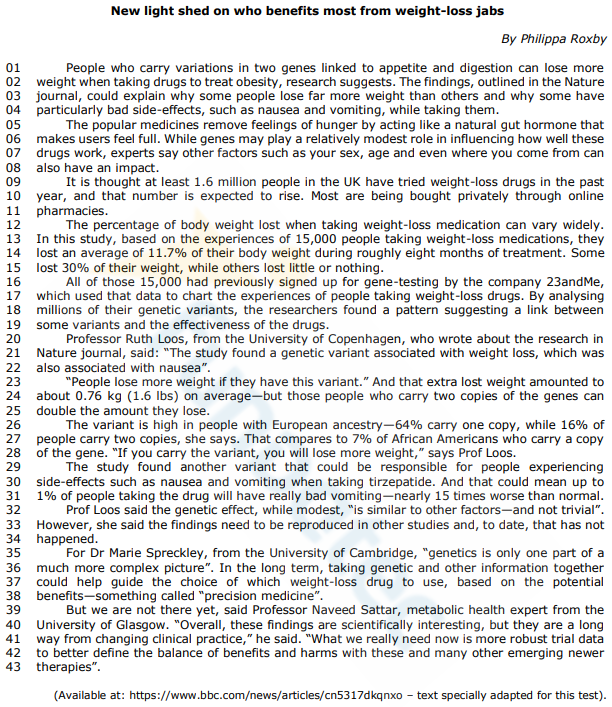
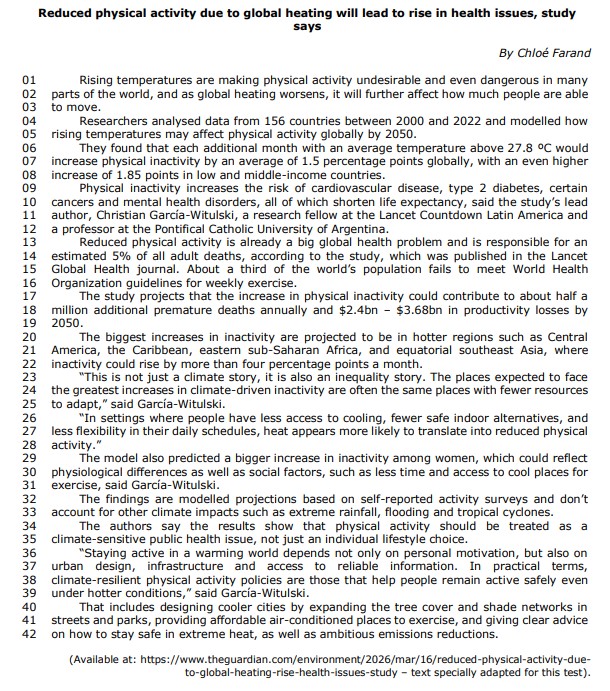
Analyse the following sentence based on the text's ideas:
“If global heating continues to worsen, physical inactivity __________ even more common”.
Mark the alternative that correctly fills in the blank in the sentence above.
Read the text to answer question.
The Tipping Point.
Last week at my neighborhood coffee shop, the barista flipped that dreaded tablet toward me. Three tip options glared back: 18%. 22%. 25%. For a $3.50 latte I was picking up. That took thirty seconds to make. I’ve hit my breaking point with tipping culture.
Growing up, tipping was simple: 15–20% for sitdown restaurants, maybe your hairdresser. Now it’s an expected tax on every transaction. The frozen yogurt shop where I serve myself wants 20%. Self-checkout kiosks are asking for tips. This is insane.
When I traveled Europe last summer, I paid exactly what was on the menu. No guilt, no calculations, no awkward pressure. Servers were paid living wages and the service was excellent.
Meanwhile, I’m expected to subsidize corporate America’s refusal to pay fair wages while their CEOs pocket millions in bonuses.
It’s 2025, and American tipping culture has spiraled out of control. It’s hurting workers, stressing customers, and letting profitable businesses guilt-trip their own customers into covering payroll. When I worked retail years ago, my employer paid my full wage. I didn’t expect customers to subsidize my paycheck because my boss decided to pocket the difference. Yet somehow in 2025, we’ve normalized corporations outsourcing their payroll responsibility to guilt-ridden customers. 72% of U.S. adults say tipping is expected in more places today than it was five years ago. But even as Americans say they’re being asked to tip more often, only about a third say it’s extremely or very easy to know whether (34%) or how much (33%) to tip for various services.
[...] The confusion is real and it’s intentional. Companies benefit from our uncertainty because confused customers tend to over-tip rather than risk social judgment.
Murdock, Jeff. Why Is Tipping Culture Out of Control in 2025? Medium. 16 Jun. 2025. Disponível em:<https://medium.com/@frat1309/why-is-tipping-cultureout-of-control-in-2025-im-done-subsidizing-corporategreed-76ba74887b82>
The conditional construction that most appropriately conveys formal contingency in institutional discourse is:
“This line of research presents serious questions for Applied Linguistics (AL) and English Language Teaching (ELT) that will, if implemented, entail major changes in that endeavor.”
The verb forms used in the segment “will, if implemented, entail” indicate that:
Read the sentence and choose the best option:
If people spend less time on their phones before bed, they ______ sleep better at night.

 Conheça nossos planos