Questões de Concurso
Sobre orações condicionais | conditional clauses em inglês
Foram encontradas 305 questões


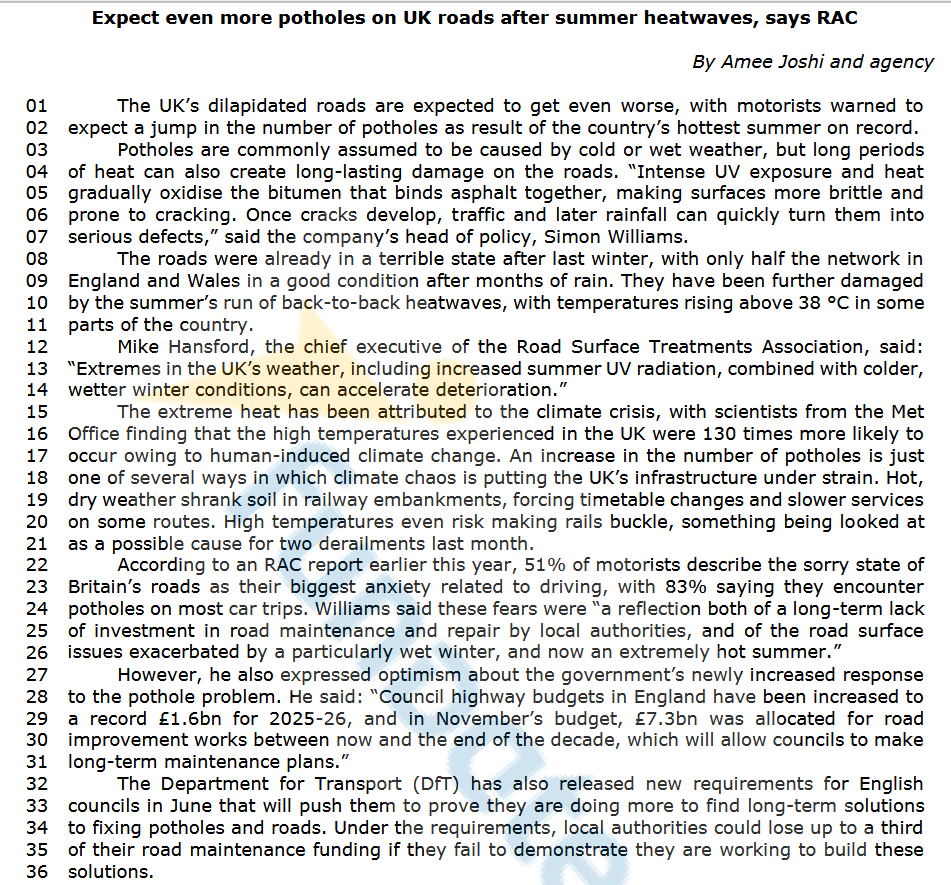
(Available at: https://www.theguardian.com/uk-news/2026/sep/16/expect-more-potholes-uk-roads-summer-
heatwaves-rac - text specially adapted for this test).
“[…] local authorities could lose up to a third of their road maintenance funding if they fail to demonstrate they are working to build these solutions.” (l. 34-36).
Considering the change of the subject “local authorities” to the singular form “the local authority”, mark the alternative that presents the necessary grammatical changes.
If the students ______ the instructions carefully, they ______ fewer mistakes in the activity
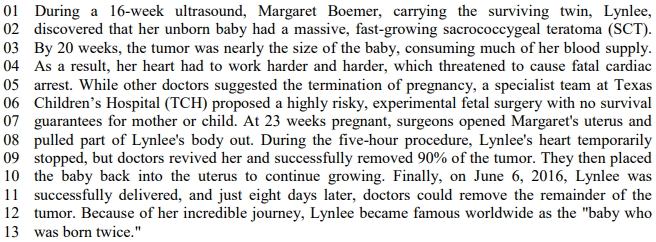
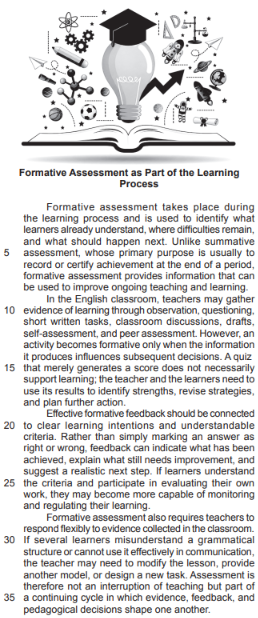
Which sentence correctly expresses a past unreal condition with a present result?
Which reported version is CORRECTLY constructed?
Brain rot
“Brain rot” is defined as “the supposed deterioration of a person’s mental or intellectual state, especially viewed as the result of overconsumption of material (now particularly online content) considered to be trivial or unchallenging. Also: something characterized as likely to lead to such deterioration”. The term gained new prominence as a term used to capture concerns about the impact of consuming excessive amounts of low-quality online content, especially on social media. The term increased in usage frequency by 230% between 2023 and 2024.
The first recorded use of “brain rot” was found in 1854 in Henry David Thoreau’s book Walden, which reports his experiences of living a simple lifestyle in the natural world. Thoreau criticizes society’s tendency to devalue complex ideas, or those that can be interpreted in multiple ways, in favour of simple ones, and sees this as indicative of a general decline in mental and intellectual effort: “While England endeavours to cure the potato rot, will not any endeavour to cure the brain-rot — which prevails so much more widely and fatally?”
The term has taken on new significance in the digital age. Initially gaining traction on social media platforms, the term is now seeing more widespread use, such as in mainstream journalism, amidst societal concerns about the negative impact of overconsuming online content.
Source: Oxford University Press. Adaptation.
Para responder à questão, leia o texto abaixo.
How Will You Get from How Things Are to How Things "Should" Be?
A lot of people get fixated on things that they think "should" happen, but fail to address substantial obstacles in the way. I may even agree with them about what I think "should" happen. But that doesn't mean that it's going to happen. If you're thinking that there is also a danger in being overly cautious or waiting to work out the perfect plan, you're right. That can become a form of procrastination. Acting on an imperfect plan is usually better than waiting until you've worked out every last detail. But at least have some kind of plan that doesn't require a miracle to happen.
The plan that works will also probably not be the plan you started with. You will have to update the plan as you proceed and the situation evolves.
A good model for this process is John Boyd's OODA decision making loop. OODA stands for Observe, Orient, Decide, Act. Actions produce responses that provide new information. New information requires reorientation and new decisions will have to be made that lead to new actions, and the loop repeats.
No big changes happened because a bunch of people sat around complaining about how things "should be."
That's like saying "l should be a millionaire." You could be, but you're going to need some kind of plan to get there that realistically acknowledges the obstacles in your way.
Many of the problems we face today took years to create.
We have inherited a big mess. A lot of things happened that "should not" have happened. Mistakes were made.
But that's life. It's going to throw all kinds of things at you that are sub-optimal. Things you didn't "deserve" or ask for. Cleaning up messes you didn't create is as normal as dealing with bad weather.
Some messes only require a dustpan.
But if you want to clean up a really big mess, you're going to need a plan.
Fonte: https://mrjackdonovan.substack.com/p/the-flow-chart
Analyze the sentence below:
If you _______ to become a millionaire, you _________ to develop a plan that accounts for realíty, rather than just comp/aining.
Choose the alternative that CORRECTLY completes the logic of the millionaire analogy.
Para responder à questão, leia o texto abaixo.
How Will You Get from How Things Are to How Things "Should" Be?
A lot of people get fixated on things that they think "should" happen, but fail to address substantial obstacles in the way. I may even agree with them about what I think "should" happen. But that doesn't mean that it's going to happen. If you're thinking that there is also a danger in being overly cautious or waiting to work out the perfect plan, you're right. That can become a form of procrastination. Acting on an imperfect plan is usually better than waiting until you've worked out every last detail. But at least have some kind of plan that doesn't require a miracle to happen.
The plan that works will also probably not be the plan you started with. You will have to update the plan as you proceed and the situation evolves.
A good model for this process is John Boyd's OODA decision making loop. OODA stands for Observe, Orient, Decide, Act. Actions produce responses that provide new information. New information requires reorientation and new decisions will have to be made that lead to new actions, and the loop repeats.
No big changes happened because a bunch of people sat around complaining about how things "should be."
That's like saying "l should be a millionaire." You could be, but you're going to need some kind of plan to get there that realistically acknowledges the obstacles in your way.
Many of the problems we face today took years to create.
We have inherited a big mess. A lot of things happened that "should not" have happened. Mistakes were made.
But that's life. It's going to throw all kinds of things at you that are sub-optimal. Things you didn't "deserve" or ask for. Cleaning up messes you didn't create is as normal as dealing with bad weather.
Some messes only require a dustpan.
But if you want to clean up a really big mess, you're going to need a plan.
Fonte: https://mrjackdonovan.substack.com/p/the-flow-chart
Reconstruct the following segments into a logically and grammatically sound sentence that aligns with the author's argument:
a / realistic / you / if / want,/ success / need / plan / that / acknowledges / obstacles
Regarding this, mark the alternative that presents the CORRECT sentence structure.
I.Had the students received clearer instructions, they might have completed the task differently.
II.Only after the second reading did the students notice the contradiction.
III.Neither the teacher nor the students was prepared to change their interpretation.
Which statements about their grammatical structure are correct?
"For to go as a passenger you must needs have a purse, and a purse is but a rag unless you have something in it. Besides, passengers get sea-sick—grow quarrelsome—don't sleep of nights—do not enjoy themselves much, as a general thing..."
Considering the meanings conveyed by the vocabulary and grammatical structures employed in the passage, analyze the statements below and choose the alternative that best interprets the highlighted expressions within their context.
I.The modal verb must expresses necessity related to travelling as a passenger.
II.The word unless introduces a condition that affects the meaning of the previous statement.
III.The adjective quarrelsome describes a tendency to engage in arguments or disputes.
IV.The expression as a general thing indicates an exception to a commonly observed situation.
Which alternative presents the correct analysis?
Read the statements below carefully:
I.The expression would depend upon indicates a conditional future situation viewed from a past perspective.
II.The modal verb should is used to express a hypothetical possibility.
III.The adjective objectionable refers to someone considered unsuitable or unacceptable.
IV.The expression put up with means to search for alternative accommodation.
V.The adjective decent conveys a positive evaluation of a person's character or behavior.
Which statements are correctly interpreted according to the excerpt?
"Jefferies' Andrew Tsai estimates BPL-003 could generate sales of more than $1 billion to $2 billion if it succeeds in late-stage trials."
Consider the statements:
I. The modal verb could expresses a projected commercial possibility rather than a guaranteed result.
II. The clause introduced by if establishes a condition for the estimated sales performance.
III. The simple present form succeeds refers to a habitual event repeatedly observed in previous trials.
Mark the alternative that presents only the CORRECT statements.
Answer question based on the paragraph bellow:
[The] centrality of emotion in identity may seem to clash with a compelling argument that identity is a consciousness of one’s memories – that is, one’s history – in some organized pattern, often a continuous narrative... At one level, it is indispu table that a sense of one’s own identity is constructed from narrative memory.... However, we believe that we are arguing about a motivational process that underlies the very construction of such memories and the motivation for their construc tion. If people organize their thoughts, memories, and future hopes around happy events, it would be circularly the case that they are most them selves when this organization functions well and should have a sense of not being them selves if it does not function. Moreover, happy people should use particular strategies for thought (including memory construction) that are somewhat different from those of people who feel most themselves when they are excited or exhilarated.
(Available at: Haviland-Jones JM, Kahlbaugh P (2004) Emotion and identity. In: Lewis M, Haviland-Jones JM (eds) Handbook of emotions, 3rd edn. The Guilford Press, New York, pp 293–305)
"Had the school received the funds earlier, it would have completed the accessibility project before the beginning of the term."
Which analysis is CORRECT?
If the local community continues to show such high levels of engagement, the library ______ one of the most important culturalcenters in the region.
Which option BEST completes the sentence to express a likely outcome based on that condition?
The quest to understand the fundamental nature of light has sparked debate for centuries and ultimately played a pivotal role in the development of quantum physics. Even the earliest recorded speculations about light contained the seeds of concepts that would, centuries later, be woven into our quantum understanding of reality. Some of the earliest recorded ideas about the nature of light appeared in the 6th century BCE. In India, for instance, the Vaisheshika school of philosophy described light as consisting of fire-like particles moving at a high speed. In ancient Greece, the Pythagoreans (6th 5th century BCE) and later Euclid (c. 300 BCE) advocated the emission theory of vision, suggesting that rays of light emanate from the eyes toward objects. In contrast, Epicurus (341 270 BCE) proposed an intromission theory, arguing that light consists of material images or "eidola" emitted by objects that travel to the eyes. Further insights into the nature of light emerged in Egypt, where Ptolemy (c. AD 90 168), working in Alexandria, conducted experiments showing that light reflects off smooth surfaces and bends when passing through transparent materials of different optical densities. Building on these concepts, Arab scholars made significant contributions to the understanding of light by establishing foundational principles governing its behavior in lenses, mirrors, and prisms. The most influential among them was the 11th-century scholar Ibn al-Haytham, who lived in present-day Iraq. Ibn al-Haytham corrected the emission theory, stating thatvision results from light entering the eye rather thanemanating from it. By the 17th century, European scientists were dividedbetween two competing theories about the fundamentalnature of light: whether it behaved as a wave or as aparticle. Dutch physicist Christiaan Huygens argued thatlight propagates as waves according to his wave-frontprinciple, which explains how waves evolve when theyencounter obstacles. In contrast, Isaac Newton proposeda corpuscular theory, suggesting that light consists ofparticles traveling in straight paths, capable of reflectingoff surfaces like mirrors. Newton's prism experiments,which showed white light splitting into colors with distinctrefraction angles, supported his corpuscular theory bysuggesting that light consists of particles of differentsizes, each corresponding to a different color, whichbend by different amounts. Both theories, however, were incomplete. Huygens' wavetheory struggled to fully explain why light travels in astraight path, and Newton's particle theory couldn'taccount for diffraction, the spreading of light as it passesaround edges or through narrow openings. Nevertheless,Newton's theory gained significant influence not onlybecause of his clever prism experiments, but alsobecause he was highly revered in the scientificcommunity, making his ideas difficult to challenge foryears. But science doesn't bow to reputation. As RichardFeynman famously pointed out in his 1964 MessengerLectures at Cornell University, "It doesn't matter howbeautiful your theory is, it doesn't matter how smart youare. If it doesn't agree with the experiment, it's wrong."Indeed, nearly a century after Newton's corpusculartheory of 1704, the scientific consensus gradually shiftedtoward the wave theory of light through decades ofexperiments, modeling, and debates. One of the keycontributors to this shift was Thomas Young, an Englishpolymath. In 1801, Young passed sunlight through anarrow slit to produce a coherent light beam. He thenplaced a thin obstacle, such as a hair or a narrow strip,across the beam, splitting it into two waves that spreadout and overlapped. When these waves recombined on ascreen, they produced a pattern of bright and dark bands.This interference pattern provided clear and compellingevidence that light behaves as a wave rather than as aparticle. A familiar example of this phenomenon is when waves onthe surface of water either combine to form larger peaksor cancel each other out. Later, in 1845, another Englishphysicist Michael Faraday showed that magnetic fieldscould alter the polarization plane of light, revealing aconnection between light and electromagnetism. In the1860s, Scottish physicist James Clerk Maxwell built onthis connection by formulating the theory ofelectromagnetism, describing light as an electromagneticwave composed of oscillating electric and magnetic fields at right angles to each other and to the wave's direction of travel. Heinrich Hertz's experimental confirmation of Maxwell's predictions in the 1880s provided further validation of the electromagnetic wave theory of light. By the 1890s, Maxwell's mathematical description of electromagnetic waves was considered so successful, particularly for its predictive power, that many physicists believed the fundamental nature of light was fully understood. But in the early 20th century, experimental discoveries began to challenge this consensus. The electromagnetic wave theory failed to predict how matter emits and absorbs radiation at thermal equilibrium. To address this question, German physicist Max Planck introduced a revolutionary idea known as energy quantization. He proposed that electromagnetic radiation is emitted or absorbed in discrete amounts, now called quanta, with higher frequency light corresponding to larger quanta. His theory accurately matched experimental results and earned him the Nobel Prize in Physics in 1918. Another major blow to the wave theory of light came from the photoelectric effect, first observed by Heinrich Hertz in 1887, when ultraviolet light caused electric charge to be emitted from a metal surface. By 1900, Philipp Lenard conducted detailed experiments to show that the energy of ejected electrons depended on light frequency, not intensity, an observation that classical wave theory struggled to explain. In 1905, Albert Einstein addressed this by proposing that light is made of discrete energy packets, now called photons, each carrying an energy proportional to its frequency according to Planck's quantization rule. This idea successfully explained the photoelectric effect and was later confirmed by Robert Millikan's experiments in 1915, which verified that the energy of the ejected electrons depends on light frequency and that intensity affects only the number of ejected electrons. Einstein's explanation earned him the 1921 Nobel Prize in Physics. The existence of the photon was further reinforced in 1923 by American physicist Arthur Compton, who showed that X-rays scatter off electrons and emerge with smaller frequencies. The photoelectric effect showed that light interacts with matter through discrete, fundamental processes, behaving as if it were made up of particles known as photons. On the other hand, Young's double-slit experiment provided convincing evidence that light also exhibits wave-like behavior through interference. These seemingly contradictory findings reveal the dual nature of light, a concept known as wave-particle duality. Today, this principle is central to quantum physics, which describes light as a quantum electromagnetic field. This field has discrete energy excitations called photons that can produce particle-like effects, while also exhibiting wave-like behavior depending on how light interacts with its environment. https://quantum2025.org/news-link/the-history-of-light-and-the-birth-of-q uantum-physics/ (adapted)
"If it doesn't agree with the experiment, it's wrong."
The conditional construction in this statement is best interpreted as:
Column I
1 - If you don't water plants, they die.
2 - If I win the lottery, I will buy a house.
3 - If I had a car, I would drive to work.
4 - If we had booked earlier, we would have paid less.
Column II
( ) First conditional
( ) Third conditional
( ) Zero conditional
( ) Second conditional

 Conheça nossos planos