Questões de Concurso
Comentadas sobre números | numbers em inglês
Foram encontradas 38 questões


Text 1
Structure of education in Singapore
The complete control and management of Singapore’s education is in the hands of the Ministry of Education (MOE). With continuous endeavour from MOE, today Singapore can be considered to have a strong and well-reputed education system. As per recent study Singapore is ranked fourth in terms of World’s Best Education System.
The preschools are run by the private sector, including religious bodies, community foundations, business groups, etc. However, every preschool need to register itself with the Singapore Ministry of Education before being functional.
After completion of 6 years of primary education, students have to appear for a Primary School Leaving Exam (PSLE). All those students who passed the exam are admitted in a secondary level course, which is usually completed in 4-5 years. It is similar to attending seventh grade through tenth grade in the American education system.
After completion of the secondary education, the students need to appear in Singaporean GCE ‘O’ Level exam. Based on the merit in that exam, students proceed to pre-university education, which is similar to attending eleventh grade and twelfth grade as per the American education system. At this level students can opt for a wide range of subjects from varied academic areas covering Humanities, Arts and Languages, Sciences and Mathematics streams.
www.singaporeeducation.info/Education-System/ Structure-of-Education
The words fourth, seventh, tenth, eleventh and twelfth can be classified as:
Dutch government bans phones in schools The Dutch government has announced a ban ______01 mobile phones, tablets, and smartwatches in classrooms starting ______02 January 1, 2024.
The aim is to reduce distractions ______03 lessons and promote better concentration and studying opportunities for students. ______04, devices
_______________05 if they are specifically required for digital skills lessons, for medical reasons, or students with disabilities.
Education Minister Robbert Dijkgraaf ______06 that ______07 mobile phones are a significant part of ______08 lives, they are not suitable for the classroom, and scientific research ______09 this view.
The ban is the result of an agreement between the ministry, schools, and related organizations. Schools have the flexibility to implement the ban in their way, but if the desired outcomes ______10 achieved by the summer of 2024, legal rules ______11 enforced.
Source: https://www.newsinlevels.com/products/dutch government-bans-phones-in-schools-level-3/.
Julgue o item que se segue.
In the sentence “She picked one or two of these apples”,
the word “one” is a number.
Julgue o item que se segue.
In the sentence “I’ll buy this one for my son”, the word
“one” is a number.
“What is the correct spelling of the number 5th, 15th, 50th respectively?”
Observe os horários abaixo e assinale a alternativa correta quanto à redação das horas por extenso:
I – 10:20 II – 3:15 III – 7:00 IV – 9:40 V – 1:45
Why women make way less than men do in more religious places
By Stephanie Pappas
Why is there a persistent wage gap between men and women? Turns out, religion may play a big role in the disparity.
New research finds that the wage gap is 8 percentage points wider in the five most religious states than in the five most secular, with women making 18% less than men in the least religious states and 26% less in the most religious. What's more, the gender gap is projected to vanish in 28 years in the most secular states, compared with a stunning 109 years in the most religious. "If they're in a religious community, our children are not going to know a world in which they're paid equitably," said Traci Sitzmann, an associate professor of management at the University of Colorado, Denver. "It's a little bit scary."
Religion and wages
Sitzmann and her colleague Elizabeth Campbell, an assistant professor of work and organizations at the University of Minnesota, were interested in exploring the impacts of religiosity on workforce issues. They started with a global view. Using data from 140 countries, they compared the likelihood of citizens answering "yes" to the question, "Is religion important in your daily life?" with the gender wage gap in those countries as of 2013, the most recent global data available. They found a striking association: The more religious a country, the greater the wage gap. In nations where more than 95% or more people said religion was important in their daily lives, such as Pakistan and the Philippines, women earned around 46% as much as men.
In countries where fewer than 20% of people said religion was important to them in daily life, such as Sweden and Estonia, women averaged around 75% of men's wages. The United States had moderately high religiosity and women in the U.S. earned 66 cents for every dollar men earned, Sitzmann told Live Science.
The effect held true for all major world religions, Sitzmann said. It didn't matter if most believers in a country were Jewish, Christian, Muslim, Buddhist, Hindu or adherants to a folk religion. The wage gap was still greater in countries where religion played a major role in daily life.
The researchers then turned to Gallup survey data on religious service attendance and the importance of religion in daily life in the 50 U.S. states. In the U.S. data, the researchers looked only at full-time wages so as not to skew the results due to women working fewer hours.
They again found that the more religious the state, the greater the wage gap. (Mississippi, Alabama, Utah, South Dakota and South Carolina were the most religious states; Vermont, Maine, Massachusetts, Rhode Island and Nevada were the least.) The researchers found that religiosity explained 17% of the variability in the gender wage gap between states. To ensure that the wider economy or levels of conservatism weren’t responsible for the difference, the researchers then looked at year-over-year data between 2008 and 2018 and found that the association between religion and wages still held. The gender gap is shrinking over time in the U.S., they found, but it is shrinking faster in secular states compared with religious ones. At current rates, it will take more than a century for the gap to close in the most religious states.
According to the workplace data analysis company PayScale, women make 81 cents for every dollar men make as of 2020. This analysis compares median salaries for men and women, and does not control for factors like seniority, years experience and education, all of which can be impacted by gender discrimination and gender role expectations.
The pathway to a wage gap
Sitzmann and Campbell found three reasons for this difference in wages between secular and religious regions. The more religious a country or state, the more that society differentiated the roles of men and women. In other words, women in more religious societies are expected to put family first. The researchers measured this by looking at how many babies women have, how many women work at all, access to abortion and family-friendly work policies. In more religious societies, women have more children, participate less in the workforce, have less access both to abortion and to policies that help balance work with family.
Religious societies are also more likely to sexually objectify women, the researchers found. They measured this by looking at regional Google Trends for the search terms "pornography" and "rape." Both were correlated with religiosity, and both were correlated with the gender wage gap.
Finally, religious societies are also less likely to promote or accept women in leadership positions. "We've got the Pope saying, 'the door is closed, women are not allowed to be leaders in the church,'" Sitzmann said, referring to Pope Francis' 2013 statement on female priests in the Catholic Church. "That sets the stage for a very strong norm."
She and Campbell found that in more religious societies, women have less representation in politics and in organizational leadership. They also have lower educational attainment and less legal equality.
Closing the gap
Finally, the researchers conducted experiments to confirm that it was indeed religion, and not some closely related concept like conservatism, that explained the results. They set up an online game in which 91 participants, about half women and half men, acted as managers who had to allocate wages to employees based on performance reviews. All of the participants saw the same performance reviews, but in some cases the employee was named Patricia Anderson and in others was called Michael Taylor.
Before seeing the performance reviews, some participants saw a description of the mock company they were working for that described it as faith-based. Others saw a description that focused on the company's dedication to communication and community.
Those who were primed to believe they were working for a religious company allocated 3% more to the male employee compared with the female employee. In contrast, those who thought the organization was secular allocated 6% more to the female employee.
But there was a way to reverse the inequality. When the researchers told people in the mock religious company that one of the company values was that women needed to be involved, and that the company had a strict anti-sexual-harassment policy, it wiped out the gender wage gap, according to their research paper published Oct. 27 in the Academy of Management Journal.
This was a heartening result, Sitzmann said, because it suggests that simply being aware of expectations for gender equality will help make people behave more equitably.
Adapted from: https://www.livescience.com/religious-states-wider-gender-pay-gap.html
Answers the question according to the text below.
TEXT I
Leia o texto abaixo e responda as questões de 21 a 24.
Mary is a nice woman. She is a nurse and works in a big hospital. She works at night on weekends. Mary has two young children and they are very intelligent. Their names are "Jack" and "Julie". Jack is nine years old and Julie is eleven years old. Jack likes soccer and Julie loves movies. Jack wants to be a soccer player and Julie wants to be a movie star.
Mary likes to be with her children when she isn't working - they play board games together. Mary's family is very happy, especially when Jake, Mary's husband, is at home with them. Jake usually travels a lot and visits different places - he is a truck driver.
Leia o trecho abaixo :
“Mary has two young children and they are very intelligent. Their names are "Jack" and "Julie". Jack is nine years old and Julie is eleven years old.”
How many numerals appear in the sentence ?
Brazil's universities take affirmative action
By Julia Carneiro
BBC Brasil, Rio de Janeiro
28August 2013
Antonio Oliveira has benefited from the “quotas” in the first semester since the law came into effect. As a teenager he had to balance his time between school and helping his parents harvest vegetables to sell at a farmer's market, and doing other small jobs to scrape by.
Until recently, he says the only prospects for those growing up in his city, Colinas, were to work with crops or to get a post at the city hall - “a mediocre job that people think is heaven,” as he puts it. But Antonio has just finished his first term studying Economic Sciences at Rio de Janeiro's prestigious Federal University (UFRJ), a dream he had nurtured since his days at a rural public school.
His placement represents a radical change in the Brazilian university system.
Competition for places
Anew law approved a year ago reserves 50% of spots in Brazil's federal universities for students coming from public schools, low-income families and who are of African or indigenous descent.
“I think this is a life-changing opportunity.I hope I will get a good job after university and be able to give my parents more comfort as they grow old,” said Antonio Oliveira, student.
The number of posts reserved for black, mixed race and indigenous students will vary according to the racial make-up of each Brazilian state.
Ten years ago affirmative action gradually started being adopted in both state and federally funded Brazilian universities, in an attempt to give underprivileged Brazilians better chances of getting free higher education - and thus access to better jobs. Half of Brazil's population is ofAfrican descent, but the country's public universities tend to reflect the Brazilian upper classes - who are mostly white.
Although these universities are free, those who traditionally made it in usually came from expensive private schools. Students from public education - the majority of whom are black or mixed race - were less likely to secure one of the highly competitive places. Now the “quotas” are mandatory in all of Brazil's 59 federal universities, which have until 2016 to reserve half of their positions for affirmative action.
Controversial issue
Antonio Freitas says the country is moving backwards with the quota policies.
But racial quotas have sparked widespread controversy in Brazil. Many who are against them argue that easing access to higher education denies the principle of merit that brings excellence to universities.
“This is bad for the future of Brazil, because the main objective of universities is research, is to achieve quality,” says Antonio Freitas, provost of the Getulio Vargas Foundation, a prestigious private university.
“Eventually you may not have the most qualified people in engineering, in medical school, in the most challenging areas which Brazil needs to develop.”
Adapted from: <http://www.bbc.com/news/business>
The sentences below provide further information about the studentAntonio Oliveira. Choose the only sentence in which the expression used to refer to his age is correct.
Acid rain and… the facts
www.acidrain.org.ca / Oxford Children´s Encyclopedia
What causes acid rain?
Acid rain is caused by air pollution. When fossil fuels such as coal and oil are burned, two gases, sulphur dioxide and nitrogen oxide, are released into the atmosphere. These two pollutants eventually react with the moisture in the air. When this polluted mixture falls onto the ground, it is called acid rain.
Rain measuring between 0 and 5 on the pH scale, is acidic therefore called ACID RAIN.
Acid rain is harmful to the environment. It is hardto control because it may be blown by the wind, falling thousands of kilometers from where it was first formed. For example, much of the acid rain in Canada is caused by smoke from factories and power-stations in the USA. The acid rain in Scandinavia may come from Britain.
What are the effects of acid rain?
Acid rain has many different effects. It has killedfish in the lakes of North America, Scandinavia, Scotland, and Wales. Vast areas of forest in northern and central Europeare dying because of it, while in many European cities statues and stone buildings are being eaten away by the acid. Acid rain corrodes metalwork such as steel bridges and railings; it also attacks some types of concrete. Even the water thatwe drink is slowly being polluted by acid rain.
What are the effects on trees and soil?
One of the most serious impacts of acid precipitation is on forests and soils. Great damage is done when sulphuric acid falls onto the earth as rain. Nutrients present in the soils are washed away. Aluminium also present in the soils is freed and this toxic element can be absorbed by the rootsof trees. Thus, the trees starve to death because they have been deprived of their vital nutrients such as calcium and magnesium.
Acid rain is one of the most serious environmental problems of our time. It is a global problems that is gradually affecting our world.
How does acid rain effect lakes?
Lakes that have been acidified cannot support the same variety of life as healthy lakes. As a lake becomes more acidic, various types of fish disappear. Other effects of acidified lakes on fish include: decreased growth, inability to regulate their own body chemistry, reduced egg deposition, deformities in young fish and increased susceptibility to naturally occurring diseases.
Clean rain usually has a pH of 5.6. It is slightly acidic because of carbon dioxide which is naturally present in the atmosphere. Vinegar, by comparison, is very acidic and has a pH of 3.
What is pH?
This is a measure of how acidic or alkaline a substance is. (See a pH scale below).
The initials pH stand for Potential of Hydrogen. Acids have pH values under 7, and alkalis have pHvalues over 7. If a substance has a pH value of 7. It is neutral-neither acidic or alkaline.
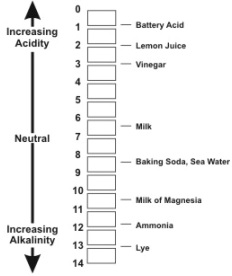
Because the pH scale is logarithmic, a difference of one pH unit represents a tenfold, or ten times change. For example, the acidity of a sample with a pH of 5 is ten timesgreater than that of a sample with a pH of 6. A difference of 2 units, from 6 to 4, would mean that the acidity in one hundred times greater, and so on.
(Reinildes Dias. Reading Critically in English, 3 rd ed. UFMG 2002. Adaptado.)
We are destroying our forests faster than any other ecological zone in our planet.
Forests cover only 6% of the Earth’s lands but they have between 50% to 90% of all plant and animal species from the planet. But unfortunately, humanity is destroying the forests faster and faster.
Many species of the rainforests (the ones that are located in a tropical area and which receive a lot of rain) benefit all of us. Many medicines (pharmaceuticals), for example, come from the rainforest. China, Brazil, Australia, and Mexico have a large number of species in extinction.
We are losing 50-100 species of plants and animals every day. Lost of species become extinct from natural processes. If we lose 50% of our planet’s species, it will take evolution 5-20 million years to replace them. Humans should help endangered species. We can work together to stop this destruction!
(Adapted from www.trentu.ca/ers/sheperd/lecture1.html#summary,
http://news.scotsman.com/international.cfm?id= 654432006 .
Accessed: April 2006. )
From fifty to _____ per cent of all plant and animal species live in the forests.
We are destroying our forests faster than any other ecological zone in our planet.
Forests cover only 6% of the Earth’s lands but they have between 50% to 90% of all plant and animal species from the planet. But unfortunately, humanity is destroying the forests faster and faster.
Many species of the rainforests (the ones that are located in a tropical area and which receive a lot of rain) benefit all of us. Many medicines (pharmaceuticals), for example, come from the rainforest. China, Brazil, Australia, and Mexico have a large number of species in extinction.
We are losing 50-100 species of plants and animals every day. Lost of species become extinct from natural processes. If we lose 50% of our planet’s species, it will take evolution 5-20 million years to replace them. Humans should help endangered species. We can work together to stop this destruction!
(Adapted from www.trentu.ca/ers/sheperd/lecture1.html#summary,
http://news.scotsman.com/international.cfm?id= 654432006 .
Accessed: April 2006. )
About _____ per cent of our planet is not covered by forests.
We are destroying our forests faster than any other ecological zone in our planet.
Forests cover only 6% of the Earth’s lands but they have between 50% to 90% of all plant and animal species from the planet. But unfortunately, humanity is destroying the forests faster and faster.
Many species of the rainforests (the ones that are located in a tropical area and which receive a lot of rain) benefit all of us. Many medicines (pharmaceuticals), for example, come from the rainforest. China, Brazil, Australia, and Mexico have a large number of species in extinction.
We are losing 50-100 species of plants and animals every day. Lost of species become extinct from natural processes. If we lose 50% of our planet’s species, it will take evolution 5-20 million years to replace them. Humans should help endangered species. We can work together to stop this destruction!
(Adapted from www.trentu.ca/ers/sheperd/lecture1.html#summary,
http://news.scotsman.com/international.cfm?id= 654432006 .
Accessed: April 2006. )
Our planet loses from _____ up to one hundred species of plants and animals daily.

 Conheça nossos planos