Questões de Concurso
Sobre interpretação de texto | reading comprehension em inglês
Foram encontradas 12.713 questões


Ano: 2008
Banca:
CESPE / CEBRASPE
Órgão:
SERPRO
Provas:
CESPE - 2008 - SERPRO - Técnico - Operação de Redes
|
CESPE - 2008 - SERPRO - Programador de computador |
CESPE - 2008 - SERPRO - Técnico de enfermagem |
Q152299
Inglês
Texto associado

Based on the text above, judge the items below.
Based on the text above, judge the items below.
Employees must be genuinely humble persons and show concern for other people.
Ano: 2008
Banca:
CESPE / CEBRASPE
Órgão:
SERPRO
Provas:
CESPE - 2008 - SERPRO - Técnico - Operação de Redes
|
CESPE - 2008 - SERPRO - Programador de computador |
CESPE - 2008 - SERPRO - Técnico de enfermagem |
Q152298
Inglês
Texto associado
Based on the text above, judge the items below.
Based on the text above, judge the items below.
Workers are expected to be faithful to their organizations.
Ano: 2008
Banca:
CESPE / CEBRASPE
Órgão:
SERPRO
Provas:
CESPE - 2008 - SERPRO - Técnico - Operação de Redes
|
CESPE - 2008 - SERPRO - Programador de computador |
CESPE - 2008 - SERPRO - Técnico de enfermagem |
Q152297
Inglês
Texto associado
Based on the text above, judge the items below.
Based on the text above, judge the items below.
Most organizations are now interested in reasonably intelligent workers and who work hard.
Ano: 2008
Banca:
CESPE / CEBRASPE
Órgão:
SERPRO
Provas:
CESPE - 2008 - SERPRO - Analista - Tecnologia da Informação
|
CESPE - 2008 - SERPRO - Analista - Programação Visual |
CESPE - 2008 - SERPRO - Analista - Suporte Técnico |
CESPE - 2008 - SERPRO - Analista - Biblioteconomia |
CESPE - 2008 - SERPRO - Analista - Negócios em Tecnologia da Informação |
Q149204
Inglês
Texto associado
One frequently overlooked area in planning is technical reviews and inspections. A technical review requires substantial preparation on the part of the presenters. Documents must be published and distributed and presentation material organized and made into slides or overheads. Practice sessions are conducted by presenters with an audience of critics to prepare for the review.
The reviewers should read the material, attend the presentations, and write reports. On large projects with many reviews and walk-throughs involving many participants, a substantial number of labor hours can be consumed analyzing documents, attending meetings, and writing reports. For example, a system design review for one module or unit can require 150 labor hours. When overlooked, this labor can result in a very large error in resource and schedule estimation.
Many projects include risk assessment and risk management as a key part of the planning process and expect the plan to identify specific risk areas. The plan is expected to quantify both probability of failure and consequences of failure and to describe what will be done to contain development risk.
A. Behforooz and F. Hudson. Software engineering fundamentals. Ed. Oxford (adapted).
Based on the text above, judge the following items.
The reviewers should read the material, attend the presentations, and write reports. On large projects with many reviews and walk-throughs involving many participants, a substantial number of labor hours can be consumed analyzing documents, attending meetings, and writing reports. For example, a system design review for one module or unit can require 150 labor hours. When overlooked, this labor can result in a very large error in resource and schedule estimation.
Many projects include risk assessment and risk management as a key part of the planning process and expect the plan to identify specific risk areas. The plan is expected to quantify both probability of failure and consequences of failure and to describe what will be done to contain development risk.
A. Behforooz and F. Hudson. Software engineering fundamentals. Ed. Oxford (adapted).
Based on the text above, judge the following items.
Some audiovisual materials are required for the presentation of issues to be dealt with.
Ano: 2008
Banca:
CESPE / CEBRASPE
Órgão:
SERPRO
Provas:
CESPE - 2008 - SERPRO - Analista - Tecnologia da Informação
|
CESPE - 2008 - SERPRO - Analista - Programação Visual |
CESPE - 2008 - SERPRO - Analista - Suporte Técnico |
CESPE - 2008 - SERPRO - Analista - Biblioteconomia |
CESPE - 2008 - SERPRO - Analista - Negócios em Tecnologia da Informação |
Q149203
Inglês
Texto associado
One frequently overlooked area in planning is technical reviews and inspections. A technical review requires substantial preparation on the part of the presenters. Documents must be published and distributed and presentation material organized and made into slides or overheads. Practice sessions are conducted by presenters with an audience of critics to prepare for the review.
The reviewers should read the material, attend the presentations, and write reports. On large projects with many reviews and walk-throughs involving many participants, a substantial number of labor hours can be consumed analyzing documents, attending meetings, and writing reports. For example, a system design review for one module or unit can require 150 labor hours. When overlooked, this labor can result in a very large error in resource and schedule estimation.
Many projects include risk assessment and risk management as a key part of the planning process and expect the plan to identify specific risk areas. The plan is expected to quantify both probability of failure and consequences of failure and to describe what will be done to contain development risk.
A. Behforooz and F. Hudson. Software engineering fundamentals. Ed. Oxford (adapted).
Based on the text above, judge the following items.
The reviewers should read the material, attend the presentations, and write reports. On large projects with many reviews and walk-throughs involving many participants, a substantial number of labor hours can be consumed analyzing documents, attending meetings, and writing reports. For example, a system design review for one module or unit can require 150 labor hours. When overlooked, this labor can result in a very large error in resource and schedule estimation.
Many projects include risk assessment and risk management as a key part of the planning process and expect the plan to identify specific risk areas. The plan is expected to quantify both probability of failure and consequences of failure and to describe what will be done to contain development risk.
A. Behforooz and F. Hudson. Software engineering fundamentals. Ed. Oxford (adapted).
Based on the text above, judge the following items.
The presenters should be duly prepared to take part in a technical review.
Ano: 2008
Banca:
CESPE / CEBRASPE
Órgão:
SERPRO
Provas:
CESPE - 2008 - SERPRO - Analista - Tecnologia da Informação
|
CESPE - 2008 - SERPRO - Analista - Programação Visual |
CESPE - 2008 - SERPRO - Analista - Suporte Técnico |
CESPE - 2008 - SERPRO - Analista - Biblioteconomia |
CESPE - 2008 - SERPRO - Analista - Negócios em Tecnologia da Informação |
Q149202
Inglês
Texto associado
One frequently overlooked area in planning is technical reviews and inspections. A technical review requires substantial preparation on the part of the presenters. Documents must be published and distributed and presentation material organized and made into slides or overheads. Practice sessions are conducted by presenters with an audience of critics to prepare for the review.
The reviewers should read the material, attend the presentations, and write reports. On large projects with many reviews and walk-throughs involving many participants, a substantial number of labor hours can be consumed analyzing documents, attending meetings, and writing reports. For example, a system design review for one module or unit can require 150 labor hours. When overlooked, this labor can result in a very large error in resource and schedule estimation.
Many projects include risk assessment and risk management as a key part of the planning process and expect the plan to identify specific risk areas. The plan is expected to quantify both probability of failure and consequences of failure and to describe what will be done to contain development risk.
A. Behforooz and F. Hudson. Software engineering fundamentals. Ed. Oxford (adapted).
Based on the text above, judge the following items.
The reviewers should read the material, attend the presentations, and write reports. On large projects with many reviews and walk-throughs involving many participants, a substantial number of labor hours can be consumed analyzing documents, attending meetings, and writing reports. For example, a system design review for one module or unit can require 150 labor hours. When overlooked, this labor can result in a very large error in resource and schedule estimation.
Many projects include risk assessment and risk management as a key part of the planning process and expect the plan to identify specific risk areas. The plan is expected to quantify both probability of failure and consequences of failure and to describe what will be done to contain development risk.
A. Behforooz and F. Hudson. Software engineering fundamentals. Ed. Oxford (adapted).
Based on the text above, judge the following items.
Technical reviews and inspections are two areas which are often looked over.
Ano: 2008
Banca:
CESPE / CEBRASPE
Órgão:
TJ-CE
Prova:
CESPE - 2008 - TJ-CE - Analista Judiciário - Tecnologia da Informação |
Q126947
Inglês
Texto associado
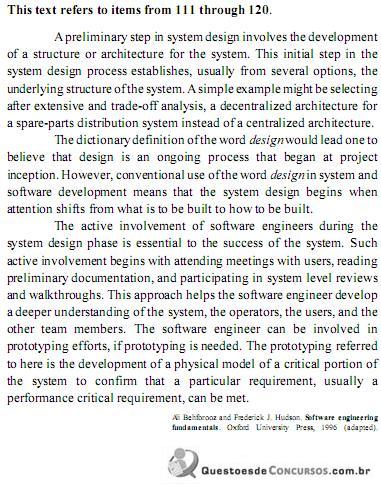
Based on the text, it can be concluded that
Based on the text, it can be concluded that
prototyping can be used in more than one sense.
Ano: 2008
Banca:
CESPE / CEBRASPE
Órgão:
TJ-CE
Prova:
CESPE - 2008 - TJ-CE - Analista Judiciário - Tecnologia da Informação |
Q126946
Inglês
Texto associado
Based on the text, it can be concluded that
Based on the text, it can be concluded that
software engineers can be part of prototyping efforts whenever prototyping is required.
Ano: 2008
Banca:
CESPE / CEBRASPE
Órgão:
TJ-CE
Prova:
CESPE - 2008 - TJ-CE - Analista Judiciário - Tecnologia da Informação |
Q126945
Inglês
Texto associado
Based on the text, it can be concluded that
Based on the text, it can be concluded that
software engineers’ active participation includes to meet users when they get together.
Ano: 2008
Banca:
CESPE / CEBRASPE
Órgão:
TJ-CE
Prova:
CESPE - 2008 - TJ-CE - Analista Judiciário - Tecnologia da Informação |
Q126944
Inglês
Texto associado
Based on the text, it can be concluded that
Based on the text, it can be concluded that
software engineers should necessarily take active participation in every single step of the system design so as to make it succeed.
Ano: 2008
Banca:
CESPE / CEBRASPE
Órgão:
TJ-CE
Prova:
CESPE - 2008 - TJ-CE - Analista Judiciário - Tecnologia da Informação |
Q126943
Inglês
Texto associado
Based on the text, judge the items from 111 through 116.
Based on the text, judge the items from 111 through 116.
The word prototyping is used to refer to a physical model of a trivial portion of the system to assure that a certain demand can be fulfilled.
Ano: 2008
Banca:
CESPE / CEBRASPE
Órgão:
TJ-CE
Prova:
CESPE - 2008 - TJ-CE - Analista Judiciário - Tecnologia da Informação |
Q126942
Inglês
Texto associado
Based on the text, judge the items from 111 through 116.
Based on the text, judge the items from 111 through 116.
Design means that the system design starts to move its focus from how it is to be built to what is to be built.
Ano: 2008
Banca:
CESPE / CEBRASPE
Órgão:
TJ-CE
Prova:
CESPE - 2008 - TJ-CE - Analista Judiciário - Tecnologia da Informação |
Q126941
Inglês
Texto associado
Based on the text, judge the items from 111 through 116.
Based on the text, judge the items from 111 through 116.
The definition for design as found in a dictionary can be misleading in the case presented.
Ano: 2008
Banca:
CESPE / CEBRASPE
Órgão:
TJ-CE
Prova:
CESPE - 2008 - TJ-CE - Analista Judiciário - Tecnologia da Informação |
Q126940
Inglês
Texto associado
Based on the text, judge the items from 111 through 116.
Based on the text, judge the items from 111 through 116.
The initial step might prefer a decentralized architecture to a centralized one.
Ano: 2008
Banca:
CESPE / CEBRASPE
Órgão:
TJ-CE
Prova:
CESPE - 2008 - TJ-CE - Analista Judiciário - Tecnologia da Informação |
Q126939
Inglês
Texto associado
Based on the text, judge the items from 111 through 116.
Based on the text, judge the items from 111 through 116.
The first step in the system must be the setting up of the underlying structure after considering multiple options.
Ano: 2008
Banca:
CESPE / CEBRASPE
Órgão:
TJ-CE
Prova:
CESPE - 2008 - TJ-CE - Analista Judiciário - Tecnologia da Informação |
Q126938
Inglês
Texto associado
Based on the text, judge the items from 111 through 116.
Based on the text, judge the items from 111 through 116.
System design is supposed to be started after the development of a structure or architecture for the system.
Ano: 2008
Banca:
FGV
Órgão:
Senado Federal
Provas:
FGV - 2008 - Senado Federal - Operador de TV
|
FGV - 2008 - Senado Federal - Produtor de Infografia Jornalística |
FGV - 2008 - Senado Federal - Produtor de Desenvolvimento de Conteúdos Jornalísticos para Internet |
FGV - 2008 - Senado Federal - Produtor de TV |
FGV - 2008 - Senado Federal - Produtor de Rádio |
Q97641
Inglês
Texto associado
Read text II and answer questions 37 to 40.
TEXT II
If you think that there’s something oddly familiar about
descriptions of social media, it may be that you recall some of
the discussions in the 1990s about what the web would
become. And many of its emerging manifestations are close to
the idealistic imaginings from that time. A good way to think
about social media is that all of this is actually just about being
human beings. Sharing ideas, cooperating and collaborating to
create art, thinking and commerce, vigorous debate and
discourse, finding people who might be good friends, allies and
lovers – it’s what our species has built several civilisations on.
That’s why it is spreading so quickly, not because it’s great
shiny, whizzy new technology, but because it lets us be
ourselves – only more so. And it is in the “more so” that the
power of this revolution lies. People can find information,
inspiration, like-minded people, communities and collaborators
faster than ever before. New ideas, services, business models
and technologies emerge and evolve at dizzying speed in social
media.
(http://www.icrossing.co.uk/fileadmin/uploads}
/eBooks/What_is_social_media_Nov_2007.pdf
TEXT II
If you think that there’s something oddly familiar about
descriptions of social media, it may be that you recall some of
the discussions in the 1990s about what the web would
become. And many of its emerging manifestations are close to
the idealistic imaginings from that time. A good way to think
about social media is that all of this is actually just about being
human beings. Sharing ideas, cooperating and collaborating to
create art, thinking and commerce, vigorous debate and
discourse, finding people who might be good friends, allies and
lovers – it’s what our species has built several civilisations on.
That’s why it is spreading so quickly, not because it’s great
shiny, whizzy new technology, but because it lets us be
ourselves – only more so. And it is in the “more so” that the
power of this revolution lies. People can find information,
inspiration, like-minded people, communities and collaborators
faster than ever before. New ideas, services, business models
and technologies emerge and evolve at dizzying speed in social
media.
(http://www.icrossing.co.uk/fileadmin/uploads}
/eBooks/What_is_social_media_Nov_2007.pdf
According to the text, social media is spreading because it
Ano: 2008
Banca:
FGV
Órgão:
Senado Federal
Provas:
FGV - 2008 - Senado Federal - Operador de TV
|
FGV - 2008 - Senado Federal - Produtor de Infografia Jornalística |
FGV - 2008 - Senado Federal - Produtor de Desenvolvimento de Conteúdos Jornalísticos para Internet |
FGV - 2008 - Senado Federal - Produtor de TV |
FGV - 2008 - Senado Federal - Produtor de Rádio |
Q97640
Inglês
Texto associado
Read text II and answer questions 37 to 40.
TEXT II
If you think that there’s something oddly familiar about
descriptions of social media, it may be that you recall some of
the discussions in the 1990s about what the web would
become. And many of its emerging manifestations are close to
the idealistic imaginings from that time. A good way to think
about social media is that all of this is actually just about being
human beings. Sharing ideas, cooperating and collaborating to
create art, thinking and commerce, vigorous debate and
discourse, finding people who might be good friends, allies and
lovers – it’s what our species has built several civilisations on.
That’s why it is spreading so quickly, not because it’s great
shiny, whizzy new technology, but because it lets us be
ourselves – only more so. And it is in the “more so” that the
power of this revolution lies. People can find information,
inspiration, like-minded people, communities and collaborators
faster than ever before. New ideas, services, business models
and technologies emerge and evolve at dizzying speed in social
media.
(http://www.icrossing.co.uk/fileadmin/uploads}
/eBooks/What_is_social_media_Nov_2007.pdf
TEXT II
If you think that there’s something oddly familiar about
descriptions of social media, it may be that you recall some of
the discussions in the 1990s about what the web would
become. And many of its emerging manifestations are close to
the idealistic imaginings from that time. A good way to think
about social media is that all of this is actually just about being
human beings. Sharing ideas, cooperating and collaborating to
create art, thinking and commerce, vigorous debate and
discourse, finding people who might be good friends, allies and
lovers – it’s what our species has built several civilisations on.
That’s why it is spreading so quickly, not because it’s great
shiny, whizzy new technology, but because it lets us be
ourselves – only more so. And it is in the “more so” that the
power of this revolution lies. People can find information,
inspiration, like-minded people, communities and collaborators
faster than ever before. New ideas, services, business models
and technologies emerge and evolve at dizzying speed in social
media.
(http://www.icrossing.co.uk/fileadmin/uploads}
/eBooks/What_is_social_media_Nov_2007.pdf
The text opens with
Ano: 2008
Banca:
FGV
Órgão:
Senado Federal
Provas:
FGV - 2008 - Senado Federal - Operador de TV
|
FGV - 2008 - Senado Federal - Produtor de Infografia Jornalística |
FGV - 2008 - Senado Federal - Produtor de Desenvolvimento de Conteúdos Jornalísticos para Internet |
FGV - 2008 - Senado Federal - Produtor de TV |
FGV - 2008 - Senado Federal - Produtor de Rádio |
Q97636
Inglês
Texto associado
Read text I and answer questions 31 to 36.
TEXT I
Beware the power of the blog
Companies may not like blogs, but if they ignore them
they may be inviting some PR disasters
The number of blogs on the internet is doubling every five
months, according to blog-tracking site Technorati. The total is
now around 20 million, with around 1.3 million posts made each
day. Most are no more interesting than overhearing another
person's telephone call, but there are exceptions that can have a
remarkable impact.
(from http://www.computing.co.uk/itweek/comment/ 2145491/beware-power-blog, retrieved on September 24th, 2008)
TEXT I
Beware the power of the blog
Companies may not like blogs, but if they ignore them
they may be inviting some PR disasters
The number of blogs on the internet is doubling every five
months, according to blog-tracking site Technorati. The total is
now around 20 million, with around 1.3 million posts made each
day. Most are no more interesting than overhearing another
person's telephone call, but there are exceptions that can have a
remarkable impact.
(from http://www.computing.co.uk/itweek/comment/ 2145491/beware-power-blog, retrieved on September 24th, 2008)
The writer’s opinion about blogs is that
Ano: 2008
Banca:
FGV
Órgão:
Senado Federal
Provas:
FGV - 2008 - Senado Federal - Operador de TV
|
FGV - 2008 - Senado Federal - Produtor de Infografia Jornalística |
FGV - 2008 - Senado Federal - Produtor de Desenvolvimento de Conteúdos Jornalísticos para Internet |
Q97635
Inglês
Texto associado
Read text I and answer questions 31 to 36.
TEXT I
Beware the power of the blog
Companies may not like blogs, but if they ignore them
they may be inviting some PR disasters
The number of blogs on the internet is doubling every five
months, according to blog-tracking site Technorati. The total is
now around 20 million, with around 1.3 million posts made each
day. Most are no more interesting than overhearing another
person's telephone call, but there are exceptions that can have a
remarkable impact.
(from http://www.computing.co.uk/itweek/comment/ 2145491/beware-power-blog, retrieved on September 24th, 2008)
TEXT I
Beware the power of the blog
Companies may not like blogs, but if they ignore them
they may be inviting some PR disasters
The number of blogs on the internet is doubling every five
months, according to blog-tracking site Technorati. The total is
now around 20 million, with around 1.3 million posts made each
day. Most are no more interesting than overhearing another
person's telephone call, but there are exceptions that can have a
remarkable impact.
(from http://www.computing.co.uk/itweek/comment/ 2145491/beware-power-blog, retrieved on September 24th, 2008)
According to the text, blogs are

 Conheça nossos planos