Questões de Concurso
Sobre interpretação de texto | reading comprehension em inglês
Foram encontradas 12.709 questões


Language programs that focus on alternative assessment are likely to instill in students lifelong skills related to critical thinking that build a basis for future learning, and enable them to evaluate what they learn both in and outside of the language class.
Internet: <www.cal.org> (adapted).
Based on prevailing theoretical assumptions on language learning assessment, it is correct to affirm that
It is a myth that all it takes to write is to sit down in front of a blank page, to begin at the beginning and write through to the end, with no planning, break, editing, or changes in between. And yet, this is sometimes what we ask our students to do. Good writers plan and revise, rearrange and delete text, re-reading and producing multiple drafts before they come up with their finished document. This is what a process writing approach is about.
Internet:<www.teachingenglish.org.uk>(adapted).
Based on the text, it can be concluded that

My heart laps up when I behold
A rainbow in the sky:
So was it when my life began;
So it is now I am a man;
So be it when I shall grow old,
Or let me die!
The child is Father of the Man;
And I could wish my days to be
Bound each to each by natural piety
Wordsworth. My Heart Leaps Up. In: Harold Bloom. How to Read and Why. New York: Touchstone, 2001. p.123
Based on Wordsworth’s poem above, choose the option that best describes what the poem is about.
The United States is one of the most diverse nations in the world. Its dynamic population of about 300 million boasts more than 30 million foreign-born individuals who speak numerous languages and dialects. Some one million new immigrants arrive each year, many from Asia and Latin America.
Literature in the U.S today is likewise dazzlingly diverse, exciting, and evolving. New voices have arisen from many quarters, challenging old ideas and adapting literary traditions to suit changing conditions of the national life. Social and economic advances have enabled previously underrepresented groups to express themselves more fully.
It is clear that American literature at the turn of the 21st century has become democratic and heterogeneous. Regionalism has flowered, and international, or “global”, writers refract U.S culture through foreign perspectives.
Kathryn Vanspanckeren. Outline of American Culture Revised edition. Published by the United States Department of State. 1994.
The United States is one of the most diverse nations in the world. Its dynamic population of about 300 million boasts more than 30 million foreign-born individuals who speak numerous languages and dialects. Some one million new immigrants arrive each year, many from Asia and Latin America.
Literature in the U.S today is likewise dazzlingly diverse, exciting, and evolving. New voices have arisen from many quarters, challenging old ideas and adapting literary traditions to suit changing conditions of the national life. Social and economic advances have enabled previously underrepresented groups to express themselves more fully.
It is clear that American literature at the turn of the 21st century has become democratic and heterogeneous. Regionalism has flowered, and international, or “global”, writers refract U.S culture through foreign perspectives.
Kathryn Vanspanckeren. Outline of American Culture Revised edition. Published by the United States Department of State. 1994.
Act I Scene I
Thunder and lightning. Enter three Witches.
FIRST WITCH When shall we three meet again?
In thunder, lightning, or in rain?
SECOND WITCH When the hurly-burly’s done.
When the battle’s lost and won.
THIRD WITCH That will be ere the set of sun.
FIRST WITCH Where the place?
SECOND WITCH Upon the heath.
THIRD WITCH There to meet with MacBeth.
FIRST WITCH I come, Grey Malkin.
SECOND WITCH Paddock calls.
THIRD WITCH Annon.
ALL Fair is foul, and foul is fair:
Hover through the fog and filthy air.
Jonathan Bate and Eric Rasmussen (editors). William Shakespeare Complete Works. London: RSC, MacMillan, 2008, p. 1862.
According to Longman Dictionary, genre is a particular type of
art, writing, music, etc., which has certain features that all examples
of this type share. Considering this definition, choose the option that
states the genre of the text above.

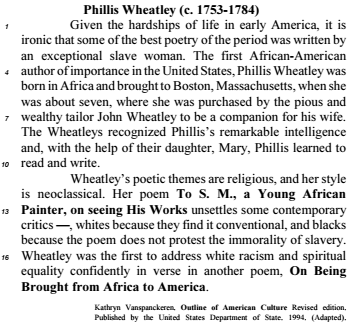
Based on the text above, choose the correct option.
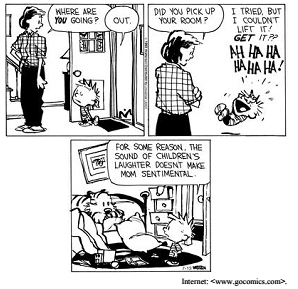
Based on the comic strip above, choose the correct option.
Reading comprehension is a multi-dimensional process that includes the reader, the text, and factors associated with the activity of reading. Most research and theories of comprehension are based primarily on research conducted with monolingual English speakers (L1). The present study was designed to investigate the cognitive and linguistic factors that have an influence on reading comprehension in English-as-a-Second-Language (ESL) speakers. The cognitive aspects of reading comprehension among L1 speakers and ESL speakers in the seventh grade were investigated. The performance of both groups was compared and the role of some relevant processes, including word reading, word reading fluency, phonological awareness, working memory, and morphological and syntactic awareness were assessed. Within this sample, three groups were examined: children with poor comprehension (PC), children with poor word reading and poor comprehension (poor readers, PR) and children with both good word reading and comprehension abilities (good comprehenders, GC). The results demonstrated that a variety of cognitive processes, such as working memory and phonological, syntactic, and morphological awareness are important for reading comprehension and compromised in poor comprehenders. The GC group performed better than the PC group on all of the cognitive measures.
Orly Lipka and Linda Siegel. The Development of Reading Comprehension Skills in Children Learning English as a Second Language. In: Reading & writing. vol. 25, 2012, p. 1873-1898. Internet
Reading comprehension is a multi-dimensional process that includes the reader, the text, and factors associated with the activity of reading. Most research and theories of comprehension are based primarily on research conducted with monolingual English speakers (L1). The present study was designed to investigate the cognitive and linguistic factors that have an influence on reading comprehension in English-as-a-Second-Language (ESL) speakers. The cognitive aspects of reading comprehension among L1 speakers and ESL speakers in the seventh grade were investigated. The performance of both groups was compared and the role of some relevant processes, including word reading, word reading fluency, phonological awareness, working memory, and morphological and syntactic awareness were assessed. Within this sample, three groups were examined: children with poor comprehension (PC), children with poor word reading and poor comprehension (poor readers, PR) and children with both good word reading and comprehension abilities (good comprehenders, GC). The results demonstrated that a variety of cognitive processes, such as working memory and phonological, syntactic, and morphological awareness are important for reading comprehension and compromised in poor comprehenders. The GC group performed better than the PC group on all of the cognitive measures.
Orly Lipka and Linda Siegel. The Development of Reading Comprehension Skills in Children Learning English as a Second Language. In: Reading & writing. vol. 25, 2012, p. 1873-1898. Internet
Mr. Durrance’s shop was halfway up the village. It was on a corner site, had a few photographs displayed in the window, a couple of marriage groups, a kicking baby in a nudist condition on a rug, one or two bearded young men taken with their girls. None of the photographs were very good; some of them already displayed signs of age. There were also postcards in large numbers; birthday cards and a few special shelves arranged in order of relationships. To my Husband. To my Wife. One or two bathing groups. There were a few pocketbooks and wallets of rather poor quality and a certain amount of stationary and envelopes bearing floral designs. Boxes of small notepaper decorated with flowers and labeled For Notes.
Agatha Christie. Postern of Fate. New York: Signet. 2000.
According to the text above, chose the correct option.
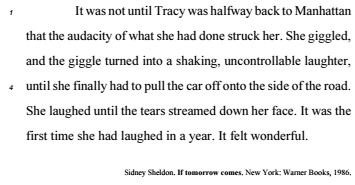
Based on the text above, choose the correct option.
“Every educator is a teacher of reading,” the expression goes. That might be a difficult mantra to live by if you consider yourself a mathematician or historian. The truth is that despite your area of expertise, you will find yourself teaching reading and writing at some point during the day in middle or high school. You may be teaching reading to adolescents who struggle to read.
With the blitz of video gaming, social networking and texting, students are bombarded with information daily in multiple ways and settings. They are less interested in reading textbooks and course material and more interested in gathering information in a fast-paced, action-packed manner as they access all they need to know on phones, hand-held gaming devices, tablets or laptops. Moreover, teachers are faced with how to keep adolescents engaged with reading in today’s world and 21st-century classrooms.
Carianne Bernadowski. A Good Read: Literacy Strategy with Newspapers. In: Newspaper Association of America Foundation, 2011. Internet <www.americanpressinstitute.org> (adapted).
It can be concluded from the text above that


 Conheça nossos planos