Questões de Concurso
Sobre interpretação de texto | reading comprehension em inglês
Foram encontradas 12.709 questões


Ano: 2014
Banca:
Gestão Concurso
Órgão:
CEMIG-TELECOM
Provas:
Gestão Concurso - 2014 - CEMIG-TELECOM - Analista Administrativo Jr.
|
Gestão Concurso - 2014 - CEMIG-TELECOM - Analista de Vendas Jr |
Gestão Concurso - 2014 - CEMIG-TELECOM - Analista de Tecnologia da Informação e Comunicação Jr. |
Q501866
Inglês
Texto para a questão.
“A World Health Organization panel is convening Monday to discuss the ethics of using experimental medicine to fight the Ebola outbreak in West Africa. Since its onset this year, the virus is believed to have infected 1,779 people and killed 961, according to WHO's latest figures. Their conditions are said to be improving. ZMapp is also being given to Miguel Pajares, a Spanish priest infected with Ebola while working in Liberia, Spain's Ministry of Heath announced Saturday. The drug was sent from Geneva, Switzerland, to Madrid, where Pajares is being treated in a special isolation unit at Hospital Carlos III.
The patients' treatment has raised questions about the use of unproven and unlicensed drugs to treat Ebola and why these three have received the serum when so many others in West Africa also have the virus. Medical ethicists, scientific experts and lay people from the countries affected by the Ebola outbreak will discuss the use of unlicensed medicines to combat the virus during the WHO teleconference Monday. The panel will look at issues including whether it is ethical to use "unregistered interventions with unknown adverse effects," and, if so, who should receive them. The WHO last week declared the Ebola outbreak a "public health emergency of international concern." Since an Ebola epidemic was declared in Guinea in March, the disease has spread to Sierra Leone, Liberia and Nigeria. On Sunday, Ivory Coast banned flights to and from those countries affected by Ebola. Emirates this month become the first major international airline to suspend flights from Guinea, followed by pan-African airline ASKY and smaller regional carrier Arik Air. British Airways stopped its flights to Sierra Leone and Liberia last Tuesday, because of the "deteriorating public health situation."
The Ebola virus causes hemorrhagic fever that affects multiple organ systems in the body. It can kill up to 90% of those infected. Early symptoms include weakness, muscle pain, headaches and a sore throat. They later progress to vomiting, diarrhea, impaired kidney and liver function -- and sometimes internal and external bleeding. Ebola spreads through contact with organs and bodily fluids such as blood, saliva, urine and other secretions of infected people. The most common treatment requires supporting organ functions and maintaining bodily fluids such as blood and water long enough for the body to fight off the infection.
Disponível em: http://edition.cnn.com. Acesso em: 11 ago 2014. (Adaptado).
De acordo com o texto acima, o painel convocado pela Organização Mundial de Saúde tem por objetivo discutir sobre
“A World Health Organization panel is convening Monday to discuss the ethics of using experimental medicine to fight the Ebola outbreak in West Africa. Since its onset this year, the virus is believed to have infected 1,779 people and killed 961, according to WHO's latest figures. Their conditions are said to be improving. ZMapp is also being given to Miguel Pajares, a Spanish priest infected with Ebola while working in Liberia, Spain's Ministry of Heath announced Saturday. The drug was sent from Geneva, Switzerland, to Madrid, where Pajares is being treated in a special isolation unit at Hospital Carlos III.
The patients' treatment has raised questions about the use of unproven and unlicensed drugs to treat Ebola and why these three have received the serum when so many others in West Africa also have the virus. Medical ethicists, scientific experts and lay people from the countries affected by the Ebola outbreak will discuss the use of unlicensed medicines to combat the virus during the WHO teleconference Monday. The panel will look at issues including whether it is ethical to use "unregistered interventions with unknown adverse effects," and, if so, who should receive them. The WHO last week declared the Ebola outbreak a "public health emergency of international concern." Since an Ebola epidemic was declared in Guinea in March, the disease has spread to Sierra Leone, Liberia and Nigeria. On Sunday, Ivory Coast banned flights to and from those countries affected by Ebola. Emirates this month become the first major international airline to suspend flights from Guinea, followed by pan-African airline ASKY and smaller regional carrier Arik Air. British Airways stopped its flights to Sierra Leone and Liberia last Tuesday, because of the "deteriorating public health situation."
The Ebola virus causes hemorrhagic fever that affects multiple organ systems in the body. It can kill up to 90% of those infected. Early symptoms include weakness, muscle pain, headaches and a sore throat. They later progress to vomiting, diarrhea, impaired kidney and liver function -- and sometimes internal and external bleeding. Ebola spreads through contact with organs and bodily fluids such as blood, saliva, urine and other secretions of infected people. The most common treatment requires supporting organ functions and maintaining bodily fluids such as blood and water long enough for the body to fight off the infection.
Disponível em: http://edition.cnn.com. Acesso em: 11 ago 2014. (Adaptado).
De acordo com o texto acima, o painel convocado pela Organização Mundial de Saúde tem por objetivo discutir sobre
Ano: 2014
Banca:
Gestão Concurso
Órgão:
CEMIG-TELECOM
Provas:
Gestão Concurso - 2014 - CEMIG-TELECOM - Analista Administrativo Jr.
|
Gestão Concurso - 2014 - CEMIG-TELECOM - Analista de Vendas Jr |
Gestão Concurso - 2014 - CEMIG-TELECOM - Analista de Tecnologia da Informação e Comunicação Jr. |
Q501859
Inglês
Texto associado
Chandelier
Party girls don't get hurt
Can't feel anything, when will I learn
I push it down, push it down
I'm the one "for a good time call"
Phone's blowin' up, they're ringin' my
doorbell
I feel the love, feel the love
1, 2, 3 1, 2, 3 drink
1, 2, 3 1, 2, 3 drink
1, 2, 3 1, 2, 3 drink
Throw ‘em back, till I lose count
I'm gonna swing from the chandelier,
from the chandelier
I'm gonna live like tomorrow doesn't
exist
Like it doesn't exist
I'm gonna fly like a bird through the night
Feel my tears as they dry
I'm gonna swing from the chandelier,
from the chandelier
And I'm holding on for dear life
Won't look down, won't open my eyes
Keep my glass full until morning light
'Cause I'm just holding on for tonight
Help me, I'm holding on for dear life
Won't look down won't open my eyes
Keep my glass full until morning light
'Cause I'm just holding on for tonight
On for tonigh
Sun is up, I'm a mess
Gotta get out now, gotta run from this
Here comes the shame, here comes the
shame
[...]
Furler, Sia. Chandelier, Sia. In: 1000 Forms of Fear. Monkey Puzzle Records e RCA Records, 2014.
Party girls don't get hurt
Can't feel anything, when will I learn
I push it down, push it down
I'm the one "for a good time call"
Phone's blowin' up, they're ringin' my
doorbell
I feel the love, feel the love
1, 2, 3 1, 2, 3 drink
1, 2, 3 1, 2, 3 drink
1, 2, 3 1, 2, 3 drink
Throw ‘em back, till I lose count
I'm gonna swing from the chandelier,
from the chandelier
I'm gonna live like tomorrow doesn't
exist
Like it doesn't exist
I'm gonna fly like a bird through the night
Feel my tears as they dry
I'm gonna swing from the chandelier,
from the chandelier
And I'm holding on for dear life
Won't look down, won't open my eyes
Keep my glass full until morning light
'Cause I'm just holding on for tonight
Help me, I'm holding on for dear life
Won't look down won't open my eyes
Keep my glass full until morning light
'Cause I'm just holding on for tonight
On for tonigh
Sun is up, I'm a mess
Gotta get out now, gotta run from this
Here comes the shame, here comes the
shame
[...]
Furler, Sia. Chandelier, Sia. In: 1000 Forms of Fear. Monkey Puzzle Records e RCA Records, 2014.
Letras de músicas abordam temas que, de certa forma, podem ser reforçados pela repetição de trechos ou palavras. O fragmento da canção Chandelier, por exemplo, permite conhecer o relato de alguém que
Ano: 2014
Banca:
CETRO
Órgão:
AEB
Prova:
CETRO - 2014 - AEB - Tecnologista Júnior - Desenvolvimento Tecnológico |
Q483830
Inglês
Texto associado
Gravity, review: “heartachingly tender”
Starring Sandra Bullock and George Clooney as astronauts adrift in
space, Alfonso Cuarón’s astonishing thriller is one of the films of
the year, says Robbie Collin
Watch an astronaut drifting through space for long enough and eventually you notice how much they look like a newborn baby. The oxygen helmet makes their head bigger, rounder and cuter; their hands grasp eagerly at whatever happens to be passing; their limbs are made fat and their movements simple by the spacesuit’s cuddly bulk. They tumble head-over-heels like tripping toddlers or simply bob there in amniotic suspension. Even the lifeline that keeps them tethered to their ship has a pulsing, umbilical aspect.
Gravity, the new Alfonso Cuarón picture, is a heart- achingly tender film about the miracle of motherhood, and the billion-to-one odds against any of us being here, astronauts or not. It’s also a totally absorbing, often overpowering spectacle - a $100 million 3D action movie in which Sandra Bullock and George Clooney play two Hollywood-handsome spacefarers, fighting for their lives 375 miles above the Earth’s crust.
A series of captions over the opening titles reminds us that this is a dead zone: no oxygen or air pressure, and nothing to carry sound. “Life in space is impossible,” the final message tells us, as the cinema shakes with Steven Price’s resonant score, and then suddenly falls quiet.
For Dr. Ryan Stone (Bullock), a mission specialist in orbit for the first time, the lack of noise is welcome. She’s a medical engineer called up by NASA to install new software on to the Hubble Telescope, but also a mother in mourning for her four- year-old daughter, whom she lost in a senseless accident, and the silence enfolds her like a comfort blanket.
Available in: http://www.telegraph.co.uk
Starring Sandra Bullock and George Clooney as astronauts adrift in
space, Alfonso Cuarón’s astonishing thriller is one of the films of
the year, says Robbie Collin
Watch an astronaut drifting through space for long enough and eventually you notice how much they look like a newborn baby. The oxygen helmet makes their head bigger, rounder and cuter; their hands grasp eagerly at whatever happens to be passing; their limbs are made fat and their movements simple by the spacesuit’s cuddly bulk. They tumble head-over-heels like tripping toddlers or simply bob there in amniotic suspension. Even the lifeline that keeps them tethered to their ship has a pulsing, umbilical aspect.
Gravity, the new Alfonso Cuarón picture, is a heart- achingly tender film about the miracle of motherhood, and the billion-to-one odds against any of us being here, astronauts or not. It’s also a totally absorbing, often overpowering spectacle - a $100 million 3D action movie in which Sandra Bullock and George Clooney play two Hollywood-handsome spacefarers, fighting for their lives 375 miles above the Earth’s crust.
A series of captions over the opening titles reminds us that this is a dead zone: no oxygen or air pressure, and nothing to carry sound. “Life in space is impossible,” the final message tells us, as the cinema shakes with Steven Price’s resonant score, and then suddenly falls quiet.
For Dr. Ryan Stone (Bullock), a mission specialist in orbit for the first time, the lack of noise is welcome. She’s a medical engineer called up by NASA to install new software on to the Hubble Telescope, but also a mother in mourning for her four- year-old daughter, whom she lost in a senseless accident, and the silence enfolds her like a comfort blanket.
Available in: http://www.telegraph.co.uk
Read the sentence taken from the text.
“It’s also a totally absorbing, often overpowering spectacle – a $100 million 3D action movie in which Sandra Bullock and George Clooney play two Hollywood-handsome spacefarers, fighting for their lives 375 miles above the Earth’s crust.”
According to the context and considering the text, it is correct to affirm that the underlined word refers to
“It’s also a totally absorbing, often overpowering spectacle – a $100 million 3D action movie in which Sandra Bullock and George Clooney play two Hollywood-handsome spacefarers, fighting for their lives 375 miles above the Earth’s crust.”
According to the context and considering the text, it is correct to affirm that the underlined word refers to
Ano: 2014
Banca:
CETRO
Órgão:
AEB
Provas:
CETRO - 2014 - AEB - Analista em C&T - Gestão Administrativa - Pleno 1
|
CETRO - 2014 - AEB - Tecnologista - Desenvolvimento Técnológico - Pleno 1 |
Q482197
Inglês
Texto associado
Building a Practical College Degree for the New Economy
This is not a great time to be a recent college graduate.
Average student-loan debt is $29,400. The underemployment rate is 44 percent for graduates ages 22 to 27, meaning they are holding jobs that don’t require bachelor’s degrees. And the average age of financial independence for college graduate these days is 30.
Such statistics have given rise to the narrative that a college degree is no longer worth it, although volumes of economic studies on lifetime earnings prove otherwise. Even so, given the number of college graduates struggling to launch their careers, a wide gap has emerged between what the workforce needs in employees and what colleges are producing in graduates.
Part of the problem is that we have high expectations for the bachelor’s degree today. Thirty years ago, when fewer people required a higher education to get ahead in life, the bachelor’s degree was seen as a vehicle for broad learning. The training part came later by going to graduate school or getting a job where the new employer trained you.
Now we demand that skills training move in tandem with broad learning, and expect both to be completed in the four years of an undergraduate education. For too many students, however, the bachelor’s degree is not providing that dual experience - high-impact, in-classroom learning and out-of-the- classroom, experiential, and hands-on learning necessary for success in today’s economy.
Because of student loan debt, graduate or professional school is no longer an option for many recent college graduates. They’re searching for quick and cheap add- on boot camps that give them what they’re missing. And a whole new set of providers are emerging outside of the traditional higher-education ecosystem to provide that lift.
Last year, General Assembly, which offers courses of a few hours to a few weeks in everything from digital marketing to web development, expanded to Washington, DC, where it is selling out of nearly all of its offerings. Its average student is in his mid-20s and just a few years out of college.
This is not a great time to be a recent college graduate.
Average student-loan debt is $29,400. The underemployment rate is 44 percent for graduates ages 22 to 27, meaning they are holding jobs that don’t require bachelor’s degrees. And the average age of financial independence for college graduate these days is 30.
Such statistics have given rise to the narrative that a college degree is no longer worth it, although volumes of economic studies on lifetime earnings prove otherwise. Even so, given the number of college graduates struggling to launch their careers, a wide gap has emerged between what the workforce needs in employees and what colleges are producing in graduates.
Part of the problem is that we have high expectations for the bachelor’s degree today. Thirty years ago, when fewer people required a higher education to get ahead in life, the bachelor’s degree was seen as a vehicle for broad learning. The training part came later by going to graduate school or getting a job where the new employer trained you.
Now we demand that skills training move in tandem with broad learning, and expect both to be completed in the four years of an undergraduate education. For too many students, however, the bachelor’s degree is not providing that dual experience - high-impact, in-classroom learning and out-of-the- classroom, experiential, and hands-on learning necessary for success in today’s economy.
Because of student loan debt, graduate or professional school is no longer an option for many recent college graduates. They’re searching for quick and cheap add- on boot camps that give them what they’re missing. And a whole new set of providers are emerging outside of the traditional higher-education ecosystem to provide that lift.
Last year, General Assembly, which offers courses of a few hours to a few weeks in everything from digital marketing to web development, expanded to Washington, DC, where it is selling out of nearly all of its offerings. Its average student is in his mid-20s and just a few years out of college.
According to the text,
I. colleges are not producing in graduates what the workforce needs in employees.
II. nowadays, the bachelor’s degree is seen only as a vehicle for broad learning.
III. nearly 44% of graduates ages 22 to 27 hold jobs that require bachelor’s degree.
IV. colleges are expected to give students not only skills training, but also broad learning.
V. economic studies on lifetime earnings prove a college degree is no longer worth it.
The correct assumption(s) is(are)
I. colleges are not producing in graduates what the workforce needs in employees.
II. nowadays, the bachelor’s degree is seen only as a vehicle for broad learning.
III. nearly 44% of graduates ages 22 to 27 hold jobs that require bachelor’s degree.
IV. colleges are expected to give students not only skills training, but also broad learning.
V. economic studies on lifetime earnings prove a college degree is no longer worth it.
The correct assumption(s) is(are)
Ano: 2014
Banca:
CETRO
Órgão:
AEB
Provas:
CETRO - 2014 - AEB - Analista em C&T - Gestão Administrativa - Pleno 1
|
CETRO - 2014 - AEB - Tecnologista - Desenvolvimento Técnológico - Pleno 1 |
Q482195
Inglês
Read the excerpt below, taken from the text “World Cup 2014: Golden goals, golf carts and other innovations” published by BBC Sport, and choose the alternative that only has cognate words.
The 2014 World Cup has seen innovations such as goal-line technology and vanishing spray introduced to football’s showpiece global event for the first time.
France benefited from the use of goal-line technology in their opening win over Honduras.
With language barriers no longer a problem, red and yellow cards were introduced at the 1970 World Cup and have been adopted worldwide since, with variants appearing in many other sports.
The 2014 World Cup has seen innovations such as goal-line technology and vanishing spray introduced to football’s showpiece global event for the first time.
France benefited from the use of goal-line technology in their opening win over Honduras.
With language barriers no longer a problem, red and yellow cards were introduced at the 1970 World Cup and have been adopted worldwide since, with variants appearing in many other sports.
Ano: 2014
Banca:
CETRO
Órgão:
AEB
Provas:
CETRO - 2014 - AEB - Analista em C&T - Gestão Administrativa - Pleno 1
|
CETRO - 2014 - AEB - Tecnologista - Desenvolvimento Técnológico - Pleno 1 |
Q482194
Inglês
Choose the alternative that rewrites correctly the excerpt below, taken from the text “Cat Watch 2014: What’s it like being a cat?” published by the BBC News, using the past simple.
Cats are at a crucial point in their evolutionary journey as they transform from solitary hunters to domestic pets, a study by the BBC and the Royal Veterinary College has revealed.
Cats see the world in muted colours, making it easier for them to see movement without distractions. They also have large eyes for their size, allowing them to see well in low-level light.
However, they can’t focus on anything less than a foot away, so use their whiskers for detecting objects closer to their bodies.
Cats are at a crucial point in their evolutionary journey as they transform from solitary hunters to domestic pets, a study by the BBC and the Royal Veterinary College has revealed.
Cats see the world in muted colours, making it easier for them to see movement without distractions. They also have large eyes for their size, allowing them to see well in low-level light.
However, they can’t focus on anything less than a foot away, so use their whiskers for detecting objects closer to their bodies.
Ano: 2014
Banca:
CETRO
Órgão:
AEB
Provas:
CETRO - 2014 - AEB - Analista em C&T - Gestão Administrativa - Pleno 1
|
CETRO - 2014 - AEB - Tecnologista - Desenvolvimento Técnológico - Pleno 1 |
Q482191
Inglês
Choose the alternative that best translates the following sentences taken from the text “Biggest observed meteorite impact” hits Moon, published by BBC World Service.
“The team believes the impact has left behind a 40m- wide crater.
‘That’s the estimation we have made according to current impact models. We expect that soon Nasa could observe the crater and confirm our prediction,’ said Prof Madiedo.
It would be one of many scars on the lunar surface. Unlike Earth, the Moon has no atmosphere to shield it from meteorite collisions, and its surface shows a record of every strike.”
“The team believes the impact has left behind a 40m- wide crater.
‘That’s the estimation we have made according to current impact models. We expect that soon Nasa could observe the crater and confirm our prediction,’ said Prof Madiedo.
It would be one of many scars on the lunar surface. Unlike Earth, the Moon has no atmosphere to shield it from meteorite collisions, and its surface shows a record of every strike.”
Ano: 2014
Banca:
UFSBA
Órgão:
UFBA
Provas:
UFBA - 2014 - UFBA - Enfermeiro
|
UFSBA - 2014 - UFBA - Nutricionista |
Q481486
Inglês
Nos dois últimos versos da canção – “And I swear that I don’t have a gun / No I don’t have a gun”–, o
autor lamenta o fato de não possuir uma arma.
Q481483
Inglês
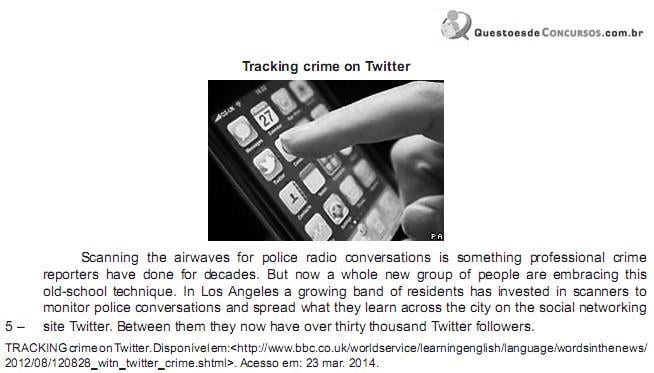
Repórteres profssionais da área criminal, após os relatos dos moradores, começaram a fazer o rastreamentodecrimesatravésdaescutadeconversasderádioentreospoliciais.
Ano: 2014
Banca:
UFSBA
Órgão:
UFBA
Provas:
UFBA - 2014 - UFBA - Assistente Social
|
UFSBA - 2014 - UFBA - Nutricionista |
Q481481
Inglês
O casal de chineses sabe que, no futuro, terá de arcar com a compra de um apartamento para o filho, a fim de que ele possa conseguir uma esposa.
Q481480
Inglês
It has been a long time since Liu Jinghu and his wife enjoyed a weekend to themselves. Saturdays and Sundays in smoggy Beijing are dedicated to their only child, 2-year-old son Xiaojing: there are early-childhood exercise classes; singing sessions with other families; Lego‑building sprees in a living room scattered with toys. Then there’s the specter of expensive tutoring to get their
5 – toddlerinto a good school and, furtherinto the future, the pressure to buy their son an apartment so he can persuade a woman to marry him. That property burden could cost Liu, a software‑development manager, and his wife, a human-resources specialist, two decades’ worth of salary. Such are the costs of raising a kid today in middle-class China.Liu Jinghu e sua esposa costumam divertir-se apenas nos fins de semana, quando seu único filho, Xiaojing,fica aos cuidados de amigos.
Ano: 2014
Banca:
CESPE / CEBRASPE
Órgão:
INPI
Provas:
CESPE - 2014 - INPI - Pesquisador em Propriedade Industrial - Conhecimentos Básicos - Cargos 22 a 24
|
CESPE - 2014 - INPI - Pesquisador em Propriedade Industrial (Classe A, Padrão I) - Cargo 22 |
Q475933
Inglês
Texto associado

Judge the following items according to the text above.
Judge the following items according to the text above.
In line 13, the word “parties” can be correctly translated into Portuguese as interessados.
Ano: 2014
Banca:
CESPE / CEBRASPE
Órgão:
INPI
Provas:
CESPE - 2014 - INPI - Pesquisador em Propriedade Industrial - Conhecimentos Básicos - Cargos 22 a 24
|
CESPE - 2014 - INPI - Pesquisador em Propriedade Industrial (Classe A, Padrão I) - Cargo 22 |
Q475932
Inglês
Texto associado
Judge the following items according to the text above.
Judge the following items according to the text above.
The possibility of making profit from an invention, in an amount enough to cover the money spent in research, is one of the reasons inventors engage in research in the first place.
Ano: 2014
Banca:
CESPE / CEBRASPE
Órgão:
INPI
Provas:
CESPE - 2014 - INPI - Pesquisador em Propriedade Industrial - Conhecimentos Básicos - Cargos 22 a 24
|
CESPE - 2014 - INPI - Pesquisador em Propriedade Industrial (Classe A, Padrão I) - Cargo 22 |
Q475931
Inglês
Texto associado
Judge the following items according to the text above.
Judge the following items according to the text above.
A patent is a legal measure which gives the inventor the exclusive right to commercially exploit his/her invention regardless of the existence of any previous patents whatsoever.
Ano: 2014
Banca:
CESPE / CEBRASPE
Órgão:
INPI
Provas:
CESPE - 2014 - INPI - Pesquisador em Propriedade Industrial - Conhecimentos Básicos - Cargos 22 a 24
|
CESPE - 2014 - INPI - Pesquisador em Propriedade Industrial (Classe A, Padrão I) - Cargo 22 |
Q475928
Inglês
Texto associado
Judge the following items according to the text above.
Judge the following items according to the text above.
By cross-licensing a patent, an inventor will usually miss the opportunity of having access to market and thus of earning income from that particular invention.
Ano: 2014
Banca:
CESPE / CEBRASPE
Órgão:
INPI
Provas:
CESPE - 2014 - INPI - Pesquisador em Propriedade Industrial - Conhecimentos Básicos - Cargos 22 a 24
|
CESPE - 2014 - INPI - Pesquisador em Propriedade Industrial (Classe A, Padrão I) - Cargo 22 |
Q475927
Inglês
Texto associado

Judge the following items based on the text above.
Judge the following items based on the text above.
Although the patent systems in Brazil and in the United States have much in common, the American system is simpler to manage since it privileges the inventors in the process of application for a patent.
Ano: 2014
Banca:
CESPE / CEBRASPE
Órgão:
INPI
Provas:
CESPE - 2014 - INPI - Pesquisador em Propriedade Industrial - Conhecimentos Básicos - Cargos 22 a 24
|
CESPE - 2014 - INPI - Pesquisador em Propriedade Industrial (Classe A, Padrão I) - Cargo 22 |
Q475926
Inglês
Texto associado
Judge the following items based on the text above.
Judge the following items based on the text above.
In the Brazilian patent system, any individual can be an inventor but only natural persons can own a patent.
Ano: 2014
Banca:
CESPE / CEBRASPE
Órgão:
INPI
Provas:
CESPE - 2014 - INPI - Pesquisador em Propriedade Industrial - Conhecimentos Básicos - Cargos 22 a 24
|
CESPE - 2014 - INPI - Pesquisador em Propriedade Industrial (Classe A, Padrão I) - Cargo 22 |
Q475925
Inglês
Texto associado
Judge the following items based on the text above.
Judge the following items based on the text above.
Transgenic microorganisms are not considered patentable in Brazil unless they present a feature that is not found in the species in its natural state.
Ano: 2014
Banca:
CESPE / CEBRASPE
Órgão:
INPI
Provas:
CESPE - 2014 - INPI - Pesquisador em Propriedade Industrial - Conhecimentos Básicos - Cargos 22 a 24
|
CESPE - 2014 - INPI - Pesquisador em Propriedade Industrial (Classe A, Padrão I) - Cargo 22 |
Q475924
Inglês
Texto associado
Judge the following items based on the text above.
Judge the following items based on the text above.
The word “which” (L.5) refers to “aspects” (L.4).
Ano: 2014
Banca:
CESPE / CEBRASPE
Órgão:
INPI
Provas:
CESPE - 2014 - INPI - Pesquisador em Propriedade Industrial - Conhecimentos Básicos - Cargos 22 a 24
|
CESPE - 2014 - INPI - Pesquisador em Propriedade Industrial (Classe A, Padrão I) - Cargo 22 |
Q475923
Inglês
Texto associado
Judge the following items based on the text above.
Judge the following items based on the text above.
In Brazil, as in the United State, for something to be considered patentable it must be original, like a new composition of matter, it must have industrial applicability, like a new and useful process, and it must be considered a creative activity, like a new abstract idea.

 Conheça nossos planos