Questões de Concurso
Sobre interpretação de texto | reading comprehension em inglês
Foram encontradas 12.689 questões


“I wanted to be his life preserver, the thing that would keep him afloat. Instead, he became my anchor. And I’m tired of drowning.”
― Amanda Grace, But I Love Him
The semantic relationship between the metaphors "life preserver," "anchor," and "drowning" primarily serves to illustrate
Cryptography is the process of hiding or coding information so that only the person a message was intended for can read it. The art of cryptography has been used to code messages for thousands of years and continues to be used in bank cards, computer passwords, and ecommerce. Modern cryptography techniques include algorithms and ciphers that enable the encryption and decryption of information, such as 128‑bit and 256‑bit encryption keys. Modern ciphers, such as the Advanced Encryption Standard (AES), are considered virtually unbreakable.
A common cryptography definition is the practice of coding information to ensure only the person that a message was written for can read and process the information. This cybersecurity practice, also known as cryptology, combines various disciplines like computer science, engineering, and mathematics to create complex codes that hide the true meaning of a message. Cryptography can be traced all the way back to ancient Egyptian hieroglyphics but remains vital to securing communication and information in transit and preventing it from being read by untrusted parties. It uses algorithms and mathematical concepts to transform messages into difficult‑to‑decipher codes through techniques like cryptographic keys and digital signing to protect data privacy, credit card transactions, email, and web browsing.
Cryptography remains important to protecting data and users, ensuring confidentiality, and preventing cyber criminals from intercepting sensitive corporate information. Individuals and organizations use cryptography on a daily basis to protect their privacy and keep their conversations and data confidential. The technique ensures confidentiality by encrypting sent messages using an algorithm with a key only known to the sender and recipient. A common example of this is the messaging tool WhatsApp, which encrypts conversations between people to ensure they cannot be hacked or intercepted. It also secures browsing, such as with virtual private networks (VPNs), which use encrypted tunnels, asymmetric encryption, and public and private shared keys.
Similar to how cryptography can confirm the authenticity of a message, it can also prove the integrity of the information being sent and received. The technology also ensures information is not altered while in storage or during transit between the sender and the intended recipient. For example, digital signatures can detect forgery or tampering in software distribution and financial transactions.Cryptography confirms accountability and responsibility from the sender of a message, which means they cannot later deny their intentions when they created or transmitted information. Digital signatures are a good example of this, as they ensure a sender cannot claim a message, contract, or document they created to be fraudulent. Furthermore, in email nonrepudiation, email tracking makes sure the sender cannot deny sending a message and a recipient cannot deny receiving it.
There are many types of cryptographic algorithms available. They vary in complexity and security, depending on the type of communication and the sensitivity of the information being shared.
Internet:
Cryptography is the process of hiding or coding information so that only the person a message was intended for can read it. The art of cryptography has been used to code messages for thousands of years and continues to be used in bank cards, computer passwords, and ecommerce. Modern cryptography techniques include algorithms and ciphers that enable the encryption and decryption of information, such as 128‑bit and 256‑bit encryption keys. Modern ciphers, such as the Advanced Encryption Standard (AES), are considered virtually unbreakable.
A common cryptography definition is the practice of coding information to ensure only the person that a message was written for can read and process the information. This cybersecurity practice, also known as cryptology, combines various disciplines like computer science, engineering, and mathematics to create complex codes that hide the true meaning of a message. Cryptography can be traced all the way back to ancient Egyptian hieroglyphics but remains vital to securing communication and information in transit and preventing it from being read by untrusted parties. It uses algorithms and mathematical concepts to transform messages into difficult‑to‑decipher codes through techniques like cryptographic keys and digital signing to protect data privacy, credit card transactions, email, and web browsing.
Cryptography remains important to protecting data and users, ensuring confidentiality, and preventing cyber criminals from intercepting sensitive corporate information. Individuals and organizations use cryptography on a daily basis to protect their privacy and keep their conversations and data confidential. The technique ensures confidentiality by encrypting sent messages using an algorithm with a key only known to the sender and recipient. A common example of this is the messaging tool WhatsApp, which encrypts conversations between people to ensure they cannot be hacked or intercepted. It also secures browsing, such as with virtual private networks (VPNs), which use encrypted tunnels, asymmetric encryption, and public and private shared keys.
Similar to how cryptography can confirm the authenticity of a message, it can also prove the integrity of the information being sent and received. The technology also ensures information is not altered while in storage or during transit between the sender and the intended recipient. For example, digital signatures can detect forgery or tampering in software distribution and financial transactions.Cryptography confirms accountability and responsibility from the sender of a message, which means they cannot later deny their intentions when they created or transmitted information. Digital signatures are a good example of this, as they ensure a sender cannot claim a message, contract, or document they created to be fraudulent. Furthermore, in email nonrepudiation, email tracking makes sure the sender cannot deny sending a message and a recipient cannot deny receiving it.
There are many types of cryptographic algorithms available. They vary in complexity and security, depending on the type of communication and the sensitivity of the information being shared.
Internet:
ONE ART
The art of losing isn’t hard to master; so many things seem filled with the intent to be lost that their loss is no disaster.
Lose something every day. Accept the fluster of lost door keys, the hour badly spent. The art of losing isn’t hard to master.
Then practice losing farther, losing faster: places, and names, and where it was you meant to travel. None of these will bring disaster.
I lost my mother’s watch. And look! my last, or next-to-last, of three loved houses went. The art of losing isn’t hard to master.
I lost two cities, lovely ones. And, vaster, some realms I owned, two rivers, a continent. I miss them, but it wasn’t a disaster.
—Even losing you (the joking voice, a gesture I love) I shan’t have lied. It’s evident the art of losing’s not too hard to master though it may look like (Write it!) like disaster.
Source: https://www.poetryfoundation.org/poems/47536/oneart
In the poem, the persona
The Hague, 29 September 1872.
My dear Theo,
I was glad to hear that you got back safely.
I missed you the first few days, and it was strange for me not to find you when I came home in the afternoon. We spent some pleasant days together, and actually did go for some walks and see a thing or two whenever we had the chance.
What terrible weather, you must feel anxious on your walks to Oisterwijk. Yesterday there were trotting races on the occasion of the exhibition, but the illumination and fireworks were postponed because of the bad weather, so it’s just as well you didn’t stay to see them
Regards from the Haanebeeks and the Rooses. Ever,
Your loving
Vincent
This text follows the conventions of
Read the text below about deepfakes:
Deepfakes are creating havoc across the globe, spreading fake news and pornography, being used to steal identities, exploiting celebrities, scamming ordinary people and even influencing elections.
Yet a recent worldwide survey found 71% of people have no idea what deepfakes are.
Deepfakes are digital photos, videos or voices of real people that have either been synthetically created or manipulated using artificial intelligence (AI) and can be hard to distinguish from the real thing.
You’ve probably seen a deepfake video or photo without even realising it. Computer-generated Tom Cruises, Taylor Swifts and Mark Zuckerbergs have been circulating on the internet for several years, but what started as a bit of harmless fun has now become much more serious.
Earlier this year, a finance worker at a multinational firm in Hong Kong was tricked into paying AUD$39 million to fraudsters who used deepfake technology to impersonate the company’s chief financial officer in a video conference.
(…)
Australia’s Defence Chief Angus Campbell has expressed fears that the world is entering “an era of truth decay,” where misinformation will undermine democracy by sowing discord and distrust.
Campbell told a defence conference in 2023 that artificial intelligence and deepfakes would “seriously damage public confidence in elected officials” by making it impossible for most people to distinguish fact from fiction.
Source: https://unisa.edu.au/connect/enterprisemagazine/articles/2024/what-are-deepfakes-and-should-we-beworried/
Choose the correct alternative based on the text.
Read the excerpt below of Virginia Woolf’s “A room of one’s own”:
It would have been impossible, completely and entirely, for any woman to have written the plays of Shakespeare in the age of Shakespeare. Let me imagine, since facts are so hard to come by, what would have happened had Shakespeare had a wonderfully gifted sister, called Judith, let us say. Shakespeare himself went, very probably,--his mother was an heiress--to the grammar school, where he may have learnt Latin--Ovid, Virgil and Horace--and the elements of grammar and logic. He was, it is well known, a wild boy who poached rabbits, perhaps shot a deer, and had, rather sooner than he should have done, to marry a woman in the neighbourhood, who bore him a child rather quicker than was right. That escapade sent him to seek his fortune in London. He had, it seemed, a taste for the theatre; he began by holding horses at the stage door. Very soon he got work in the theatre, became a successful actor, and lived at the hub of the universe, meeting everybody, knowing everybody, practising his art on the boards, exercising his wits in the streets, and even getting access to the palace of the queen.
Meanwhile his extraordinarily gifted sister, let us suppose, remained at home. She was as
adventurous, as imaginative, as agog to see the world as he was. But she was not sent to school. She had no chance of learning grammar and logic, let alone of reading Horace and Virgil. She picked up a book now and then, one of her brother's perhaps, and read a few pages. But then her parents came in and told her to mend the stockings or mind the stew and not moon about with books and papers. They would have spoken sharply but kindly, for they were substantial people who knew the conditions of life for a woman and loved their daughter--indeed, more likely than nots he was the apple of her father's eye. Perhaps she scribbled some pages up in an apple loft on the sly but was careful to hide them or set fire to them. Soon, however, before she was out of her teens, she was to be betrothed to the son of a neighbouring woolstapler. She cried out that marriage was hateful to her, and for that she was severely beaten by her father. Then he ceased to scold her. He begged her instead not to hurt him, not to shame him in this matter of her marriage. He would give her a chain of beads or a fine petticoat, he said; and there were tears in his eyes. How could she disobey him? How could she break his heart? (...)
According to the narrator:
I remember being caught speaking Spanish at recess – that was good for three licks on the knuckles with a sharp ruler. I remember being sent to the comer of the classroom for “talking back” to the Anglo teacher when all I was trying to do was tell her how to pronounce my name. “If you want to be American, speak ‘American.’ If you don’t like it, go back to Mexico where you belong.”
(…) At Pan American University, I and all Chicano students were required to take two speech classes. Their purpose: to get rid of our accents. Attacks on one’s form of expression with the intent to censor are a violation of the First Amendment.
(…) Wild tongues can’t be tamed, they can only be cut out.
Reference: Anzaldúa, Gloria. Borderlands/La Frontera: The New Mestiza. 2nd ed. San Francisco: Aunt Lute Books, 1999. I
In this passage, Anzaldúa
Look at the comic strip below.
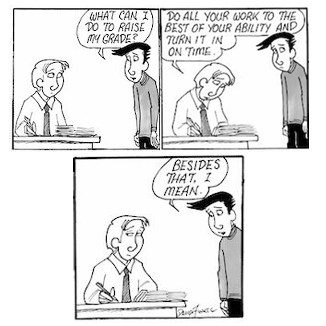
Source: https://www.middleweb.com/20394/daily-comic-strip-chronicles-teaching-life/
Choose the correct alternative according to the text.

 Conheça nossos planos