Questões de Concurso
Sobre interpretação de texto | reading comprehension em inglês
Foram encontradas 12.706 questões


The Pros and Cons of Nuclear Power
Since the disaster at the Fukushima nuclear power plant in Japan in 2011, a debate has been raging (1) the future of atomic energy. Consequently, the safety risks have been well publicized in the global media. But do the risks outweigh the damage that could be done to the planet because of our ongoing addiction to fossil fuels?
Even environmentalists don’t have the answer. They are split over nuclear (2) , and its pros and cons. Some say it is neither safe nor economical because it produces potentially (3) radioactive waste, and reactors are so costly to build. However, others believe nuclear energy is a necessary evil. They say we should continue using it until (4) energy sources, like wind turbines and solar panels, can meet global demand. Supporters also argue that nuclear energy helps cut down on carbon emissions from fossil fuels such as coal and natural gas, which are linked to global warming and pollute the environment. They say this is because nuclear reactors produce a tiny fraction of the carbon dioxide generated by burning coal.
But perhaps the biggest hurdle for atomic energy to overcome is its image problem. Despite industry claims of a strong safety record, critics remain unconvinced because each reactor annually produces up to 30 tons of nuclear waste, which can continue to be radioactive and hazardous for thousands of years. Furthermore, the Chernobyl disaster in 1986 left the public with vivid images of the impact of a nuclear meltdown, including deformed babies, mutated vegetables, and abandoned towns.
While nuclear reactors may continue to be installed in some countries for decades to come, after Fukushima others have decided to rethink their energy policies. For example, the German government has revealed plans for a “green” renewable energy plan, even though it has relied on nuclear power for up to 23 percent of its consumption in the past. It has been announced that all seventeen nuclear power plants would be phased out by 2022. The policy will also promote energy-saving measures encouraging people to insulate their homes, recycle, and reduce waste. Experts argue it could be a risky strategy because Germany doesn’t have natural gas or oil supplies, and coal supplies have been depleted.
Meanwhile, in Brazil, there is just one nuclear plant at Angra dos Reis. Nuclear power represents only three per cent of Brazil’s energy production. After sharp oil price rises in the 1970s, the country’s leaders anticipated future energy supply problems. So they concentrated on developing alternative energy sources including biofuel, hydroelectric schemes, and wind power.
This approach seems to be working because by May
2012 plans to build more nuclear reactors were shelved by Brazilian officials. The move was welcomed
by environmental lobby groups, which had feared a
potential ecological catastrophe in case of an accident. If a big country like Brazil, which is the tenth
largest energy consumer in the world, can survive and
improve its economy without much nuclear power,
maybe others can do so, too.
The Pros and Cons of Nuclear Power
Since the disaster at the Fukushima nuclear power plant in Japan in 2011, a debate has been raging (1) the future of atomic energy. Consequently, the safety risks have been well publicized in the global media. But do the risks outweigh the damage that could be done to the planet because of our ongoing addiction to fossil fuels?
Even environmentalists don’t have the answer. They are split over nuclear (2) , and its pros and cons. Some say it is neither safe nor economical because it produces potentially (3) radioactive waste, and reactors are so costly to build. However, others believe nuclear energy is a necessary evil. They say we should continue using it until (4) energy sources, like wind turbines and solar panels, can meet global demand. Supporters also argue that nuclear energy helps cut down on carbon emissions from fossil fuels such as coal and natural gas, which are linked to global warming and pollute the environment. They say this is because nuclear reactors produce a tiny fraction of the carbon dioxide generated by burning coal.
But perhaps the biggest hurdle for atomic energy to overcome is its image problem. Despite industry claims of a strong safety record, critics remain unconvinced because each reactor annually produces up to 30 tons of nuclear waste, which can continue to be radioactive and hazardous for thousands of years. Furthermore, the Chernobyl disaster in 1986 left the public with vivid images of the impact of a nuclear meltdown, including deformed babies, mutated vegetables, and abandoned towns.
While nuclear reactors may continue to be installed in some countries for decades to come, after Fukushima others have decided to rethink their energy policies. For example, the German government has revealed plans for a “green” renewable energy plan, even though it has relied on nuclear power for up to 23 percent of its consumption in the past. It has been announced that all seventeen nuclear power plants would be phased out by 2022. The policy will also promote energy-saving measures encouraging people to insulate their homes, recycle, and reduce waste. Experts argue it could be a risky strategy because Germany doesn’t have natural gas or oil supplies, and coal supplies have been depleted.
Meanwhile, in Brazil, there is just one nuclear plant at Angra dos Reis. Nuclear power represents only three per cent of Brazil’s energy production. After sharp oil price rises in the 1970s, the country’s leaders anticipated future energy supply problems. So they concentrated on developing alternative energy sources including biofuel, hydroelectric schemes, and wind power.
This approach seems to be working because by May
2012 plans to build more nuclear reactors were shelved by Brazilian officials. The move was welcomed
by environmental lobby groups, which had feared a
potential ecological catastrophe in case of an accident. If a big country like Brazil, which is the tenth
largest energy consumer in the world, can survive and
improve its economy without much nuclear power,
maybe others can do so, too.
The Pros and Cons of Nuclear Power
Since the disaster at the Fukushima nuclear power plant in Japan in 2011, a debate has been raging (1) the future of atomic energy. Consequently, the safety risks have been well publicized in the global media. But do the risks outweigh the damage that could be done to the planet because of our ongoing addiction to fossil fuels?
Even environmentalists don’t have the answer. They are split over nuclear (2) , and its pros and cons. Some say it is neither safe nor economical because it produces potentially (3) radioactive waste, and reactors are so costly to build. However, others believe nuclear energy is a necessary evil. They say we should continue using it until (4) energy sources, like wind turbines and solar panels, can meet global demand. Supporters also argue that nuclear energy helps cut down on carbon emissions from fossil fuels such as coal and natural gas, which are linked to global warming and pollute the environment. They say this is because nuclear reactors produce a tiny fraction of the carbon dioxide generated by burning coal.
But perhaps the biggest hurdle for atomic energy to overcome is its image problem. Despite industry claims of a strong safety record, critics remain unconvinced because each reactor annually produces up to 30 tons of nuclear waste, which can continue to be radioactive and hazardous for thousands of years. Furthermore, the Chernobyl disaster in 1986 left the public with vivid images of the impact of a nuclear meltdown, including deformed babies, mutated vegetables, and abandoned towns.
While nuclear reactors may continue to be installed in some countries for decades to come, after Fukushima others have decided to rethink their energy policies. For example, the German government has revealed plans for a “green” renewable energy plan, even though it has relied on nuclear power for up to 23 percent of its consumption in the past. It has been announced that all seventeen nuclear power plants would be phased out by 2022. The policy will also promote energy-saving measures encouraging people to insulate their homes, recycle, and reduce waste. Experts argue it could be a risky strategy because Germany doesn’t have natural gas or oil supplies, and coal supplies have been depleted.
Meanwhile, in Brazil, there is just one nuclear plant at Angra dos Reis. Nuclear power represents only three per cent of Brazil’s energy production. After sharp oil price rises in the 1970s, the country’s leaders anticipated future energy supply problems. So they concentrated on developing alternative energy sources including biofuel, hydroelectric schemes, and wind power.
This approach seems to be working because by May
2012 plans to build more nuclear reactors were shelved by Brazilian officials. The move was welcomed
by environmental lobby groups, which had feared a
potential ecological catastrophe in case of an accident. If a big country like Brazil, which is the tenth
largest energy consumer in the world, can survive and
improve its economy without much nuclear power,
maybe others can do so, too.
Instruction: Answer question based on the following text.
Fake news: improved critical literacy skills are key to telling fact from fiction
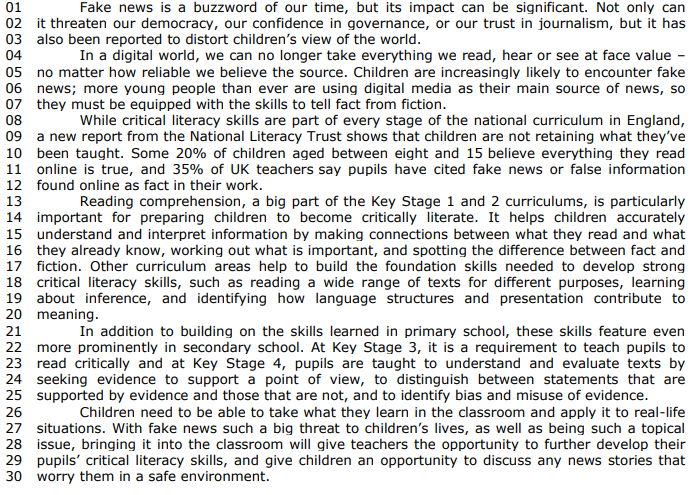
Adapted from https://www.theguardian.com/teacher-network/2017/oct/17/fake-news-improved-criticalliteracy-skills-teaching-young-people
Instruction: Answer question based on the following text.
Fake news: improved critical literacy skills are key to telling fact from fiction
Adapted from https://www.theguardian.com/teacher-network/2017/oct/17/fake-news-improved-criticalliteracy-skills-teaching-young-people
Instruction: Answer question based on the following text.
Fake news: improved critical literacy skills are key to telling fact from fiction
Adapted from https://www.theguardian.com/teacher-network/2017/oct/17/fake-news-improved-criticalliteracy-skills-teaching-young-people
Instruction: Answer question based on the following text.
Fake news: improved critical literacy skills are key to telling fact from fiction
Adapted from https://www.theguardian.com/teacher-network/2017/oct/17/fake-news-improved-criticalliteracy-skills-teaching-young-people
Instruction: Answer question based on the following text.
Fake news: improved critical literacy skills are key to telling fact from fiction
Adapted from https://www.theguardian.com/teacher-network/2017/oct/17/fake-news-improved-criticalliteracy-skills-teaching-young-people
Instruction: Answer question based on the following text.
Fake news: improved critical literacy skills are key to telling fact from fiction
Adapted from https://www.theguardian.com/teacher-network/2017/oct/17/fake-news-improved-criticalliteracy-skills-teaching-young-people
Instruction: Answer question based on the following text.
Fake news: improved critical literacy skills are key to telling fact from fiction
Adapted from https://www.theguardian.com/teacher-network/2017/oct/17/fake-news-improved-criticalliteracy-skills-teaching-young-people
( ) Teachers are worried because students are citing false information found online as fact in their work. ( ) Students have problems, and do not memorize what they learn. ( ) Reading comprehension is key to develop students’ critical literacy.
From the top to the bottom, the parentheses are correctly filled with:
De acordo com o autor, portanto, é FALSO afirmar:
Dear Mr. Thompson,
We would be grateful if you could send us the report from /ast month.
Yours sincere/y, Joe Peterson Human Resource Manager
Based on the message above and the given context, analyse the way(s) which can be used to reply to a request such as Joe Peterson's request.
l. "As you requested ... ". II. "As promised ... ". III. "ln answer to your enquiry ... ".
The correct ways(s) is(are):
A perfect office - Career in Office Administration
No office would be able to function effectively with the structural backbone - the administrative staff.
Sector overview
Technology can make the various jobs easier, but the fact remains, that there needs to be a person to run the technology effectively. The job in question here is one that you watch happening in every office in every city or town in every country. Whichever office you go to, one thing is common. Virtually every business needs office support personnel. This is needed and is not likely to change anytime soon. Many small businesses started out by working without support staff (admin or assistants), but with expansion, they had to give in and hire.
lt is understandable that when dealing with the employees internally and in dealing with other business parties externally, businesses need the services of such personnel, apart from the day-to-day office administration functions. Whatever the number of people working in the administrative capacity in an office, the role could mean looking after severa! functions. lt could all include handling the telephone, dealing with difficult phone calls from customers or other parties, handling challenging clients,maintaining reports, accounting for petty cash, mail management, banking work, and so on.
ln fact in severa! companies and professions, a trusted administrative assistant is looked upon as a confidant. Many managers prefer assistants who know everything about them, about their lives and especially about their style of work. There is something deeply comforting about having everything in office run smoothly, and meetings happening on time, with the correct coffee and snacks. And for that, you need personnel!
To getthere
Since a formal education may not be necessary to get a job, there is no single route to becoming an administrative assistant. There are severa! ways in which one can go about it. lt often happens that people get a job, and learn on it and develop expertise while working. Even then , there are certain soft and behavioural skills, apart from technical skills that assistants are supposed to have.
Aspirants should ideally think of taking a professional course, since the curriculum is designed to look into particular job descriptions and so training will be offered in those areas. This training provides an upper hand in many cases in terms of getting a good job. ln either case, the skills are essential. When hiring office support personnel, many companies look for employees with a combination of the types of technical skills that are needed in the particular job as well as a positive attitude and strong communication skills. With technology now ruling the roost, most positions look for personnel who not only display the soft skills to work on the job, but also have a fair knowledge of operating computers and the required software on them. Often, before recruitment, companies ask applicants to take severa! tests to gauge their abilities in handling the tasks that lie ahead.
( ... )
Whatever the designation or the title, the person in charge of office administration (management) carries a lot of responsibility. The diverse duties comprise those that must be performed on a daily basis, and some that need to be handled on a case-to-case basis. The role may vary with the business and the size of the office, but the primary duty is to ensure that the daily running of the office is smooth. Among other things, the office administrator is responsible for collecting and sending out mai l, for directing the calls to the appropriate offices or extensions, and making sure that the documentation is in place.
These job prospects are usually high for those who are qualified, since offices will always need administrative personnel, and with expansion, they tend to take on more and more people. Openings can be found at departments and offices in the public as well as private sectors, no matter the industry. A variety of positions are available depending upon the work and the kind of hours to be put in. Usually, the aftice administrators and assistants have fixed hour jobs. It is a good option for those looking for a little flexibility, or even a single shift, and they should be able to work something out with employers.
Salaries vary like night and day. They depend heavily on the size of the organization, the duties involved, the tasks assigned and most importantly, the experience the person has.
Available in: http://www.freepressjournal.in/education/a-
perfect-office-career-in-office-administration/656443. Adapted.
According to the text, analyse the assertions below.
I. Due to the technology, many companies do not call for office support personnel.
II . ln many companies, a reliable administrative assistant can be taken as a person you can share feelings and secrets.
IlI. The one and only responsibility that the office administrator carries is sending and receiving mails.
The correct assertion(s) is(are):
Read the statement and answer.
“Susan’s wife passed away one year ago.”
We can say that

Counting carnivores is a tricky business. Individual identification is a tremendous challenge and requires highresolution cameras or good, unobstructed views in person. They are often shy and cover large distances. Lions are difficult to count even though they are social and sleep most of the day. Only a very few lion populations are known at the individual level, such as Liuwa Plains National Park, Zambia. Individual recognition of every lion in an area requires intense study, significant resources, and low numbers of individuals. Therefore, researchers use a variety of other imperfect techniques to estimate lion population size in all other lion areas. Some more common estimation techniques include spoor tracking or call-up surveys.
The drastic reduction in lion numbers and habitat highlighted by our research is certainly alarming from a conservation standpoint. Yet, African lions are not in immediate danger of extinction. Substantial lion populations exist in large, well-protected areas such as the Serengeti or Kruger ecosystem. Many of the remaining lion populations in East or Southern Africa are in well-protected areas such as national parks and game reserves (although some of these allow hunting). Nevertheless, this should not be used as a blanket statement; there are populations and even countries in these regions that have few or no lions remaining. Overall, lions in West and Central Africa are in the gravest danger of extinction. More than half of the populations vital to lion conservation in these regions (as noted by the IUCN) have been extirpated in the past five years, with several countries losing their lions entirely. According to our research, fewer than 500 lions remain in West Africa, scattered across eight isolated sites. This is of serious concern as these populations contain the most genetically unique lions in all of Africa and are most closely related to the Asiatic lion.
You cannot protect what you do not know you have. This is a simple but true adage. Our compilation needed to occur in order to prioritize areas for conservation action. With a good map, numbers, and some understanding of connectivity between the lion areas, we now know which populations are threatened with extinction or conversely, which are well connected and well protected.

 Conheça nossos planos