Questões de Concurso Sobre interpretação de texto | reading comprehension em inglês

Foram encontradas 12.997 questões

Q2383968 Inglês
Texto 5


What are some microlearning resources that can enhance
your teaching practice?


Powered by AI and the LinkedIn community


Microlearning is a teaching strategy that involves delivering short and focused lessons or activities that target specific learning outcomes. It can help you engage your learners, reinforce key concepts, and enhance retention and transfer of knowledge. In this article, you will discover some microlearning resources that can support your teaching practice and align with various pedagogical theories.


Why microlearning?
Microlearning is not a new concept, but it has become more popular in recent years due to the increasing use of technology and the changing needs and preferences of learners. This type of learning can provide a variety of benefits for both teachers and learners. For example, it can reduce cognitive load and increase attention span by breaking down complex topics into smaller pieces. Additionally, microlearning is convenient and flexible, allowing learners to access content anytime and anywhere. Furthermore, it supports personalized and selfdirected learning by enabling learners to choose their own pace and path. Moreover, it can enhance motivation and engagement by using interactive and multimedia elements. Finally, it can improve retention and application by reinforcing and reviewing essential information and skills.


Disponível em: <https://www.linkedin.com/advice/1/what-some-microlearningresources-can-enhance-your-teaching>. Acesso em: 19 dez. 2023. [Adaptado].

De acordo com o primeiro parágrafo do texto, de que forma o microlearning pode auxiliar no processo de ensino?
Alternativas
Q2383638 Inglês

Text 18A3-I 


    The roar of a waterfall suggests the power of water. Rampaging floodwaters can uproot strong trees and twist railroad tracks. When the power of water is harnessed, however, it can do useful work for humans. 


    Since ancient times, people have put the energy in the flow of water to work. They first made water work for them with the waterwheel, a wheel with paddles around its rim. Flowing water rotated the waterwheel, which in turn ran machinery that was linked to it. Today, new kinds of waterwheels — turbines — spin generators that produce electricity. Electricity from water-turned generators is known as hydroelectricity. 


    By building a dam across a river, the natural upstream water level is elevated and a difference in head is created that can be used to drive turbines and generate electricity. A large upstream reservoir may balance seasonal water flow; rain or melted snow can be stored in the reservoir during the wet season to provide electricity during dry seasons. 


    Waterpower is distributed unevenly among the continents and nations of the world. Europe and North America have developed much of their waterpower. Asia, South America, and Africa have abundant waterpower potential, but while countries such as China and Brazil have become leading hydroelectric producers, much of the waterpower resource on those continents remains undeveloped. 


Elizabeth Lachner. Hydroelectricity. Rosen Publishing Group, 2018 (adapted). 

The expression “The roar of a waterfall” (first sentence of text 18A3-I), is more closely related to the sense of 
Alternativas
Q2383531 Inglês

Text 18A3-I 


    The roar of a waterfall suggests the power of water. Rampaging floodwaters can uproot strong trees and twist railroad tracks. When the power of water is harnessed, however, it can do useful work for humans. 

     Since ancient times, people have put the energy in the flow of water to work. They first made water work for them with the waterwheel, a wheel with paddles around its rim. Flowing water rotated the waterwheel, which in turn ran machinery that was linked to it. Today, new kinds of waterwheels – turbines – spin generators that produce electricity. Electricity from waterturned generators is known as hydroelectricity. 

     By building a dam across a river, the natural upstream water level is elevated and a difference in head is created that can be used to drive turbines and generate electricity. A large upstream reservoir may balance seasonal water flow; rain or melted snow can be stored in the reservoir during the wet season to provide electricity during dry seasons. 

    Waterpower is distributed unevenly among the continents and nations of the world. Europe and North America have developed much of their waterpower. Asia, South America, and Africa have abundant waterpower potential, but while countries such as China and Brazil have become leading hydroelectric producers, much of the waterpower resource on those continents remains undeveloped. 


Elizabeth Lachner. Hydroelectricity. Rosen Publishing Group, 2018 (adapted). 

In the first paragraph of text 18A3-I, the expression which best suggests an image of the power of man over rivers is 
Alternativas
Q2383530 Inglês

Text 18A3-I 


    The roar of a waterfall suggests the power of water. Rampaging floodwaters can uproot strong trees and twist railroad tracks. When the power of water is harnessed, however, it can do useful work for humans. 

     Since ancient times, people have put the energy in the flow of water to work. They first made water work for them with the waterwheel, a wheel with paddles around its rim. Flowing water rotated the waterwheel, which in turn ran machinery that was linked to it. Today, new kinds of waterwheels – turbines – spin generators that produce electricity. Electricity from waterturned generators is known as hydroelectricity. 

     By building a dam across a river, the natural upstream water level is elevated and a difference in head is created that can be used to drive turbines and generate electricity. A large upstream reservoir may balance seasonal water flow; rain or melted snow can be stored in the reservoir during the wet season to provide electricity during dry seasons. 

    Waterpower is distributed unevenly among the continents and nations of the world. Europe and North America have developed much of their waterpower. Asia, South America, and Africa have abundant waterpower potential, but while countries such as China and Brazil have become leading hydroelectric producers, much of the waterpower resource on those continents remains undeveloped. 


Elizabeth Lachner. Hydroelectricity. Rosen Publishing Group, 2018 (adapted). 

Based on the fragment “much of the waterpower resource on those continents remains undeveloped” (last sentence of text 18A3), it can be concluded that 
Alternativas
Q2383502 Inglês
Text 3A4


      During the last century water infrastructure projects involving large dams played a major role in the socio-economic transformation of many countries. At the same time, in a significant number of cases the benefits were not shared equitably, and the negative impacts on the environmental and sociocultural structures were excessive. In some cases their economic performance was questionable. Diverging views have arisen on the merits and demerits of dams, the roles they play, and their alternatives in providing water and energy services. However, recognition that such roles are complementary rather than mutually exclusive has been growing as the dam debate has moved forward.

      It is envisaged that, as part of the global effort to improve water and energy supplies, more dams will be constructed, especially in developing countries, alongside other diverse alternatives. There will, consequently, be a need to enhance the benefits of dams and avoid many of their drawbacks by applying better decision-making processes within the overall framework of sustainability. There are complex issues around the planning and management of dams in the context of sustainable development which will need to be adequately considered and addressed to achieve sustainable outcomes.

      Dealing with the environmental and social challenges within the context of meeting water and energy needs is at the heart of the sustainability of projects involving dams. Dams are one of the options, structural or non-structural, available to meet specific water or energy needs. In many cases water and energy services are best provided through a mix of options. Each case is different. A decision to build a dam should emerge after a comprehensive assessment of the full range of available options, giving appropriate consideration to all aspects of sustainability.


 United Nations Environmental Programme. Dams and Development: Relevant Practices for Improved

Decision-making. Nairobi: The Secretariat of the Dams and Development Project, 2007. p. 10-1 (adapted).

In the second sentence of the second paragraph of text 3A4, the word “drawbacks” has a similar meaning to and can be correctly replaced with
Alternativas
Q2383499 Inglês
Text 3A4


      During the last century water infrastructure projects involving large dams played a major role in the socio-economic transformation of many countries. At the same time, in a significant number of cases the benefits were not shared equitably, and the negative impacts on the environmental and sociocultural structures were excessive. In some cases their economic performance was questionable. Diverging views have arisen on the merits and demerits of dams, the roles they play, and their alternatives in providing water and energy services. However, recognition that such roles are complementary rather than mutually exclusive has been growing as the dam debate has moved forward.

      It is envisaged that, as part of the global effort to improve water and energy supplies, more dams will be constructed, especially in developing countries, alongside other diverse alternatives. There will, consequently, be a need to enhance the benefits of dams and avoid many of their drawbacks by applying better decision-making processes within the overall framework of sustainability. There are complex issues around the planning and management of dams in the context of sustainable development which will need to be adequately considered and addressed to achieve sustainable outcomes.

      Dealing with the environmental and social challenges within the context of meeting water and energy needs is at the heart of the sustainability of projects involving dams. Dams are one of the options, structural or non-structural, available to meet specific water or energy needs. In many cases water and energy services are best provided through a mix of options. Each case is different. A decision to build a dam should emerge after a comprehensive assessment of the full range of available options, giving appropriate consideration to all aspects of sustainability.


 United Nations Environmental Programme. Dams and Development: Relevant Practices for Improved

Decision-making. Nairobi: The Secretariat of the Dams and Development Project, 2007. p. 10-1 (adapted).

Choose the correct option according to text 3A4. 
Alternativas
Q2382891 Inglês

Text 22A4-II 


      Over the past few years, Peruvian authorities have tried to find ways to manage increasing visitor numbers to the popular site which often had long lines and overcrowding, leaving many tourists unable to enter. Machu Picchu was awarded UNESCO World Heritage status in 1983 and is described by the awarding body as probably the most amazing urban creation of the Inca Empire at its height. It added its giant walls, terraces, and ramps “seem as if they have been cut naturally” into the continuous rock escarpments. The citadel, 130 km from Cusco, was built in the 15th as a religious sanctuary for the Incas at an altitude of 2,490 meters. 


      However, UNESCO also highlighted the challenges faced by the site, which it says requires more stringent management. “Tourism itself represents a double-edged sword by providing economic benefits but also by resulting in major cultural and ecological impacts,” said UNESCO. “The strongly increasing number of visitors to the historic sanctuary of Machu Picchu must be matched by an adequate management regulating access, diversifying the offer, and efforts to fully understand and minimize impacts. A larger appropriate and increasing share of the significant tourism revenues could be reinvested in planning and management.”. 


Internet: <https://www.thenationalnews.com> (adapted).

In text 22A4-II, UNESCO affirms that, due to tourism, Machu Picchu has been facing 
Alternativas
Q2382890 Inglês

Text 22A4-I 


        Tourism cannot be treated in isolation since it embodies all tourism practices in the system they operate in. Thus, tourism is a complex sociocultural, economic, and political phenomenon that touches all levels of society. The investigation of tourism’s role in society, the tourism system’s effects on nature, tourism spaces, objects, practices, relationships, and tourist typologies demand systematic sociological investigations. It is important to consider the whole macro system through its members’ social, political, cultural, and economic interactions. In such a social context, both human and nonhuman actors continuously shape and reshape the tourism system, and the tourism system reshapes these actors’ values, attitudes, and behaviors. 


        Researchers examining the sociology of tourism departed from several theoretical perspectives, blended theory and method, and focused on sociological concepts to understand and explain the different aspects of tourism. This group of scholars has been working within the several cores of sociology (like education, family, economy, development, religion, gender, language, migration, social inequalities, labor, and art) and at the margins of emerging interdisciplinary formations, including those crossing many disciplines such as geography, anthropology, economics, political science, psychology, marketing, communication, women’s studies, history, and cultural studies. The sociology of tourism studies engendered transdisciplinary conversations both in academia and in practice, and the results of these studies have created pragmatic changes in tourism practices, habits, and governance. 


Internet: <https://www.oxfordbibliographies.com> (adapted). 

Based on text 22A4-I, it is correct to affirm that the sociology of tourism impacted tourism practices, habits, and governance because 
Alternativas
Q2382889 Inglês

Text 22A4-I 


        Tourism cannot be treated in isolation since it embodies all tourism practices in the system they operate in. Thus, tourism is a complex sociocultural, economic, and political phenomenon that touches all levels of society. The investigation of tourism’s role in society, the tourism system’s effects on nature, tourism spaces, objects, practices, relationships, and tourist typologies demand systematic sociological investigations. It is important to consider the whole macro system through its members’ social, political, cultural, and economic interactions. In such a social context, both human and nonhuman actors continuously shape and reshape the tourism system, and the tourism system reshapes these actors’ values, attitudes, and behaviors. 


        Researchers examining the sociology of tourism departed from several theoretical perspectives, blended theory and method, and focused on sociological concepts to understand and explain the different aspects of tourism. This group of scholars has been working within the several cores of sociology (like education, family, economy, development, religion, gender, language, migration, social inequalities, labor, and art) and at the margins of emerging interdisciplinary formations, including those crossing many disciplines such as geography, anthropology, economics, political science, psychology, marketing, communication, women’s studies, history, and cultural studies. The sociology of tourism studies engendered transdisciplinary conversations both in academia and in practice, and the results of these studies have created pragmatic changes in tourism practices, habits, and governance. 


Internet: <https://www.oxfordbibliographies.com> (adapted). 

According to text 22A4-I, what characterizes the approach of researchers examining the sociology of tourism is 
Alternativas
Q2382888 Inglês

Text 22A4-I 


        Tourism cannot be treated in isolation since it embodies all tourism practices in the system they operate in. Thus, tourism is a complex sociocultural, economic, and political phenomenon that touches all levels of society. The investigation of tourism’s role in society, the tourism system’s effects on nature, tourism spaces, objects, practices, relationships, and tourist typologies demand systematic sociological investigations. It is important to consider the whole macro system through its members’ social, political, cultural, and economic interactions. In such a social context, both human and nonhuman actors continuously shape and reshape the tourism system, and the tourism system reshapes these actors’ values, attitudes, and behaviors. 


        Researchers examining the sociology of tourism departed from several theoretical perspectives, blended theory and method, and focused on sociological concepts to understand and explain the different aspects of tourism. This group of scholars has been working within the several cores of sociology (like education, family, economy, development, religion, gender, language, migration, social inequalities, labor, and art) and at the margins of emerging interdisciplinary formations, including those crossing many disciplines such as geography, anthropology, economics, political science, psychology, marketing, communication, women’s studies, history, and cultural studies. The sociology of tourism studies engendered transdisciplinary conversations both in academia and in practice, and the results of these studies have created pragmatic changes in tourism practices, habits, and governance. 


Internet: <https://www.oxfordbibliographies.com> (adapted). 

According to text 22A4-I, the sociology of tourism primarily investigates 
Alternativas
Q2382862 Inglês

Text 19A4-II 


        Photo exhibitions are great opportunities for excited and ambitious photographers to showcase their work beyond just the safety of their friends and family. They’re also a stellar opportunity to develop a thicker skin, as your work will be subject to critique, but that’s all part of the territory that comes with getting more exposure as a photographer, which is what all artists should strive for. Beyond that, they’re a great way to advertise yourself as a photographer, both your talents and your availability. Think of it almost as the artist’s equivalent to having a booth at a trade show when you’re selling a product. 


        First-timers to an exhibition will likely find themselves a bit unsure of what to do and somewhat nervous. Here’s a series of surefire tips to make any exhibition a success. Before you do anything else, it’s imperative that you make up your mind about what you’ll be showcasing at your exhibition. You only have two choices, when you think about it: brand-new work that you’ll shoot especially for the exhibition or archival stuff that you’ll just pull out for the exhibition. Also, being creative when finding the exhibition location is as important as the showcase itself. 


Internet: <https://contrastly.com> (adapted). 

According to text 19A4-II, choose the correct option. 
Alternativas
Q2382861 Inglês

Text 19A4-II 


        Photo exhibitions are great opportunities for excited and ambitious photographers to showcase their work beyond just the safety of their friends and family. They’re also a stellar opportunity to develop a thicker skin, as your work will be subject to critique, but that’s all part of the territory that comes with getting more exposure as a photographer, which is what all artists should strive for. Beyond that, they’re a great way to advertise yourself as a photographer, both your talents and your availability. Think of it almost as the artist’s equivalent to having a booth at a trade show when you’re selling a product. 


        First-timers to an exhibition will likely find themselves a bit unsure of what to do and somewhat nervous. Here’s a series of surefire tips to make any exhibition a success. Before you do anything else, it’s imperative that you make up your mind about what you’ll be showcasing at your exhibition. You only have two choices, when you think about it: brand-new work that you’ll shoot especially for the exhibition or archival stuff that you’ll just pull out for the exhibition. Also, being creative when finding the exhibition location is as important as the showcase itself. 


Internet: <https://contrastly.com> (adapted). 

In text 19A4-II, the word “likely” (first sentence of the second paragraph) conveys the idea of 
Alternativas
Q2382860 Inglês

Text 19A4-I 


        It is a universal fact that cinema is a visual medium. Films have the power to overwhelm our senses as well as our minds, subjecting us to a variety of experiences that can range from the sublime to the devastating. Colours play a crucial role in this interesting phenomenon, forming an integral part of the composition of each frame and dictating how the viewer perceives the spectacle on the screen. Apart from the cinematic medium, colours have always been a part of our experience and how we make sense of the vastly nuanced world around us. Although science has definitively explained what colours are in terms of light, they have always mystified artists and philosophers like Arthur Schopenhauer and Ludwig Wittgenstein, who tried to understand their importance in anthropological frameworks. 


        More notably, the famous German poet and artist Johann Wolfgang von Goethe published a seminal exploration of colours in his 1810 work Theory of Colours. In it, he examined how each colour corresponds to various psychological states in the minds of human beings. He wrote, “Light and darkness, brightness and obscurity, or if a more general expression is preferred, light and its absence, are necessary to the production of colour… Colour itself is a degree of darkness.” Goethe’s theories might seem baselessly romantic in the 21st century but the underlying ideas have been implemented by filmmakers and cinematographers to curate the voyeuristic experiences of their audiences. Famed cinematographer Vittorio Storaro has based his artistic vision on Goethe’s work, insisting that colours do have a direct connection to the mind of the viewer. 


Internet: <https://faroutmagazine.co.uk> (adapted).

Maintaining the original meaning of text 19A4-I, the excerpt “Vittorio Storaro has based his artistic vision on Goethe’s work”, in the last sentence of the last paragraph, can be correctly rephrased as 
Alternativas
Q2382859 Inglês

Text 19A4-I 


        It is a universal fact that cinema is a visual medium. Films have the power to overwhelm our senses as well as our minds, subjecting us to a variety of experiences that can range from the sublime to the devastating. Colours play a crucial role in this interesting phenomenon, forming an integral part of the composition of each frame and dictating how the viewer perceives the spectacle on the screen. Apart from the cinematic medium, colours have always been a part of our experience and how we make sense of the vastly nuanced world around us. Although science has definitively explained what colours are in terms of light, they have always mystified artists and philosophers like Arthur Schopenhauer and Ludwig Wittgenstein, who tried to understand their importance in anthropological frameworks. 


        More notably, the famous German poet and artist Johann Wolfgang von Goethe published a seminal exploration of colours in his 1810 work Theory of Colours. In it, he examined how each colour corresponds to various psychological states in the minds of human beings. He wrote, “Light and darkness, brightness and obscurity, or if a more general expression is preferred, light and its absence, are necessary to the production of colour… Colour itself is a degree of darkness.” Goethe’s theories might seem baselessly romantic in the 21st century but the underlying ideas have been implemented by filmmakers and cinematographers to curate the voyeuristic experiences of their audiences. Famed cinematographer Vittorio Storaro has based his artistic vision on Goethe’s work, insisting that colours do have a direct connection to the mind of the viewer. 


Internet: <https://faroutmagazine.co.uk> (adapted).

Based on text 19A4-I, choose the option that correctly presents Goethe’s description of the relationship between light, darkness, and colour. 
Alternativas
Q2382858 Inglês

Text 19A4-I 


        It is a universal fact that cinema is a visual medium. Films have the power to overwhelm our senses as well as our minds, subjecting us to a variety of experiences that can range from the sublime to the devastating. Colours play a crucial role in this interesting phenomenon, forming an integral part of the composition of each frame and dictating how the viewer perceives the spectacle on the screen. Apart from the cinematic medium, colours have always been a part of our experience and how we make sense of the vastly nuanced world around us. Although science has definitively explained what colours are in terms of light, they have always mystified artists and philosophers like Arthur Schopenhauer and Ludwig Wittgenstein, who tried to understand their importance in anthropological frameworks. 


        More notably, the famous German poet and artist Johann Wolfgang von Goethe published a seminal exploration of colours in his 1810 work Theory of Colours. In it, he examined how each colour corresponds to various psychological states in the minds of human beings. He wrote, “Light and darkness, brightness and obscurity, or if a more general expression is preferred, light and its absence, are necessary to the production of colour… Colour itself is a degree of darkness.” Goethe’s theories might seem baselessly romantic in the 21st century but the underlying ideas have been implemented by filmmakers and cinematographers to curate the voyeuristic experiences of their audiences. Famed cinematographer Vittorio Storaro has based his artistic vision on Goethe’s work, insisting that colours do have a direct connection to the mind of the viewer. 


Internet: <https://faroutmagazine.co.uk> (adapted).

According to text 19A4-I, filmmakers and cinematographers implement Johann Wolfgang von Goethe’s theories on colours 
Alternativas
Q2380309 Inglês
Text I

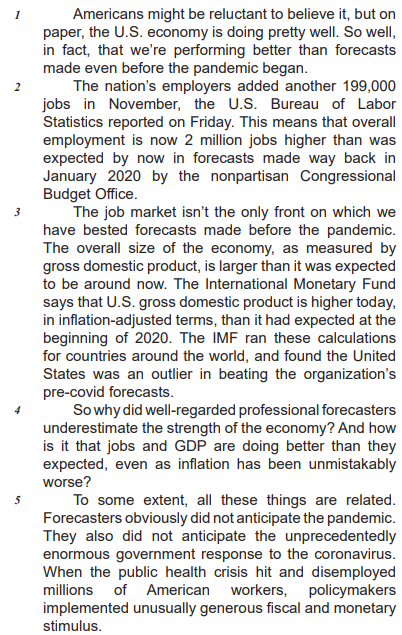
How good is the U.S. economy? It’s beating pre-pandemic predictions.


Available at: https://www.washingtonpost.com/opinions/
2023/12/08/jobs-report-economy-beats-pandemic
predictions/. Retrieved on: Dec. 12, 2023. Adapted.
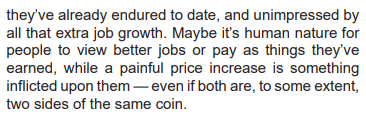
In the sentence “Maybe it’s human nature for people to view better jobs or pay as things they’ve earned, while a painful price increase is something inflicted upon them — even if both are, to some extent, two sides of the same coin.” (Text I, paragraph 7), the word both refers to  
Alternativas
Q2380306 Inglês
Text I

How good is the U.S. economy? It’s beating pre-pandemic predictions.


Available at: https://www.washingtonpost.com/opinions/
2023/12/08/jobs-report-economy-beats-pandemic
predictions/. Retrieved on: Dec. 12, 2023. Adapted.
In Text I, in paragraph 4, one of the questions is “why did well-regarded professional forecasters underestimate the strength of the economy?”.
The expression well-regarded professional forecasters can be rewritten, with no change in meaning, as

Alternativas
Q2380305 Inglês
Text I

How good is the U.S. economy? It’s beating pre-pandemic predictions.


Available at: https://www.washingtonpost.com/opinions/
2023/12/08/jobs-report-economy-beats-pandemic
predictions/. Retrieved on: Dec. 12, 2023. Adapted.
According to Text I, 
Alternativas
Q2372855 Inglês
In the image below, the source of humor is built on the usage of English, as well as on its lexical wealth because.

                                                      Imagem associada para resolução da questão
                                                                 (Disponible in: https://br.pinterest.com)
Alternativas
Q2372854 Inglês

Analyse the set of sentences to indicate the option that does NOT fit them. 


1. Not only did they arrive late but they talked throughout the film.


2. Rarely do we find such talent.


3. Never have I been so happy to see someone.


4. Barely had she got back in bed when her alarm went off.


5. Seldom has she taken a day off work.


6. No sooner had the game started than the captain was taken ill.


7. Only later did they discover they hadn't been told the truth.


8. Under no circumstances should children travel without an adult


9. Little do people realise how hard it is to be a chef.


10. In no way did we agree to this.

Alternativas
Respostas
3821: C
3822: B
3823: B
3824: E
3825: B
3826: D
3827: C
3828: E
3829: A
3830: E
3831: C
3832: E
3833: B
3834: B
3835: D
3836: E
3837: A
3838: D
3839: A
3840: C