Questões de Concurso
Sobre interpretação de texto | reading comprehension em inglês
Foram encontradas 12.687 questões


Judge the item below according to the text.
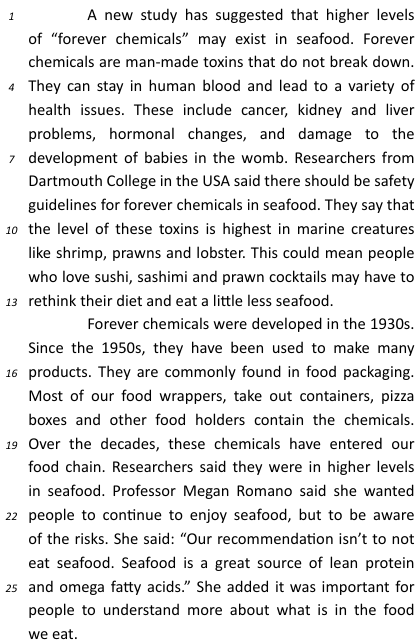
In the sentence “People who love sushi, sashimi and prawn cocktails may have to rethink their diet.” the word “may” expresses possibility.
Judge the item below according to the text.
The researchers recommend completely avoiding seafood due to the presence of forever chemicals.
Judge the item below according to the text.
In the sentence “Researchers said they were in higher levels in seafood,” the pronoun “they” refers to seafood.
Judge the item below according to the text.
Forever chemicals are natural toxins found in the environment, they do not pose long-term risks.
Based on the information provided in the text and your knowledge of English grammar, judge the item below.
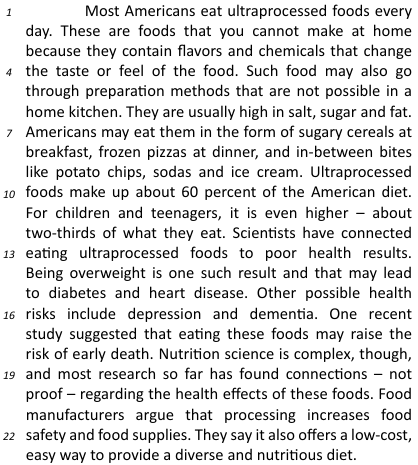
The sentence “These are foods that you cannot make at home” can be rewritten as These are foods which you cannot make at home without changing the meaning.
Based on the information provided in the text and your knowledge of English grammar, judge the item below.
The word “because” in the sentence “because they contain flavors and chemicals” is used to express contrast.
Based on the information provided in the text and your knowledge of English grammar, judge the item below.
The text suggests that eating ultraprocessed foods has been linked to negative health outcomes, such as being overweight and potential risks of diabetes and heart disease.
Based on the information provided in the text and your knowledge of English grammar, judge the item below.
Frozen pizzas and sugary cereals are examples of ultraprocessed foods that Americans often consume. When it comes to children and teenagers, ultraprocessed foods account for a smaller proportion of their diet compared to adults.
Based on the information provided in the text and your knowledge of English grammar, judge the item below.
The text states that ultraprocessed foods are only high in sugar, making them a primary concern for people with diabetes.
Based on the information provided in the text and your knowledge of English grammar, judge the item below.
Ultraprocessed foods contain ingredients like flavors and chemicals that are not commonly found in home kitchens.
Magi Richani is the founder of San Francisco-based Nobell Foods, a startup company developing a new kind of cheese made from soybeans. She says plant-based cheese not only accommodates people who can’t consume dairy, but it also could be key to more sustainable food production worldwide. “The reality is that when you raise an animal for food, it’s not just the animals, you are actually growing crops, you are clearing land, and you’re raising the animal for years so it builds biomass,” Richani explained. “It’s an extremely inefficient supply chain.”
Nobell is particularly focused on creating plant-based casein, which is a protein produced when a cow gives birth and is present in the milk for its offspring. It is the ingredient that gives dairy cheese its unique stretchy texture. If Nobell is able to go to market and have the kind of impact it’s hoping to, then plant-based cheese could help us stretch toward a more sustainable future.
Internet: <newsweek.com> (adapted).
Based on the ideas presented in the previous text as well as its linguistic aspects, judge the following item.
Magi Richani affirms that the motivation to seek the production of plant-based cheese is twofold.
Magi Richani is the founder of San Francisco-based Nobell Foods, a startup company developing a new kind of cheese made from soybeans. She says plant-based cheese not only accommodates people who can’t consume dairy, but it also could be key to more sustainable food production worldwide. “The reality is that when you raise an animal for food, it’s not just the animals, you are actually growing crops, you are clearing land, and you’re raising the animal for years so it builds biomass,” Richani explained. “It’s an extremely inefficient supply chain.”
Nobell is particularly focused on creating plant-based casein, which is a protein produced when a cow gives birth and is present in the milk for its offspring. It is the ingredient that gives dairy cheese its unique stretchy texture. If Nobell is able to go to market and have the kind of impact it’s hoping to, then plant-based cheese could help us stretch toward a more sustainable future.
Internet: <newsweek.com> (adapted).
Based on the ideas presented in the previous text as well as its linguistic aspects, judge the following item.
According to the text, Nobell Foods works to implement a more efficient supply chain for the production of dairy cheese.
When a person (or team or firm or government) decides how to act in dealings with other people (or teams or firms or governments), there must be some cross-effect of their actions; what one does must affect the outcome for the other. For the interaction to become a strategic game, however, we need the participants’ mutual awareness of this cross-effect. What the other person does affects you; if you know this, you can react to his actions, or take advance actions to forestall the bad effects his future actions may have on you and to facilitate any good effects, or even take advance actions so as to alter his future reactions to your advantage. If you know that the other person knows that what you do affects him, you know that he will be taking similar actions. And so on. It is this mutual awareness of the cross-effects of actions and the actions taken as a result of this awareness that constitute the most interesting aspects of strategy.
When each participant is significant in the interaction, either because each is a large player to start with or because commitments or private information narrow the scope of the relationship to a point where each is an important player within the relationship, we must think of the interaction as a strategic game. Such situations are the rule rather than the exception in business, in politics, and even in social interactions. Therefore, the study of strategic games forms an important part of all fields that analyze these matters.
Avinash Dixit et al. Games of strategy.
New York: W.W. Norton & Coadapted, 2015 (adapted).
Considering to the preceding text, judge the item that follow.
In the first sentence of the text, the phrase “what one does must affect the outcome for the other” functions as an explanation of the previous expression “cross-effect”.
When a person (or team or firm or government) decides how to act in dealings with other people (or teams or firms or governments), there must be some cross-effect of their actions; what one does must affect the outcome for the other. For the interaction to become a strategic game, however, we need the participants’ mutual awareness of this cross-effect. What the other person does affects you; if you know this, you can react to his actions, or take advance actions to forestall the bad effects his future actions may have on you and to facilitate any good effects, or even take advance actions so as to alter his future reactions to your advantage. If you know that the other person knows that what you do affects him, you know that he will be taking similar actions. And so on. It is this mutual awareness of the cross-effects of actions and the actions taken as a result of this awareness that constitute the most interesting aspects of strategy.
When each participant is significant in the interaction, either because each is a large player to start with or because commitments or private information narrow the scope of the relationship to a point where each is an important player within the relationship, we must think of the interaction as a strategic game. Such situations are the rule rather than the exception in business, in politics, and even in social interactions. Therefore, the study of strategic games forms an important part of all fields that analyze these matters.
Avinash Dixit et al. Games of strategy.
New York: W.W. Norton & Coadapted, 2015 (adapted).
Considering to the preceding text, judge the item that follow.
The text presents a field of study, called strategic games, that uses concepts derived from business and politics to analyze social interactions.
When a person (or team or firm or government) decides how to act in dealings with other people (or teams or firms or governments), there must be some cross-effect of their actions; what one does must affect the outcome for the other. For the interaction to become a strategic game, however, we need the participants’ mutual awareness of this cross-effect. What the other person does affects you; if you know this, you can react to his actions, or take advance actions to forestall the bad effects his future actions may have on you and to facilitate any good effects, or even take advance actions so as to alter his future reactions to your advantage. If you know that the other person knows that what you do affects him, you know that he will be taking similar actions. And so on. It is this mutual awareness of the cross-effects of actions and the actions taken as a result of this awareness that constitute the most interesting aspects of strategy.
When each participant is significant in the interaction, either because each is a large player to start with or because commitments or private information narrow the scope of the relationship to a point where each is an important player within the relationship, we must think of the interaction as a strategic game. Such situations are the rule rather than the exception in business, in politics, and even in social interactions. Therefore, the study of strategic games forms an important part of all fields that analyze these matters.
Avinash Dixit et al. Games of strategy.
New York: W.W. Norton & Coadapted, 2015 (adapted).
Considering to the preceding text, judge the item that follow.
Is it correct to infer from the text’s information that in strategic games both parties must be large players since the beginning of the interaction.
The philosopher Jeremy Bentham was regarded as the founder of utilitarianism and a leading advocate of the separation of church and state, freedom of expression, and individual legal rights. Furthermore, the “panopticon” is a type of institutional building that has long dominated Bentham’s legacy. As a work of architecture, the panopticon allows a watchman in a central tower to observe occupants of surrounding cells without the occupants knowing whether or not they are being watched. As a metaphor, the panopticon was commandeered in the latter half of the 20th century as a way to trace the surveillance tendencies of disciplinarian societies. Is it still a useful way to think about surveillance today?
The French philosopher Michel Foucault used the idea of the panopticon as a way to illustrate the proclivity of disciplinary societies to subjugate its citizens. He describes the prisoner of a panopticon as being at the receiving end of asymmetrical surveillance: “He is seen, but he does not see.” As a consequence, the inmate polices himself for fear of punishment.
The parallels between the panopticon and surveillance cameras may be obvious, but what happens when you step into the world of digital surveillance and data capture? Unlike the panopticon, citizens don’t know they are being watched. Jake Goldenfein, from the University of Melbourne, tells me it’s important to remember the corrective purposes of Bentham’s panopticon when considering it as a metaphor for modern surveillance. “The relevance of the panopticon as a metaphor begins to wither when we start thinking about whether contemporary types of visuality are analogous to the central tower concept. For example, whether this type of visuality is as asymmetrical, and being co-opted for the same political exercise.” In the panopticon the occupants are constantly aware of the threat of being watched — this is the whole point — but state surveillance on the Internet is invisible; there is no looming tower, no dead-eye lens staring at you every time you enter a URL. There may not be a central tower, but there will be communicating sensors in our most intimate objects.
Internet: <theguardian.com> (adapted).
Based on the previous text, judge the following item.
According to the text, Jeremy Bentham prominently protested against the dissociation of religion from state institutions.
The philosopher Jeremy Bentham was regarded as the founder of utilitarianism and a leading advocate of the separation of church and state, freedom of expression, and individual legal rights. Furthermore, the “panopticon” is a type of institutional building that has long dominated Bentham’s legacy. As a work of architecture, the panopticon allows a watchman in a central tower to observe occupants of surrounding cells without the occupants knowing whether or not they are being watched. As a metaphor, the panopticon was commandeered in the latter half of the 20th century as a way to trace the surveillance tendencies of disciplinarian societies. Is it still a useful way to think about surveillance today?
The French philosopher Michel Foucault used the idea of the panopticon as a way to illustrate the proclivity of disciplinary societies to subjugate its citizens. He describes the prisoner of a panopticon as being at the receiving end of asymmetrical surveillance: “He is seen, but he does not see.” As a consequence, the inmate polices himself for fear of punishment.
The parallels between the panopticon and surveillance cameras may be obvious, but what happens when you step into the world of digital surveillance and data capture? Unlike the panopticon, citizens don’t know they are being watched. Jake Goldenfein, from the University of Melbourne, tells me it’s important to remember the corrective purposes of Bentham’s panopticon when considering it as a metaphor for modern surveillance. “The relevance of the panopticon as a metaphor begins to wither when we start thinking about whether contemporary types of visuality are analogous to the central tower concept. For example, whether this type of visuality is as asymmetrical, and being co-opted for the same political exercise.” In the panopticon the occupants are constantly aware of the threat of being watched — this is the whole point — but state surveillance on the Internet is invisible; there is no looming tower, no dead-eye lens staring at you every time you enter a URL. There may not be a central tower, but there will be communicating sensors in our most intimate objects.
Internet: <theguardian.com> (adapted).
Based on the previous text, judge the following item.
According to the researcher Jake Goldenfein, the fact that nowadays people know they are being watched by cameras is the aspect that lessens the panopticon effectiveness as a metaphor for contemporary surveillance.
The philosopher Jeremy Bentham was regarded as the founder of utilitarianism and a leading advocate of the separation of church and state, freedom of expression, and individual legal rights. Furthermore, the “panopticon” is a type of institutional building that has long dominated Bentham’s legacy. As a work of architecture, the panopticon allows a watchman in a central tower to observe occupants of surrounding cells without the occupants knowing whether or not they are being watched. As a metaphor, the panopticon was commandeered in the latter half of the 20th century as a way to trace the surveillance tendencies of disciplinarian societies. Is it still a useful way to think about surveillance today?
The French philosopher Michel Foucault used the idea of the panopticon as a way to illustrate the proclivity of disciplinary societies to subjugate its citizens. He describes the prisoner of a panopticon as being at the receiving end of asymmetrical surveillance: “He is seen, but he does not see.” As a consequence, the inmate polices himself for fear of punishment.
The parallels between the panopticon and surveillance cameras may be obvious, but what happens when you step into the world of digital surveillance and data capture? Unlike the panopticon, citizens don’t know they are being watched. Jake Goldenfein, from the University of Melbourne, tells me it’s important to remember the corrective purposes of Bentham’s panopticon when considering it as a metaphor for modern surveillance. “The relevance of the panopticon as a metaphor begins to wither when we start thinking about whether contemporary types of visuality are analogous to the central tower concept. For example, whether this type of visuality is as asymmetrical, and being co-opted for the same political exercise.” In the panopticon the occupants are constantly aware of the threat of being watched — this is the whole point — but state surveillance on the Internet is invisible; there is no looming tower, no dead-eye lens staring at you every time you enter a URL. There may not be a central tower, but there will be communicating sensors in our most intimate objects.
Internet: <theguardian.com> (adapted).
Based on the previous text, judge the following item.
The text informs that the prisoners of a panopticon know they are under surveillance, but they do not know the exact moments they are being watched.

 Conheça nossos planos