Questões de Concurso
Comentadas sobre interpretação de texto | reading comprehension em inglês
Foram encontradas 8.877 questões


Ano: 2009
Banca:
COSEAC
Órgão:
DATAPREV
Provas:
COSEAC - 2009 - DATAPREV - Analista de Tecnologia da Informação - Ambiente Operacional
|
COSEAC - 2009 - DATAPREV - Analista de Tecnologia da Informação - Banco de Dados |
COSEAC - 2009 - DATAPREV - Analista de Tecnologia da Informação - Desenvolvimento de Sistemas |
COSEAC - 2009 - DATAPREV - Analista de Tecnologia da Informação - Análise de Informações |
Q112897
Inglês
Texto associado
GadgetDesigners Push the Limits of Size, Safety
By Brian X. Chen, August 28, 2008
Just as small, fast-moving mammals replaced lumbering
dinosaurs, pocketable gadgets are evolving to fill niches that
larger, deskbound computers can't reach. But as they shrink,
these gadgets are faced with problems mammals face, too,
such as efficiently dissipating heat.
The recent example of Apple's first-generation iPod nanos
causing fires in Japan raises the question of whether
increasingly innovative product designs are impinging on
safety. The nano incident illustrates how risk can increase as
devices decrease in size, says Roger Kay, an analyst at
EndpointTechnologies.
"As [gadgets] get smaller, the tradeoffs become more difficult,
the balance becomes more critical and there's less room for
error," Kay said. "I'm not surprised it's happening to the nano
because that's the small one. You're asking it to do a lot in a
very, very small package and that's pushing the envelope.”
There's no question that industrial designers' jobs have
become much more difficult as the industry demands ever
more powerful and smaller gadgets. With paper-thin
subnotebooks, ultrasmall MP3 players, and pinkie finger-
sized Bluetooth headsets becoming increasingly popular, it's
questionable where exactly designers draw the line between
innovation and safety.
By Brian X. Chen, August 28, 2008
Just as small, fast-moving mammals replaced lumbering
dinosaurs, pocketable gadgets are evolving to fill niches that
larger, deskbound computers can't reach. But as they shrink,
these gadgets are faced with problems mammals face, too,
such as efficiently dissipating heat.
The recent example of Apple's first-generation iPod nanos
causing fires in Japan raises the question of whether
increasingly innovative product designs are impinging on
safety. The nano incident illustrates how risk can increase as
devices decrease in size, says Roger Kay, an analyst at
EndpointTechnologies.
"As [gadgets] get smaller, the tradeoffs become more difficult,
the balance becomes more critical and there's less room for
error," Kay said. "I'm not surprised it's happening to the nano
because that's the small one. You're asking it to do a lot in a
very, very small package and that's pushing the envelope.”
There's no question that industrial designers' jobs have
become much more difficult as the industry demands ever
more powerful and smaller gadgets. With paper-thin
subnotebooks, ultrasmall MP3 players, and pinkie finger-
sized Bluetooth headsets becoming increasingly popular, it's
questionable where exactly designers draw the line between
innovation and safety.
The title of the text let us know that there must be a close relation between…
Ano: 2009
Banca:
FUNIVERSA
Órgão:
SEPLAG-DF
Provas:
FUNIVERSA - 2009 - SEPLAG-DF - Analista - Planejamento e Orçamento
|
FUNIVERSA - 2009 - SEPLAG-DF - Analista - Tecnologia da Informação |
Q95224
Inglês
Texto associado
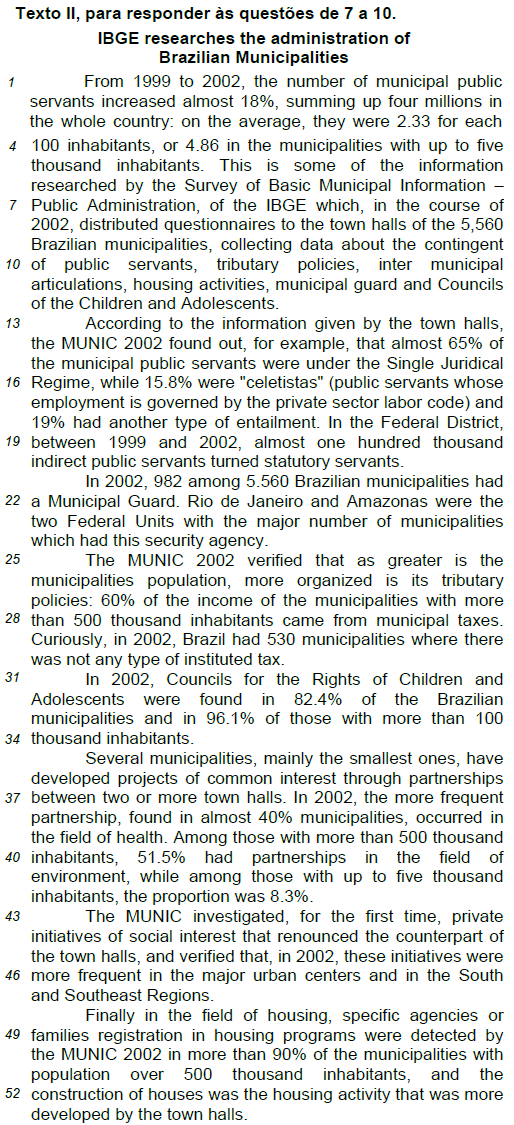
Internet: <http://www.ibge.gov.br/english/presidencia/noticias/noticia_impressao.php?id_noticia=345> (with adaptations).
According to the text II and your background knowledge, which alternative is not a possible definition to “tax”?
Ano: 2009
Banca:
FUNIVERSA
Órgão:
SEPLAG-DF
Provas:
FUNIVERSA - 2009 - SEPLAG-DF - Analista - Planejamento e Orçamento
|
FUNIVERSA - 2009 - SEPLAG-DF - Analista - Tecnologia da Informação |
Q95221
Inglês
Texto associado
Internet: <http://www.ibge.gov.br/english/presidencia/noticias/noticia_impressao.php?id_noticia=345> (with adaptations).
Based on the text II, mark the correct alternative.
Q95200
Inglês
Texto associado
We can help you save energy in the home…
There are lots of things you can do to save energy at home, from simple things like washing at 30 °C, saving water and
recycling, to insulating your loft and cavity walls. By saving energy you’ll be reducing your home’s carbon dioxide ( ) emissions
and helping to fight climate change.
Why should you save energy?
Over 40 per cent of the UK’s man-made emissions actually come from energy we use every day – at home and when
we travel. To generate that energy, we burn fossil fuels (coal, oil and gas) that produce ‘greenhouse’ gases – in particular –
–
which are changing our climate and damaging the environment.
The greenhouse effect
 and various other gases wrap the Earth in an invisible ‘blanket’, helping to prevent heat from escaping. Without this
greenhouse effect, the average temperature on Earth would be around -18 ºC, compared with the current average of around +15
ºC. This blanket of gases has remained at a constant concentration for many thousands of years. Since the Industrial Revolution
began around 200 years ago, people have been burning more fossil fuels. This has increased the heating effect of the ‘blanket’,
trapping more of the sun’s energy inside our atmosphere. In turn the Earth’s temperature has increased more rapidly in a shorter
period of time than it has for thousands of years.
The impact of climate change
People sometimes think that climate change will be a positive thing for the UK, giving us warmer summers and fewer cold
winters. But hotter summers and less rain in the south and east will mean water shortages, forest fires and damage to crops and
wildlife. In the north and west there could be much heavier rain and more flooding. As the polar ice caps continue to melt, rising sea
levels will threaten many coastal communities. Overall, the cost to society, the environment, our health and the economy is likely to
far outweigh any benefits.
Make a difference
The average UK household creates around six tonnes of every year – that’s 6,000 kg – to heat and power their home.
Making your home more energy efficient could save you up to £340 a year and reduce your home’s emissions by up to 1,500–
2,000 kg. You could save even more by switching to renewable energy sources, by walking, cycling or using public transport
whenever possible, and by driving more efficiently.
(Texto introdutório ao manual “A guide to energy saving in the home”, disponível em: http://www.energysavingtrust.org.uk/Resources/Publications.)
There are lots of things you can do to save energy at home, from simple things like washing at 30 °C, saving water and
recycling, to insulating your loft and cavity walls. By saving energy you’ll be reducing your home’s carbon dioxide (
) emissions and helping to fight climate change.
Why should you save energy?
Over 40 per cent of the UK’s man-made
emissions actually come from energy we use every day – at home and when we travel. To generate that energy, we burn fossil fuels (coal, oil and gas) that produce ‘greenhouse’ gases – in particular
– which are changing our climate and damaging the environment.
The greenhouse effect
and various other gases wrap the Earth in an invisible ‘blanket’, helping to prevent heat from escaping. Without this greenhouse effect, the average temperature on Earth would be around -18 ºC, compared with the current average of around +15
ºC. This blanket of gases has remained at a constant concentration for many thousands of years. Since the Industrial Revolution
began around 200 years ago, people have been burning more fossil fuels. This has increased the heating effect of the ‘blanket’,
trapping more of the sun’s energy inside our atmosphere. In turn the Earth’s temperature has increased more rapidly in a shorter
period of time than it has for thousands of years.
The impact of climate change
People sometimes think that climate change will be a positive thing for the UK, giving us warmer summers and fewer cold
winters. But hotter summers and less rain in the south and east will mean water shortages, forest fires and damage to crops and
wildlife. In the north and west there could be much heavier rain and more flooding. As the polar ice caps continue to melt, rising sea
levels will threaten many coastal communities. Overall, the cost to society, the environment, our health and the economy is likely to
far outweigh any benefits.
Make a difference
The average UK household creates around six tonnes of
every year – that’s 6,000 kg – to heat and power their home. Making your home more energy efficient could save you up to £340 a year and reduce your home’s
emissions by up to 1,500–2,000 kg. You could save even more by switching to renewable energy sources, by walking, cycling or using public transport
whenever possible, and by driving more efficiently.
(Texto introdutório ao manual “A guide to energy saving in the home”, disponível em: http://www.energysavingtrust.org.uk/Resources/Publications.)
According to the text, it is important to save energy:
1. because we spend less money.
2. because a great part of the produced by humans is a result of energy used at home and when travelling.
3. because the world does not have enough fossil fuels.
4. because fossil fuels are too expensive.
5. to fight climate change.
Based on the statements above, choose ONE alternative:
1. because we spend less money.
2. because a great part of the
produced by humans is a result of energy used at home and when travelling. 3. because the world does not have enough fossil fuels.
4. because fossil fuels are too expensive.
5. to fight climate change.
Based on the statements above, choose ONE alternative:
Q77869
Inglês
Texto associado
Para responder às questões de números 46 a 50, considere o texto abaixo.


Segundo o texto, os dois candidatos à presidência dos Estados Unidos têm pontos de vista divergentes em relação
Q77867
Inglês
Texto associado
Para responder às questões de números 46 a 50, considere o texto abaixo.
According to the text,
Q77866
Inglês
Texto associado
Para responder às questões de números 46 a 50, considere o texto abaixo.
Segundo o texto,
Q77864
Inglês
Texto associado
Para responder às questões de números 32 a 45, considere o texto abaixo.


The phrase that completes the TITLE of the text in the best way is:
Q77862
Inglês
Texto associado
Para responder às questões de números 32 a 45, considere o texto abaixo.
According to the text,
Q77860
Inglês
Texto associado
Para responder às questões de números 32 a 45, considere o texto abaixo.
One can infer from the text that
Q77859
Inglês
Texto associado
Para responder às questões de números 32 a 45, considere o texto abaixo.
According to the text, Mr Amorim
Q77858
Inglês
Texto associado
Para responder às questões de números 32 a 45, considere o texto abaixo.
Infere-se, pelo texto, que
Q77853
Inglês
Texto associado
Para responder às questões de números 32 a 45, considere o texto abaixo.
The alternative that correctly completes the first paragraph of the above text is
Q77850
Inglês
Texto associado
Para responder às questões de números 26 a 31, considere o texto abaixo.

Infere-se do texto que
Q77849
Inglês
Texto associado
Para responder às questões de números 26 a 31, considere o texto abaixo.
According to the text, Mr Amorim
Ano: 2009
Banca:
VUNESP
Órgão:
CETESB
Provas:
VUNESP - 2009 - CETESB - Analista Administrativo
|
VUNESP - 2009 - CETESB - Analista de Tecnologia da Informação - Banco de Dados |
VUNESP - 2009 - CETESB - Analista de TI - Analista de Suporte |
VUNESP - 2009 - CETESB - Analista - Educação Ambiental - Bibliotecário |
VUNESP - 2009 - CETESB - Analista de TI - Administração de Dados |
VUNESP - 2009 - CETESB - Analista de TI - Sistemas |
VUNESP - 2009 - CETESB - Analista de redes e comunicação de dados |
VUNESP - 2009 - CETESB - Analista Administrativo - Recursos Humanos - Pessoal |
VUNESP - 2009 - CETESB - Engenheiro Civil |
VUNESP - 2009 - CETESB - Engenheiro Eletricista |
VUNESP - 2009 - CETESB - Analista Administrativo - Econômico-Financeiro |
VUNESP - 2009 - CETESB - Analista - Educação Ambiental - Recursos Humanos - Serviço Social |
VUNESP - 2009 - CETESB - Analista Ambiental - Engenheiro Ambiental |
VUNESP - 2009 - CETESB - Arquiteto |
Q58247
Inglês
Texto associado
3 Homemade Natural Cleaning Products
One of my earliest memories is of my mother cleaning with
what looked to me like cooking ingredients. She would be listening
to the radio as she poured baking soda, lemon, and vinegar
combinations on the surfaces of our home. Magically these natural
cleaning products kept our home clean and smelling fresh, without
stretching an already thin household budget. Here are a few basic
household ingredients and items you can use to clean your home.
Vinegar naturally cleans like an all-purpose cleaner. Mix a
solution of 1 part water to 1 part vinegar in a new store bought
spray bottle and you have a solution that will clean most areas of
your home. Vinegar is a great natural cleaning product as well as
a disinfectant and deodorizer. Always test on an inconspicuous
area. It is safe to use on most surfaces and has the added bonus of
being incredibly cheap. Improperly diluted vinegar is acidic and
can eat away at tile grout. Never use vinegar on marble surfaces.
Don't worry about your home smelling like vinegar. The smell
disappears when it dries.
Lemon juice is another natural substance that can be used to
clean your home. Lemon juice can be used to dissolve soap scum
and hard water deposits. Lemon is a great substance to clean and
shine brass and copper. Lemon juice can be mixed with vinegar
and or baking soda to make cleaning pastes. Cut a lemon in half
and sprinkle baking soda on the cut section. Use the lemon to
scrub dishes, surfaces, and stains.
Baking soda can be used to scrub surfaces in much the same
way as commercial abrasive cleansers. Baking soda is great as a
deodorizer. Place a box in the refrigerator and freezer to absorb
odors. Put it anywhere you need deodorizing action. Try these three
kitchen ingredients as natural cleaning products in your home.
(http://housekeeping.about.com/cs/environment/a/alternateclean.30.10.2009.
Adaptado)
One of my earliest memories is of my mother cleaning with
what looked to me like cooking ingredients. She would be listening
to the radio as she poured baking soda, lemon, and vinegar
combinations on the surfaces of our home. Magically these natural
cleaning products kept our home clean and smelling fresh, without
stretching an already thin household budget. Here are a few basic
household ingredients and items you can use to clean your home.
Vinegar naturally cleans like an all-purpose cleaner. Mix a
solution of 1 part water to 1 part vinegar in a new store bought
spray bottle and you have a solution that will clean most areas of
your home. Vinegar is a great natural cleaning product as well as
a disinfectant and deodorizer. Always test on an inconspicuous
area. It is safe to use on most surfaces and has the added bonus of
being incredibly cheap. Improperly diluted vinegar is acidic and
can eat away at tile grout. Never use vinegar on marble surfaces.
Don't worry about your home smelling like vinegar. The smell
disappears when it dries.
Lemon juice is another natural substance that can be used to
clean your home. Lemon juice can be used to dissolve soap scum
and hard water deposits. Lemon is a great substance to clean and
shine brass and copper. Lemon juice can be mixed with vinegar
and or baking soda to make cleaning pastes. Cut a lemon in half
and sprinkle baking soda on the cut section. Use the lemon to
scrub dishes, surfaces, and stains.
Baking soda can be used to scrub surfaces in much the same
way as commercial abrasive cleansers. Baking soda is great as a
deodorizer. Place a box in the refrigerator and freezer to absorb
odors. Put it anywhere you need deodorizing action. Try these three
kitchen ingredients as natural cleaning products in your home.
(http://housekeeping.about.com/cs/environment/a/alternateclean.30.10.2009.
Adaptado)
According to the text, vinegar must be avoided
Ano: 2009
Banca:
VUNESP
Órgão:
CETESB
Provas:
VUNESP - 2009 - CETESB - Analista Administrativo
|
VUNESP - 2009 - CETESB - Analista de Tecnologia da Informação - Banco de Dados |
VUNESP - 2009 - CETESB - Analista de TI - Analista de Suporte |
VUNESP - 2009 - CETESB - Analista - Educação Ambiental - Bibliotecário |
VUNESP - 2009 - CETESB - Analista de TI - Administração de Dados |
VUNESP - 2009 - CETESB - Analista de TI - Sistemas |
VUNESP - 2009 - CETESB - Analista de redes e comunicação de dados |
VUNESP - 2009 - CETESB - Analista Administrativo - Recursos Humanos - Pessoal |
VUNESP - 2009 - CETESB - Engenheiro Civil |
VUNESP - 2009 - CETESB - Engenheiro Eletricista |
VUNESP - 2009 - CETESB - Analista Administrativo - Econômico-Financeiro |
VUNESP - 2009 - CETESB - Analista - Educação Ambiental - Recursos Humanos - Serviço Social |
VUNESP - 2009 - CETESB - Analista Ambiental - Engenheiro Ambiental |
VUNESP - 2009 - CETESB - Arquiteto |
Q58246
Inglês
Texto associado
3 Homemade Natural Cleaning Products
One of my earliest memories is of my mother cleaning with
what looked to me like cooking ingredients. She would be listening
to the radio as she poured baking soda, lemon, and vinegar
combinations on the surfaces of our home. Magically these natural
cleaning products kept our home clean and smelling fresh, without
stretching an already thin household budget. Here are a few basic
household ingredients and items you can use to clean your home.
Vinegar naturally cleans like an all-purpose cleaner. Mix a
solution of 1 part water to 1 part vinegar in a new store bought
spray bottle and you have a solution that will clean most areas of
your home. Vinegar is a great natural cleaning product as well as
a disinfectant and deodorizer. Always test on an inconspicuous
area. It is safe to use on most surfaces and has the added bonus of
being incredibly cheap. Improperly diluted vinegar is acidic and
can eat away at tile grout. Never use vinegar on marble surfaces.
Don't worry about your home smelling like vinegar. The smell
disappears when it dries.
Lemon juice is another natural substance that can be used to
clean your home. Lemon juice can be used to dissolve soap scum
and hard water deposits. Lemon is a great substance to clean and
shine brass and copper. Lemon juice can be mixed with vinegar
and or baking soda to make cleaning pastes. Cut a lemon in half
and sprinkle baking soda on the cut section. Use the lemon to
scrub dishes, surfaces, and stains.
Baking soda can be used to scrub surfaces in much the same
way as commercial abrasive cleansers. Baking soda is great as a
deodorizer. Place a box in the refrigerator and freezer to absorb
odors. Put it anywhere you need deodorizing action. Try these three
kitchen ingredients as natural cleaning products in your home.
(http://housekeeping.about.com/cs/environment/a/alternateclean.30.10.2009.
Adaptado)
One of my earliest memories is of my mother cleaning with
what looked to me like cooking ingredients. She would be listening
to the radio as she poured baking soda, lemon, and vinegar
combinations on the surfaces of our home. Magically these natural
cleaning products kept our home clean and smelling fresh, without
stretching an already thin household budget. Here are a few basic
household ingredients and items you can use to clean your home.
Vinegar naturally cleans like an all-purpose cleaner. Mix a
solution of 1 part water to 1 part vinegar in a new store bought
spray bottle and you have a solution that will clean most areas of
your home. Vinegar is a great natural cleaning product as well as
a disinfectant and deodorizer. Always test on an inconspicuous
area. It is safe to use on most surfaces and has the added bonus of
being incredibly cheap. Improperly diluted vinegar is acidic and
can eat away at tile grout. Never use vinegar on marble surfaces.
Don't worry about your home smelling like vinegar. The smell
disappears when it dries.
Lemon juice is another natural substance that can be used to
clean your home. Lemon juice can be used to dissolve soap scum
and hard water deposits. Lemon is a great substance to clean and
shine brass and copper. Lemon juice can be mixed with vinegar
and or baking soda to make cleaning pastes. Cut a lemon in half
and sprinkle baking soda on the cut section. Use the lemon to
scrub dishes, surfaces, and stains.
Baking soda can be used to scrub surfaces in much the same
way as commercial abrasive cleansers. Baking soda is great as a
deodorizer. Place a box in the refrigerator and freezer to absorb
odors. Put it anywhere you need deodorizing action. Try these three
kitchen ingredients as natural cleaning products in your home.
(http://housekeeping.about.com/cs/environment/a/alternateclean.30.10.2009.
Adaptado)
According to the text, the natural cleaning products are
Ano: 2009
Banca:
CESPE / CEBRASPE
Órgão:
ANTAQ
Provas:
CESPE - 2009 - ANTAQ - Analista Administrativo - Informática
|
CESPE - 2009 - ANTAQ - Especialista em Regulação - Economia |
CESPE - 2009 - ANTAQ - Especialista em Regulação - Engenharia Ambiental ou Biologia |
Q46919
Inglês
Texto associado
Sharks in the water
In the last year, Somalia's pirates have attacked 120 vessels in the Gulf of Aden, choking commerce in a critical shipping lane (the transit route for 20 percent of the world's oil), blocking aid supplies and driving up transport costs.
The last few weeks have shown how hard it will be to defeat the pirates on the high seas, which seems like the international community's approach. When British Marines tried to board a captured fishing dhow on Nov. 11, they had to go in with guns blazing and killed one possible hostage in the process. A week later, an Indian warship opened fire on what it thought was a pirate mother ship. But the target turned out to be a Thai fishing vessel. When pirates seized their most valuable prize ever on Nov. 15 - the Sirius Star supertanker holding 2 million barrels of Saudi crude - everyone kept their distance.
As this suggests, Somalia's seaborne bandits are making a mockery of all efforts to stop them. Pirates have only increased their efforts, ranging across an area bigger than the Mediterranean. The Sirius Star was taken 450 nautical miles southeast of Kenya, and with it, the Somalis now hold 300 hostages and 15 ships.
The Somalia's internationally recognized transitional government has invited foreign navies to do what's necessary to stop the pirates, even attacking them ashore if need be. The Security Council has affirmed that option. Moreover, nearly all of Somalia's pirates come from one region (Puntland), live in a single town (Boosaaso) and stash captured vessels in one of three ports (Eyl, Hobyo or Haradhere) - making interdiction that much easier. Andrew Linington of Nautilus UK, a seaman's union that has had many of its members taken hostage, says the international community "knows where the pirates are, they know the ports they use, they know the mother ships. Stopping them could be done," he says. But that would be expensive at a time when U.S. resources are tied up in Afghanistan and Iraq.
Rod Nordlant. Sharks in the water. Internet: (adapted).
According to the text, it is correct to affirm that
In the last year, Somalia's pirates have attacked 120 vessels in the Gulf of Aden, choking commerce in a critical shipping lane (the transit route for 20 percent of the world's oil), blocking aid supplies and driving up transport costs.
The last few weeks have shown how hard it will be to defeat the pirates on the high seas, which seems like the international community's approach. When British Marines tried to board a captured fishing dhow on Nov. 11, they had to go in with guns blazing and killed one possible hostage in the process. A week later, an Indian warship opened fire on what it thought was a pirate mother ship. But the target turned out to be a Thai fishing vessel. When pirates seized their most valuable prize ever on Nov. 15 - the Sirius Star supertanker holding 2 million barrels of Saudi crude - everyone kept their distance.
As this suggests, Somalia's seaborne bandits are making a mockery of all efforts to stop them. Pirates have only increased their efforts, ranging across an area bigger than the Mediterranean. The Sirius Star was taken 450 nautical miles southeast of Kenya, and with it, the Somalis now hold 300 hostages and 15 ships.
The Somalia's internationally recognized transitional government has invited foreign navies to do what's necessary to stop the pirates, even attacking them ashore if need be. The Security Council has affirmed that option. Moreover, nearly all of Somalia's pirates come from one region (Puntland), live in a single town (Boosaaso) and stash captured vessels in one of three ports (Eyl, Hobyo or Haradhere) - making interdiction that much easier. Andrew Linington of Nautilus UK, a seaman's union that has had many of its members taken hostage, says the international community "knows where the pirates are, they know the ports they use, they know the mother ships. Stopping them could be done," he says. But that would be expensive at a time when U.S. resources are tied up in Afghanistan and Iraq.
Rod Nordlant. Sharks in the water. Internet:
According to the text, it is correct to affirm that
Judge the following items according to the text.
All of Somalia's pirates come from one region, what makes their interdiction quite easy.
All of Somalia's pirates come from one region, what makes their interdiction quite easy.
Ano: 2009
Banca:
CESPE / CEBRASPE
Órgão:
ANTAQ
Provas:
CESPE - 2009 - ANTAQ - Analista Administrativo - Qualquer Área de Formação
|
CESPE - 2009 - ANTAQ - Analista Administrativo - Informática |
CESPE - 2009 - ANTAQ - Especialista em Regulação - Economia |
CESPE - 2009 - ANTAQ - Analista Administrativo - Ciências Contábeis |
CESPE - 2009 - ANTAQ - Analista Administrativo - Arquivologia |
CESPE - 2009 - ANTAQ - Especialista em Regulação - Engenharia Civil |
CESPE - 2009 - ANTAQ - Especialista em Regulação - Engenharia Naval ou Engenharia Mecânica |
CESPE - 2009 - ANTAQ - Especialista em Regulação - Estatística |
CESPE - 2009 - ANTAQ - Especialista em Regulação - Qualquer Área de Formação |
CESPE - 2009 - ANTAQ - Especialista em Regulação - Engenharia Ambiental ou Biologia |
Q46918
Inglês
Texto associado
Sharks in the water
In the last year, Somalia's pirates have attacked 120 vessels in the Gulf of Aden, choking commerce in a critical shipping lane (the transit route for 20 percent of the world's oil), blocking aid supplies and driving up transport costs.
The last few weeks have shown how hard it will be to defeat the pirates on the high seas, which seems like the international community's approach. When British Marines tried to board a captured fishing dhow on Nov. 11, they had to go in with guns blazing and killed one possible hostage in the process. A week later, an Indian warship opened fire on what it thought was a pirate mother ship. But the target turned out to be a Thai fishing vessel. When pirates seized their most valuable prize ever on Nov. 15 - the Sirius Star supertanker holding 2 million barrels of Saudi crude - everyone kept their distance.
As this suggests, Somalia's seaborne bandits are making a mockery of all efforts to stop them. Pirates have only increased their efforts, ranging across an area bigger than the Mediterranean. The Sirius Star was taken 450 nautical miles southeast of Kenya, and with it, the Somalis now hold 300 hostages and 15 ships.
The Somalia's internationally recognized transitional government has invited foreign navies to do what's necessary to stop the pirates, even attacking them ashore if need be. The Security Council has affirmed that option. Moreover, nearly all of Somalia's pirates come from one region (Puntland), live in a single town (Boosaaso) and stash captured vessels in one of three ports (Eyl, Hobyo or Haradhere) - making interdiction that much easier. Andrew Linington of Nautilus UK, a seaman's union that has had many of its members taken hostage, says the international community "knows where the pirates are, they know the ports they use, they know the mother ships. Stopping them could be done," he says. But that would be expensive at a time when U.S. resources are tied up in Afghanistan and Iraq.
Rod Nordlant. Sharks in the water. Internet: (adapted).
According to the text, it is correct to affirm that
In the last year, Somalia's pirates have attacked 120 vessels in the Gulf of Aden, choking commerce in a critical shipping lane (the transit route for 20 percent of the world's oil), blocking aid supplies and driving up transport costs.
The last few weeks have shown how hard it will be to defeat the pirates on the high seas, which seems like the international community's approach. When British Marines tried to board a captured fishing dhow on Nov. 11, they had to go in with guns blazing and killed one possible hostage in the process. A week later, an Indian warship opened fire on what it thought was a pirate mother ship. But the target turned out to be a Thai fishing vessel. When pirates seized their most valuable prize ever on Nov. 15 - the Sirius Star supertanker holding 2 million barrels of Saudi crude - everyone kept their distance.
As this suggests, Somalia's seaborne bandits are making a mockery of all efforts to stop them. Pirates have only increased their efforts, ranging across an area bigger than the Mediterranean. The Sirius Star was taken 450 nautical miles southeast of Kenya, and with it, the Somalis now hold 300 hostages and 15 ships.
The Somalia's internationally recognized transitional government has invited foreign navies to do what's necessary to stop the pirates, even attacking them ashore if need be. The Security Council has affirmed that option. Moreover, nearly all of Somalia's pirates come from one region (Puntland), live in a single town (Boosaaso) and stash captured vessels in one of three ports (Eyl, Hobyo or Haradhere) - making interdiction that much easier. Andrew Linington of Nautilus UK, a seaman's union that has had many of its members taken hostage, says the international community "knows where the pirates are, they know the ports they use, they know the mother ships. Stopping them could be done," he says. But that would be expensive at a time when U.S. resources are tied up in Afghanistan and Iraq.
Rod Nordlant. Sharks in the water. Internet:
According to the text, it is correct to affirm that
Judge the following items according to the text.
Although the international community may know where the pirates are or the ports they use, interdicting them would be quite expensive for the U.S. at this moment.
Although the international community may know where the pirates are or the ports they use, interdicting them would be quite expensive for the U.S. at this moment.
Ano: 2009
Banca:
FCC
Órgão:
MPE-SE
Prova:
FCC - 2009 - MPE-SE - Analista do Ministério Público – Especialidade Análise de Sistemas |
Q42866
Inglês
Texto associado
Title:_____________
January 26, 2009
By John C. Dvorak
It's no coincidence that the computer industry peaked around the year 2000, went into a serious decline, stabilized at the low point a couple of years ago, and has since collapsed again.
A confluence of reasons is responsible for this, but when it comes to the industry bringing this on itself, one major event may have taken down the entire business.
I'm speaking about the announcement of the Itanium processor. This continues to be one of the great fiascos of the last 50 years, and not because Intel blew too much money on its development or that the chip performed poorly and will never be widely adopted. It was the reaction and subsequent consolidation in the industry that took place once this grandiose chip was preannounced.
We heard that HP, IBM, Dell, and even Sun Microsystems would use these chips and discontinue anything else they were developing. This included Sun making noise about dropping the SPARC chip for this thing - sight unseen. I say "sight unseen" because it would be years before the chip was even prototyped. The entire industry just took Intel at its word that Itanium would work as advertised in a PowerPoint presentation.
Because this chip was supposed to radically change the way computers work and become the driving force behind all systems in the future, one promising project after another was dropped. Why? Because Itanium was the future for all computing. Why bother wasting money on good ideas that didn't include it?
The failure of this chip to do anything more than exist as a niche processor sealed the fate of Intel - and perhaps the entire industry, since from 1997 to 2001 everyone waited for the messiah of chips to take us all to the next level.
It did that all right. It took us to the next level. But we didn't know that the next level was below us, not above.
(Adapted from PCMAG.COM)
January 26, 2009
By John C. Dvorak
It's no coincidence that the computer industry peaked around the year 2000, went into a serious decline, stabilized at the low point a couple of years ago, and has since collapsed again.
A confluence of reasons is responsible for this, but when it comes to the industry bringing this on itself, one major event may have taken down the entire business.
I'm speaking about the announcement of the Itanium processor. This continues to be one of the great fiascos of the last 50 years, and not because Intel blew too much money on its development or that the chip performed poorly and will never be widely adopted. It was the reaction and subsequent consolidation in the industry that took place once this grandiose chip was preannounced.
We heard that HP, IBM, Dell, and even Sun Microsystems would use these chips and discontinue anything else they were developing. This included Sun making noise about dropping the SPARC chip for this thing - sight unseen. I say "sight unseen" because it would be years before the chip was even prototyped. The entire industry just took Intel at its word that Itanium would work as advertised in a PowerPoint presentation.
Because this chip was supposed to radically change the way computers work and become the driving force behind all systems in the future, one promising project after another was dropped. Why? Because Itanium was the future for all computing. Why bother wasting money on good ideas that didn't include it?
The failure of this chip to do anything more than exist as a niche processor sealed the fate of Intel - and perhaps the entire industry, since from 1997 to 2001 everyone waited for the messiah of chips to take us all to the next level.
It did that all right. It took us to the next level. But we didn't know that the next level was below us, not above.
(Adapted from PCMAG.COM)
No texto, a expressão it would be years before the chip was even prototyped significa que

 Conheça nossos planos