Questões de Concurso
Comentadas sobre interpretação de texto | reading comprehension em inglês
Foram encontradas 9.238 questões


Amy Larkin believes the worldwide scarcity of resources is affecting the world’s economy.
Wall Street and the City experts foresee a complete market breakdown

Few signs of human life were detected in the excavation site
The site was named ‘Thing’ for lack of a better way to describe it
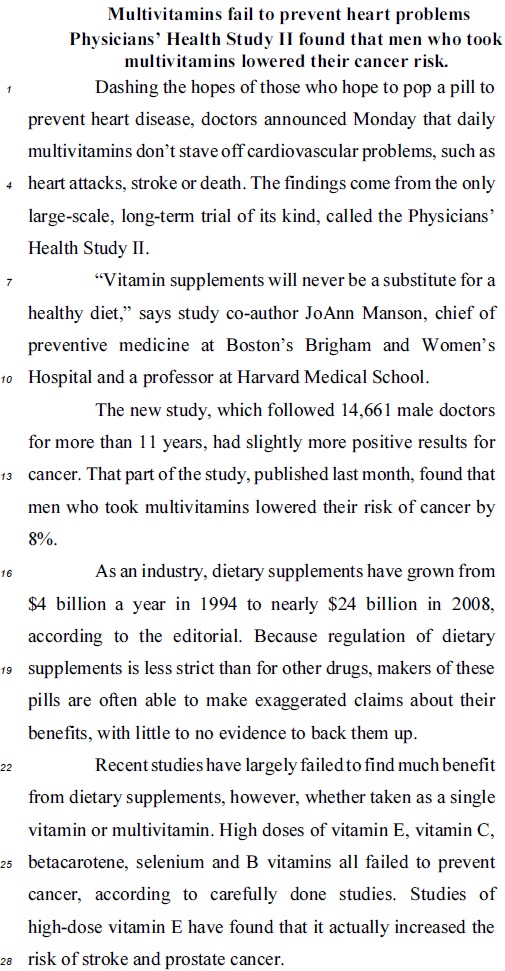
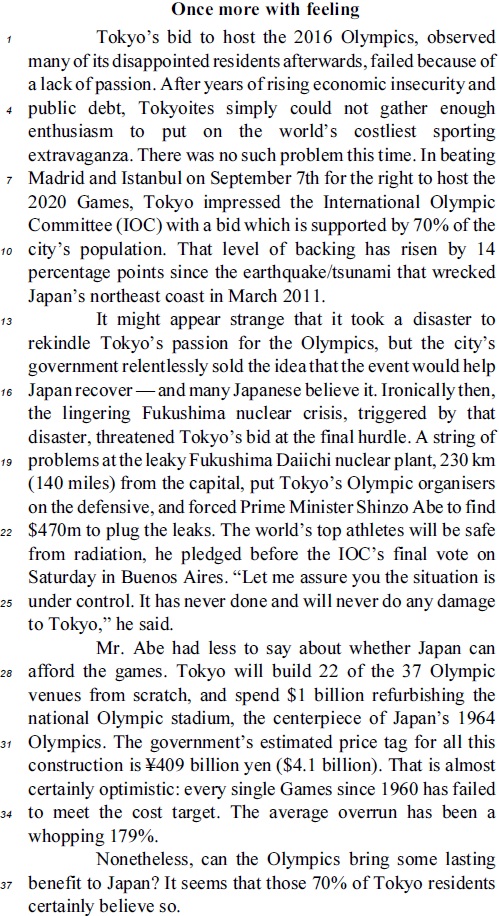

Based on the text it is correct to affirm that

According to the text
1 Public health is what we, as a society, do collectively
to assure the conditions for people to be healthy. This requires
that continuing and emerging threats to the health of the public
4 be successfully countered. These threats include immediate
crises, such as the AIDS epidemic; enduring problems, such as
injuries and chronic illnesses; and growing challenges, such as
7 the aging of the populations and the toxic by-products of a
modern economy, transmitted through air, water, soil, or food.
These and many other problems raise in common the need to
10 protect the nation’s health through effective, organized, and
sustained efforts led by the public sector.
Internet: <www.publichealthpolicy.org> (adapted).
It can be inferred from the text that one of the possible measures public health officials could take is the launching of a national obesity awareness campaign.
1 Public health is what we, as a society, do collectively
to assure the conditions for people to be healthy. This requires
that continuing and emerging threats to the health of the public
4 be successfully countered. These threats include immediate
crises, such as the AIDS epidemic; enduring problems, such as
injuries and chronic illnesses; and growing challenges, such as
7 the aging of the populations and the toxic by-products of a
modern economy, transmitted through air, water, soil, or food.
These and many other problems raise in common the need to
10 protect the nation’s health through effective, organized, and
sustained efforts led by the public sector.
Internet: <www.publichealthpolicy.org> (adapted).
In the text, “enduring problems” (l.5) are the sorts of problems that take a very long time to be solved.
1 Public health is what we, as a society, do collectively
to assure the conditions for people to be healthy. This requires
that continuing and emerging threats to the health of the public
4 be successfully countered. These threats include immediate
crises, such as the AIDS epidemic; enduring problems, such as
injuries and chronic illnesses; and growing challenges, such as
7 the aging of the populations and the toxic by-products of a
modern economy, transmitted through air, water, soil, or food.
These and many other problems raise in common the need to
10 protect the nation’s health through effective, organized, and
sustained efforts led by the public sector.
Internet: <www.publichealthpolicy.org> (adapted).
The author suggests that in a modern economy the public and private sectors must work closely together to protect a nation’s health.
this: it is simply not possible to promote healthier lifestyles
through presidential decree or through being overprotective
4 towards people and the way they choose to live. Recent history
has proved that one-size-fits-all solutions are no good when
public health challenges vary from one area of the country to
7 the next. But we cannot sit back while, in spite of all this, so
many people are suffering such severe lifestyle-driven ill health
and such acute health inequalities.
Internet: <www.gov.uk> (adapted).
the author suggests that some public health policies that have already been used did not work.
No such luck for Charles Charlesworth, who was born on the 14th of March, 1829, in Stafford. At the age of four Charles had a beard and was sexually active.
In the final three years of his life his skin wrinkled, he developed varicose veins, shortness of breath, grey hair, senile dementia and incontinence. Some time in his seventh year he fainted and never gained consciousness
The coroner returned a verdict of natural causes due to old age.
Hugh Cory. Advanced writing with english in use. Oxford University Press, p. 34.
Charles Charlesworth’s cause of death was old age although he was only seven.
No such luck for Charles Charlesworth, who was born on the 14th of March, 1829, in Stafford. At the age of four Charles had a beard and was sexually active.
In the final three years of his life his skin wrinkled, he developed varicose veins, shortness of breath, grey hair, senile dementia and incontinence. Some time in his seventh year he fainted and never gained consciousness
The coroner returned a verdict of natural causes due to old age.
Hugh Cory. Advanced writing with english in use. Oxford University Press, p. 34.
Colin looks and behaves as if he were much older than he actually is.
A repeater is an electronic device that receives a network signal, cleans it of unnecessary noise, and regenerates it. The signal is retransmitted at a higher power level, or to the other side of an obstruction, so that the signal can cover longer distances without degradation. In most twisted pair Ethernet configurations, repeaters are required for cable that runs longer than 100 meters. A repeater with multiple ports is known as a hub. Repeaters work on the physical layer of the OSI model. Repeaters require a small amount of time to regenerate the signal. This can cause a propagation delay which can affect network performance. As a result, many network architectures limit the number of repeaters that can be used in a row, e.g., the Ethernet 5-4-3 rule.
Hubs have been mostly obsoleted by modern switches; but repeaters are used for long distance links, notably undersea cabling.
Bridges
A network bridge connects multiple network segments at the data link layer (layer 2) of the OSI model to form a single network. Bridges broadcast to all ports except the port on which the broadcast was received. However, bridges do not promiscuously copy traffic to all ports, as hubs do. Instead, bridges learn which MAC addresses are reachable through specific ports. Once the bridge associates a port with an address, it will send traffic for that address to that port only.
Bridges learn the association of ports and addresses by examining the source address of frames that it sees on various ports. Once a frame arrives through a port, the bridge assumes that the MAC address is associated with that port and stores its source address.
The first time a bridge sees a previously unknown destination address, the bridge will forward the frame to all ports other than the one on which the frame arrived.
Bridges come in three basic types:
Local bridges: Directly connect LANs
Remote bridges: Can be used to create a wide area network (WAN) link between LANs. Remote bridges, where the connecting link is slower than the end networks, largely have been replaced with routers. Wireless bridges: Can be used to join LANs or connect remote devices to LANs.
Internet: http://en.wikipedia.org (adapted).
Remote devices can be connected to LANs with the use of wireless bridges.

 Conheça nossos planos