Questões de Concurso Sobre imperativo | imperative em inglês

Questões Discursivas

Foram encontradas 34 questões

Q4149830 Inglês
The sentence “Tighten the screws securely” is a typical example of the imperative language and technical vocabulary found in which of the following textual genres? 
Alternativas
Q4050519 Inglês
The imperative mood in English is used for various pragmatic functions, from giving orders to offering invitations. Its syntactic simplicity belies its complex usage in different levels of politeness. Mark the CORRECT alternative.  
Alternativas
Q3517848 Inglês
        Diplomacy is often described as an art, involving decisions shaped by sensitive political nuances that require human judgment, cultural understanding, and emotional intelligence — qualities that AI cannot fully replicate. While AI can support decision-making, it may also manipulate human behavior subtly, especially through systems developed in countries with different geopolitical priorities. This deepens the AI divide between technologically advanced and resource-limited nations, embedding linguistic and cultural biases and reinforcing global power asymmetries. As algorithms take their place alongside diplomats, the art of negotiation now meets the science of AI. The future of diplomacy must lie in fostering a symbiotic relationship where AI enhances human expertise, streamlines processes, and offers new strategic tools while leaving the nuanced art of diplomacy in human hands.

        Diplomatic institutions adopting such technologies should also adopt guardrails to clarify how these systems inform decision-making. To ensure that AI systems function appropriately across diverse cultural contexts, adaptive and responsible AI frameworks should be integrated into policy discussions at the national and international levels. Crucially, any AI deployment must prioritise human agency. The goal must not be to automate diplomacy, but to augment it. AI’s incorporation into diplomacy offers both promise and peril. While the technology supports efficiency and expands access to information, it must be governed by strong ethical frameworks, particularly when it can shape global power relations through sensitive negotiations. Rather than embracing AI as a magic wand, it must be approached as a double-edged sword that is capable of assisting, but never replacing the unique human skills that diplomacy demands. 

Anusha Guru. The Future of Diplomacy: AI’s Expanding Role in International Affairs.
In: Observer Research Foundation, 18/6/2025. Internet:<www.orfonline.org>  (adapted). 

Judge the following item based on the ideas presented in the preceding text, as well as on its linguistic aspects. 


In the fragment “Diplomatic institutions adopting such technologies” (first sentence of the second paragraph), “adopting” describes an ongoing action that started in the past and continues in the present, since it is in the present perfect continuous.  

Alternativas
Q3153135 Inglês
Consider the following text:

How to Make a Cup of Green Tea

To prepare a cup of green tea, follow these steps. First, boil water to about 80°C (176°F); avoid using boiling water as it can make the tea taste bitter. Place a green tea bag or one teaspoon of loose green tea leaves into a cup. Pour the hot water over the tea and let it steep for 2 to 3 minutes. Do not steep for too long, as this can affect the flavor. After steeping, remove the tea bag or strain the leaves. Finally, enjoy your tea plain or add a touch of honey if you prefer a bit of sweetness.

Select the alternative that correctly identifies the linguistic features present in the text.
Alternativas
Q3147571 Inglês
        “The High Priestess of Soul,” Nina Simone was a singer, pianist, songwriter, and civil rights activist. Mostly known as a jazz singer, her music blended gospel, blues, folk, pop, and classical styles. No popular singer was more closely associated with the Civil Rights Movement than Simone.

         Nina Simone was born Eunice Kathleen Waymon on February 21st, 1933, in Tryon, North Carolina. Her mother, Mary Kate Irvin, was a Methodist preacher and housekeeper, and her father, John Divine Waymon, worked as an entertainer, barber, and dry-cleaner. The family’s home was filled with music and Simone’s mother encouraged her musical pursuits but she did not approve of nonreligious music like blues and jazz. Simone took up the piano before her feet could reach the pedals, and by the age of six, she was playing during church services.

         In 2008, Rolling Stone named Simone to its list of the 100 Greatest Singers of All Time, and, in 2018, Simone was inducted into the Rock & Roll Hall of Fame.

Internet:<womenshistory.org>  (adapted).  

Based on the previous text, judge the following item. 


The verb “encourage” has a cognate in Portuguese: encorajar.

Alternativas
Q3147570 Inglês

Internet:<phdcomics.com>  (adapted)

Regarding the language usage in the preceding comic strip, judge the following item.


In the second panel, the clause “Let me tell you:” presents a verb in the imperative mood.

Alternativas
Q3143795 Inglês
Which of the following sentences is in the imperative mood?
Alternativas
Q4208662 Inglês
Leia e analise as sentenças abaixo
“Don’t give up your Dreams.” e “It doesn’t seem possible, but you can do it.”
1) Imperative form and presente tense respectively. 2) Both in the imperative form. 3) Both in presente tense. 4) Both in the imperative negative.

Marque a opção CORRETA:
Alternativas
Q3550798 Inglês

Read Text II to answer the question:


TEXT II
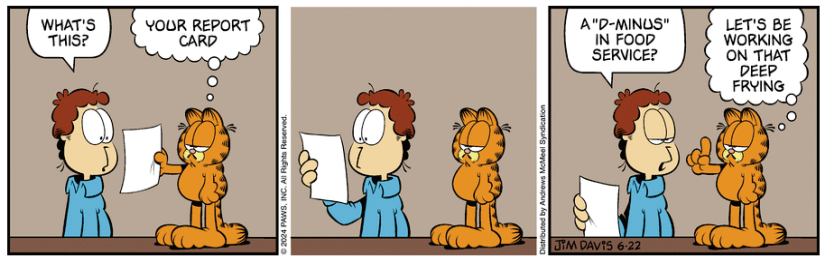

Available at: https://www.gocomics.com/garfield (adapted)

Considering that the phrase “Let's be working on that deep frying”, does not represent a regular structure in English grammar, which one of the following alternatives contains an option that is grammatically accurate and maintains the meaning?
Alternativas
Q3407910 Inglês
Read the text to answer question.


   "I’m not a naturally wrathful person. I don’t like to (and usually don’t) lose my temper. The exception is when drivers ignore pedestrian right of way. I will, whether I’m a few steps or a few miles into my walk, admonish them — loudly and none too gently. (They, of course, cannot hear me inside their cars.)

   It’s hard to shake the impression that New York City’s drivers have become more aggressive. They run reds, viciously honk and yell at pedestrians who clearly have the right of way and generally endanger the lives of those on foot.

   From 2009 to 2022, an average of 136 pedestrians were killed each year by traffic in the city. The numbers have gone down slightly — to 99 in 2023 — but cyclist deaths have climbed, though they remain a small fraction of pedestrian deaths. (The city’s decision to give pedestrians a head start at many intersections, where walk signals turn white before streetlights go green, may be helping.)

   In the United States generally, walking has become far more dangerous. The number of pedestrian fatalities nationally has climbed more than 80 percent in the past 15 years, largely because of increasingly hazardous automotive design. Some police departments effectively no longer punish drivers for any traffic infractions. San Francisco’s police officers “have almost entirely abandoned enforcement of traffic laws,” The Times’s Heather Knight reported.

  All of this calls not just for policy changes such as automobile regulation, improved policing and better urban planning but also for a more assertive pedestrian culture. Aggressive drivers have exacerbated this problem; aggressive pedestrians can help solve it."


Available at: https://www.nytimes.com/live/2024/02/27/opinion/thepoint#pedestrian-safetyassertiveness
Identify the mood of the verb in the sentence "I will, whether I’m a few steps or a few miles into my walk, admonish them — loudly and none too gently." 
Alternativas
Q3131221 Inglês


Tom Gauld. The narrator. Internet: <theguardian.com>.


According to the previous comic strip, judge the items that follow. 


The sentence “Get out of our house!” is grammatically inadequate because it is missing the subject, essential part of every clause. 

Alternativas
Q3108927 Inglês

TEXT:


Making homework count

By Stephanie Hirschman

October 8, 2024


Homework and independent study can make a massive contribution to students’ progress, particularly when classes don’t meet daily, or students aren’t living, working or studying in anglophone environments. There are several issues to consider when setting homework.

Why students are doing homework is a fundamental question which can cover a wide spectrum of reasons. The most obvious is that it offers both teachers and students a chance to check on learning and identify areas for further review and consolidation. Exam preparation courses make use of homework to consolidate and accelerate learning and deliver results. Finally, some institutions require teachers to set homework and some clients, for example parents, believe that a course with homework offers better value for money.

Whatever the reason behind setting homework, be clear with students about how they’ll benefit from the assignment, how to do it effectively, how long they should spend on it and how it will be marked.

The homework that many people expect from a language course is “more of the same” exercises, that is, those that offer extra opportunities to practice grammar or vocabulary from the lesson.

It is also possible to bring in practice from other online or print sources, but this can sometimes be problematic, especially for lower levels. Make sure that the resource you choose maps onto the lesson content without placing extra demands on students, for example, by introducing a completely different context or topic with unfamiliar vocabulary to practice a grammar point. You also need to make sure that terminology is consistent – students who are expecting to practice present continuous may not recognize that it is also called present progressive. With lower levels, go over the instructions and/or demonstrate one of the exercises so they know how to get started.

It's worth mentioning here that flipped learning may also be a useful approach to homework. This is where students preview part of the lesson plan (like a reading or listening task) or research a general topic independently before class in order to maximize opportunities for communicative activities during the lesson.

Other types of homework include semi-controlled practice of target language. Students could write personal sentences including vocabulary items or grammatical structures from the class – note that they may need training to do this. A sentence like, “The milk went off,” is not as effective for learning as, “We had no milk for the coffee this morning – it went off because we didn’t put it in the fridge last night.” You may wish to provide some question or example prompts as support.

An unusual and motivating type of speaking homework is a personalized bingo game. Students create their own bingo card, which might be a 4x4 grid. In each cell, they write a key word or structure from the lesson that they wish to practice during the next few days. They carry the card around in their pocket, and every time they use an item of target language, they can tick it off, aiming to complete a line. This is especially suitable for students who are living, working or studying in anglophone environments. Teachers can monitor progress regularly and even offer small prizes.

The question of what teachers actually do with homework also has multiple possible responses, which will depend on the teaching context. At one end of the spectrum, if there is good buy-in from the students, teachers may only need to point them towards a selected set of “more of the same” exercises and make sure the answers are accessible for self-checking. Make it clear that you welcome questions if anything isn’t clear and test regularly to check understanding.

Whatever choices you make about homework, here’s one final tip. It’s best to complete assignments the day after receiving them and not on the same day. Research on spaced repetition shows that reviewing information after around 24 hours, “just before you forget it,” is the most effective way to boost retention.


Adapted from: https://www.linguahouse.com/blog/post/makinghomework-count

Acesso em 25/10/2024

Dentre as frases abaixo, todas retiradas do texto, a que contém um verbo no modo imperativo é:
Alternativas
Q3062003 Inglês
Leia o anúncio a seguir.
37.png (408×588)
Multidict.net. Advertising language. Multidict.net, 2024. Disponível em: https://multidict.net/clilstore/page.php?id=5243. Acesso em: 12 jul. 2024.
Uma das formas de identificar a função social de um texto é a partir dos recursos linguísticos usados. O anúncio publicitário acima tem a função social de induzir o leitor a ter um certo comportamento, que é alcançada, também, pelo uso de 
Alternativas
Q4162859 Inglês

For question, choose the best option to fill in blanks CORRECTLY and RESPECTIVELY.


I- ________ is very important when it comes to traveling.


II- ________ your trip more effectively, you can use a planning tool.


III- ________ your trip at least one month before the trip.


Alternativas
Q2346539 Inglês

Choose the correct imperative form of the verb for the given statement:


                                "_________ (to mix) the dry ingredients in a bowl."

Alternativas
Q2346528 Inglês
'Come, we shall have some fun now!' thought Alice. 'I'm glad they've begun asking riddles. I believe I can guess that,' she added aloud. 

What role does the imperative form play in the given context?

Alternativas
Q2344893 Inglês
Read Text II and answer the question that follow it 


Text II 


The verb used in the post is in the: 
Alternativas
Q2342568 Inglês
What is the correct imperative form of the sentence “You should clean your room”? 
Alternativas
Q2342567 Inglês
In a busy restaurant, the chef urgently instructs the kitchen staff to prepare a special dish for a VIP customer. Which sentence reflects the chef’s command, according to the scenario above? 
Alternativas
Q2342563 Inglês
The imperative sentence is: 
Alternativas
Respostas
1: C
2: C
3: E
4: A
5: C
6: C
7: A
8: B
9: B
10: A
11: E
12: B
13: A
14: C
15: B
16: C
17: D
18: B
19: D
20: B
