Questões de Concurso Comentadas sobre futuro simples | simple future em inglês

Questões Discursivas

Foram encontradas 99 questões

Q1679409 Inglês

What is the verb tense underlined in the sentence below?


"The teacher thought we had understood the book."

Alternativas
Q1677693 Inglês
Thanksgiving Day: An American Tradition.

Thanksgiving is an American holiday that points back to the days of the pioneers and the colonization of the new country called the United States of America. History:
In the 1700s when the pioneers first arrived to the New World they were overwhelmed by disease, lack of food and shelter, and conflict with Native Americans. However, after a period of time they grew accustomed to these challenges and even managed to create a friendly relationship with the natives. There came a point where certain Native American groups helped the new Americans plant crops, raise animals, and build shelter.
The first Thanksgiving was a day during harvest time when the pioneers and the Native Americans joined together to enjoy a feast of the grains, vegetables, and meats that they had raised. It was a time of celebration for their survival up until that point as well as a bright future that lay ahead of them.

Disponível em: https://www.inglesnapontadalingua.com.br/2013/11/tha nksgiving.html Acesso em 05 jan. 2021. 
Thanksgiving is an American holiday that points back to the days of the pioneers and the colonization of the new country called the United States of America. Os tempos verbais utilizados no trecho acima são, respectivamente:
Alternativas
Q1676674 Inglês
Assinale a alternativa que contém uma frase que faz referência a um evento no futuro.
Alternativas
Q1757150 Inglês
Complete the sentence: If she __________at 11 a.m., she _________at home after midnight.
Alternativas
Q1735537 Inglês

Answers the question according to the text below.


Organ Donation and Transplant  


At this moment, more than 113,000 people in the U.S. are waiting for an organ. One more person is added to the national waiting list every 12 minutes. Each of these people is in desperate need of a kidney, liver, heart, or other organ. More than 6,500 people a year -- about 20 a day -- die before that organ ever becomes available.
Organ donors are always in short supply. There are far more people in need of a transplant than there are people willing to donate an organ. Most of the organs that are available come from deceased donors. When you fill out an organ donor card with your driver's license, you're agreeing to donate all or some of your organs if you die.
A smaller number of organs come from healthy people. More than 6,000 transplants from living donors are performed each year.
You might have wondered about donating an organ -- either to a friend or relative who needs an organ right now, or by filling out an organ donor card.
Just about anyone, at any age, can become an organ donor. Anyone younger than age18 needs to have the consent of a parent or guardian.
For organ donation after death, a medical assessment will be done to determine what organs can be donated. Certain conditions, such as having HIV, actively spreading cancer, or severe infection would exclude organ donation.
Having a serious condition like cancer, HIV, diabetes, kidney disease, or heart disease can prevent you from donating as a living donor. 

“For organ donation after death, a medical assessment WILL BE DONE to determine what organs can be donated.”. (lines 17-18). The highlighted expression is in the:
Alternativas
Q1694827 Inglês
Analyze the excerpts below regarding verb tenses respectively in the order they appear:
i. “[…] that’s how we’re going to meet those targets.” (line 12) ii. The Aichi biodiversity goals for 2020 included removing all incentives or subsidies harmful to nature (line 19, 20) iii. […] which will now be opened to signatories worldwide […] (line 24) iv. […] but the UK is not yet meeting the targets […] (lines 34, 35)
Alternativas
Q1694810 Inglês
The worldwide effort to combat critical levels of biodiversity loss will fail without far greater involvement from local communities, according to an international declaration. (lines 1, 2)
Which verb tense is seen in the excerpt?
Alternativas
Q1694634 Inglês

Analise as tabelas abaixo:


TABELA 1

I Water boils at 100°C.
II Mary heard the sound of a bell.
III I will drive the car tomorrow.


TABELA 2

A Passado
B Presente
C Futuro


Assinale a alternativa que relaciona a frase da “Tabela 1” ao tempo verbal correto da “Tabela 2”:


Alternativas
Q2026130 Inglês

“Fay, what are you going to do on your next vacation?

I'm going ...”

The verb that completes Fay's answer correctly is:

Alternativas
Q1738378 Inglês

Use of the Simple Future Tense


1. to talk about _______

________________________________

2. to ________/______________


Complete:
Alternativas
Q1738373 Inglês

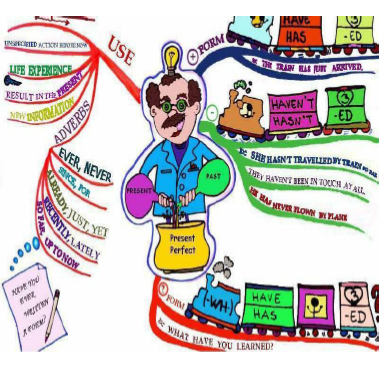
Imagem associada para resolução da questão


This is a mind map about:

Alternativas
Q1729071 Inglês
The government __________ all very nervous about the report, which _________ published tomorrow. Identify the correct verb forms that completes the context:
Alternativas
Q1725578 Inglês
Read the news below.

The impact of the smoke will be minimized by burning under specific wind and atmospheric conditions, however __________________ times when large amounts of low-lying smoke will be present. At other stages in the operation, a very large smoke column protruding hundreds of feet into the atmosphere may be seen for many miles.

Identify the best alternative that completes the context.
Alternativas
Q1725017 Inglês

Considere the sentence below:


“Our classes begin at nine.”


The verb tense is:

Alternativas
Q1724861 Inglês
Look at the picture. Based on what you can see, choose the CORRECT answer.
Imagem associada para resolução da questão
“He ______ the ball.” 
Alternativas
Q1721803 Inglês

For the question, fill in the blanks with the correct alternative.


Adam: Are you _______________ go out of the town this weekend?

Tom: Yes, I am. I am going to visit my grandparents.

Alternativas
Q1640154 Inglês
Considering verb tenses for future, choose the CORRECT alternative:
Alternativas
Q1621176 Inglês
Look at the picture. Based on what you can see, choose the CORRECT answer.
“The postman _________ the letter.”
Imagem associada para resolução da questão
Alternativas
Q1801492 Inglês
ALL HE NEEDED. Escolha a sentença CORRETA, colocada no plural, tempo futuro simples:
Alternativas
Q1798468 Inglês
TEACHING GRAMMAR IN THE POST COMMUNICATIVE APPROACH ERA
D I A N A B A U D U C C O

   Grammar. To teach or not to teach? This has been the question that language teachers have asked themselves for ages. It has been a matter of debate for teachers, linguists and second language acquisition experts.
   Historically, language teaching approaches and methods have moved from one extreme of the spectrum to another as regards the explicit teaching of grammar. Long before our times, grammar was at the centre of language teaching, as it was believed that the study of the grammar of X‟s language was the best way to its mastery. So, from medieval times till around the 1970s, the fixation of language teaching on the study and description of structures manifested in approaches such as the Grammar Translation and the Audio Lingual method, with short interludes of the other approaches such as the Direct Method, Total Physical Response and the Silent way which although claiming to differ still based their syllabus on grammar points.
   From the Grammar-dominated end of the spectrum, we moved to the Absolutely-noGrammar end. Grammar based approaches proved inadequate in that students were unable to communicate outside the classroom. Based mainly on Hymes‟ “communicative competence” and Krashen‟s models of language acquisition, the Communicative Approach emerged as the meaning-focused alternative to the formfocused approaches of the past. Strong versions of the approach emphasized the teaching of functions and absolutely discouraged the teaching of grammar structures arguing that communication – and not language description- was the aim of language teaching.
   However, the studies of the last 30 years have proved that the lack of grammar instruction has not encouraged language acquisition. On the contrary, more recent studies show that grammar instruction and explicit knowledge of the target language do have positive effects on language acquisition. So, how should we approach the teaching of Grammar in the Post- CommunicativeApproach Era?

Source: https://www.eflmagazine.com/teachinggrammar-post-communicative-approach-era/ Accessed on 17/06/2018
(Concurso Milagres/2018) In the clause that language teachers have asked themselves for ages, the verbal form is in the:
Alternativas
Respostas
61: C
62: D
63: D
64: B
65: D
66: D
67: D
68: D
69: C
70: E
71: A
72: D
73: D
74: B
75: B
76: B
77: B
78: B
79: A
80: C