Questões de Concurso
Comentadas sobre falso cognatos | false cognates em inglês
Foram encontradas 129 questões


What is Validity?
by Evelina Galaczi
July 17th, 2020
The fundamental concept to keep in mind when creating any assessment is validity. Validity refers to whether a test measures what it aims to measure. For example, a valid driving test should include a practical driving component and not just a theoretical test of the rules of driving. A valid language test for university entry, for example, should include tasks that are representative of at least some aspects of what actually happens in university settings, such as listening to lectures, giving presentations, engaging in tutorials, writing essays, and reading texts.
Validity has different elements, which we are now going to look at
in turn.
Test Purpose – Why am I testing?
We can never really say that a test is valid or not valid. Instead, we can say that a test is valid for a particular purpose. There are several reasons why you might want to test your students. You could be trying to check their learning at the end of a unit, or trying to understand what they know and don't know. Or, you might want to use a test to place learners into groups based on their ability, or to provide test takers with a certificate of language proficiency. Each of these different reasons for testing represents a different test purpose.
The purpose of the test determines the type of test you're going
to produce, which in turn affects the kinds of tasks you're going
to choose, the number of test items, the length of the test, and so
on. For example, a test certifying that doctors can practise in an
English-speaking country would be different from a placement test
which aims to place those doctors into language courses.
Test Takers – Who am I testing?
It’s also vital to keep in mind who is taking your test. Is it primary
school children or teenagers or adults? Or is it airline pilots or
doctors or engineers? This is an important question because the
test has to be appropriate for the test takers it is aimed for. If your
test takers are primary school children, for instance, you might
want to give them more interactive tasks or games to test their
language ability. If you are testing listening skills, for example,
you might want to use role plays for doctors, but lectures or
monologues with university students.
Test Construct – What am I testing?
Another key point is to consider what you want to test. Before
designing a test, you need to identify the ability or skill that the test
is designed to measure – in technical terms, the ‘test construct’.
Some examples of constructs are: intelligence, personality,
anxiety, English language ability, pronunciation. To take
language assessment as an example, the test construct could be
communicative language ability, or speaking ability, or perhaps
even a construct as specific as pronunciation. The challenge is
to define the construct and find ways to elicit it and measure it;
for example, if we are testing the construct of fluency, we might
consider features such as rate of speech, number of pauses/
hesitations and the extent to which any pauses/hesitations cause
strain for a listener.
Test Tasks – How am I testing?
Once you’ve defined what you want to test, you need to decide how
you’re going to test it. The focus here is on selecting the right test
tasks for the ability (i.e. construct) you're interested in testing. All
task types have advantages and limitations and so it’s important to
use a range of tasks in order to minimize their individual limitations
and optimize the measurement of the ability you’re interested in.
The tasks in a test are like a menu of options that are available to
choose from, and you must be sure to choose the right task or the
right range of tasks for the ability you're trying to measure.
Test Reliability - How am I scoring?
Next it’s important to consider how to score your test. A test needs
to be reliable and to produce accurate scores. So, you’ll need to
make sure that the scores from a test reflect a learner's actual
ability. In deciding how to score a test, you’ll need to consider
whether the answers are going to be scored as correct or incorrect
(this might be the case for multiple–choice tasks, for example) or
whether you might use a range of marks and give partial credit,
as for example, in reading or listening comprehension questions.
In speaking and writing, you’ll also have to decide what criteria
to use (for example, grammar, vocabulary, pronunciation, essay, organisation in writing, and so on). You’ll also need to make sure
that the teachers involved in speaking or writing assessment have
received some training, so that they are marking to (more or less)
the same standard.
Test Impact - How will my test help learners?
The final – and in many ways most important – question to ask yourself is how the test is benefitting learners. Good tests engage learners in situations similar to ones that they might face outside the classroom (i.e. authentic tasks), or which provide useful feedback or help their language development by focusing on all four skills (reading, listening, writing, speaking). For example, if a test has a speaking component, this will encourage speaking practice in the classroom. And if that speaking test includes both language production (e.g. describe a picture) and interaction (e.g. discuss a topic with another student), then preparing for the test encourages the use of a wide range of speaking activities in the classroom and enhances learning.
Adapted from: https://www.cambridgeenglish.org/blog/what-is-validity. Acesso em:
15 dez. 2023.
I. Mishmash, as said in the text, means a smooth mix of things and can be changed to 'hodgepodge'.
II. Seamlessly, as used in the text, means with no sudden changes or interruptions, and can be changed to ‘smoothly’.
Choose the CORRECT answer:
Leia o texto para responder à questão.
Canada: Educating in and for climate emergency
Climate change is the most urgent crisis facing our planet today. Youth have repeatedly called for action on tackling this crisis, including the implementation of climate change curricula in schools.
Canadian students are among those demanding improvement to the sparse and inconsistent delivery of climate change education. A study published in 2019 found that only about half of Canada’s ministries of education and about 60 per cent of school divisions in the country had sustainabilityspecific policy, with this understood to include governance, curriculum, facilities, research, and community outreach. When climate change topics are taught, key concepts are often missing such as the scientific consensus that humans are causing climate change, or a focus on impacts or solutions.
A recent countrywide survey of 4,035 respondents across the country highlighted the consequences of inadequate climate change education in schools. One-third of Canadians failed a 10-question knowledge quiz. Only around half knew greenhouse gases were the main cause of climate change. Few responded correctly that the average temperature has already increased by more than one degree Celsius. Despite their gaps in knowledge, the majority of survey respondents agreed that we are experiencing a climate emergency and that climate change education should be a high priority.
Ten percent of survey respondents were educators (406 people), and among this group, half said a lack of time is a barrier when attempting to include climate change education within the classroom. In fact, respected international organizations have noted that implementing climate change education in schools cannot continue to fall on the shoulders of overburdened teachers.
The traditional way of teaching doesn’t work for complex topics like climate change. Teachers need to shift towards student-directed inquiry and active, real-world learning. It’s not enough to simply quote scientific facts, as a focus on “doom and gloom” can intensify eco-anxiety. Best practices for climate change education include the opportunity to take personal and collective action.
(Karen S. Acton. http://theconversation.com, 07.03.2023. Adaptado)
"The officer found a data storage device hidden inside the collar of the suspect's coat, along with a baton."
How many false cognates did we find in the sentence above?
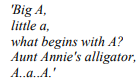
Based on this poem, which letter of the alphabet is being
introduced?
In the quest for technological advancements that can revolutionize our world, the scientific community has always been captivated by the elusive phenomenon of superconductivity. For decades, researchers have strived to unlock its full potential, seeking to discover materials that can exhibit superconducting properties at room temperature. And now, the wait might finally be over! Enter LK-99, a groundbreaking potential room-temperature superconductor that has sent shockwaves through the scientific world, spearheaded by a team of brilliant minds from Korea University, led by esteemed researchers Sukbae Lee and Ji-Hoon Kim.
Superconductors are materials that can conduct electricity with zero resistance, leading to unprecedented energy efficiency and technological advancements. In summary, LK-99 represents an exciting prospect as a potential room-temperature superconductor, but its superconducting properties have yet to be confirmed and independently verified.
Room temperature superconductors could revolutionize the energy sector by enabling lossless power transmission over long distances. With reduced energy dissipation during transmission, electricity could be distributed more efficiently, lowering carbon footprints and electricity costs.
Internet: <dataconomy.com/> (adapted).
According to the preceding text, judge the following item.
It is correct to affirm that the word “elusive” (first sentence
of the first paragraph) has a similar meaning to its cognate
word in Portuguese.
About the cognate words, choose the alternative that has:
real cognate – cognate – false cognate, respectively
Text: Paulo Freire and Communication Studies
(Adapted from Tania Ramalho article in Communication
- Oxford University Press.
Paulo Freire, the Brazilian activist educator and philosopher of education, affirmed that communication is at the heart of pedagogy, as teaching, and learning through praxis that involves reflection and action ultimately to address social injustice and dehumanization. Dialogue is at the center of his pedagogical approach, as means to individualization and humanization. Dialogue assumes participants from EJA - young and adult education- to be on an equal level even in the presence of difference. In his literacy work, Freire required teacher-facilitators to co-investigate the most important themes in the lives of students. These themes were codified into pictures and brought to dialogue that animated the re-creation of knowledge of participants’ world in the process of learning how to read, achieving the meaning of the word. The objective of this approach was not to reproduce “banking” education but to promote revolutionary emancipation of individual and society. Freire developed his work in life context at the state of Pernambuco, in the challenging circumstances – socially, historically, and geographically – of the Brazilian Northeast Region. He experienced poverty and hunger and was lucky in his access to education thanks to the efforts of his mother. He rose through the ranks of civil service, serving at state and national levels, addressing the literacy and emancipatory needs of the population, particularly adults in rural areas. Exiled during the military dictatorship in Brazil, Freire lived in Chile, the United States, and Switzerland, where he worked on education projects worldwide.
A questão foi desenvolvida em língua portuguesa oficial do Brasil.
Consider a sentence below:
"I intend to support the next mayor of the city".
How many false cognates did you find in the sentence above?
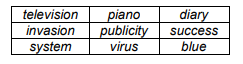
Text 4 (for questions 42, 43, 44, 45, and 46)
Social networks
Going into the small room at the end of the corridor, Roberta sat down _______ 1 the computer. It was the computer she had bought when her old one’s hard disk had started to go wrong. Her new computer was a laptop with a lot of extra features and she needed it for her online work _______ 2 her students. Roberta had started to worry that her students would be bored unless she used modern technology in her teaching.
She turned_______ 3 the switch at the back of her computer. She looked at the email messages waiting for her answer, but she ignored them. Then she looked at the homework posted on a special site she created for the students, but she didn’t feel like correcting it. Instead she went to her favorite social network site and looked at the news about her friends. She sent messages to her favorite people and she had many online conversations _______ 4 teaching and other things. She posted some new messages on her own web page and then watched a film clip on a video site which her friend had told her about.
_______ 5 now, it was late and she realized that she had spent too much time talking to her friends online. She was very tired. She would have to do all her work in the morning.
(HARMER, J. Essential Teacher Knowledge: core concepts in English language teaching, p. 42. Harlow: Pearson Education Limited, 2012.
Adaptado.)

Observe a análise linguística abaixo e responda ao que se pede.
I. Em “Salad dressing, something we never used before, is also popular now. ”, o termo dressing, na expressão sublinhada, é um substantivo e significa, em português, molho.
II. No trecho “I fear our traditional way of doing things will soon be forgotten.”, o termo sublinhado é uma expressão idiomática que corresponde a “Eu confio”.
III. No 1º parágrafo, as palavras affected, restaurants, traditional e ingredients são palavras cognatas, mas popular é falsa cognata.
IV. No trecho “Traditionally Koreans don’t use individual plates for eating main dishes.”, as palavras plates e dishes são substantivos e têm significados semelhantes.
V. Em “Before, we had never rewarded good service with money”, foi empregado o past perfect, e o verbo destacado significa recompensar.
Estão CORRETAS apenas
I pretend to make a gripe. The lunch at the cafeteria has been disgusting. I hope you are sympathetic and support the students about this subject.
Have a terrific day!
All words in bold are false cognates. The word that is being used INCORRECTLY in the sentences above is
Consider a sentence below:
"Yesterday, the retired principal was here in the school library during lunch".
How many false cognates did you find in the sentence above?

 Conheça nossos planos