Questões de Concurso
Comentadas sobre ensino da língua estrangeira inglesa em inglês
Foram encontradas 2.026 questões


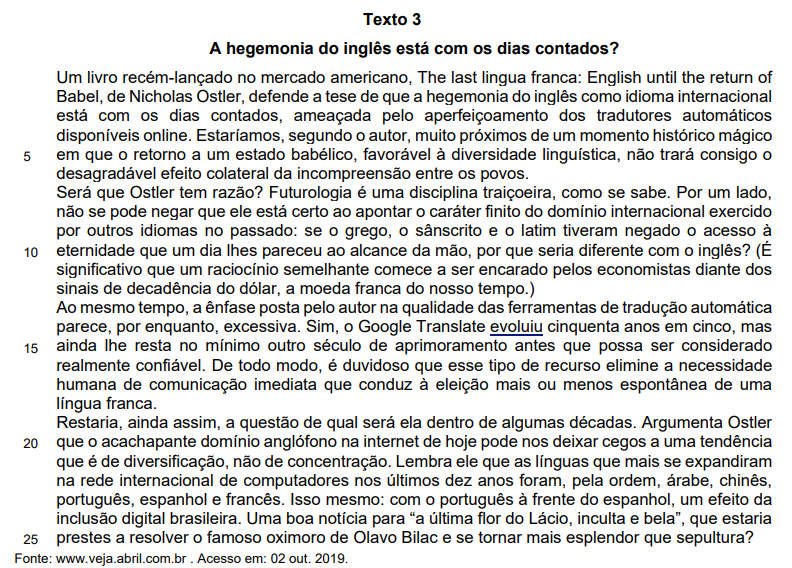
Considerando o fragmento do texto 3 “Ao mesmo tempo, a ênfase posta pelo autor na qualidade das
ferramentas de tradução automática parece, por enquanto, excessiva” e “De todo modo, é duvidoso
que esse tipo de recurso elimine a necessidade humana de comunicação imediata que conduz à eleição
mais ou menos espontânea de uma língua franca” (linhas 13-18), de acordo com os Parâmetros
Curriculares Nacional da Língua Estrangeira, é correto afirmar que
“A prática secular no Brasil privilegia o estudo da língua pela língua, muita forma gramatical que se
enfeixa num colar de conhecimentos desaplicados, que se vão de nossa memória sem aviso prévio”
(ALMEIDA FILHO, 2003). Sobre o ensino da língua inglesa, nesse contexto, é correto afirmar que
Analise a figura 5.
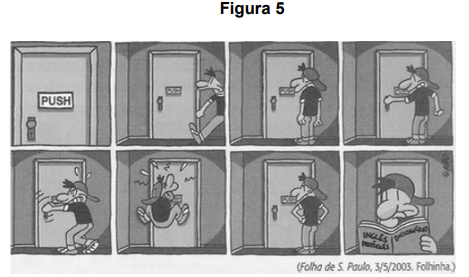
A tirinha apresentada na figura 5 revela o não cumprimento do direito educacional à aprendizagem de
língua estrangeira, concomitantemente à língua materna, previsto nos Parâmetros Curriculares
Nacionais da Língua Estrangeira, portanto fere ao pressuposto básico
In order for collection of sentences and utterances to succed effectively, the discourse needs to be organised or conducted in such a way that it will be successful. In written English this calls for both coherence and cohesion. For a text to be coherent, it needs to be in the right order. (…)
No matter how coherent a text is, however, it will not work unless it has internal cohesion. The elements in that text must cohere or stick to each other successfully to help us navigate our way around the stretch of discourse. One way of achieving this is through lexical cohesion, and a way of ensuring lexical cohesion is through the repetition of words and phrases. (…) We can also use interrelated words and meanings to bind a text together (…)
Another similar cohesive technique is that of substitution, using a phrase to refer to something we have already written. (…) Writers also use linkers such as and, also, moreover (…)
These features are also present in spoken language, which also shows many examples of ellipsis (where words from a written-grammar version of an utterance are left out without compromising the meaning of what is said). (…)
(Harmer, J. The practice of English language teaching. 2007. Adapted)
There is a danger in paying too much attention to learners’ errors. While errors indeed reveal a system at work, the classroom language teacher can become so preoccupied ________ noticing errors that the correct utterances in the second language go unnoticed. In our observation and analysis of errors – for all that they do reveal about the learner – we must beware of placing too much attention on errors and not lose sight of the value of positive reinforcement of clearly expressed language that is a product of the learner’s progress of development. While the diminishing of errors is an important criterion ______ increasing language proficiency, the ultimate goal of second language learning is the attainment of communicative fluency.
Another inadequacy in error analysis is an overemphasis on production data. Language is speaking and listening, writing and reading. The comprehension of language is as important as production. It so happens that production lends itself to analysis and thus becomes the prey of researchers, __________ comprehension data is equally important in developing an understanding of the process of SLA.
(Brown, D. H. Principles of language learning and teaching. 2000. Adapted)
Classes which are arranged in a circle make quite a strong statement about what the teacher and the students believe in. With all the people in the room sitting in a circle, there is a far greater feeling of equality than when the teacher stays out at the front. This may not be quite so true of the horseshoe shape, where the teacher is often located in a commanding position, but, even here, the rigidity that comes with orderly rows, for example, is lessened.
With the horseshoe and circle seating, the classroom is a more intimate place and the potential for students to share feelings and information through talking, eye contact or expressive body movements (eyebrow-raising, shouldershrugging, etc.) is far greater than when they are sitting in rows.
(Harmer, J. The practice of English language teaching. 2007)
Classes which are arranged in a circle make quite a strong statement about what the teacher and the students believe in. With all the people in the room sitting in a circle, there is a far greater feeling of equality than when the teacher stays out at the front. This may not be quite so true of the horseshoe shape, where the teacher is often located in a commanding position, but, even here, the rigidity that comes with orderly rows, for example, is lessened.
With the horseshoe and circle seating, the classroom is a more intimate place and the potential for students to share feelings and information through talking, eye contact or expressive body movements (eyebrow-raising, shouldershrugging, etc.) is far greater than when they are sitting in rows.
(Harmer, J. The practice of English language teaching. 2007)
Study the sentence ‘We asked Mrs. Cooper for her advise’. What type of mistake does it contain?
Choose the word that rhymes with NOW.
The terms aims, materials and class profile are traditionally used to refer to
Choose the term that best represents the following description:
|
Vocabulary is the main focus for syllabus design and classroom teaching. |
Read text 4 and answer questions 23 and 24.
TEXT 4
The sense of individuality and nationalism that has been borne from the diversity of ethnicities and traditions in Brazil is extremely strong; people take great pride in the uniqueness of their culture. The idea of ‘Brazilianism,’ which examines Brazil’s powerful history and how its distinct communities have come together to form a cohesive and unified nation, is now being offered at the university level as a subject of study. Cultivated partially by decades of unfavourable sentiment directed at different times towards the Portuguese, Spanish, British and Americans, the Brazilian identity is also defined to a certain extent by its anti-imperialist views.
The English language specifically has long been denied special consideration in Brazilian politics, policy and education due in part to the association between the language and the notion of cultural imperialism; generations of Brazilians have prospered without knowledge of the language and many in the country associate English with the United States and its role in the military regime from the 1960s to the 1980s. Due to this and the diversity of Brazilian history and the Brazilian people, it has been important not to refer to English as a second language - of which many exist in the form of indigenous languages – but as one of many foreign languages. Examples of the democratisation of language is exemplified by the fact that seven foreign languages are offered to middle schoolers in Sao Paulo as well as the historical role of Spanish and French as the foreign languages of choice. Our research has shown that the popular sentiment towards English is slowly changing, especially with the new generation of citizens that has no experience with the former dictatorship and an awareness of the increasingly globalised knowledge economy, of which Brazil is an important part.
https://ei.britishcouncil.org/sites/default/files/latin-america-research/English%20in%20Brazil.pdf
Access on August 18th, 2018
In the passage ‘how its distinct communities have come together to form a cohesive and unified nation, ITS refers to
Read text 3 and answer questions 19, 20 and 21.
TEXT 3
In Chloe Snow`s diary: confessions of a high school disaster, author Emma Chastain uses diary entries to tell the story of 14-year-old Chloe Snow. Read the following excerpt from the book.
Thursday, August 27
After dinner, Dad and I watched Midnight in Paris. The point of the movie is, everyone idealizes the past, not realizing that their own era is pretty great and will be idealized by future generations. After it was over, I said, “I still think I’d be happier in the Jazz Age,” and Dad said, “You wouldn’t last five minutes without your phone,” which doesn’t make sense, because if I were born back then, I wouldn`t know about smartphones, so I couldn’t miss them, which I said, thereby winning the argument. For dessert, Dad had whiskey, and I had a lemon Italian ice, which I flipped over so I could eat the mushy super-sweet part first.
(Chastain, E. Chloe Snow’s diary: confessions of a High School disaster. New York: Simon & Schuster, 2017. p.17)
The conjunction SO in ‘I wouldn`t know about smartphones, so I couldn’t miss them’, is closest in meaning to
Leia as afirmativas a seguir:
I. As instituições governamentais não exercem qualquer influência sobre o ensino nas escolas.
II. Está correta a grafia do trecho a seguir, em inglês: it is like enough (é muito provável).
III. Os saberes da prática sempre levam o docente a fazer escolhas equivocadas e incorretas.
Marque a alternativa CORRETA:
Leia as afirmativas a seguir:
I. O trecho a seguir, em inglês, está corretamente grafado: to play for keeps (jogar por dinheiro).
II. É dever dos municípios autorizar, credenciar e supervisionar os estabelecimentos do seu sistema de ensino.
III. O trecho a seguir, em inglês, está corretamente grafado: he is in the know (ele está a par de).
Marque a alternativa CORRETA:
Leia as afirmativas a seguir:
I. O trecho a seguir, em inglês, está corretamente grafado: to keep quiet (ficar quieto).
II. Está correta a grafia do trecho a seguir, em inglês: to know oneself (conhecer a si mesmo).
III. É vedado aos docentes estabelecer estratégias de recuperação para os alunos de menor rendimento.
Marque a alternativa CORRETA:
Leia as afirmativas a seguir:
I. Cabe aos docentes ministrar os dias letivos e horas-aula estabelecidos.
II. No Brasil, o ensino deve ser ministrado com base no princípio da garantia de padrão de qualidade.
III. O trecho a seguir, em inglês, está corretamente grafado: to keep to oneself (isolar-se dos outros espontaneamente).
Marque a alternativa CORRETA:
Leia as afirmativas a seguir:
I. A educação sexual no espaço escolar deve permitir que se aja de modo solidário em relação aos portadores do HIV.
II. Está correta a grafia do trecho a seguir, em inglês: to lend an ear (prestar atenção, dar ouvidos).
III. A educação abrange exclusivamente os processos formativos que se desenvolvem na vida familiar.
Marque a alternativa CORRETA:
Leia as afirmativas a seguir:
I. O trabalho interdisciplinar deve propiciar o diálogo entre os conteúdos disciplinares.
II. O trecho a seguir, em inglês, está corretamente grafado: to keep one’s end up (prosseguir, não desistir).
III. A efetivação da gestão democrática é fruto da mobilização dos trabalhadores em educação, das comunidades escolar e local.
Marque a alternativa CORRETA:
Leia as afirmativas a seguir:
I. A escola não é capaz de prover conhecimento ao estudante.
II. A escola deve assegurar o cumprimento dos dias letivos e horasaula estabelecidas, além das demais ações planejadas, com o objetivo de prover o desenvolvimento do estudante no meio educacional.
III. O trecho a seguir, em inglês, está corretamente grafado: where do you keep? (onde é que você mora?).
Marque a alternativa CORRETA:

 Conheça nossos planos