Questões de Concurso
Comentadas sobre ensino da língua estrangeira inglesa em inglês
Foram encontradas 1.874 questões
Analyze the following sentence: “Yesterday evening I left work at 6 p.m. and went straight home. When I arrived home last night my parents had had dinner and were watching a movie”. Choose the alternative that IS NOT correct.
Analyze the following sentence and choose the correct alternative: “Ann has lost her cell phone”.
Instruction: answer questions 31 to 40 based on the following text. The highlights throughout the text are cited in the questions.
Carnival
- ______ Carnival is ____ festival celebrated in _____countries of Catholic tradition, often
- with public parades of playful, imaginative wagons typically called "floats, masking, jokes and
- feasts”.
- Etymology
- The word carnival comes from the Latin "carnem levare" (=eliminate meat) and
- originally indicated the banquet that was held on the last day of Carnival (Mardi Gras),
- immediately before Lent, the period of fasting and abstinence when Christians would abstain
- _____ meat. The first evidence of the use of the word "carnevale" (or "carnevalo") are the texts
- of minstrel Matazone da Caligano of the late 13th century and writer Giovanni Sercambi around
- 1400.
- Carnival period
- In Catholic countries, traditionally Carnival begins on the Septuagesima Sunday (70
- days to Easter, it was the first of the nine Sundays before the Holy Week in the Gregorian
- calendar), and in the Roman rite ends on the Tuesday before Ash Wednesday, which marks the
- beginning of Lent. The climax is usually from Thursday until Tuesday, the last day of Carnival.
- Being connected with Easter which is a moveable feast, the final dates of Carnival vary each
- year, though in some places it may begin already on 17th January. Since Catholic Easter is on
- the Sunday after the 17first full moon of spring, therefore from 22 March to 25 April, and since
- there are 46 days between Ash Wednesday and Easter, then in non-leap years the last day of
- Carnival, Mardi Gras, can fall any time within February 3 to March 9.
- In the Ambrosian rite, which is followed in the Archdiocese of Milan and in some
- neighboring dioceses, Lent begins with the first Sunday of Lent, therefore the last day of
- Carnival is on Saturday, four days later than the Mardi Gras in other areas of Italy.
- Carnival in antiquity
- Although present in the Catholic tradition, Carnival has its origins in much older
- celebrations, such as the Greek Dionysian festivals ("Anthesteria") or the Roman "Saturnalia".
- During these ancient rites a temporary dissolution of the social obligations and hierarchies took
- place in favor of chaos, jokes and even debauchery. From a historical and religious point of
- view Carnival represented, therefore, a period of renewal, when chaos replaced the established
- order, but once festive period was over, a new or the old order re-emerged for another cycle
- until the next carnival.
- In Babylon, shortly after the vernal equinox the process of the foundation of the cosmos
- was re-enacted, described with the myth of the struggle of Marduk, the savior-god with Tiamat
- the dragon, which ended with the victory of the former. During these ceremonies a procession
- was held in which the forces of chaos were allegorically represented fighting the recreation of
- the universe, that is the myth of the death and resurrection of Marduk, the savior. In the parade
- there was a ship on wheels where the deities Moon and Sun were carried along a large avenue
- - a symbol of the Zodiac - to the sanctuary of Babylon, symbol of the earth. This period was
- accompanied by an unbridled freedom and a reversal of social order and morality.
- In the Roman world the feast in honor of the Egyptian goddess Isis involved the presence
- of masked groups, as told by Lucius Apuleius in the Metamorphoses (Book XI). Among the
- Romans the end of the old year was represented by a man covered with goat skins, carried in
- procession, hit with sticks and called Mamurius Veturius.
- Carnival is therefore a moment in a mythic cycle, it is the movement of spirits between
- heaven, earth and the underworld. In the spring, when the earth begins to show its power,
- Carnival opens a passage between the earth and the underworld, whose souls must be honored
- and for a short period the living lend them their bodies wearing masks. Masks therefore have
- often an apotropaic meaning, as the wearer takes on the features of the spirit represented.
- In the 15th and 16th centuries, the Medici in Florence organized large masked carts
- called "Trionfi" accompanied by carnival songs and dances one, the "Trionfo di Bacco e Arianna"
- also written by Lorenzo the Magnificent. In Rome under the Popes horse races took place and
- a called the "race of moccoletti" where runners bearing lit candles tried to blow out each other's
- candles.
(Available at: http://www.italyheritage.com/traditions/carnival/2023/04/14/ – text especially adapted for this test).
The use of the underlined verb ‘would’ (line 07) indicates:
Instruction: answer questions 31 to 40 based on the following text. The highlights throughout the text are cited in the questions.
Carnival
- ______ Carnival is ____ festival celebrated in _____countries of Catholic tradition, often
- with public parades of playful, imaginative wagons typically called "floats, masking, jokes and
- feasts”.
- Etymology
- The word carnival comes from the Latin "carnem levare" (=eliminate meat) and
- originally indicated the banquet that was held on the last day of Carnival (Mardi Gras),
- immediately before Lent, the period of fasting and abstinence when Christians would abstain
- _____ meat. The first evidence of the use of the word "carnevale" (or "carnevalo") are the texts
- of minstrel Matazone da Caligano of the late 13th century and writer Giovanni Sercambi around
- 1400.
- Carnival period
- In Catholic countries, traditionally Carnival begins on the Septuagesima Sunday (70
- days to Easter, it was the first of the nine Sundays before the Holy Week in the Gregorian
- calendar), and in the Roman rite ends on the Tuesday before Ash Wednesday, which marks the
- beginning of Lent. The climax is usually from Thursday until Tuesday, the last day of Carnival.
- Being connected with Easter which is a moveable feast, the final dates of Carnival vary each
- year, though in some places it may begin already on 17th January. Since Catholic Easter is on
- the Sunday after the 17first full moon of spring, therefore from 22 March to 25 April, and since
- there are 46 days between Ash Wednesday and Easter, then in non-leap years the last day of
- Carnival, Mardi Gras, can fall any time within February 3 to March 9.
- In the Ambrosian rite, which is followed in the Archdiocese of Milan and in some
- neighboring dioceses, Lent begins with the first Sunday of Lent, therefore the last day of
- Carnival is on Saturday, four days later than the Mardi Gras in other areas of Italy.
- Carnival in antiquity
- Although present in the Catholic tradition, Carnival has its origins in much older
- celebrations, such as the Greek Dionysian festivals ("Anthesteria") or the Roman "Saturnalia".
- During these ancient rites a temporary dissolution of the social obligations and hierarchies took
- place in favor of chaos, jokes and even debauchery. From a historical and religious point of
- view Carnival represented, therefore, a period of renewal, when chaos replaced the established
- order, but once festive period was over, a new or the old order re-emerged for another cycle
- until the next carnival.
- In Babylon, shortly after the vernal equinox the process of the foundation of the cosmos
- was re-enacted, described with the myth of the struggle of Marduk, the savior-god with Tiamat
- the dragon, which ended with the victory of the former. During these ceremonies a procession
- was held in which the forces of chaos were allegorically represented fighting the recreation of
- the universe, that is the myth of the death and resurrection of Marduk, the savior. In the parade
- there was a ship on wheels where the deities Moon and Sun were carried along a large avenue
- - a symbol of the Zodiac - to the sanctuary of Babylon, symbol of the earth. This period was
- accompanied by an unbridled freedom and a reversal of social order and morality.
- In the Roman world the feast in honor of the Egyptian goddess Isis involved the presence
- of masked groups, as told by Lucius Apuleius in the Metamorphoses (Book XI). Among the
- Romans the end of the old year was represented by a man covered with goat skins, carried in
- procession, hit with sticks and called Mamurius Veturius.
- Carnival is therefore a moment in a mythic cycle, it is the movement of spirits between
- heaven, earth and the underworld. In the spring, when the earth begins to show its power,
- Carnival opens a passage between the earth and the underworld, whose souls must be honored
- and for a short period the living lend them their bodies wearing masks. Masks therefore have
- often an apotropaic meaning, as the wearer takes on the features of the spirit represented.
- In the 15th and 16th centuries, the Medici in Florence organized large masked carts
- called "Trionfi" accompanied by carnival songs and dances one, the "Trionfo di Bacco e Arianna"
- also written by Lorenzo the Magnificent. In Rome under the Popes horse races took place and
- a called the "race of moccoletti" where runners bearing lit candles tried to blow out each other's
- candles.
(Available at: http://www.italyheritage.com/traditions/carnival/2023/04/14/ – text especially adapted for this test).
Select the alternative that defines correctly the bold word “Lent” (line 07):
Instruction: answer questions 31 to 40 based on the following text. The highlights throughout the text are cited in the questions.
Carnival
- ______ Carnival is ____ festival celebrated in _____countries of Catholic tradition, often
- with public parades of playful, imaginative wagons typically called "floats, masking, jokes and
- feasts”.
- Etymology
- The word carnival comes from the Latin "carnem levare" (=eliminate meat) and
- originally indicated the banquet that was held on the last day of Carnival (Mardi Gras),
- immediately before Lent, the period of fasting and abstinence when Christians would abstain
- _____ meat. The first evidence of the use of the word "carnevale" (or "carnevalo") are the texts
- of minstrel Matazone da Caligano of the late 13th century and writer Giovanni Sercambi around
- 1400.
- Carnival period
- In Catholic countries, traditionally Carnival begins on the Septuagesima Sunday (70
- days to Easter, it was the first of the nine Sundays before the Holy Week in the Gregorian
- calendar), and in the Roman rite ends on the Tuesday before Ash Wednesday, which marks the
- beginning of Lent. The climax is usually from Thursday until Tuesday, the last day of Carnival.
- Being connected with Easter which is a moveable feast, the final dates of Carnival vary each
- year, though in some places it may begin already on 17th January. Since Catholic Easter is on
- the Sunday after the 17first full moon of spring, therefore from 22 March to 25 April, and since
- there are 46 days between Ash Wednesday and Easter, then in non-leap years the last day of
- Carnival, Mardi Gras, can fall any time within February 3 to March 9.
- In the Ambrosian rite, which is followed in the Archdiocese of Milan and in some
- neighboring dioceses, Lent begins with the first Sunday of Lent, therefore the last day of
- Carnival is on Saturday, four days later than the Mardi Gras in other areas of Italy.
- Carnival in antiquity
- Although present in the Catholic tradition, Carnival has its origins in much older
- celebrations, such as the Greek Dionysian festivals ("Anthesteria") or the Roman "Saturnalia".
- During these ancient rites a temporary dissolution of the social obligations and hierarchies took
- place in favor of chaos, jokes and even debauchery. From a historical and religious point of
- view Carnival represented, therefore, a period of renewal, when chaos replaced the established
- order, but once festive period was over, a new or the old order re-emerged for another cycle
- until the next carnival.
- In Babylon, shortly after the vernal equinox the process of the foundation of the cosmos
- was re-enacted, described with the myth of the struggle of Marduk, the savior-god with Tiamat
- the dragon, which ended with the victory of the former. During these ceremonies a procession
- was held in which the forces of chaos were allegorically represented fighting the recreation of
- the universe, that is the myth of the death and resurrection of Marduk, the savior. In the parade
- there was a ship on wheels where the deities Moon and Sun were carried along a large avenue
- - a symbol of the Zodiac - to the sanctuary of Babylon, symbol of the earth. This period was
- accompanied by an unbridled freedom and a reversal of social order and morality.
- In the Roman world the feast in honor of the Egyptian goddess Isis involved the presence
- of masked groups, as told by Lucius Apuleius in the Metamorphoses (Book XI). Among the
- Romans the end of the old year was represented by a man covered with goat skins, carried in
- procession, hit with sticks and called Mamurius Veturius.
- Carnival is therefore a moment in a mythic cycle, it is the movement of spirits between
- heaven, earth and the underworld. In the spring, when the earth begins to show its power,
- Carnival opens a passage between the earth and the underworld, whose souls must be honored
- and for a short period the living lend them their bodies wearing masks. Masks therefore have
- often an apotropaic meaning, as the wearer takes on the features of the spirit represented.
- In the 15th and 16th centuries, the Medici in Florence organized large masked carts
- called "Trionfi" accompanied by carnival songs and dances one, the "Trionfo di Bacco e Arianna"
- also written by Lorenzo the Magnificent. In Rome under the Popes horse races took place and
- a called the "race of moccoletti" where runners bearing lit candles tried to blow out each other's
- candles.
(Available at: http://www.italyheritage.com/traditions/carnival/2023/04/14/ – text especially adapted for this test).
The expression “chaos, jokes and even debauchery” (line 28) refers to:
How were the first 'voice mails' sent? In envelopes
“Hello Mother, Dad, and Blanche,” a quiet voice says above the cracks and pops of an old vinyl record, which has clearly been played many times over. “How’s everything at home? I’m recording this from Dallas…from this very little place where there are pinball machines and many other things like that…”
The disc is small, seven inches across, dated ___________ 1954. The faded green label shows that the speaker’s name is “Gene,” the recording addressed to “Folks.” Gene suggests in his minute-long message that he is traveling—“seeing America”—and tells his family not to worry about him.
“I should complete my trip sometime around Thanksgiving. I hope you received my letter and I, in turn, hope to receive some of the letters that you sent me.”
This largely forgotten sound is one of the world’s early “voice mails.” During the first half of the 20th century, these audio letters and other messages were recorded largely in booths, pressed onto metal discs and vinyl records, and mailed in places all over the world. Best known today for playing music at home, record players were then being used as a means of _____________ over long distances.
The idea of transporting a person’s voice had _________ large in the human imagination for some three centuries before it was finally achieved with the invention of the phonograph in the late 19th century. Historical documents from the Qing Dynasty in 16th-century China suggest the existence of a mysterious device called the “thousand-mile speaker,” a wooden cylinder that could be spoken into and sealed, such that the recipient could still hear the reverberations when opening it back up.
(Fonte: National Geographic - adaptado.)
In “‘Hello Mother, Dad, and Blanche,’ a quiet voice says above the cracks and pops of an old vinyl record [...]”, the underlined word can be substituted without loss of meaning by:
How were the first 'voice mails' sent? In envelopes
“Hello Mother, Dad, and Blanche,” a quiet voice says above the cracks and pops of an old vinyl record, which has clearly been played many times over. “How’s everything at home? I’m recording this from Dallas…from this very little place where there are pinball machines and many other things like that…”
The disc is small, seven inches across, dated ___________ 1954. The faded green label shows that the speaker’s name is “Gene,” the recording addressed to “Folks.” Gene suggests in his minute-long message that he is traveling—“seeing America”—and tells his family not to worry about him.
“I should complete my trip sometime around Thanksgiving. I hope you received my letter and I, in turn, hope to receive some of the letters that you sent me.”
This largely forgotten sound is one of the world’s early “voice mails.” During the first half of the 20th century, these audio letters and other messages were recorded largely in booths, pressed onto metal discs and vinyl records, and mailed in places all over the world. Best known today for playing music at home, record players were then being used as a means of _____________ over long distances.
The idea of transporting a person’s voice had _________ large in the human imagination for some three centuries before it was finally achieved with the invention of the phonograph in the late 19th century. Historical documents from the Qing Dynasty in 16th-century China suggest the existence of a mysterious device called the “thousand-mile speaker,” a wooden cylinder that could be spoken into and sealed, such that the recipient could still hear the reverberations when opening it back up.
(Fonte: National Geographic - adaptado.)
Concerning the parts of speech, the underlined word in “How’s everything at home?” is classified as a/an:
How were the first 'voice mails' sent? In envelopes
“Hello Mother, Dad, and Blanche,” a quiet voice says above the cracks and pops of an old vinyl record, which has clearly been played many times over. “How’s everything at home? I’m recording this from Dallas…from this very little place where there are pinball machines and many other things like that…”
The disc is small, seven inches across, dated ___________ 1954. The faded green label shows that the speaker’s name is “Gene,” the recording addressed to “Folks.” Gene suggests in his minute-long message that he is traveling—“seeing America”—and tells his family not to worry about him.
“I should complete my trip sometime around Thanksgiving. I hope you received my letter and I, in turn, hope to receive some of the letters that you sent me.”
This largely forgotten sound is one of the world’s early “voice mails.” During the first half of the 20th century, these audio letters and other messages were recorded largely in booths, pressed onto metal discs and vinyl records, and mailed in places all over the world. Best known today for playing music at home, record players were then being used as a means of _____________ over long distances.
The idea of transporting a person’s voice had _________ large in the human imagination for some three centuries before it was finally achieved with the invention of the phonograph in the late 19th century. Historical documents from the Qing Dynasty in 16th-century China suggest the existence of a mysterious device called the “thousand-mile speaker,” a wooden cylinder that could be spoken into and sealed, such that the recipient could still hear the reverberations when opening it back up.
(Fonte: National Geographic - adaptado.)
Check the alternative that CORRECTLY fills the gaps in the text:
Considere a situação a seguir:
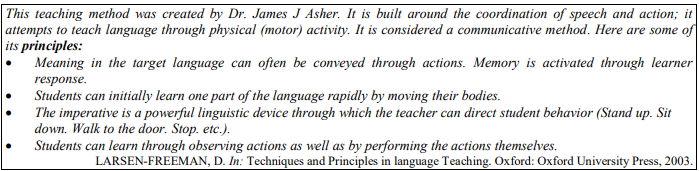
O(a) professor(a) de Língua Inglesa de uma escola pública municipal começa a aula pedindo aos alunos que escutem um diálogo em inglês e repitam após ele(a). Os alunos começam a se familiarizar com a pronúncia correta das palavras e a entonação da língua. Em seguida, a(o) professor(a) pede que os alunos realizem exercícios de repetição, para fixar o vocabulário aprendido. Ao final da aula, os alunos estão empolgados e confiantes para praticar a língua inglesa em situações cotidianas.
Podemos afirmar que o método empreendido pelo(a) professor(a) é o:
What is the process called when two sounds merge into one in connected speech, and which sound is often deleted or weakened in English phonology?
Indirect speech conveys a report of something that was said or written rather than the exact words that were spoken or written. Moreover, indirect speech is also called reported speech. It is when something that has been said is written without directly quoting the speaker. In short, reported speech is the linguistic technique that is used to tell somebody what someone else’s direct speech was. In consideration of the foregoing, read the sentence that follows, which was written in the direct speech form, and check its correspondent correct reported speech form.
DIRECT SPEECH: An English teacher said: “I have taught my students to help them become independent learners and critical citizens”.
Genre has been defined as ‘‘a distinctive category of discourse of any type, spoken or written’’ that serves as ‘‘responses by speakers or writers to the demands of a social context’’. Genre has been produced in many different spheres of human activities. For example, they are present in magazines, newspapers, television, internet, and others. That is to say that a genre represents a pattern or a set of rules that a given text follows in order to communicate its message effectively to its intended audience. Taking that into consideration, check the alternative, whose statement provided may not be associated with the tenets of a potential genre-based theory or approach to the English language teaching (ELT).
Teaching methods have been considered as a set of core teaching and learning principles together with a body of classroom practices that are derived from them. There are, and have been, many methods in English teaching. Methods deal with practical details and fundamentals of teaching. In Applied Linguistics, studies associated with English language teaching have suggested the following methods, along with a few others, as the most known, debated and analyzed in English teaching literature (written works). They are: I) Audiolingual Method or Audiolingualism; II) Total Physical Response; III) Silent Way; IV) Grammar-Translation Method; and, V) Direct Method or Natural Method. With that in mind, check the alternative that presents the correct information about one of the before-mentioned methods.
O ensino de Língua Inglesa como X representa uma abordagem que reconhece o inglês não apenas como uma língua estrangeira, mas como uma ferramenta de comunicação global entre pessoas de diferentes línguas. Nessa perspectiva, o foco vai além da aquisição de uma cultura específica ou da reprodução de padrões linguísticos tradicionais, priorizando a eficácia da comunicação intercultural. No contexto de ensino de Língua Inglesa como X, o objetivo principal é capacitar os alunos a se comunicarem de forma clara e eficaz em situações diversas, onde o inglês é usado como um meio de interação internacional. Isso implica uma abordagem flexível que valoriza a compreensão mútua acima da conformidade rígida com normas linguísticas específicas.
Marque a alternativa que substitui corretamente o X no texto acima.
Julgue as sentenças abaixo como VERDADEIRAS ou FALSAS:
1.(__)A metodologia lexical enfatiza o papel das palavras e expressões unidades lexicais na comunicação eficaz.
2.(__)A abordagem comunicativa é baseada na ideia de que a aprendizagem de uma língua é um hábito que pode ser desenvolvido por meio da leitura e da escrita.
3.(__)A aprendizagem baseada em tarefas (Task-Based Learning) dá ênfase na prática oral, repetição controlada, treinos e diálogos memorizados.
A sequência CORRETA é:
Plurilingualism and translanguaging: commonalities and divergences
Both plurilingual and translanguaging pedagogical practices in the education of language minoritized students remain controversial, for schools have a monolingual and monoglossic tradition that is hard to disrupt, even when the disrupting stance brings success to learners. At issue is the national identity that schools are supposed to develop in their students, and the Eurocentric system of knowledge, circulated through standardized named languages, that continues to impose what Quijano (2000) has called a coloniality of power.
All theories emerge from a place, an experience, a time, and a position, and in this case, plurilingualism and translanguaging have developed, as we have seen, from different loci of enunciation. But concepts do not remain static in a time and place, as educators and researchers take them up, as they travel, and as educators develop alternative practices. Thus, plurilingual and translanguaging pedagogical practices sometimes look the same, and sometimes they even have the same practical goals. For example, educators who say they use plurilingual pedagogical practices might insist on developing bilingual identities, and not solely use plurilingualism as a scaffold. And educators who claim to use translanguaging pedagogical practices sometimes use them only as a scaffold to the dominant language, not grasping its potential. In the United States, translanguaging pedagogies are often used in English-as-a-Second Language programs only as a scaffold. And although the potential for translanguaging is more likely to be found in bilingual education programs, this is also at times elusive. The potential is curtailed, for example, by the strict language allocation policies that have accompanied the growth of dual language education programs in the last decade in the USA, which come close to the neoliberal understanding of multilingualism espoused in the European Union.
It is important to keep the conceptual distinctions between plurilingualism and translanguaging at the forefront as we develop ways of enacting them in practice, even when pedagogies may turn out to look the same. Because the theoretical stance of translanguaging brings forth and affirms dynamic multilingual realities, it offers the potential to transform minoritized communities sense of self that the concept of plurilingualism may not always do. The purpose of translanguaging could be transformative of socio-political and socio-educational structures that legitimize the language hierarchies that exclude minoritized bilingual students and the epistemological understandings that render them invisible. In its theoretical formulation, translanguaging disrupts the concept of named languages and the power hierarchies in which languages are positioned. But the issue for the future is whether school authorities will allow translanguaging to achieve its potential, or whether it will silence it as simply another kind of scaffold. To the degree that educators act on translanguaging with political intent, it will continue to crack some openings and to open opportunities for bilingual students. Otherwise, the present conceptual differences between plurilingualism and translanguaging will be erased.
Source: GARCÍA, Ofelia; OTHEGUY, Ricardo. Plurilingualism and translanguaging: Commonalities and divergences. International Journal of Bilingual Education and Bilingualism, v. 23, n. 1, p. 17-35, 2020.
Garcia e Otheguy (2020)
Discourse genres refer to specific types or forms of communication that follow particular conventions, structures, and styles, and are used within specific contexts or communities to convey information, ideas, or meaning effectively. These genres can include various forms such as essays, reports, letters, conversations, speeches, and more, each tailored to suit the purpose and audience of the communication. Said that, consider the following statements about discourse genres in TESOL (Teaching English to Speakers of Other Languages):
I.Discourse genres primarily focus on the structural aspects of language, such as grammar and vocabulary.
II.Discourse genres are a valuable pedagogical tool in TESOL as they provide students with the practical ability to use language in context, enabling effective communication and language acquisition.
III.In TESOL, discourse genres often revolve around written communication and are less relevant in spoken language instruction.
It is correct what is state in:
Plurilingualism and translanguaging: commonalities and divergences
Both plurilingual and translanguaging pedagogical practices in the education of language minoritized students remain controversial, for schools have a monolingual and monoglossic tradition that is hard to disrupt, even when the disrupting stance brings success to learners. At issue is the national identity that schools are supposed to develop in their students, and the Eurocentric system of knowledge, circulated through standardized named languages, that continues to impose what Quijano (2000) has called a coloniality of power.
All theories emerge from a place, an experience, a time, and a position, and in this case, plurilingualism and translanguaging have developed, as we have seen, from different loci of enunciation. But concepts do not remain static in a time and place, as educators and researchers take them up, as they travel, and as educators develop alternative practices. Thus, plurilingual and translanguaging pedagogical practices sometimes look the same, and sometimes they even have the same practical goals. For example, educators who say they use plurilingual pedagogical practices might insist on developing bilingual identities, and not solely use plurilingualism as a scaffold. And educators who claim to use translanguaging pedagogical practices sometimes use them only as a scaffold to the dominant language, not grasping its potential. In the United States, translanguaging pedagogies are often used in English-as-a-Second Language programs only as a scaffold. And although the potential for translanguaging is more likely to be found in bilingual education programs, this is also at times elusive. The potential is curtailed, for example, by the strict language allocation policies that have accompanied the growth of dual language education programs in the last decade in the USA, which come close to the neoliberal understanding of multilingualism espoused in the European Union.
It is important to keep the conceptual distinctions between plurilingualism and translanguaging at the forefront as we develop ways of enacting them in practice, even when pedagogies may turn out to look the same. Because the theoretical stance of translanguaging brings forth and affirms dynamic multilingual realities, it offers the potential to transform minoritized communities sense of self that the concept of plurilingualism may not always do. The purpose of translanguaging could be transformative of socio-political and socio-educational structures that legitimize the language hierarchies that exclude minoritized bilingual students and the epistemological understandings that render them invisible. In its theoretical formulation, translanguaging disrupts the concept of named languages and the power hierarchies in which languages are positioned. But the issue for the future is whether school authorities will allow translanguaging to achieve its potential, or whether it will silence it as simply another kind of scaffold. To the degree that educators act on translanguaging with political intent, it will continue to crack some openings and to open opportunities for bilingual students. Otherwise, the present conceptual differences between plurilingualism and translanguaging will be erased.
Source: GARCÍA, Ofelia; OTHEGUY, Ricardo. Plurilingualism and translanguaging: Commonalities and divergences. International Journal of Bilingual Education and Bilingualism, v. 23, n. 1, p. 17-35, 2020.
Garcia e Otheguy (2020)
In the field of TESOL, understanding language conceptions is crucial for effective language teaching. Which of the following statements accurately represents a commonly held language conception in TESOL?
Plurilingualism and translanguaging: commonalities and divergences
Both plurilingual and translanguaging pedagogical practices in the education of language minoritized students remain controversial, for schools have a monolingual and monoglossic tradition that is hard to disrupt, even when the disrupting stance brings success to learners. At issue is the national identity that schools are supposed to develop in their students, and the Eurocentric system of knowledge, circulated through standardized named languages, that continues to impose what Quijano (2000) has called a coloniality of power.
All theories emerge from a place, an experience, a time, and a position, and in this case, plurilingualism and translanguaging have developed, as we have seen, from different loci of enunciation. But concepts do not remain static in a time and place, as educators and researchers take them up, as they travel, and as educators develop alternative practices. Thus, plurilingual and translanguaging pedagogical practices sometimes look the same, and sometimes they even have the same practical goals. For example, educators who say they use plurilingual pedagogical practices might insist on developing bilingual identities, and not solely use plurilingualism as a scaffold. And educators who claim to use translanguaging pedagogical practices sometimes use them only as a scaffold to the dominant language, not grasping its potential. In the United States, translanguaging pedagogies are often used in English-as-a-Second Language programs only as a scaffold. And although the potential for translanguaging is more likely to be found in bilingual education programs, this is also at times elusive. The potential is curtailed, for example, by the strict language allocation policies that have accompanied the growth of dual language education programs in the last decade in the USA, which come close to the neoliberal understanding of multilingualism espoused in the European Union.
It is important to keep the conceptual distinctions between plurilingualism and translanguaging at the forefront as we develop ways of enacting them in practice, even when pedagogies may turn out to look the same. Because the theoretical stance of translanguaging brings forth and affirms dynamic multilingual realities, it offers the potential to transform minoritized communities sense of self that the concept of plurilingualism may not always do. The purpose of translanguaging could be transformative of socio-political and socio-educational structures that legitimize the language hierarchies that exclude minoritized bilingual students and the epistemological understandings that render them invisible. In its theoretical formulation, translanguaging disrupts the concept of named languages and the power hierarchies in which languages are positioned. But the issue for the future is whether school authorities will allow translanguaging to achieve its potential, or whether it will silence it as simply another kind of scaffold. To the degree that educators act on translanguaging with political intent, it will continue to crack some openings and to open opportunities for bilingual students. Otherwise, the present conceptual differences between plurilingualism and translanguaging will be erased.
Source: GARCÍA, Ofelia; OTHEGUY, Ricardo. Plurilingualism and translanguaging: Commonalities and divergences. International Journal of Bilingual Education and Bilingualism, v. 23, n. 1, p. 17-35, 2020.
Garcia e Otheguy (2020)
Observe the following clauses I and II:
I.If school authorities had allowed translanguaging to achieve its potential,
II.It could have cracked open more opportunities for students to have plurilingual contexts in the education system.
Regarding these statements, select the correct option:
Plurilingualism and translanguaging: commonalities and divergences
Both plurilingual and translanguaging pedagogical practices in the education of language minoritized students remain controversial, for schools have a monolingual and monoglossic tradition that is hard to disrupt, even when the disrupting stance brings success to learners. At issue is the national identity that schools are supposed to develop in their students, and the Eurocentric system of knowledge, circulated through standardized named languages, that continues to impose what Quijano (2000) has called a coloniality of power.
All theories emerge from a place, an experience, a time, and a position, and in this case, plurilingualism and translanguaging have developed, as we have seen, from different loci of enunciation. But concepts do not remain static in a time and place, as educators and researchers take them up, as they travel, and as educators develop alternative practices. Thus, plurilingual and translanguaging pedagogical practices sometimes look the same, and sometimes they even have the same practical goals. For example, educators who say they use plurilingual pedagogical practices might insist on developing bilingual identities, and not solely use plurilingualism as a scaffold. And educators who claim to use translanguaging pedagogical practices sometimes use them only as a scaffold to the dominant language, not grasping its potential. In the United States, translanguaging pedagogies are often used in English-as-a-Second Language programs only as a scaffold. And although the potential for translanguaging is more likely to be found in bilingual education programs, this is also at times elusive. The potential is curtailed, for example, by the strict language allocation policies that have accompanied the growth of dual language education programs in the last decade in the USA, which come close to the neoliberal understanding of multilingualism espoused in the European Union.
It is important to keep the conceptual distinctions between plurilingualism and translanguaging at the forefront as we develop ways of enacting them in practice, even when pedagogies may turn out to look the same. Because the theoretical stance of translanguaging brings forth and affirms dynamic multilingual realities, it offers the potential to transform minoritized communities sense of self that the concept of plurilingualism may not always do. The purpose of translanguaging could be transformative of socio-political and socio-educational structures that legitimize the language hierarchies that exclude minoritized bilingual students and the epistemological understandings that render them invisible. In its theoretical formulation, translanguaging disrupts the concept of named languages and the power hierarchies in which languages are positioned. But the issue for the future is whether school authorities will allow translanguaging to achieve its potential, or whether it will silence it as simply another kind of scaffold. To the degree that educators act on translanguaging with political intent, it will continue to crack some openings and to open opportunities for bilingual students. Otherwise, the present conceptual differences between plurilingualism and translanguaging will be erased.
Source: GARCÍA, Ofelia; OTHEGUY, Ricardo. Plurilingualism and translanguaging: Commonalities and divergences. International Journal of Bilingual Education and Bilingualism, v. 23, n. 1, p. 17-35, 2020.
Garcia e Otheguy (2020)
Read the following statements about English and language conceptions:
I.The official document called 'BNCC' treats the English language, prioritizing the focus on the social and political function of the language, in its status as a língua franca.
II.According to BNCC, the concept of English as a foreign language is heavily criticized for its Eurocentric bias.
III.According to BNCC, other language concepts such as international language, global language, additional language and língua franca are more up to date and because of that the term 'foreign language' should be left in the past and never be used in any type of context.
It is correct what is state in:
Plurilingualism and translanguaging: commonalities and divergences
Both plurilingual and translanguaging pedagogical practices in the education of language minoritized students remain controversial, for schools have a monolingual and monoglossic tradition that is hard to disrupt, even when the disrupting stance brings success to learners. At issue is the national identity that schools are supposed to develop in their students, and the Eurocentric system of knowledge, circulated through standardized named languages, that continues to impose what Quijano (2000) has called a coloniality of power.
All theories emerge from a place, an experience, a time, and a position, and in this case, plurilingualism and translanguaging have developed, as we have seen, from different loci of enunciation. But concepts do not remain static in a time and place, as educators and researchers take them up, as they travel, and as educators develop alternative practices. Thus, plurilingual and translanguaging pedagogical practices sometimes look the same, and sometimes they even have the same practical goals. For example, educators who say they use plurilingual pedagogical practices might insist on developing bilingual identities, and not solely use plurilingualism as a scaffold. And educators who claim to use translanguaging pedagogical practices sometimes use them only as a scaffold to the dominant language, not grasping its potential. In the United States, translanguaging pedagogies are often used in English-as-a-Second Language programs only as a scaffold. And although the potential for translanguaging is more likely to be found in bilingual education programs, this is also at times elusive. The potential is curtailed, for example, by the strict language allocation policies that have accompanied the growth of dual language education programs in the last decade in the USA, which come close to the neoliberal understanding of multilingualism espoused in the European Union.
It is important to keep the conceptual distinctions between plurilingualism and translanguaging at the forefront as we develop ways of enacting them in practice, even when pedagogies may turn out to look the same. Because the theoretical stance of translanguaging brings forth and affirms dynamic multilingual realities, it offers the potential to transform minoritized communities sense of self that the concept of plurilingualism may not always do. The purpose of translanguaging could be transformative of socio-political and socio-educational structures that legitimize the language hierarchies that exclude minoritized bilingual students and the epistemological understandings that render them invisible. In its theoretical formulation, translanguaging disrupts the concept of named languages and the power hierarchies in which languages are positioned. But the issue for the future is whether school authorities will allow translanguaging to achieve its potential, or whether it will silence it as simply another kind of scaffold. To the degree that educators act on translanguaging with political intent, it will continue to crack some openings and to open opportunities for bilingual students. Otherwise, the present conceptual differences between plurilingualism and translanguaging will be erased.
Source: GARCÍA, Ofelia; OTHEGUY, Ricardo. Plurilingualism and translanguaging: Commonalities and divergences. International Journal of Bilingual Education and Bilingualism, v. 23, n. 1, p. 17-35, 2020.
Garcia e Otheguy (2020)
In TESOL (Teaching English to Speakers of Other Languages) classes, students develop their language skills through various activities: they enhance their listening abilities by engaging in group discussions, practice speaking by participating in oral presentations, refine their writing skills through essay assignments, and strengthen their reading comprehension by analyzing texts in different genres. In the light of that, match the second column according to the first:
First column: skill
1.Reading
2.Listening
3.Writing
4.Speaking
Second column: definition
(__)is the skill of actively perceiving and comprehending spoken language, allowing individuals to understand and interpret oral communication effectively.
(__)is the aptitude to convey thoughts, information, and creativity through the creation of text, using written language to communicate ideas, stories, or messages.
(__)involves the ability to express one's thoughts, ideas, and emotions through coherent and articulate oral communication, contributing to effective dialogue and interpersonal interactions.
(__)is the capacity to decode, interpret, and comprehend written text, enabling individuals to access and extract meaning from written materials, ranging from books and articles to digital content.
Select the option that presents the correct association between the columns: