Questões de Concurso
Comentadas sobre determinantes e quantificadores | determiners and quantifiers em inglês
Foram encontradas 92 questões
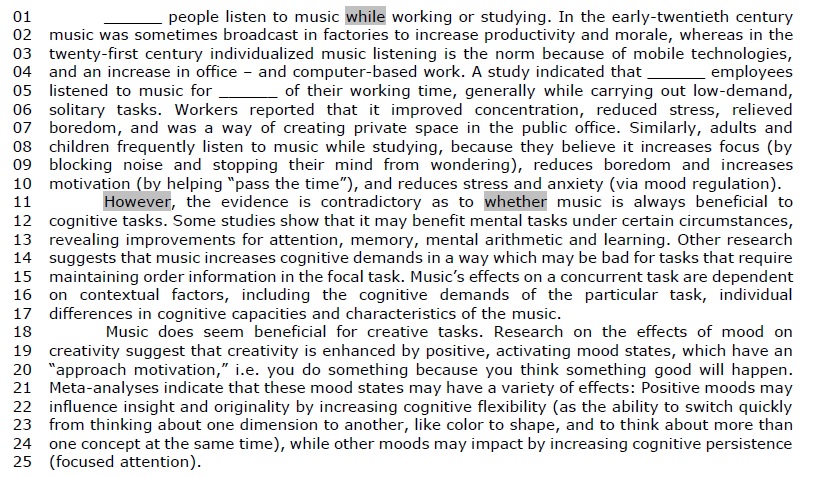
Based on the text, judge the following item.
“most of them” (lines 2 and 3) and the majority of them
are synonymous expressions.
Based on the text, judge the following item.
Using a lot instead of “much”, in “much harder” (line 12), will not affect the meaning of the sentence in any way.
Based on the text, judge the following items.
In “some pathological eating disorders” (lines 6 and 7),
“some” means a few.
With Brazil in Turmoil, Rio Counts Down to Olympics
By REBECCAR. RUIZAPRIL27, 2016
RIO DE JANEIRO- Brazil's president is facing impeachment. The country's economy is in sharp decline. Bodies of water that will be used for Olympic competitions are polluted, and global public health officials are trying to tamp down the Zika virus epidemic.
With less than 100 days before the Olympic Games come to South Amarica for the first time, Rio de Janeiro faces more than the usual challenges that bedevil host cities, like delayed stadium construction and transportation concerns. (Rio has those, too.) The mood here, however, is hardly one of panic. Officials in charge of executing the Summer Games say they feel insulated from Brazil's turmoil at this late stage. The Olympics, after all, tend to exist in their own bubble, elaborately coordinated to ensure that the multibillion-dollar operation goes off smoothly. "The machine is in place, and it's relatively stable," Ricardo Leyser, Brazil's sports minister, said in an interview this week. "My biggest concern isn't any individual issue. lt's the small demands that all come at once."
Local organizers are beginning to lay colorful comforters patterned with the silhouettes of cartoon cyclists, fencers and swimmers - on the twin beds in the athletes' village. They are monitoring the growth of 14-month-old grass that will be transplanted to Maracanã, the storied soccer stadium that will also be used for the opening and closing ceremonies. They are pulling trash from Guanabara Bay, where the Games' sailing events will be held; mopping up standing water to minimize mosquito breeding; and ramping up a round-the-clock security operation - all while publicly expressing little worry about the unrest encircling them.
On Wednesday, with the handoff of the Olympic flame in Greece and the start of a journey that in little more than a week will bring it to Brazil, the official countdown to the Aug. 5 opening ceremony began.
ln Rio, the race to be ready is intensifying, with construction workers here still laboring on mass transit projects that were key promises seven years ago in the city's bid to host the Games. Costing several billion dollars, those projects include a new subway line and express bus lanes that connect the Olympic Park in Barra da Tijuca to the rest of the city, which is expected to swell with more than half a million visitors.
As the value ofthe Brazilian real has drastically declined overthe last year, some have expressed doubt that the transit projects will materialize beyond the sleek, modernist weather shelters that have been built at various stations. At a news conference Wednesday, the city's secretary of transportation said the new routes would be ready i n ti me but did not specify when. To the vast majority of people watching the Games on television, however, such infrastructure may not matter.
The permanent venues for competitions here are mostly complete - all but those for tennis and track cycling - and athletes from around the world have competed in dozens of test events in Rio in recent months. "lt's about the filling of the cake," Mr. Leyser said. "lt's not about the stadiums; it's about the scoreboards."
As ofthe latest counts, 62 percent ofthe 5.7 million tickets on the market had been sold - roughly half of the total tickets for the Olympics - and 24 percent of tickets available for the Paralympics had been sold. But compareci with past Olympics, the buyers of those tickets may be disproportionately international, saidAndrew Parsons, the presidentofthe Brazilian Paralympic Committee.
For some Brazilians, the country's political and economic crises have cast a shadow on the celebration. President Dilma Rousseff's ouster looks increasingly likely amid a sweeping graft scandal, and those in line to succeed her have their own controversies hanging overthem.
Questions of corruption have extended to Olympics planning, particularly after a businessman who worked on many Olympic projects in Rio was convicted of corruption and money laundering related to separata contracts. Mr. Leyser said that the questions centered on irregularities at the Deodoro event site and that no publicofficial had been accused ofwrongdoing. "lt's more an administrativa issue than a corruption scheme," he said. "lt's basically a question ofthe numbers." Mr. Leyser called the devaluation of Brazil's currency an opportunity because it increases the buying power of foreign money coming into Brazil forthe Games.
But not everyone sees the event as a boon to the country. Shirlei Alves, who lives in the Santa Marta favela of Rio, criticized the government for spending on the Olympics in the face of Brazil's problems.
"The world is just getting worse here," Ms. Alves said, noting that she was without medication and electricity. "The government is making a mistake. l'd like if they'd take a better look at the poor people and not help people who are already rich." Eduardo Paes, the mayor of Rio, said Wednesday that the city had a "comfortable financial situation" and had spent on stadium construction 1 percent ofwhat it spent on health education. "I know people are skeptical," Mr. Paes said, citing the "huge deliverables" for the Olympics. "Of course the situation here has been difficult. But there is a commitment of the Brazilian state to deliverthe Olympics."
Perhaps the most vexing issue for local organizers-the one that may stir anxiety among athletes and spectators - is the mosquito-borne Zika virus, which has been linked to birth defects and temporary paralysis. Zika is of greater concern outside Rio, in the far north part of Brazil, but the World Health Organization has declared the virus a global public health emergency and has advised pregnant women notto travei anywhere in Brazil.
"The Olympics is a pretty effective way of taking whatever disease is local and making it global," said Ashish K. Jha, director ofthe Global Health lnstitute at Harvard.
Some scientists have suggested that by the time the Olympics start in August - wintertime in Brazil, when mosquitoes are less numerous - the virus might be more prevalent in the southern United States.
"Zika's been spreading effectively on its own, but there's very good reason to think the Olympics will accelerate the spread," Dr. Jhasaid.
But the virus poses a unique problem because it isso far beyond the contrai of local organizing officials, and so many questions about it remain unanswered. Few athletes have publicly expressed concern, but it is unclear how many might withdraw as the Games draw closer.
"At this point you just keep going," David Wallechinsky, an Olympics historian, said. "You have to continue as if everything's going to be fine. These are real concerns - Zika, the water quality. But even if Dilma is forced out of office, it's not going to stop the Olympics."
Com base na Leitura do texto "With Brazil in Turmoil, Rio Counts Down to Olympics", responda a questão:
Complete the question below:
“For the pick-nick we´ll need ___________CDs, _________
cheese to make sandwiches and ________ lemonade.”
Complete the question below:
Jim drinks _______ soda everyday!
Technology and legal pressure have changed
spammers’ terms of trade. They long relied on sending
more e-mails from more computers, knowing that some
will get through. But it is hard to send 100m e-mails
without someone noticing. In 2008 researchers from the
University of California at Berkeley and San Diego posed
as spammers, infiltrated a botnet and measured its
success rate. The investigation confirmed only 28 “sales”
on 350m e-mail messages sent, a conversion rate
under .00001%. Since then the numbers have got worse.
But spammers are a creative bunch.
of tricking consumers into a purchase, they are stealing their money
directly. Links used to direct the gullible to a site selling
counterfeits. Now they install “Trojan” software that
ransacks hard drives for bank details and the like.
Spammers also have become more sophisticated
about exploiting trust. In few places is it granted more
readily than on social-networking sites. Twitter, a forum for
short, telegram-like messages, estimates that only 1% of
its traffic is spam. But researchers from the University of
California at Berkeley and the University of Illinois at
Champaign-Urbana show that 8% of links published were
shady, with
of them leading to scams and the rest to Trojans. Links in Twitter messages, they found, are over
20 times more likely to get clicked than those in e-mail
spam.
Nor is Facebook as safe as it seems. As an
experiment, BitDefender, an online-security firm, set up
fake profiles on the social network and asked strangers to
enter into a digital friendship. They were able to create as
many as 100 new friends a day. Offering a profile picture,
particularly of a pretty woman, increased their odds. When
the firm’s researchers expanded their requests to strangers
who shared even one mutual friend, almost half accepted.
Worse, a quarter of BitDefender’s new friends clicked on
links posted by the firm, even when the destination was
obscured.
(Adapted from http://www.economist.com/node/17519964)
é 

TEXT I
Beware the power of the blog
Companies may not like blogs, but if they ignore them
they may be inviting some PR disasters
The number of blogs on the internet is doubling every five
months, according to blog-tracking site Technorati. The total is
now around 20 million, with around 1.3 million posts made each
day. Most are no more interesting than overhearing another
person's telephone call, but there are exceptions that can have a
remarkable impact.
(from http://www.computing.co.uk/itweek/comment/ 2145491/beware-power-blog, retrieved on September 24th, 2008)
TEXT I
Beware the power of the blog
Companies may not like blogs, but if they ignore them
they may be inviting some PR disasters
The number of blogs on the internet is doubling every five
months, according to blog-tracking site Technorati. The total is
now around 20 million, with around 1.3 million posts made each
day. Most are no more interesting than overhearing another
person's telephone call, but there are exceptions that can have a
remarkable impact.
(from http://www.computing.co.uk/itweek/comment/ 2145491/beware-power-blog, retrieved on September 24th, 2008)